Stage 01 · Write · Researched comparison
Best React Native Animation Libraries in 2026
React Native Reanimated is the first pick for most teams that need gesture-driven and UI-thread animation, because it runs animations off the JavaScript thread. The built-in Animated API suits simple fades and transitions with no extra dependency. Lottie React Native is the better choice when designers hand off After Effects files, and React Native Skia fits custom canvas-style drawing and effects.

By Shihab Mia
Published 27 Nov 2026 · 6 tools compared
We run no ads and no affiliate links at launch. The order of a list follows our published method. See how we score.
Prices are the starting prices vendors list publicly. Plans change, so confirm the current price on the vendor page before you buy.
Key takeaways
- Reanimated, Animated, Lottie, Moti, Skia and LayoutAnimation are all free; the first five are open source, and Animated and LayoutAnimation ship with React Native itself.
- Reanimated and Skia run animation work outside the JavaScript thread, which matters for gesture-heavy screens and complex drawing.
- Lottie React Native plays JSON exported from After Effects, so motion design can be handed off without rewriting it in code.
- Animated and LayoutAnimation need no install, but they cover a narrower range of motion than the dedicated libraries.
Who each pick is for
- Gesture-driven and UI-thread animation in production appsReact Native Reanimated
- Simple transitions with no extra dependencyAnimated API (built in)
- Playing After Effects animations exported as JSONLottie React Native
- Declarative animations on top of ReanimatedMoti
- Custom drawing, shaders, and canvas-style effectsReact Native Skia
- Quick layout transitions with minimal codeLayoutAnimation (built in)
Comparison
| Tool | Best for | Standout feature | Listed starting price | Free plan or trial |
|---|---|---|---|---|
| 1React Native Reanimated | Gesture-driven and UI-thread animation in production apps | Runs animations on the UI thread | Free (open source) | Free plan |
| 2Animated API (built in) | Simple transitions with no extra dependency | Ships with React Native | Free | Free plan |
| 3Lottie React Native | Playing After Effects animations exported as JSON | Plays designer-made JSON animations | Free (open source) | Free plan |
| 4Moti | Declarative animations on top of Reanimated | Simple declarative API | Free (open source) | Free plan |
| 5React Native Skia | Custom drawing, shaders, and canvas-style effects | High-performance 2D graphics | Free (open source) | Free plan |
| 6LayoutAnimation (built in) | Quick layout transitions with minimal code | Built into React Native | Free | Free plan |
How we picked
We picked libraries that are actively maintained and genuinely used for React Native animation work. Criteria were fit for the job, platform support (iOS, Android, web), licence and price, how well each option handles performance-sensitive motion, and the main limits users should expect. Sources are official documentation, project repositories, and vendor pages. All six options are free or open source. Prices and maintenance status can change, so confirm details on the official project page before committing.
The tools, one by one
React Native Reanimated
Best for gesture-driven and UI-thread animation in production apps
What it is and where it fits
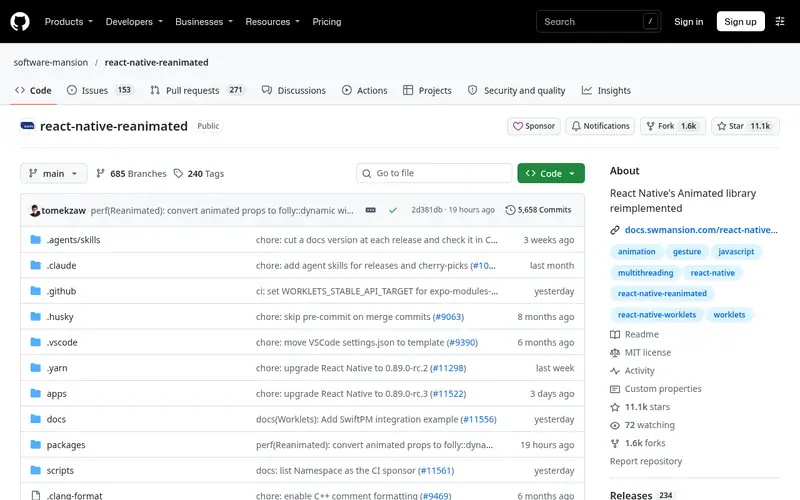
Reanimated is a third-party animation library maintained by Software Monster. It lets you define animations that run on the UI thread rather than the JavaScript thread, which keeps motion smooth when the JS thread is busy. It provides shared values, worklets, layout animations, and hooks such as useAnimatedStyle and useAnimatedGestureHandler.
It pairs with react-native-gesture-handler for interactive gestures and is widely used for swipeable lists, drag interactions, and shared element transitions. The library is open source under the MIT license and supports iOS, Android, and the web through React Native Web. Setup requires a Babel plugin and, on some versions, changes to the native build.
Teams with only simple fades and slides may find it heavier than needed. It is the right fit when animation quality and gesture responsiveness are central to the app.
Standout: Runs animations on the UI thread
Free (open source), as listed by the vendor (React Native Reanimated website). Confirm the current plan price before you buy.
Free plan. Plans change, so confirm on the vendor's pricing page before you buy.
Benefits
- Runs animations on the UI thread
- strong gesture and scroll integration
Drawbacks
- Steep learning curve
- worklets and shared values take time to learn
Skip it if this limit matters to you: steep learning curve.
Verdict. A sensible pick for gesture-driven and UI-thread animation in production apps.
Alternatives in this guide: Animated API (built in), Lottie React Native, Moti
Animated API (built in)
Best for simple transitions with no extra dependency
What it is and where it fits
Animated is part of React Native core. It covers timing, spring, and decay animations, and it can drive style properties such as opacity, transform, and position. The API includes Animated.Value, interpolation, and the useNativeDriver option, which moves supported animations to the native side.
Because it needs no install, it is the lowest-friction option for basic screen transitions, loading indicators, and button feedback. It runs on iOS, Android, and the web through React Native Web. The main limits are that native driver support covers only some properties, and complex chained or gesture-driven sequences become verbose compared with Reanimated.
Small apps and teams that want to avoid extra dependencies should start here. Move to a dedicated library when motion becomes a core part of the interface.
Standout: Ships with React Native
Free, as listed by the vendor (Animated API (built in) website). Confirm the current plan price before you buy.
Free plan. Plans change, so confirm on the vendor's pricing page before you buy.
Benefits
- Ships with React Native
- documented and stable
Drawbacks
- Limited for complex gesture work
- can compete with JS thread load
Skip it if this limit matters to you: limited for complex gesture work.
Verdict. A sensible pick for simple transitions with no extra dependency.
Alternatives in this guide: React Native Reanimated, Lottie React Native, Moti
Lottie React Native
Best for playing After Effects animations exported as JSON
What it is and where it fits
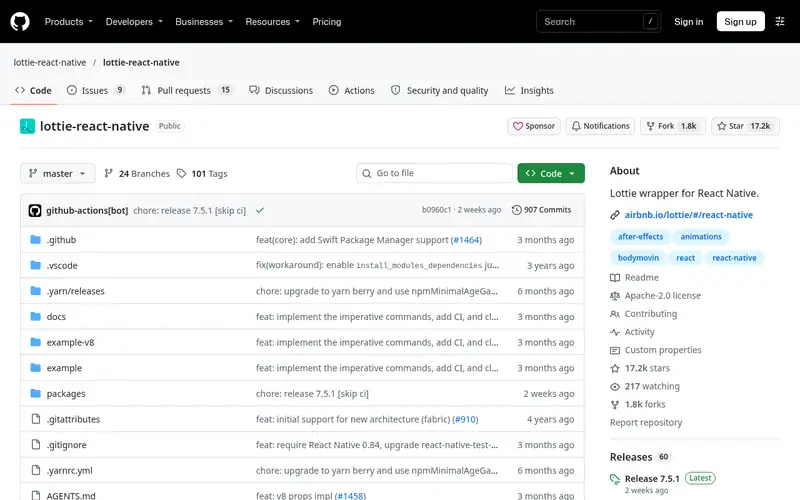
Lottie React Native renders animations exported from Adobe After Effects as JSON using the Lottie format. Designers can build motion in After Effects and hand off a file that the app plays without reimplementing it in code. The library wraps native Lottie players on iOS and Android and supports playback controls such as play, pause, loop, and speed.
It is open source under the Apache 2.0 license. Typical uses are onboarding illustrations, success and error states, and empty-state art. The main tradeoffs are file size and render cost: large or complex animations can slow down low-end devices, so files should be optimized before shipping.
Use it when motion design comes from a design team. For UI transitions built in code, Reanimated or Animated is a better fit.
Standout: Plays designer-made JSON animations
Free (open source), as listed by the vendor (Lottie React Native website). Confirm the current plan price before you buy.
Free plan. Plans change, so confirm on the vendor's pricing page before you buy.
Benefits
- Plays designer-made JSON animations
- wide format support through lottie libraries
Drawbacks
- Large JSON files add bundle weight
- complex files can cost performance
Skip it if this limit matters to you: large JSON files add bundle weight.
Verdict. A sensible pick for playing After Effects animations exported as JSON.
Alternatives in this guide: React Native Reanimated, Animated API (built in), Moti
Moti
Best for declarative animations on top of Reanimated
What it is and where it fits
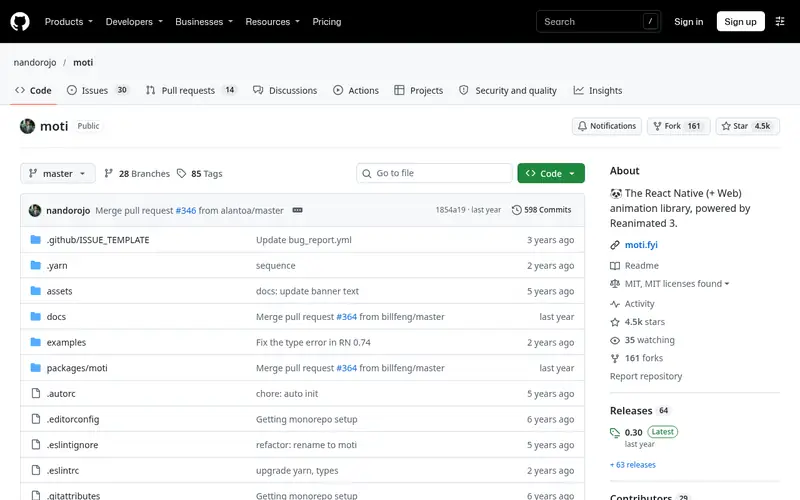
Moti is an open-source animation library built on React Native Reanimated. It offers a declarative component API, so you describe the animation state and Moti handles the transitions. It includes variants, sequence helpers, and support for gestures through integration with Reanimated and gesture-handler.
It suits developers who like Reanimated's performance but want less boilerplate for common patterns such as mount and unmount transitions, staggered lists, and hover-like states. It runs wherever Reanimated runs: iOS, Android, and the web. Because it depends on Reanimated, you still need that library installed and configured.
The tradeoff is an extra abstraction layer. Teams that already know Reanimated well may prefer to use it directly. Moti is a reasonable fit for smaller teams that want readable animation code quickly.
Standout: Simple declarative API
Free (open source), as listed by the vendor (Moti website). Confirm the current plan price before you buy.
Free plan. Plans change, so confirm on the vendor's pricing page before you buy.
Benefits
- Simple declarative API
- built on Reanimated
Drawbacks
- Adds a layer over Reanimated
- smaller ecosystem than Reanimated alone
Skip it if this limit matters to you: adds a layer over Reanimated.
Verdict. A sensible pick for declarative animations on top of Reanimated.
Alternatives in this guide: React Native Reanimated, Animated API (built in), Lottie React Native
React Native Skia
Best for custom drawing, shaders, and canvas-style effects
What it is and where it fits
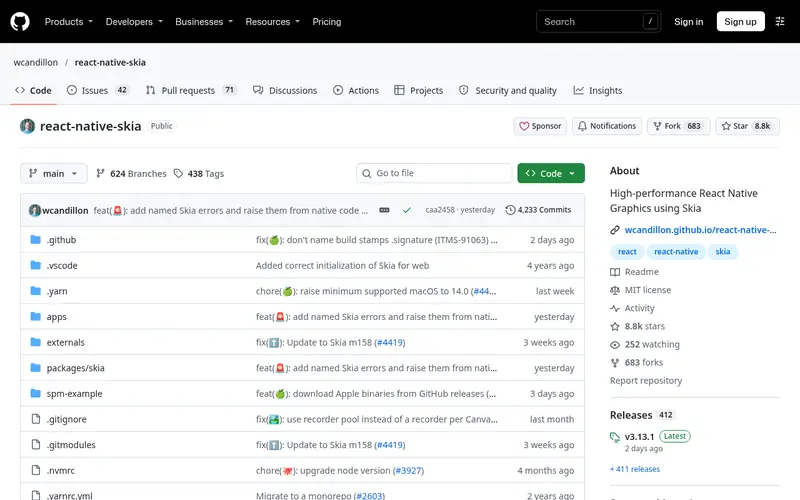
React Native Skia brings the Skia graphics engine to React Native, the same engine used by Chrome and Flutter. It is maintained by Shopify and is open source under the MIT license. It supports drawing primitives, paths, images, text, and shaders, and it can drive animation through Reanimated values.
It fits work that goes beyond moving views around: charts, custom loaders, particle effects, image filters, and animated illustrations. It runs on iOS, Android, and the web. Setup involves native dependencies, and the API is closer to a drawing library than to a view animation API, so there is a learning curve.
Most apps do not need it. Choose Skia when the design calls for custom rendering that standard views cannot express.
Standout: High-performance 2D graphics
Free (open source), as listed by the vendor (React Native Skia website). Confirm the current plan price before you buy.
Free plan. Plans change, so confirm on the vendor's pricing page before you buy.
Benefits
- High-performance 2D graphics
- supports advanced effects and shaders
Drawbacks
- Different mental model from view animation
- larger setup footprint
Skip it if this limit matters to you: different mental model from view animation.
Verdict. A sensible pick for custom drawing, shaders, and canvas-style effects.
Alternatives in this guide: React Native Reanimated, Animated API (built in), Lottie React Native
LayoutAnimation (built in)
Best for quick layout transitions with minimal code
What it is and where it fits
LayoutAnimation is part of React Native core. It animates layout changes automatically when the next render happens, such as a list item expanding or a view appearing. A single call before a state update can animate position, size, and opacity changes across the tree.
It needs no install and works on iOS and Android, though behavior and support differ between platforms and it has known limitations on the New Architecture. It is best for small, one-off layout transitions where precise timing is not critical.
For controlled sequences or gesture-driven motion, use Reanimated or Animated instead. LayoutAnimation is a quick tool, not a full animation system.
Standout: Built into React Native
Free, as listed by the vendor (LayoutAnimation (built in) website). Confirm the current plan price before you buy.
Free plan. Plans change, so confirm on the vendor's pricing page before you buy.
Benefits
- Built into React Native
- very little code for layout changes
Drawbacks
- Limited control over timing and curves
- platform behavior differs
Skip it if this limit matters to you: limited control over timing and curves.
Verdict. A sensible pick for quick layout transitions with minimal code.
Alternatives in this guide: React Native Reanimated, Animated API (built in), Lottie React Native
Who should use what
Teams building gesture-heavy interfaces such as swipeable lists or drag-and-drop should start with React Native Reanimated. Apps that only need simple fades and screen transitions can stay on the built-in Animated API and skip extra dependencies. Design-led products with motion assets from After Effects should use Lottie React Native. Developers who want Reanimated performance with less boilerplate should look at Moti, while teams drawing charts, shaders, or custom effects should evaluate React Native Skia.
Questions to settle before you buy
What to check before you buy
- Confirm the library supports your React Native version and the New Architecture if you have enabled it.
- Check whether animation runs on the UI thread or the JS thread, and test on a low-end Android device.
- Verify iOS, Android, and web support if your app ships to more than one platform.
- Review the licence and confirm the project has recent commits and open issue activity.
- Measure bundle size impact, especially for Lottie JSON files and Skia native dependencies.
FAQ
Do I need a library, or can I use the built-in Animated API?
The built-in Animated API covers fades, slides, and simple transitions without extra dependencies. Add a library when you need gesture-driven motion, UI-thread performance, or designer-made animations. Many apps start with Animated and move to Reanimated as motion requirements grow.
Is React Native Reanimated free?
Yes. Reanimated is open source under the MIT license and free to use. There is no paid tier. Costs come from your own development time, since setup and the worklet model take some learning.
Can I use Lottie and Reanimated together?
Yes. Lottie handles playback of After Effects JSON, and Reanimated can drive surrounding layout and gesture behavior. Many apps use Lottie for illustration and Reanimated for interface transitions in the same screen.
Does React Native Skia replace Reanimated?
No. Skia is a 2D graphics engine for custom drawing and effects. Reanimated animates views and values. They are often used together, with Reanimated values driving Skia drawings.
Which option works on the web?
Animated, Reanimated, Moti, Lottie React Native, and Skia all have some React Native Web support, though coverage varies by feature. LayoutAnimation support on the web is limited. Test the specific animations you need on your target platforms.
Sources we checked
Method: how we score · editorial policy.
Change log. First published 27 Nov 2026.