Stage 03 · Host · Researched comparison
Best WebAssembly Runtimes for Developers in 2026
Wasmtime is the safest default for most server-side and embedding work, because it is a Bytecode Alliance project with broad platform support and a permissive licence. Wasmer suits teams that want a single runtime across many languages plus a package registry. WasmEdge fits edge and cloud-native workloads, and wazero is the pick when you want a pure Go runtime with no C dependencies.

By Shihab Mia
Published 27 Nov 2026 · 5 tools compared
We run no ads and no affiliate links at launch. The order of a list follows our published method. See how we score.
Prices are the starting prices vendors list publicly. Plans change, so confirm the current price on the vendor page before you buy.
Key takeaways
- Wasmtime, Wasmer, WasmEdge, WAMR and wazero are all open source, so the runtime itself costs nothing to start with.
- Wasmtime and WAMR come from the Bytecode Alliance; Wasmer and WasmEdge are independent projects with their own tooling.
- wazero is written in pure Go and needs no cgo, which simplifies builds for Go services.
- All five runtimes execute local modules, so no code or data leaves your machine.
Who each pick is for
- General server-side and embedded Wasm executionWasmtime
- Teams that want one runtime plus a package registryWasmer
- Edge, cloud-native and AI inference workloadsWasmEdge
- Embedded devices and small-footprint deploymentsWAMR (WebAssembly Micro Runtime)
- Go applications that need an embedded Wasm runtimewazero
Comparison
| Tool | Best for | Standout feature | Listed starting price | Free plan or trial |
|---|---|---|---|---|
| 1Wasmtime | General server-side and embedded Wasm execution | Broad host embedding APIs | Free (open source) | Free plan |
| 2Wasmer | Teams that want one runtime plus a package registry | Many language SDKs and a WAPM package registry | Free (open source) | Free plan |
| 3WasmEdge | Edge, cloud-native and AI inference workloads | Designed for cloud-native and edge use | Free (open source) | Free plan |
| 4WAMR (WebAssembly Micro Runtime) | Embedded devices and small-footprint deployments | Small footprint with interpreter and AOT modes | Free (open source) | Free plan |
| 5wazero | Go applications that need an embedded Wasm runtime | Pure Go with no cgo dependency | Free (open source) | Free plan |
How we picked
We compared runtimes on fit for common Wasm jobs, supported host platforms and architectures, licence terms, embedding APIs and known limits such as extension models or footprint. Sources are the official project repositories and vendor documentation. Prices and licence terms can change, so confirm details on each project's site before you commit.
The tools, one by one
Wasmtime
Best for general server-side and embedded Wasm execution
What it is and where it fits
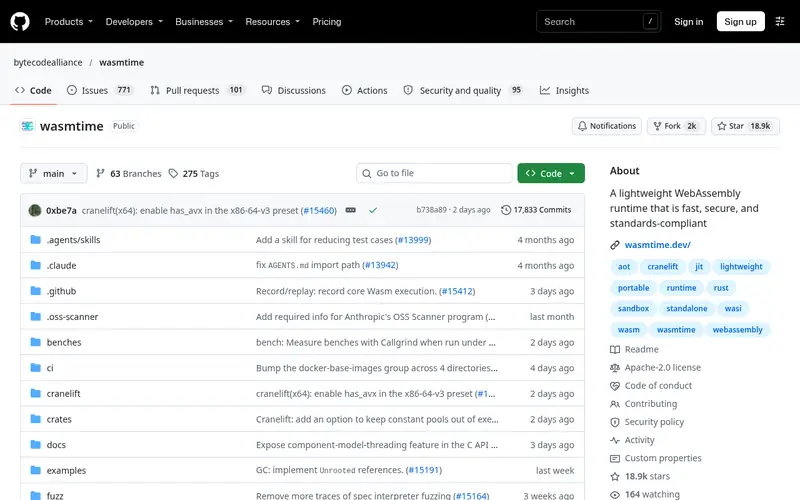
Wasmtime is a standalone runtime and a library for embedding WebAssembly in other programs. It runs on Linux, macOS and Windows, and supports x86-64, AArch64 and other targets. Hosts can embed it through Rust, C, C#, Go, Python and other language bindings. It tracks the WASI standards closely, which matters if you run WASI command modules or components.
The project is maintained by the Bytecode Alliance under the Apache 2.0 license with LLVM exceptions. There is no paid tier and no registry; you fetch modules yourself or use a tool such as cargo-component. Configuration is done through CLI flags or the embedding API.
Skip Wasmtime if you need a managed registry and cross-language package distribution out of the box, or if you want a runtime with a commercial support contract attached by default. For most teams that just need to run or embed Wasm, it is the first thing to try.
Standout: Broad host embedding APIs
Free (open source), as listed by the vendor (Wasmtime website). Confirm the current plan price before you buy.
Free plan. Plans change, so confirm on the vendor's pricing page before you buy.
Benefits
- Broad host embedding APIs
- strong WASI support and active development
Drawbacks
- No built-in package registry
- some features move fast between releases
Skip it if this limit matters to you: no built-in package registry.
Verdict. A sensible pick for general server-side and embedded Wasm execution.
Alternatives in this guide: Wasmer, WasmEdge, WAMR (WebAssembly Micro Runtime)
Wasmer
Best for teams that want one runtime plus a package registry
What it is and where it fits
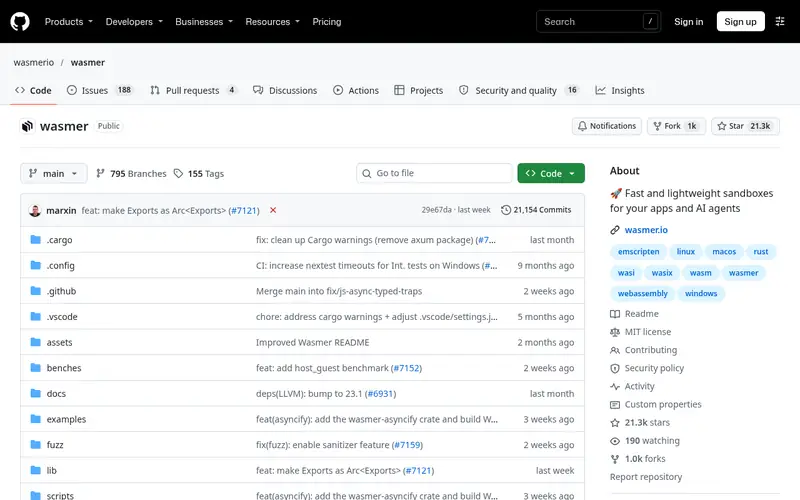
Wasmer is a general-purpose WebAssembly runtime with embeddable APIs for Rust, C, C++, Go, Python, JavaScript, Java and others. It offers several compiler backends, including Singlepass for fast startup and Cranelift for optimized code. It runs on Linux, macOS and Windows, and supports WASI and WASIX extensions.
The core runtime is open source under the MIT license. The project also operates WAPM, a package registry for Wasm modules, and sells commercial offerings around the runtime. Those commercial parts are separate from the open-source core, so check which features you actually need before planning around them.
Choose Wasmer when you want a single runtime with wide language bindings and a package ecosystem. Skip it if you prefer a runtime governed entirely by a foundation, or if you do not want to depend on a vendor-run registry for distribution.
Standout: Many language SDKs and a WAPM package registry
Free (open source), as listed by the vendor (Wasmer website). Confirm the current plan price before you buy.
Free plan. Plans change, so confirm on the vendor's pricing page before you buy.
Benefits
- Many language SDKs and a WAPM package registry
- multiple compiler backends
Drawbacks
- Registry and commercial features sit outside the core runtime
- some features are vendor-led
Skip it if this limit matters to you: registry and commercial features sit outside the core runtime.
Verdict. A sensible pick for teams that want one runtime plus a package registry.
Alternatives in this guide: Wasmtime, WasmEdge, WAMR (WebAssembly Micro Runtime)
WasmEdge
Best for edge, cloud-native and AI inference workloads
What it is and where it fits
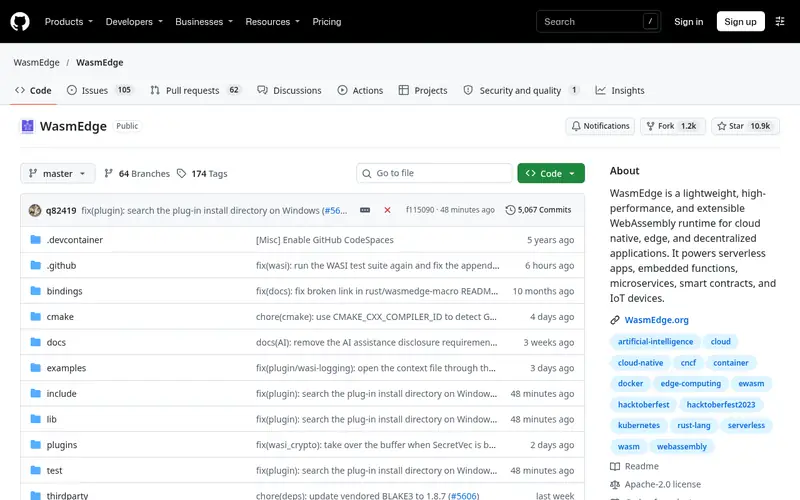
WasmEdge is a lightweight runtime aimed at edge computing, serverless functions and cloud-native deployments. It runs on Linux, macOS and Windows, and has builds for container and Kubernetes environments. It supports WASI and adds extensions for networking, tensor operations and other host capabilities.
The runtime is open source under the Apache 2.0 license and is a Cloud-Native Computing Foundation sandbox project. It can be embedded through C, Rust, Go and other SDKs. The extension model means some features go beyond standard WebAssembly, so portability across runtimes depends on which extensions a module uses.
Pick WasmEdge when your workload targets edge devices, serverless platforms or on-device inference. Skip it if you need strict standard-only behavior, or if you want the largest possible embedding community around a single runtime.
Standout: Designed for cloud-native and edge use
Free (open source), as listed by the vendor (WasmEdge website). Confirm the current plan price before you buy.
Free plan. Plans change, so confirm on the vendor's pricing page before you buy.
Benefits
- Designed for cloud-native and edge use
- supports networking and AI extensions
Drawbacks
- Extension set is broader than core Wasm
- ecosystem is smaller than Wasmtime's
Skip it if this limit matters to you: extension set is broader than core Wasm.
Verdict. A sensible pick for edge, cloud-native and AI inference workloads.
Alternatives in this guide: Wasmtime, Wasmer, WAMR (WebAssembly Micro Runtime)
WAMR (WebAssembly Micro Runtime)
Best for embedded devices and small-footprint deployments
What it is and where it fits
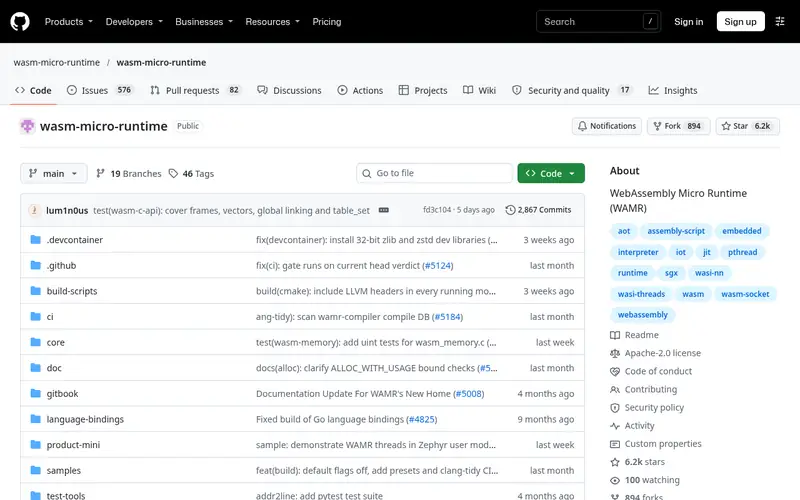
WAMR is a Bytecode Alliance project built for small devices. It offers an interpreter, a fast interpreter, an ahead-of-time compiler and a just-in-time compiler, so you can trade memory and startup time against throughput. It targets embedded Linux, Zephyr, RTOS environments and other constrained platforms alongside standard desktop systems.
The runtime is open source under the Apache 2.0 license. It exposes embedding APIs for C and can be driven from other languages through those bindings. Because it is built for small footprints, some conveniences found in larger runtimes are absent, and you will spend more time on build configuration.
Use WAMR when the target is a microcontroller, an embedded board or a device with tight memory limits. Skip it for ordinary server workloads where Wasmtime or Wasmer will be simpler to set up and better documented for host embedding.
Standout: Small footprint with interpreter and AOT modes
Free (open source), as listed by the vendor (WAMR (WebAssembly Micro Runtime) website). Confirm the current plan price before you buy.
Free plan. Plans change, so confirm on the vendor's pricing page before you buy.
Benefits
- Small footprint with interpreter and AOT modes
- fits microcontrollers and RTOS targets
Drawbacks
- Fewer high-level language bindings
- tuning for constrained devices takes effort
Skip it if this limit matters to you: fewer high-level language bindings.
Verdict. A sensible pick for embedded devices and small-footprint deployments.
wazero
Best for go applications that need an embedded Wasm runtime
What it is and where it fits
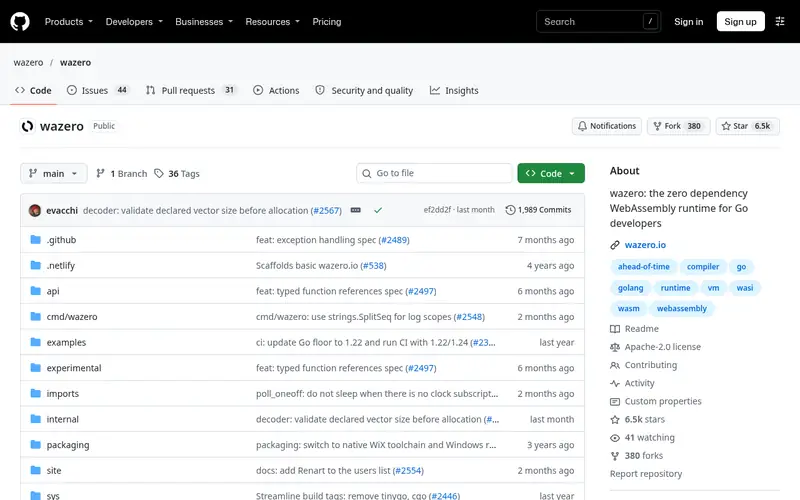
wazero is a WebAssembly runtime written entirely in Go. It has zero dependencies and does not use cgo, so cross-compiling a Go program that embeds it stays straightforward. It implements the WebAssembly core specification and WASI, and it runs wherever Go runs, including Linux, macOS, Windows and various architectures.
The project is open source under the Apache 2.0 license. Its API is designed for Go developers: you compile a module, instantiate it and call exported functions from Go code. There is no separate CLI runtime to install, which is a difference from Wasmtime, Wasmer and WasmEdge.
Choose wazero when your host application is written in Go and you want to avoid C toolchains. Skip it if you need to embed Wasm from Rust, C or Python, or if you want a standalone command-line runtime for running modules outside an application.
Standout: Pure Go with no cgo dependency
Free (open source), as listed by the vendor (wazero website). Confirm the current plan price before you buy.
Free plan. Plans change, so confirm on the vendor's pricing page before you buy.
Benefits
- Pure Go with no cgo dependency
- simple to embed in Go services
Drawbacks
- Go-only host API
- no CLI-first workflow like the other runtimes
Skip it if this limit matters to you: go-only host API.
Verdict. A sensible pick for go applications that need an embedded Wasm runtime.
Who should use what
If you are adding Wasm execution to a Rust or C service, start with Wasmtime. If you need one runtime across many host languages and want a package registry, look at Wasmer. If you deploy to edge or serverless platforms, evaluate WasmEdge. If your host code is Go, wazero removes the C toolchain from the build. If the target is a microcontroller or a memory-constrained device, WAMR is built for that case.
Questions to settle before you buy
What to check before you buy
- Confirm the runtime supports your host OS, CPU architecture and language bindings.
- Check whether you need WASI, components or vendor extensions, and whether the runtime covers them.
- Read the licence terms and note any separate commercial or registry services.
- Measure memory use and startup time on your own modules, especially on embedded targets.
- Verify the project's release cadence and issue activity before depending on it.
FAQ
Are these WebAssembly runtimes free?
Yes. Wasmtime, Wasmer, WasmEdge, WAMR and wazero are all open source. Wasmer and WasmEdge also offer commercial or hosted services around their runtimes, but the core runtime does not require payment.
Which runtime should I use for a Go service?
wazero is the natural fit because it is pure Go and needs no cgo. If you need features from another runtime, Wasmtime and Wasmer both provide Go bindings, though those bindings involve C libraries.
Can these runtimes run on embedded devices?
WAMR is designed for embedded and RTOS targets and has the smallest footprint options. WasmEdge and Wasmtime also build for some constrained Linux targets, but WAMR is the more common choice for microcontrollers.
Do I need to send my Wasm modules to a third party?
No. All five runtimes execute modules locally. There is no requirement to upload code or data to a hosted service, which keeps source and input data on your own machines.
What about wasm3?
wasm3 is a small interpreter that is in minimal maintenance, so we left it out of the main list. It can still run existing modules, but for new projects the maintained runtimes above are the safer choice.
Sources we checked
Method: how we score · editorial policy.
Change log. First published 27 Nov 2026.