Stage 01 · Write · Researched comparison
Best Python i18n Libraries in 2026
Babel is the first pick for most Python projects that need message catalogs, locale-aware date and number formatting, and timezone data, because it builds on the standard gettext workflow and ships CLDR data. Teams already on Django should use the built-in Django i18n framework, which handles translation loading, URL prefixes and locale middleware. Projects that need full ICU behavior, such as complex plural rules and collation, should look at PyICU.

By Shihab Mia
Published 27 Nov 2026 · 7 tools compared
We run no ads and no affiliate links at launch. The order of a list follows our published method. See how we score.
Prices are the starting prices vendors list publicly. Plans change, so confirm the current price on the vendor page before you buy.
Key takeaways
- Babel is free and open source, works outside any web framework, and provides both message extraction and locale data formatting.
- gettext is part of the Python standard library, so it adds no dependency, but it does not format dates, numbers or currencies by locale.
- Django i18n and Flask-Babel are framework-specific; they are the shortest path if you already use those frameworks.
- fluent.runtime, PyICU and python-i18n cover narrower needs: Fluent message syntax, ICU bindings and a small dict-based translator.
Who each pick is for
- General Python projects needing catalogs and locale formattingBabel
- Minimal projects that want no extra dependenciesgettext
- Django projects that want built-in translation supportDjango i18n
- Flask apps that need Babel integrationFlask-Babel
- Projects using Fluent message syntaxfluent.runtime
- Apps needing full ICU collation, plurals and formattingPyICU
- Small projects that want simple dict-based translationspython-i18n
Comparison
| Tool | Best for | Standout feature | Listed starting price | Free plan or trial |
|---|---|---|---|---|
| 1Babel | General Python projects needing catalogs and locale formatting | Includes CLDR locale data for dates, numbers and currencies | Free (open source) | Free plan |
| 2gettext | Minimal projects that want no extra dependencies | Ships with Python, so no install step | Free (open source) | Free plan |
| 3Django i18n | Django projects that want built-in translation support | Integrated with Django settings, templates and middleware | Free (open source) | Free plan |
| 4Flask-Babel | Flask apps that need Babel integration | Adds locale selection and translation helpers to Flask | Free (open source) | Free plan |
| 5fluent.runtime | Projects using Fluent message syntax | Supports Fluent syntax with selectors, variants and attributes | Free (open source) | Free plan |
| 6PyICU | Apps needing full ICU collation, plurals and formatting | Exposes ICU's collation, plural rules and formatting | Free (open source) | Free plan |
| 7python-i18n | Small projects that want simple dict-based translations | Simple API with YAML, JSON or Python dict translation files | Free (open source) | Free plan |
How we picked
We compared libraries on fit for Python internationalization work, supported platforms, license and price, how they handle catalogs and locale data, and their main limits. Sources are vendor documentation pages, project repositories and public pricing pages, not hands-on testing. All listed options are free or open source. Prices and plan details can change, so confirm on the vendor site before you commit.
The tools, one by one
Babel
Best for general Python projects needing catalogs and locale formatting
What it is and where it fits
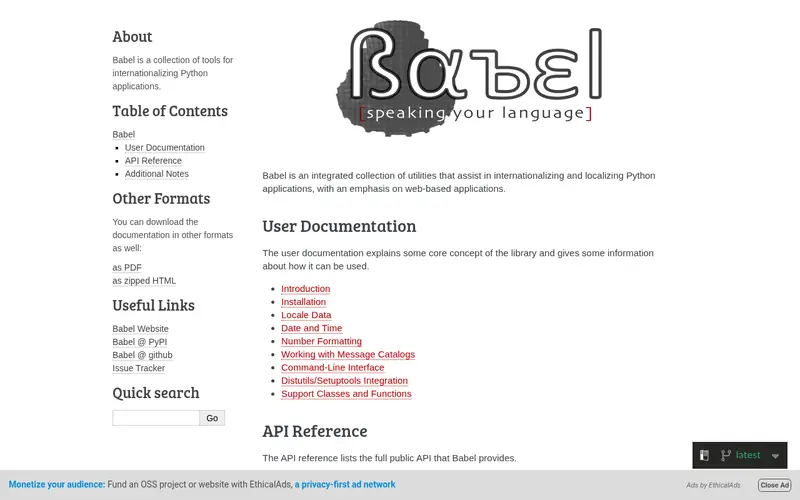
Babel is the most common general-purpose i18n library for Python. It provides the `babel` command-line tool for extracting messages from source into `.pot` files, updating `.po` catalogs, and compiling them to `.mo` files. At runtime it loads those catalogs and selects the right one for a locale.
Beyond messages, Babel formats dates, times, numbers, currencies and timezones using CLDR data. That means you can render a date in a user's locale without writing your own format tables. It runs on CPython and PyPy and is not tied to a web framework.
Babel is free and open source under a BSD-style license. The main cost is workflow: you need to run extraction and compilation as part of your build or deploy. Skip Babel if you only need translated strings and never format locale-specific values.
Standout: Includes CLDR locale data for dates, numbers and currencies
Free (open source), as listed by the vendor (Babel website). Confirm the current plan price before you buy.
Free plan. Plans change, so confirm on the vendor's pricing page before you buy.
Benefits
- Includes CLDR locale data for dates, numbers and currencies
- integrates with gettext-style catalogs and message extraction
Drawbacks
- Extraction and compilation add build steps
- large locale data set increases install size
Skip it if this limit matters to you: extraction and compilation add build steps.
Verdict. A sensible pick for general Python projects needing catalogs and locale formatting.
Alternatives in this guide: gettext, Django i18n, Flask-Babel
gettext
Best for minimal projects that want no extra dependencies
What it is and where it fits
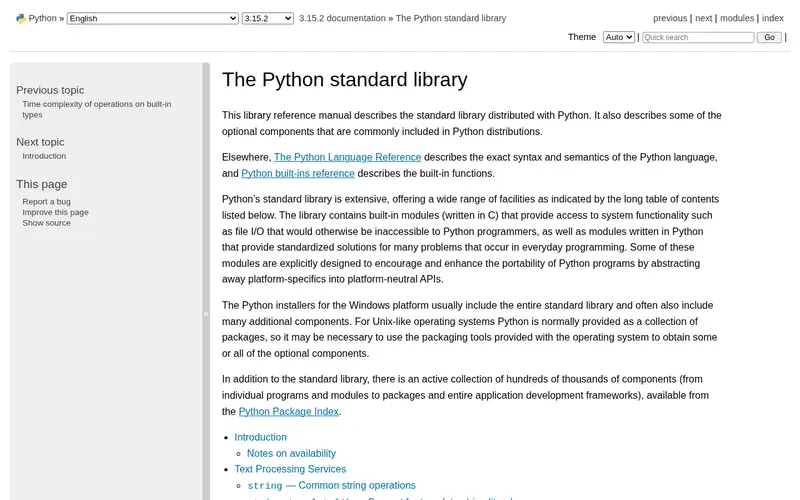
The `gettext` module is part of the Python standard library. It reads `.mo` files, installs a translation function, and returns translated strings for the active locale. You can also use the `_()` convention that most translation tooling expects.
Because it is built in, gettext adds no dependency and works in constrained environments. It pairs well with external tools that produce `.po` files. The tradeoff is scope: gettext translates strings and handles plural forms, but it does not format dates, numbers or currencies for a locale. You need another library for that.
gettext is free with Python. Choose it for small scripts, CLIs or services where translated strings are the only requirement. Skip it if your UI shows locale-formatted dates or currency.
Standout: Ships with Python, so no install step
Free (open source), as listed by the vendor (gettext website). Confirm the current plan price before you buy.
Free plan. Plans change, so confirm on the vendor's pricing page before you buy.
Benefits
- Ships with Python, so no install step
- uses the widely supported .po and .mo catalog format
Drawbacks
- No locale-aware date, number or currency formatting
- plural handling is limited to the forms you define
Skip it if this limit matters to you: no locale-aware date, number or currency formatting.
Verdict. A sensible pick for minimal projects that want no extra dependencies.
Alternatives in this guide: Babel, Django i18n, Flask-Babel
Django i18n
Best for django projects that want built-in translation support
What it is and where it fits
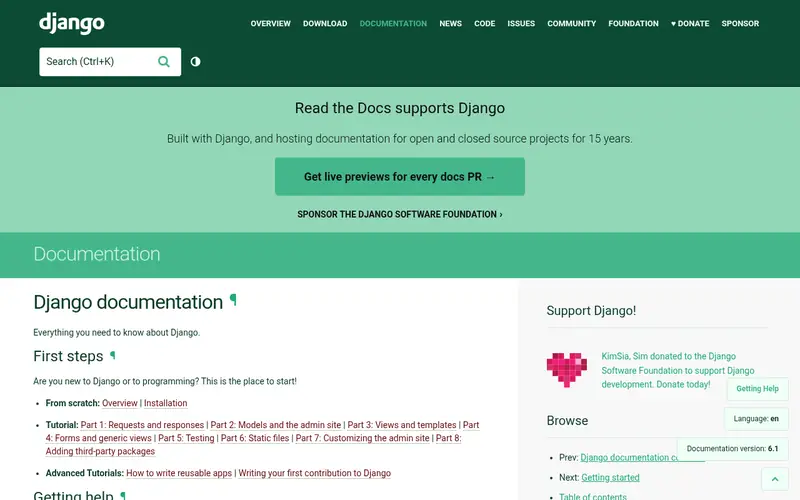
Django ships its own internationalization framework. It covers translation of Python strings and template text, locale-aware formatting of dates and numbers, timezone handling, and language selection per request. The `makemessages` and `compilemessages` management commands wrap the gettext workflow.
Language selection can come from URL prefixes, session data, cookies or the `Accept-Language` header, depending on your middleware and settings. Templates get a `{% translate %}` tag and a `{% blocktranslate %}` tag for longer passages.
Django i18n is free and open source as part of Django. It is the right choice if your project is already Django, because it avoids adding a parallel translation layer. Skip it for Flask, FastAPI or plain scripts, where it does not apply.
Standout: Integrated with Django settings, templates and middleware
Free (open source), as listed by the vendor (Django i18n website). Confirm the current plan price before you buy.
Free plan. Plans change, so confirm on the vendor's pricing page before you buy.
Benefits
- Integrated with Django settings, templates and middleware
- supports locale-prefixed URLs and per-request language selection
Drawbacks
- Only useful inside Django
- adds framework coupling for translation logic
Skip it if this limit matters to you: only useful inside Django.
Verdict. A sensible pick for django projects that want built-in translation support.
Alternatives in this guide: Babel, gettext, Flask-Babel
Flask-Babel
Best for flask apps that need Babel integration
What it is and where it fits
Flask-Babel connects Babel to Flask. It adds a `get_locale` selector, request-scoped locale handling, and template helpers for translated strings and locale-formatted dates. It uses Babel for extraction, catalogs and formatting, so the `.po` and `.mo` workflow is the same.
The extension fits apps that already render templates in Flask and want per-request language selection from a URL, session or header. It keeps configuration in the Flask app config, which keeps setup short.
Flask-Babel is free and open source. Its limits follow from its scope: it only helps inside a Flask request context, and it depends on Babel for the heavy lifting. Skip it if you use another framework or need translations outside request handling, such as in background jobs.
Standout: Adds locale selection and translation helpers to Flask
Free (open source), as listed by the vendor (Flask-Babel website). Confirm the current plan price before you buy.
Free plan. Plans change, so confirm on the vendor's pricing page before you buy.
Benefits
- Adds locale selection and translation helpers to Flask
- reuses Babel's formatting and catalog tools
Drawbacks
- Tied to Flask's request context
- smaller user base than Babel itself
Skip it if this limit matters to you: tied to Flask's request context.
Verdict. A sensible pick for flask apps that need Babel integration.
Alternatives in this guide: Babel, gettext, Django i18n
fluent.runtime
Best for projects using Fluent message syntax
What it is and where it fits
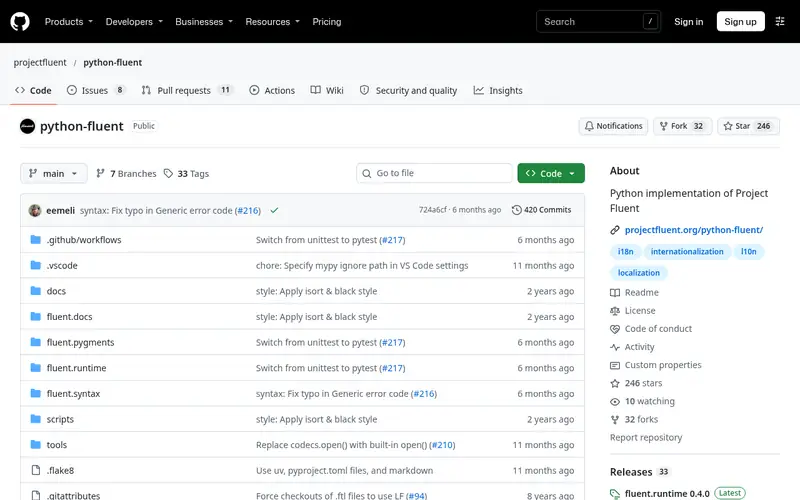
fluent.runtime is the Python implementation of Project Fluent, a localization system built around a message syntax that handles plurals, gender and other variants without code changes. Messages live in `.ftl` files, and the runtime resolves them for a locale.
The model differs from gettext. Instead of one string per key, a Fluent message can branch on a selector and return different text for each variant. That can reduce the number of keys and keep grammar rules in the translation file.
fluent.runtime is free and open source. It fits products that already use Fluent in other platforms, such as Firefox-derived or cross-platform apps, so one message format serves every client. Skip it if your team and tooling are built around gettext and `.po` files.
Standout: Supports Fluent syntax with selectors, variants and attributes
Free (open source), as listed by the vendor (fluent.runtime website). Confirm the current plan price before you buy.
Free plan. Plans change, so confirm on the vendor's pricing page before you buy.
Benefits
- Supports Fluent syntax with selectors, variants and attributes
- separates messages from code cleanly
Drawbacks
- Smaller ecosystem than gettext
- requires learning Fluent syntax and tooling
Skip it if this limit matters to you: smaller ecosystem than gettext.
Verdict. A sensible pick for projects using Fluent message syntax.
Alternatives in this guide: Babel, gettext, Django i18n
PyICU
Best for apps needing full ICU collation, plurals and formatting
What it is and where it fits
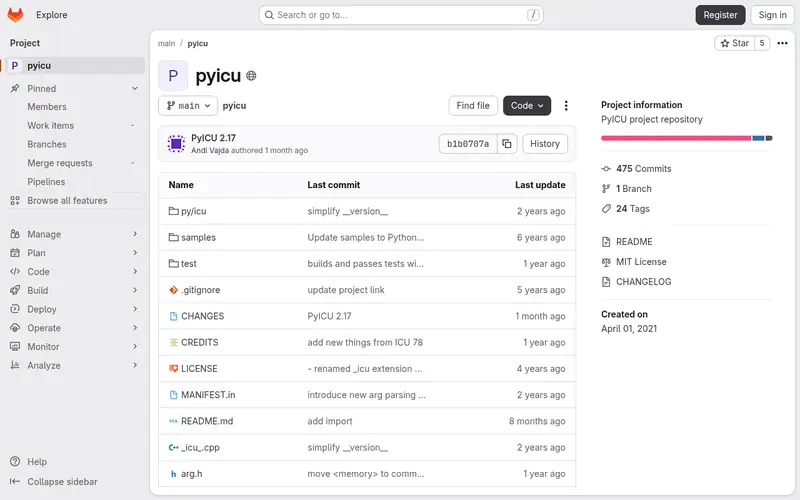
PyICU provides Python bindings to the International Components for Unicode (ICU) C library. It covers collation, locale-aware formatting, plural and ordinal rules, transliteration and text boundary analysis. If you need sorting that respects a locale's rules, PyICU is the usual route.
Because it wraps a C library, installation needs ICU headers and libraries on the system. That adds setup work on servers and CI. The API mirrors ICU concepts, so expect a learning curve if you have only used gettext.
PyICU is free and open source. Use it when Babel's CLDR-based formatting is not enough, for example when you need locale-correct sorting or complex plural selection. Skip it for simple string translation, where Babel or gettext is lighter.
Standout: Exposes ICU's collation, plural rules and formatting
Free (open source), as listed by the vendor (PyICU website). Confirm the current plan price before you buy.
Free plan. Plans change, so confirm on the vendor's pricing page before you buy.
Benefits
- Exposes ICU's collation, plural rules and formatting
- handles locales and scripts that simpler libraries miss
Drawbacks
- Requires the ICU C library to be installed
- API is larger and closer to ICU than to Python conventions
Skip it if this limit matters to you: requires the ICU C library to be installed.
Verdict. A sensible pick for apps needing full ICU collation, plurals and formatting.
Alternatives in this guide: Babel, gettext, Django i18n
python-i18n
Best for small projects that want simple dict-based translations
What it is and where it fits
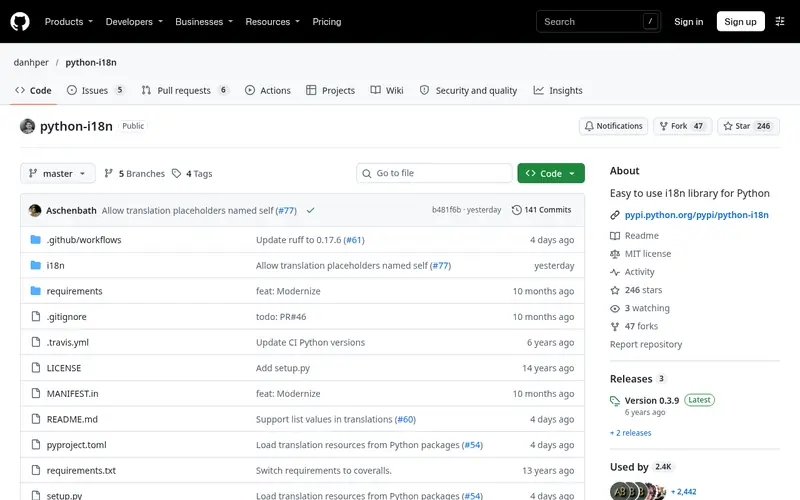
python-i18n is a small library that loads translations from YAML, JSON or Python dictionaries and returns strings for a locale. It supports interpolation and plural forms through its own file format, and it can set a default and fallback locale.
It suits scripts, small services and prototypes where a full gettext pipeline is more work than the app itself. Configuration is short: point it at a directory of translation files and call the translation function.
python-i18n is free and open source. Its limits are scope and tooling: there is no extraction command, and locale-aware date and number formatting is not its job. Skip it for large applications that need translator tooling, catalog validation and broad community support.
Standout: Simple API with YAML, JSON or Python dict translation files
Free (open source), as listed by the vendor (python-i18n website). Confirm the current plan price before you buy.
Free plan. Plans change, so confirm on the vendor's pricing page before you buy.
Benefits
- Simple API with YAML, JSON or Python dict translation files
- little setup for small apps
Drawbacks
- Smaller project with fewer features
- no message extraction tooling like Babel's
Skip it if this limit matters to you: smaller project with fewer features.
Verdict. A sensible pick for small projects that want simple dict-based translations.
Alternatives in this guide: Babel, gettext, Django i18n
Who should use what
A Django team adding a second language should start with Django i18n, since it is already installed and wired into templates and middleware. A Flask app that needs translated templates and locale-formatted dates should use Flask-Babel with Babel. A library or CLI with no web framework should use Babel for catalogs and formatting, or gettext if translated strings are the only need. A product that already uses Fluent on other platforms should use fluent.runtime so one message format serves every client. Teams that need locale-correct sorting or complex plural rules should evaluate PyICU.
Questions to settle before you buy
What to check before you buy
- Confirm the library supports the plural forms and scripts your target locales need.
- Check whether you need locale-aware date, number and currency formatting, not just translated strings.
- Verify the extraction and compilation steps fit your build and deploy pipeline.
- For PyICU, confirm the ICU C library is available on your servers and CI images.
- Review the license and the project's recent commit activity before depending on it.
FAQ
Do I need Babel if I already use gettext?
Not always. gettext handles translated strings and plural forms. Babel adds locale-aware formatting and CLDR data, plus extraction tooling. If your app only shows translated text, gettext may be enough. If it shows dates, numbers or currencies per locale, Babel is the usual addition.
Is Django i18n separate from gettext?
Django i18n builds on gettext. It uses `.po` and `.mo` catalogs and the gettext runtime, then adds Django-specific pieces: settings, middleware, template tags, URL language prefixes and management commands. You do not install gettext separately because it is in the standard library.
Can I use these libraries together?
Yes, in some combinations. Flask-Babel depends on Babel. Django i18n can coexist with Babel for formatting outside templates. Mixing two catalog systems, such as gettext and Fluent, in one codebase adds complexity, so pick one message format per project where possible.
Which library handles plural rules best?
ICU, through PyICU, has the most complete plural and ordinal rule support. Babel also handles plural forms using CLDR data. gettext supports plurals but relies on the forms you define in the catalog. For most apps, Babel's plural support is sufficient.
Are these libraries free for commercial use?
All seven are free and open source. Each has its own license, so check the repository for the exact terms. Babel, Django and gettext use permissive licenses. PyICU wraps ICU, which has its own license. Review licenses before shipping in a commercial product.
Sources we checked
Method: how we score · editorial policy.
Change log. First published 27 Nov 2026.