Stage 01 · Write · Researched comparison
Best JavaScript Transpilers in 2026
Babel is the first pick for most teams that need a configurable transpiler with a large plugin ecosystem, especially when you must support older browsers or custom syntax transforms. SWC and esbuild are the main alternatives when build speed matters more than plugin depth. TypeScript's tsc is the choice when you need type checking rather than only syntax lowering. All six tools listed here are open source.

By Shihab Mia
Published 27 Nov 2026 · 6 tools compared
We run no ads and no affiliate links at launch. The order of a list follows our published method. See how we score.
Prices are the starting prices vendors list publicly. Plans change, so confirm the current price on the vendor page before you buy.
Key takeaways
- Babel, SWC, esbuild, tsc, Sucrase and Oxc are all free and open source; none requires a paid licence.
- Babel offers the widest plugin and preset ecosystem; SWC and esbuild focus on fast builds.
- tsc performs type checking and can emit JavaScript; the others lower syntax without full type checking.
- Sucrase and Oxc target fast, narrow transforms, so check that your target syntax is supported before adopting them.
Who each pick is for
- Teams needing configurable transforms and a large plugin ecosystemBabel
- Teams wanting fast transforms with a Babel-compatible surfaceSWC
- Fast bundling and syntax lowering in one toolesbuild
- Projects that need type checking and JavaScript outputTypeScript compiler (tsc)
- Fast dev builds when you only need a few transformsSucrase
- Teams exploring a fast Rust toolchain for transforms and lintingOxc transformer
Comparison
| Tool | Best for | Standout feature | Listed starting price | Free plan or trial |
|---|---|---|---|---|
| 1Babel | Teams needing configurable transforms and a large plugin ecosystem | Large plugin and preset ecosystem | Free (open source) | Free plan |
| 2SWC | Teams wanting fast transforms with a Babel-compatible surface | Written in Rust for fast builds | Free (open source) | Free plan |
| 3esbuild | Fast bundling and syntax lowering in one tool | Very fast Go-based build | Free (open source) | Free plan |
| 4TypeScript compiler (tsc) | Projects that need type checking and JavaScript output | Full TypeScript type checking | Free (open source) | Free plan |
| 5Sucrase | Fast dev builds when you only need a few transforms | Very fast for its supported transforms | Free (open source) | Free plan |
| 6Oxc transformer | Teams exploring a fast Rust toolchain for transforms and linting | Rust-based for fast processing | Free (open source) | Free plan |
How we picked
We picked tools that genuinely perform JavaScript or TypeScript syntax lowering, or type checking where that is the stated job. Criteria were fit for the task, supported platforms and integrations, licence and price, and the main limits each tool documents. Sources are vendor pages, official documentation and project repositories. All six are open source. Prices and features change, so confirm details on each project's site before you commit.
The tools, one by one
Babel
Best for teams needing configurable transforms and a large plugin ecosystem
What it is and where it fits
Babel is a JavaScript compiler that turns modern syntax into code older runtimes can run. You drive it with presets such as @babel/preset-env, which selects transforms based on your browser targets, and with plugins for JSX, TypeScript syntax and experimental proposals. It runs on Node.js and integrates with most build tools through official loaders and plugins.
The project is open source under the MIT licence and is maintained on GitHub. Its main strength is flexibility: almost any syntax transform has a plugin, and the preset system lets you target specific browsers. The tradeoff is speed. Babel is written in JavaScript, so it is slower than native-code tools like SWC and esbuild on large codebases.
Babel handles syntax lowering and can strip TypeScript types, but it does not type check. Teams that need type errors should run tsc separately. Skip Babel if raw build speed is your top priority and your transform needs are simple.
Standout: Large plugin and preset ecosystem
Free (open source), as listed by the vendor (Babel website). Confirm the current plan price before you buy.
Free plan. Plans change, so confirm on the vendor's pricing page before you buy.
Benefits
- Large plugin and preset ecosystem
- broad syntax support and configurable targets
Drawbacks
- Slower than Rust- and Go-based tools
- configuration can grow complex
Skip it if this limit matters to you: slower than Rust- and Go-based tools.
Verdict. A sensible pick for teams needing configurable transforms and a large plugin ecosystem.
Alternatives in this guide: SWC, esbuild, TypeScript compiler (tsc)
SWC
Best for teams wanting fast transforms with a Babel-compatible surface
What it is and where it fits
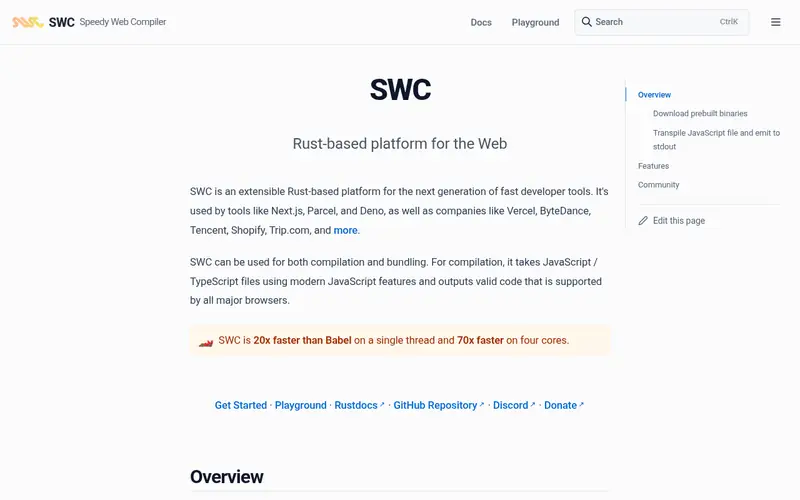
SWC is a Rust-based compiler and bundler platform for JavaScript and TypeScript. It lowers modern syntax, compiles JSX and TypeScript, and exposes a configuration model that maps closely to Babel's presets and plugins. It runs as a CLI, as a library, and through integrations with tools such as Next.js and various bundlers.
The project is open source under the Apache-2.0 licence and is maintained on GitHub. Its main appeal is speed: because it is written in Rust, it processes large files faster than JavaScript-based compilers. It supports a broad set of syntax transforms and can target specific ECMAScript versions.
SWC's plugin ecosystem is smaller than Babel's, and some options do not map one-to-one, so migrating a complex Babel config takes review. It lowers syntax but does not type check. Skip it if you depend on a Babel plugin that has no SWC equivalent.
Standout: Written in Rust for fast builds
Free (open source), as listed by the vendor (SWC website). Confirm the current plan price before you buy.
Free plan. Plans change, so confirm on the vendor's pricing page before you buy.
Benefits
- Written in Rust for fast builds
- supports JSX, TypeScript and modern syntax
Drawbacks
- Plugin ecosystem is smaller than Babel's
- some config options differ from Babel
Skip it if this limit matters to you: plugin ecosystem is smaller than Babel's.
Verdict. A sensible pick for teams wanting fast transforms with a Babel-compatible surface.
Alternatives in this guide: Babel, esbuild, TypeScript compiler (tsc)
esbuild
Best for fast bundling and syntax lowering in one tool
What it is and where it fits
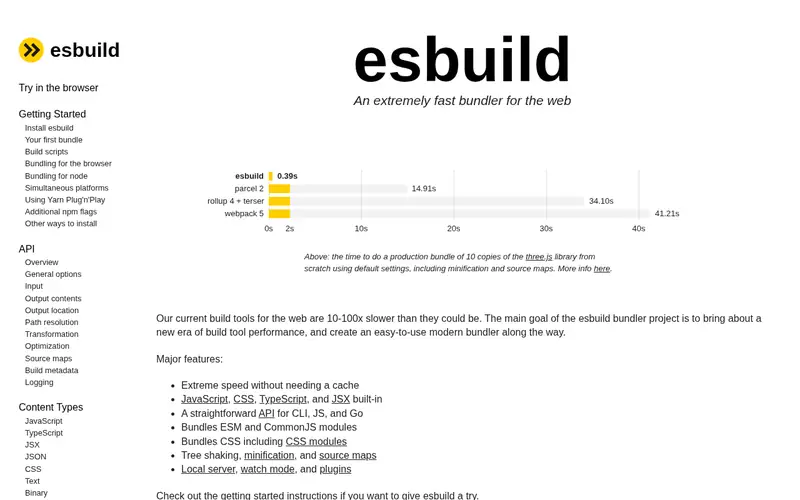
esbuild is a Go-based bundler and transpiler. It lowers modern JavaScript and TypeScript syntax, compiles JSX, and can bundle and minify in the same pass. It runs as a CLI, a JavaScript API and a Go API, and many tools use it internally for transforms.
The project is open source under the MIT licence and is maintained on GitHub. Its main strength is speed and its all-in-one scope: transform, bundle and minify without a separate pipeline. It supports a defined set of target environments and lowers syntax to match them.
esbuild's plugin API is narrower than Babel's, and it does not implement every proposal or legacy transform. It strips TypeScript types but does not type check. Skip it if you need a specific Babel plugin or a transform esbuild does not support.
Standout: Very fast Go-based build
Free (open source), as listed by the vendor (esbuild website). Confirm the current plan price before you buy.
Free plan. Plans change, so confirm on the vendor's pricing page before you buy.
Benefits
- Very fast Go-based build
- handles bundling, minification and transforms together
Drawbacks
- Limited plugin API compared with Babel
- fewer syntax transforms for old targets
Skip it if this limit matters to you: limited plugin API compared with Babel.
Verdict. A sensible pick for fast bundling and syntax lowering in one tool.
Alternatives in this guide: Babel, SWC, TypeScript compiler (tsc)
TypeScript compiler (tsc)
Best for projects that need type checking and JavaScript output
What it is and where it fits
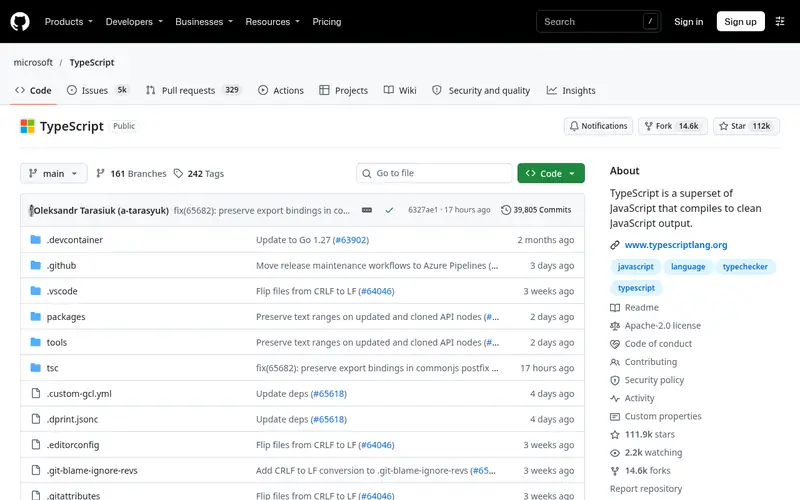
The TypeScript compiler, usually run as tsc, checks types and can emit JavaScript. You set a target such as ES2015 or ES2020, and tsc lowers newer syntax to match. It runs on Node.js and ships as the typescript package on npm. The project is open source under the Apache-2.0 licence and is maintained on GitHub.
tsc's role differs from the other tools here. It is the reference implementation for TypeScript type checking, and its emit step handles syntax lowering for the configured target. Many teams use tsc for checking and a faster tool such as esbuild or SWC for emit during development.
tsc is slower than syntax-only transpilers on large projects, and it is not designed as a host for Babel plugins. Skip it as your only transpiler if you need Babel-specific transforms; pair it with one of the other tools instead.
Standout: Full TypeScript type checking
Free (open source), as listed by the vendor (TypeScript compiler (tsc) website). Confirm the current plan price before you buy.
Free plan. Plans change, so confirm on the vendor's pricing page before you buy.
Benefits
- Full TypeScript type checking
- can emit JavaScript for a chosen target
Drawbacks
- Slower than syntax-only tools
- not a general Babel-plugin host
Skip it if this limit matters to you: slower than syntax-only tools.
Verdict. A sensible pick for projects that need type checking and JavaScript output.
Sucrase
Best for fast dev builds when you only need a few transforms
What it is and where it fits
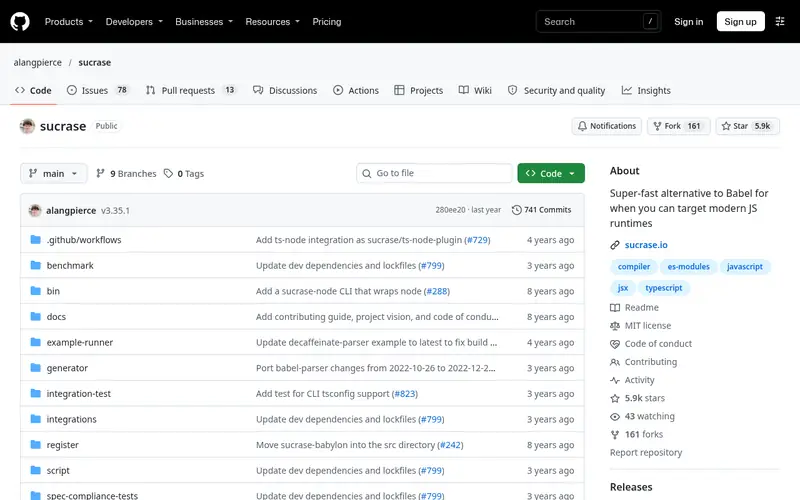
Sucrase is a JavaScript transpiler focused on speed for a limited set of transforms: TypeScript, JSX, and some modern syntax such as optional chaining. It runs on Node.js and exposes a JavaScript API plus integrations with build tools. The project is open source under the MIT licence and is maintained on GitHub.
Sucrase is designed for development builds where you control the runtime. It does not aim to support every legacy target or Babel plugin. Its documentation states that it handles a specific list of transforms and expects a modern runtime for the rest.
That narrow scope is the point: less work per file means faster builds. It strips TypeScript types but does not type check. Skip Sucrase if you must support old browsers or need transforms outside its supported list.
Standout: Very fast for its supported transforms
Free (open source), as listed by the vendor (Sucrase website). Confirm the current plan price before you buy.
Free plan. Plans change, so confirm on the vendor's pricing page before you buy.
Benefits
- Very fast for its supported transforms
- simple API and small scope
Drawbacks
- Supports a narrow set of transforms
- not a full Babel replacement
Skip it if this limit matters to you: supports a narrow set of transforms.
Verdict. A sensible pick for fast dev builds when you only need a few transforms.
Oxc transformer
Best for teams exploring a fast Rust toolchain for transforms and linting
What it is and where it fits
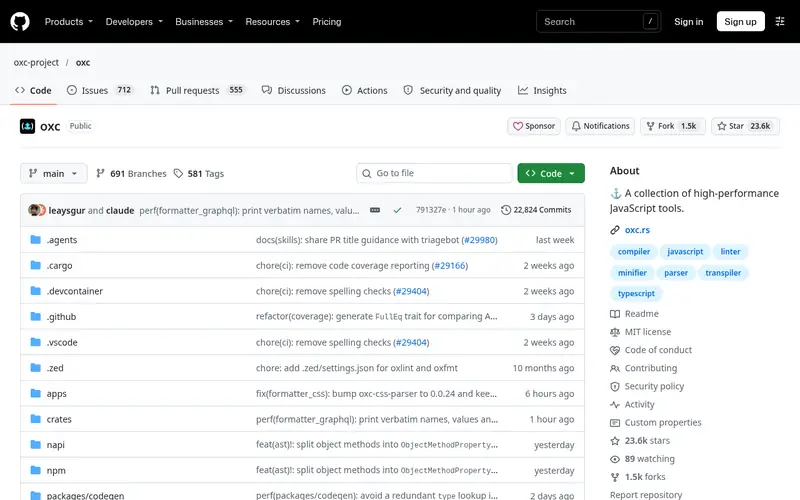
Oxc is a Rust-based toolchain for JavaScript that includes a parser, a transformer, a linter and related tools. The transformer lowers modern syntax and handles TypeScript and JSX, and it is designed to plug into build pipelines. It runs as a CLI and as a library, with Node.js bindings.
The project is open source under the MIT licence and is maintained on GitHub. Its appeal is speed from Rust and a unified toolchain: parsing, transforming and linting in one project. It is newer than Babel and SWC, so its transform coverage and API are still developing.
Check the project's documentation for the syntax and options it currently supports before relying on it for production builds. It lowers syntax but does not type check. Skip it if you need a mature plugin ecosystem or guaranteed coverage of every legacy transform.
Standout: Rust-based for fast processing
Free (open source), as listed by the vendor (Oxc transformer website). Confirm the current plan price before you buy.
Free plan. Plans change, so confirm on the vendor's pricing page before you buy.
Benefits
- Rust-based for fast processing
- part of a broader toolchain including a linter
Drawbacks
- Younger project with a smaller ecosystem
- API and coverage still evolving
Skip it if this limit matters to you: younger project with a smaller ecosystem.
Verdict. A sensible pick for teams exploring a fast Rust toolchain for transforms and linting.
Who should use what
If you maintain a complex Babel config with custom plugins and must support older browsers, use Babel. If build speed is the priority and your transforms are standard, use SWC or esbuild. If you need type errors caught in CI, run tsc alongside a faster emit tool. If you want the fastest dev builds and control your runtime, try Sucrase. If you are evaluating a Rust toolchain that also lints, look at Oxc.
Questions to settle before you buy
What to check before you buy
- Confirm the tool supports every syntax transform your code and dependencies need.
- Decide whether you need type checking (tsc) or only syntax lowering.
- Check integration with your bundler, test runner and editor.
- Review the licence and confirm it fits your project.
- Test on a branch with your real codebase before switching build pipelines.
FAQ
Do JavaScript transpilers type check?
Most do not. Babel, SWC, esbuild, Sucrase and Oxc lower syntax and can strip TypeScript types, but they do not report type errors. The TypeScript compiler (tsc) performs type checking. Many teams run tsc for checking and a faster tool for emit.
Is Babel still needed if esbuild and SWC are faster?
It depends on your transforms. Babel has the largest plugin and preset ecosystem, so it remains the choice for custom or legacy transforms. If your needs are standard syntax lowering and TypeScript, esbuild or SWC can replace it and build faster.
Can I use these tools for TypeScript?
Yes. Babel, SWC, esbuild, Sucrase and Oxc can strip TypeScript types and lower syntax. tsc checks types and can emit JavaScript. For type safety, pair a fast transpiler with tsc in your check step.
Are these transpilers free?
All six listed here are open source and free to use. Babel, esbuild, Sucrase and Oxc use the MIT licence; SWC and TypeScript use Apache-2.0. Check each repository for the current licence text.
Which transpiler is fastest?
Speed claims vary by codebase and configuration, so test with your own project. In general, native-code tools written in Rust or Go (SWC, esbuild, Oxc) process files faster than JavaScript-based compilers such as Babel. Sucrase is also built for fast dev builds with a narrow transform set.
Sources we checked
Method: how we score · editorial policy.
Change log. First published 27 Nov 2026.