Stage 01 · Write · Researched comparison
Best .NET Object Mapping Libraries in 2026
AutoMapper is the most established pick and suits teams that want convention-based mapping and a large body of documentation. Mapster is a good alternative when you want faster mapping with less configuration and a free MIT licence. Mapperly suits projects that prefer compile-time generated mapping code with no runtime reflection. Manual mapping with extension methods remains a valid baseline for small models.

By Shihab Mia
Published 27 Nov 2026 · 5 tools compared
We run no ads and no affiliate links at launch. The order of a list follows our published method. See how we score.
Prices are the starting prices vendors list publicly. Plans change, so confirm the current price on the vendor page before you buy.
Key takeaways
- AutoMapper moved to a commercial licence in 2025, with a free community tier for smaller organisations and paid licences above it.
- Mapster and Mapperly are free and open source under the MIT licence.
- Mapperly generates mapping code at compile time, so it adds no runtime reflection cost.
- AgileMapper is open source but sees low maintenance activity, so check recent commits before adopting it.
Who each pick is for
- Teams wanting convention-based mapping with broad documentationAutoMapper
- Developers wanting fast mapping with minimal configurationMapster
- Teams wanting compile-time generated mapping codeMapperly
- Teams wanting a free mapper with flexible configurationAgileMapper
- Small models where explicit mapping is simplestManual mapping with extension methods
Comparison
| Tool | Best for | Standout feature | Listed starting price | Free plan or trial |
|---|---|---|---|---|
| 1AutoMapper | Teams wanting convention-based mapping with broad documentation | Mature and widely documented | See vendor pricing page | Free plan |
| 2Mapster | Developers wanting fast mapping with minimal configuration | MIT licence with no paid tier | Free (open source) | Free plan |
| 3Mapperly | Teams wanting compile-time generated mapping code | Source generator with no runtime reflection | Free (open source) | Free plan |
| 4AgileMapper | Teams wanting a free mapper with flexible configuration | Free and open source | Free (open source) | Free plan |
| 5Manual mapping with extension methods | Small models where explicit mapping is simplest | No dependency and no licence cost | Free | Free plan |
How we picked
We picked libraries that map one .NET type to another and are currently maintained or widely used. Criteria were fit for the job, supported platforms and target frameworks, licence and price, whether mapping runs at build time or runtime, and the main limits of each. Sources are vendor pages, official documentation and project repositories. Prices and licence terms change, so confirm them on the vendor site before you commit.
The tools, one by one
AutoMapper
Best for teams wanting convention-based mapping with broad documentation
What it is and where it fits
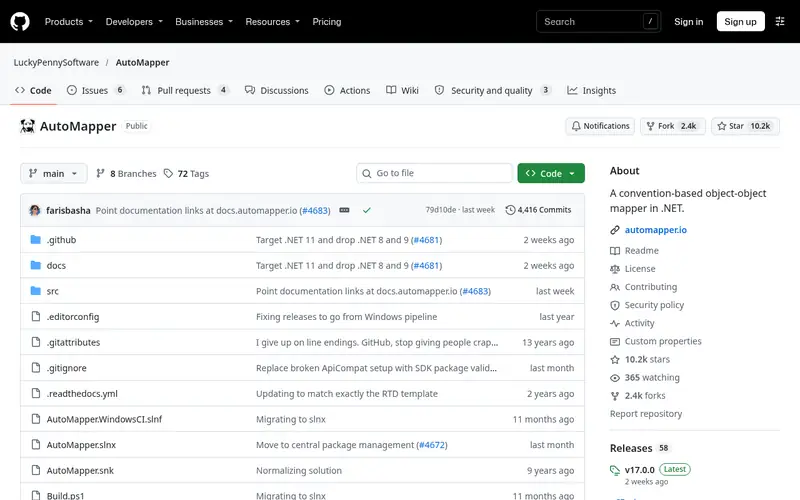
AutoMapper maps objects by matching property names and types, so most mappings need little or no configuration. You define profiles and the library builds the mapping at runtime. It targets .NET Standard and runs on .NET Framework and modern .NET, and it integrates with common DI containers.
The licence changed in 2025. AutoMapper is now distributed by Lucky Penny Software with a free community tier and paid commercial licences for larger use. Confirm the current thresholds and terms on the vendor pricing page before you commit, because the tier limits and prices are set by the vendor and can change.
Choose AutoMapper when your team already knows it or when you want projection support for queryable sources. Skip it if you need a fully permissive open-source licence or want to avoid runtime reflection.
Standout: Mature and widely documented
See vendor pricing page, as listed by the vendor (AutoMapper website). Confirm the current plan price before you buy.
Free plan. Plans change, so confirm on the vendor's pricing page before you buy.
Benefits
- Mature and widely documented
- Convention-based configuration reduces boilerplate
Drawbacks
- Commercial licence since 2025
- Runtime mapping relies on reflection
Skip it if this limit matters to you: commercial licence since 2025.
Verdict. A sensible pick for teams wanting convention-based mapping with broad documentation.
Alternatives in this guide: Mapster, Mapperly, AgileMapper
Mapster
Best for developers wanting fast mapping with minimal configuration
What it is and where it fits
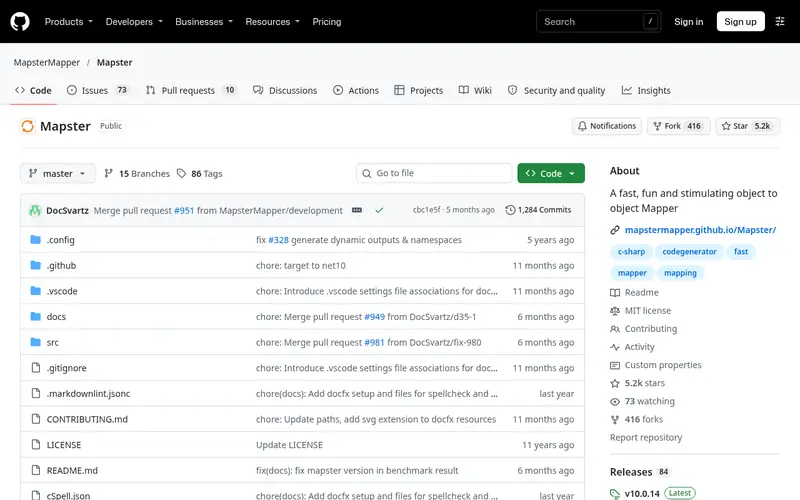
Mapster is an open-source mapper under the MIT licence. It maps by convention and also supports explicit configuration through type adapter settings. It can generate mapping code and works with DI, and it supports projection into queryable sources.
The library targets .NET Standard and runs on .NET Framework and modern .NET. Because it is MIT licensed, there is no paid tier and no seat limit. The trade-off is a smaller ecosystem and fewer community answers than AutoMapper, so complex mapping rules may need more of your own configuration.
Choose Mapster when licence cost matters and your mappings are mostly straightforward. Skip it if you depend on a large set of third-party extensions built around AutoMapper.
Standout: MIT licence with no paid tier
Free (open source), as listed by the vendor (Mapster website). Confirm the current plan price before you buy.
Free plan. Plans change, so confirm on the vendor's pricing page before you buy.
Benefits
- MIT licence with no paid tier
- Low configuration for simple models
Drawbacks
- Smaller community than AutoMapper
- Fewer built-in conventions for complex cases
Skip it if this limit matters to you: smaller community than AutoMapper.
Verdict. A sensible pick for developers wanting fast mapping with minimal configuration.
Alternatives in this guide: AutoMapper, Mapperly, AgileMapper
Mapperly
Best for teams wanting compile-time generated mapping code
What it is and where it fits
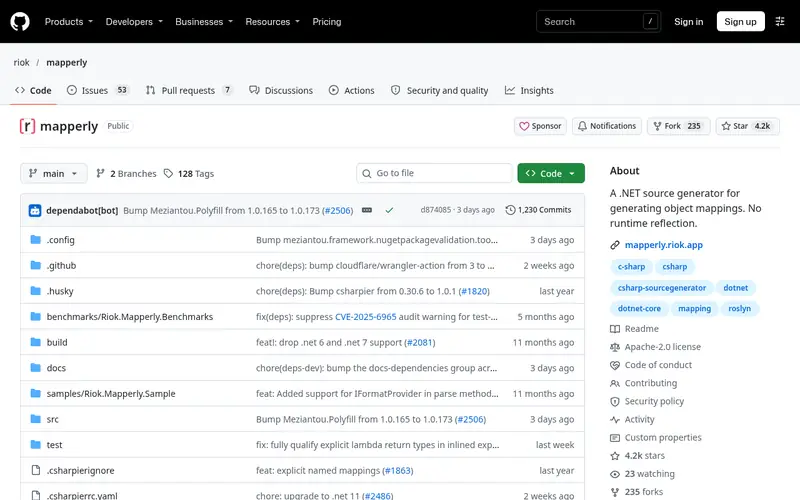
Mapperly is a source generator. It reads your mapping declarations at build time and writes the mapping code into your assembly, so no reflection runs at runtime. That makes it a good fit for trimmed or ahead-of-time compiled applications.
It is open source, and you add it as an analyzer package. Because mapping code is generated, mistakes in property names or types show up as build errors rather than runtime exceptions. The cost is that you declare mappings with partial methods and attributes, which is a different style from convention-based runtime mappers.
Choose Mapperly when startup time and trimming matter, or when you want mapping logic visible in generated code. Skip it if you need runtime, configuration-driven mappings built from strings or external config.
Standout: Source generator with no runtime reflection
Free (open source), as listed by the vendor (Mapperly website). Confirm the current plan price before you buy.
Free plan. Plans change, so confirm on the vendor's pricing page before you buy.
Benefits
- Source generator with no runtime reflection
- Mapping errors surface at build time
Drawbacks
- Requires partial classes and generator setup
- Less flexible for dynamic mappings
Skip it if this limit matters to you: requires partial classes and generator setup.
Verdict. A sensible pick for teams wanting compile-time generated mapping code.
Alternatives in this guide: AutoMapper, Mapster, AgileMapper
AgileMapper
Best for teams wanting a free mapper with flexible configuration
What it is and where it fits
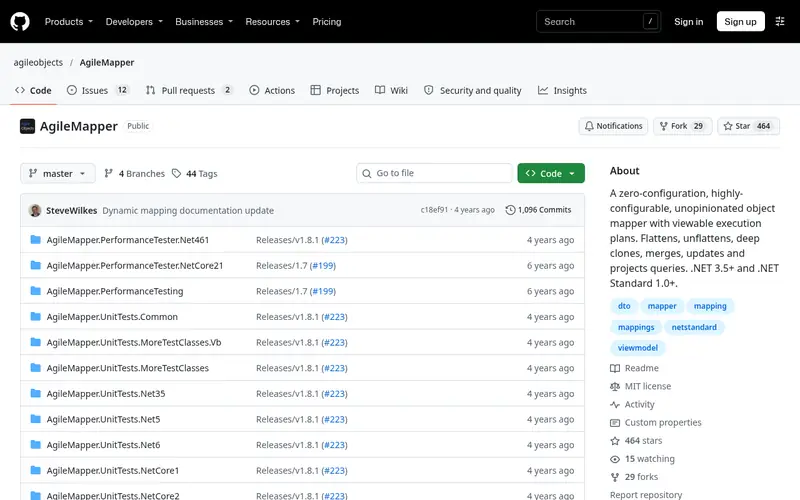
AgileMapper is an open-source object mapper that handles nested types, collections and custom configuration. It maps by convention and lets you override behaviour per type or per member. It runs on .NET Standard and works with .NET Framework and modern .NET.
The main caution is maintenance. The project sees low activity, so check the repository for recent commits and open issues before you adopt it for a long-lived codebase. It remains usable, but you should be prepared to fork or patch it if you hit a bug.
Choose AgileMapper for smaller projects where its configuration style fits and you can accept the maintenance risk. Skip it for large systems that need active vendor support.
Standout: Free and open source
Free (open source), as listed by the vendor (AgileMapper website). Confirm the current plan price before you buy.
Free plan. Plans change, so confirm on the vendor's pricing page before you buy.
Benefits
- Free and open source
- Supports complex and nested mappings
Drawbacks
- Low maintenance activity
- Smaller user base
Skip it if this limit matters to you: low maintenance activity.
Verdict. A sensible pick for teams wanting a free mapper with flexible configuration.
Alternatives in this guide: AutoMapper, Mapster, Mapperly
Manual mapping with extension methods
Best for small models where explicit mapping is simplest
What it is and where it fits
Manual mapping means writing extension methods or static helpers that copy values from one type to another. It needs no library, no licence and no reflection. Every mapping is visible in source, which makes debugging and code review straightforward.
The cost is volume. As the number of types and members grows, hand-written mappings become long and easy to miss when a property is added. There is also no built-in projection support for queryable sources, so you write those expressions yourself.
Choose manual mapping for small models, for boundary code where you want full control, or when you want to avoid a third-party dependency. Skip it once mappings span many types and drift out of sync, where a mapper with build-time or test-time checks helps.
Standout: No dependency and no licence cost
Free, as listed by the vendor (Manual mapping with extension methods website). Confirm the current plan price before you buy.
Free plan. Plans change, so confirm on the vendor's pricing page before you buy.
Benefits
- No dependency and no licence cost
- Mapping code is explicit and easy to debug
Drawbacks
- Verbose as models grow
- No convention support or projection
Skip it if this limit matters to you: verbose as models grow.
Verdict. A sensible pick for small models where explicit mapping is simplest.
Alternatives in this guide: AutoMapper, Mapster, Mapperly
Who should use what
Teams already using AutoMapper, or wanting convention-based mapping with broad documentation, should check the current licence terms first. Developers who want a free MIT-licensed mapper with low configuration should look at Mapster. Projects that care about startup time, trimming or ahead-of-time compilation should use Mapperly. Small codebases or teams avoiding third-party dependencies can start with manual mapping and add a library only when the mappings grow.
Questions to settle before you buy
What to check before you buy
- Confirm the licence and any paid tier, especially for AutoMapper, and check the current thresholds on the vendor page.
- Check that the library targets the frameworks you use, including .NET Framework if you still support it.
- Decide whether you want runtime reflection or compile-time generated mapping code.
- Confirm projection support if you map into queryable sources such as EF Core.
- Check repository activity and open issues for projects with low maintenance, such as AgileMapper.
FAQ
Is AutoMapper still free?
AutoMapper moved to a commercial licence in 2025 with a free community tier and paid licences above it. The exact thresholds and prices are set by the vendor, so check the official pricing page before you rely on the free tier.
What is the difference between Mapster and Mapperly?
Mapster is a runtime mapper that maps by convention and supports configuration. Mapperly is a source generator that writes mapping code at build time, so it uses no runtime reflection. Choose Mapster for flexible runtime mapping and Mapperly for compile-time code generation.
Do object mappers work with .NET Framework?
Several do. AutoMapper, Mapster and AgileMapper target .NET Standard and run on .NET Framework and modern .NET. Check the package's target frameworks on its repository before you add it to an older project.
Should I use a mapping library or write mappings by hand?
For small models, hand-written extension methods are simple and dependency-free. As the number of types and members grows, a library reduces boilerplate and helps keep mappings consistent. Many teams start manual and adopt a library when the volume justifies it.
Does object mapping affect performance?
Runtime mappers rely on reflection or cached delegates, which adds some cost per mapping call. Source generators such as Mapperly produce direct code with no runtime reflection. Measure your own scenarios rather than assuming, since results depend on model size and call volume.
Sources we checked
Method: how we score · editorial policy.
Change log. First published 27 Nov 2026.