Stage 01 · Write · Researched comparison
Best Angular State Management Libraries in 2026
NgRx Store is the first pick for teams that want a structured, Redux-style store with strong tooling and a large ecosystem. NgRx SignalStore suits projects built around Angular Signals, and NGXS is a good alternative if you prefer a class-based, less boilerplate-heavy API. All of these are open source and free to use.

By Shihab Mia
Published 27 Nov 2026 · 6 tools compared
We run no ads and no affiliate links at launch. The order of a list follows our published method. See how we score.
Prices are the starting prices vendors list publicly. Plans change, so confirm the current price on the vendor page before you buy.
Key takeaways
- NgRx Store and NgRx SignalStore are separate packages in the same open-source project, so you can adopt one without the other.
- NGXS and RxAngular are free and open source, and each takes a different approach to state, from class-based stores to RxJS-first services.
- Angular Signals is built into the framework, so it adds no dependency but covers local and shared state rather than full devtools-driven stores.
- TanStack Query for Angular is an experimental adapter aimed at server state, not a replacement for a general client-side store.
Who each pick is for
- Large apps that want a Redux-style store with devtoolsNgRx Store
- Signal-based apps that want a structured store with less boilerplateNgRx SignalStore
- Teams that want a class-based store with less boilerplateNGXS
- Apps that want built-in reactive state without extra dependenciesAngular Signals
- RxJS-heavy apps that want a lightweight state serviceRxAngular State
- Server state such as caching and refetching API dataTanStack Query for Angular
Comparison
| Tool | Best for | Standout feature | Listed starting price | Free plan or trial |
|---|---|---|---|---|
| 1NgRx Store | Large apps that want a Redux-style store with devtools | Mature ecosystem with effects, entity and router packages | Free (open source) | Free plan |
| 2NgRx SignalStore | Signal-based apps that want a structured store with less boilerplate | Built on Angular Signals with a compact, composable API | Free (open source) | Free plan |
| 3NGXS | Teams that want a class-based store with less boilerplate | Concise decorator-based state classes | Free (open source) | Free plan |
| 4Angular Signals | Apps that want built-in reactive state without extra dependencies | Part of Angular itself, so no extra package | Free | Free plan |
| 5RxAngular State | RxJS-heavy apps that want a lightweight state service | Small API built on RxJS | Free (open source) | Free plan |
| 6TanStack Query for Angular | Server state such as caching and refetching API data | Strong caching, refetching and mutation handling | Free (open source) | Free plan |
How we picked
We picked libraries that are currently maintained and genuinely handle state management in Angular. Criteria were fit for the job, how they integrate with Angular and RxJS or Signals, licence and price, and the main limits such as boilerplate, ecosystem size and experimental status. Sources are vendor documentation, project repositories and public pricing pages. All listed options are open source and free. Prices and status change, so confirm details on the vendor site.
The tools, one by one
NgRx Store
Best for large apps that want a Redux-style store with devtools
What it is and where it fits
NgRx Store implements the Redux pattern for Angular: actions describe events, reducers produce new state, and selectors read it. The wider ngrx/platform repository also ships effects for side effects, @ngrx/entity for collections, and @ngrx/store-devtools for inspecting state changes. It runs in any Angular application and has no paid tier.
The main cost is boilerplate. Every change needs an action and a reducer, which pays off in large teams that need traceable state transitions but slows down small features. Devtools integration and a long track record make it the default choice for enterprise-scale apps. Teams that want less ceremony but still want NgRx tooling should look at NgRx SignalStore instead.
Standout: Mature ecosystem with effects, entity and router packages
Free (open source), as listed by the vendor (NgRx Store website). Confirm the current plan price before you buy.
Free plan. Plans change, so confirm on the vendor's pricing page before you buy.
Benefits
- Mature ecosystem with effects, entity and router packages
- Strong devtools and time-travel debugging
Drawbacks
- Verbose action and reducer boilerplate
- Steeper learning curve for small teams
Skip it if this limit matters to you: verbose action and reducer boilerplate.
Verdict. A sensible pick for large apps that want a Redux-style store with devtools.
Alternatives in this guide: NgRx SignalStore, NGXS, Angular Signals
NgRx SignalStore
Best for signal-based apps that want a structured store with less boilerplate
What it is and where it fits
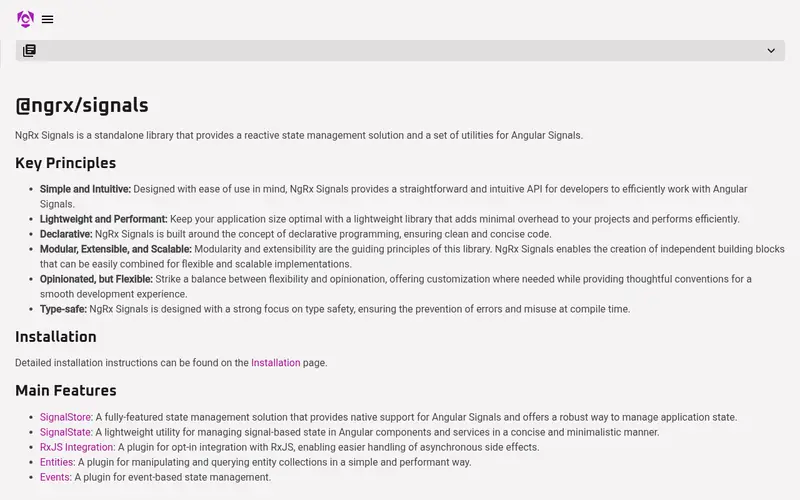
NgRx SignalStore is a standalone package in the ngrx/platform repository. It lets you define state with Signals and compose features such as computed values, methods and hooks. It is lighter than the classic Store and fits codebases already using Signals for components and services.
It is not a drop-in replacement for NgRx Store. You choose it when your app is Signal-first and you want structure without actions and reducers. Because it is newer, community examples are fewer than for classic NgRx, so check the official guide before committing. It is free and open source, and it works in any Angular version that supports Signals.
Standout: Built on Angular Signals with a compact, composable API
Free (open source), as listed by the vendor (NgRx SignalStore website). Confirm the current plan price before you buy.
Free plan. Plans change, so confirm on the vendor's pricing page before you buy.
Benefits
- Built on Angular Signals with a compact, composable API
- Part of the maintained NgRx project
Drawbacks
- Newer than NgRx Store, so fewer established patterns
- Requires a Signals-based codebase to pay off
Skip it if this limit matters to you: newer than NgRx Store, so fewer established patterns.
Verdict. A sensible pick for signal-based apps that want a structured store with less boilerplate.
Alternatives in this guide: NgRx Store, NGXS, Angular Signals
NGXS
Best for teams that want a class-based store with less boilerplate
What it is and where it fits
NGXS models state as classes with actions handled by methods, which cuts the action-and-reducer ceremony of Redux-style stores. It includes selectors, async actions and a plugin system for things like logging and storage. It runs in any Angular app and is free and open source.
The trade-off is ecosystem size. NgRx has more third-party packages and examples, while NGXS is smaller but stable and actively maintained. It suits teams that like object-oriented state classes and want a middle ground between full Redux and plain services. Teams standardizing on Signals may prefer NgRx SignalStore or built-in Signals instead.
Standout: Concise decorator-based state classes
Free (open source), as listed by the vendor (NGXS website). Confirm the current plan price before you buy.
Free plan. Plans change, so confirm on the vendor's pricing page before you buy.
Benefits
- Concise decorator-based state classes
- Built-in actions, selectors and plugins
Drawbacks
- Smaller ecosystem than NgRx
- Decorator style is less common in newer Angular code
Skip it if this limit matters to you: smaller ecosystem than NgRx.
Verdict. A sensible pick for teams that want a class-based store with less boilerplate.
Alternatives in this guide: NgRx Store, NgRx SignalStore, Angular Signals
Angular Signals
Best for apps that want built-in reactive state without extra dependencies
What it is and where it fits
Angular Signals is the framework's built-in reactive primitive. A signal holds a value, computed signals derive from it, and effects run when values change. For many components and small services, this replaces a dedicated state library entirely, and it adds no dependency because it ships with Angular.
Signals do not provide a store abstraction, devtools or action logging. You decide how to structure shared state, often with injectable services that expose signals. That is enough for small and medium apps but can get inconsistent in large teams without conventions. It is free and works in any Angular version that supports Signals. Use it as the base layer, and add a library when you need structure.
Standout: Part of Angular itself, so no extra package
Free, as listed by the vendor (Angular Signals website). Confirm the current plan price before you buy.
Free plan. Plans change, so confirm on the vendor's pricing page before you buy.
Benefits
- Part of Angular itself, so no extra package
- Simple API for local and shared state
Drawbacks
- No devtools or time-travel debugging
- You design your own store patterns
Skip it if this limit matters to you: no devtools or time-travel debugging.
Verdict. A sensible pick for apps that want built-in reactive state without extra dependencies.
Alternatives in this guide: NgRx Store, NgRx SignalStore, NGXS
RxAngular State
Best for rxJS-heavy apps that want a lightweight state service
What it is and where it fits
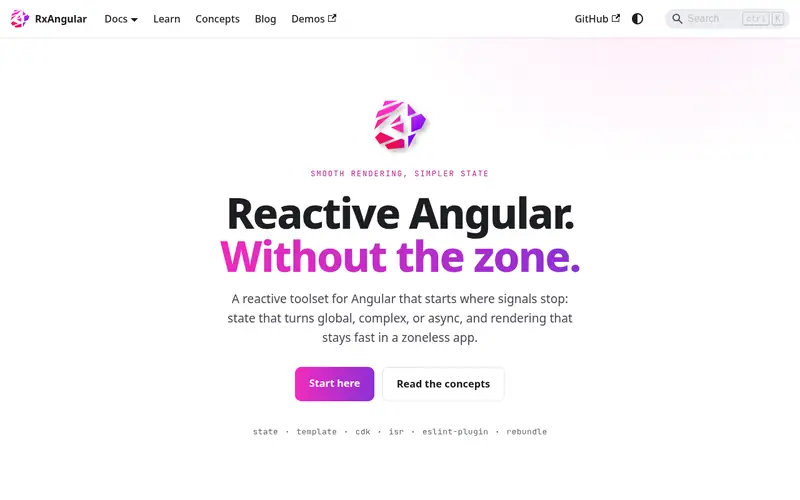
RxAngular State provides a small set of primitives for holding state in RxJS-based services. It focuses on local and component state rather than a global store, and it pairs with the wider RxAngular project, which also covers rendering and zone-less change detection. It is free and open source and runs in any Angular app.
It fits teams already comfortable with RxJS who want explicit, service-based state without actions and reducers. It does not try to be a full Redux-style store, so large apps with complex cross-cutting state may need more structure. Check the documentation for the current API and maintenance status before adopting it.
Standout: Small API built on RxJS
Free (open source), as listed by the vendor (RxAngular State website). Confirm the current plan price before you buy.
Free plan. Plans change, so confirm on the vendor's pricing page before you buy.
Benefits
- Small API built on RxJS
- Pairs with RxAngular's rendering helpers
Drawbacks
- Narrower scope than full store libraries
- Smaller ecosystem
Skip it if this limit matters to you: narrower scope than full store libraries.
Verdict. A sensible pick for rxJS-heavy apps that want a lightweight state service.
Alternatives in this guide: NgRx Store, NgRx SignalStore, NGXS
TanStack Query for Angular
Best for server state such as caching and refetching API data
What it is and where it fits
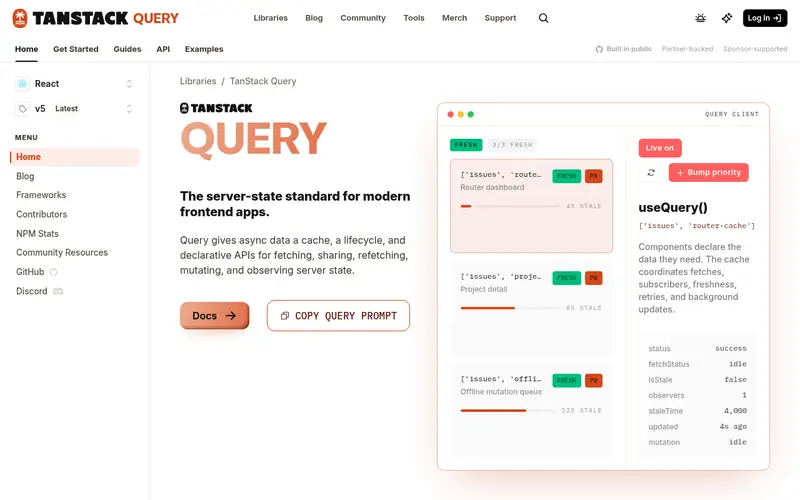
TanStack Query manages server state: fetching, caching, background refetching and mutations. The core project is widely used across frameworks, and an Angular adapter exists. It is free and open source.
The Angular adapter is marked experimental, so expect API changes and check the documentation before relying on it in production. It complements a client-side store rather than replacing one: use it for data from APIs and keep a store for UI and app state. Teams that need a stable, Angular-first API may prefer NgRx effects or NGXS actions for data loading until the adapter matures.
Standout: Strong caching, refetching and mutation handling
Free (open source), as listed by the vendor (TanStack Query for Angular website). Confirm the current plan price before you buy.
Free plan. Plans change, so confirm on the vendor's pricing page before you buy.
Benefits
- Strong caching, refetching and mutation handling
- Part of a widely used cross-framework project
Drawbacks
- Angular adapter is experimental
- Handles server state, not general client state
Skip it if this limit matters to you: angular adapter is experimental.
Verdict. A sensible pick for server state such as caching and refetching API data.
Alternatives in this guide: NgRx Store, NgRx SignalStore, NGXS
Who should use what
Large teams with complex, shared state and a need for devtools should start with NgRx Store. Signal-first projects that want structure without actions and reducers should look at NgRx SignalStore. Teams that prefer class-based state and less boilerplate can use NGXS. Small apps and services may need nothing more than built-in Angular Signals. For server state such as API caching, consider TanStack Query for Angular, keeping its experimental status in mind.
Questions to settle before you buy
What to check before you buy
- Confirm the library is actively maintained by checking recent commits and releases in its repository.
- Check that it supports the Angular version you use, especially for Signals-based options.
- Decide whether you need a global store, local component state, or server state, and pick accordingly.
- Review boilerplate and learning cost against your team size and turnover.
- Verify devtools and debugging support if traceable state changes matter to you.
FAQ
Is NgRx Store the same as NgRx SignalStore?
No. They are separate packages in the same ngrx/platform project. NgRx Store uses actions and reducers in the Redux style. NgRx SignalStore is built on Angular Signals with a composable API and less boilerplate. You can adopt one without the other, and both are free and open source.
Do I need a state management library at all?
Not always. Angular Signals covers local and shared state for many small and medium apps without extra dependencies. A library helps when you need structure, devtools, or consistent patterns across a large team. Start with Signals and add a library when the app outgrows it.
Which option works best with Angular Signals?
NgRx SignalStore is designed around Signals and is the most direct fit among the listed libraries. Built-in Angular Signals is the base layer. NGXS and NgRx Store are built around RxJS observables, though they can be used alongside Signals in the same app.
Is TanStack Query for Angular ready for production?
The Angular adapter is marked experimental, so treat it with caution. It is strong for server state such as caching and refetching, but the API may change. Check the current documentation and test it in a non-critical area before relying on it widely.
Are these libraries free?
Yes. All six options listed are free and open source, including NgRx Store, NgRx SignalStore, NGXS, RxAngular State and TanStack Query. Angular Signals ships with the framework at no cost. Check each project's licence if you need details for your organization.
Sources we checked
Method: how we score · editorial policy.
Change log. First published 27 Nov 2026.