Stage 03 · Host · Researched comparison
Best Rust Async Runtimes in 2026
Tokio is the first pick for most teams. It is the most widely used async runtime for Rust, with a large ecosystem, a multithreaded work-stealing scheduler and support for networking, timers and filesystem tasks. Pick smol if you want a small, simple runtime built on async-executor. Pick monoio or Glommio if you need thread-per-core I/O on Linux with io_uring. Pick embassy for embedded and no_std targets.

By Shihab Mia
Published 27 Nov 2026 · 6 tools compared
We run no ads and no affiliate links at launch. The order of a list follows our published method. See how we score.
Prices are the starting prices vendors list publicly. Plans change, so confirm the current price on the vendor page before you buy.
Key takeaways
- Tokio, smol, Glommio, monoio and embassy are all free and open source, so cost is not a deciding factor.
- Tokio has the broadest ecosystem and library support; smol is smaller and easier to read.
- Glommio and monoio target Linux thread-per-core designs and depend on io_uring.
- async-std is discontinued and should not be chosen for new projects.
Who each pick is for
- Most applications and services that need a broad ecosystemTokio
- Developers who want a small, readable runtimesmol
- Linux services that need thread-per-core io_uring I/OGlommio
- Thread-per-core servers that need io_uring and cross-platform fallbacksmonoio
- Embedded and no_std async projects on microcontrollersembassy
- Libraries and tests that need a minimal executorfutures-rs executor
Comparison
| Tool | Best for | Standout feature | Listed starting price | Free plan or trial |
|---|---|---|---|---|
| 1Tokio | Most applications and services that need a broad ecosystem | Widest library and framework support | Free (open source) | Free plan |
| 2smol | Developers who want a small, readable runtime | Small codebase built from reusable async-* crates | Free (open source) | Free plan |
| 3Glommio | Linux services that need thread-per-core io_uring I/O | Thread-per-core design with low cross-core contention | Free (open source) | Free plan |
| 4monoio | Thread-per-core servers that need io_uring and cross-platform fallbacks | Thread-per-core runtime with io_uring on Linux | Free (open source) | Free plan |
| 5embassy | Embedded and no_std async projects on microcontrollers | Designed for no_std and embedded targets | Free (open source) | Free plan |
| 6futures-rs executor | Libraries and tests that need a minimal executor | Part of the widely used futures crate family | Free (open source) | Free plan |
How we picked
We compared runtimes on fit for common async workloads, supported platforms, licence, ecosystem size and known limits such as Linux-only requirements or no_std support. Sources are official project sites, documentation and repositories. Prices and maintenance status can change, so confirm details on the project site before you commit.
The tools, one by one
Tokio
Best for most applications and services that need a broad ecosystem
What it is and where it fits
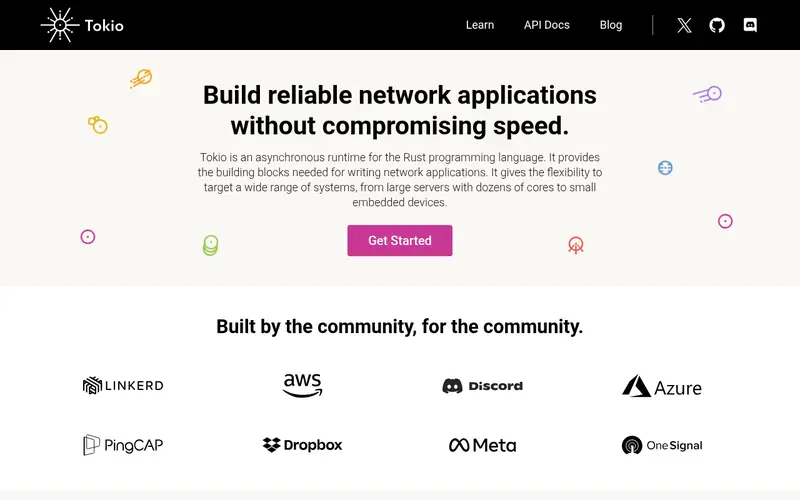
Tokio is the default async runtime for most Rust projects. It provides a multithreaded scheduler, async TCP and UDP, timers, a filesystem API and synchronization primitives. Popular web frameworks, database drivers and gRPC libraries build on it, so choosing Tokio usually means fewer integration problems. It runs on Linux, macOS and Windows.
The crate is dual licensed under MIT and Apache-2.0. You can use a single-threaded runtime for simpler workloads or the multithreaded runtime for servers. Tokio also offers a current-thread mode and a `#[tokio::main]` macro for quick setup. The main limit is scope: it is a general-purpose runtime, not a thread-per-core design, so very high-throughput I/O workloads may benefit from a specialized runtime. Skip it if you need no_std or embedded support.
Standout: Widest library and framework support
Free (open source), as listed by the vendor (Tokio website). Confirm the current plan price before you buy.
Free plan. Plans change, so confirm on the vendor's pricing page before you buy.
Benefits
- Widest library and framework support
- multithreaded work-stealing scheduler with full networking and timer support
Drawbacks
- Larger dependency footprint
- opinionated API that shapes your whole codebase
Skip it if this limit matters to you: larger dependency footprint.
Verdict. A sensible pick for most applications and services that need a broad ecosystem.
smol
Best for developers who want a small, readable runtime
What it is and where it fits
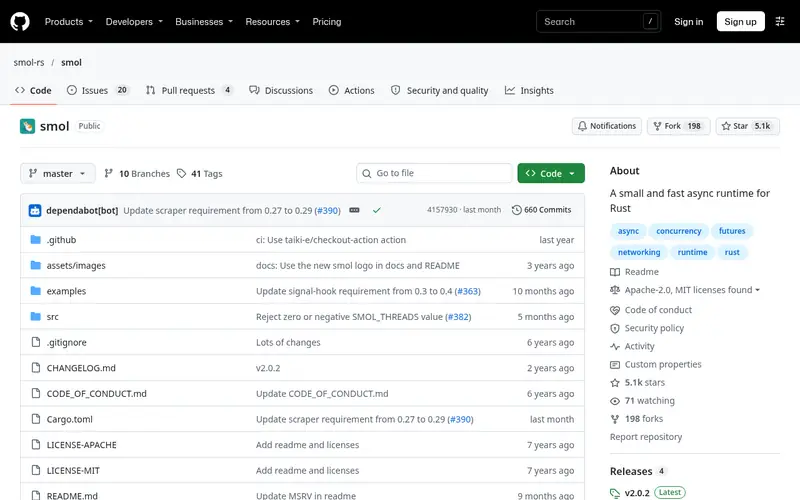
smol is a compact async runtime assembled from the async-* family of crates, including async-executor, async-io and async-net. It provides a global executor, a `block_on` function, async TCP and UDP, and a task spawning API. The codebase is small enough to read and understand, which helps when you need to debug runtime behavior.
It runs on Linux, macOS and Windows and is licensed under MIT or Apache-2.0. smol is a good fit for small services, command-line tools and libraries that want async I/O without pulling in the full Tokio stack. The tradeoff is ecosystem size: fewer frameworks and database drivers target smol directly, though many async crates are runtime-agnostic.
Standout: Small codebase built from reusable async-* crates
Free (open source), as listed by the vendor (smol website). Confirm the current plan price before you buy.
Free plan. Plans change, so confirm on the vendor's pricing page before you buy.
Benefits
- Small codebase built from reusable async-* crates
- Simple API with a blocking executor and async I/O helpers
Drawbacks
- Smaller ecosystem than Tokio
- Fewer framework integrations
Skip it if this limit matters to you: smaller ecosystem than Tokio.
Verdict. A sensible pick for developers who want a small, readable runtime.
Glommio
Best for linux services that need thread-per-core io_uring I/O
What it is and where it fits
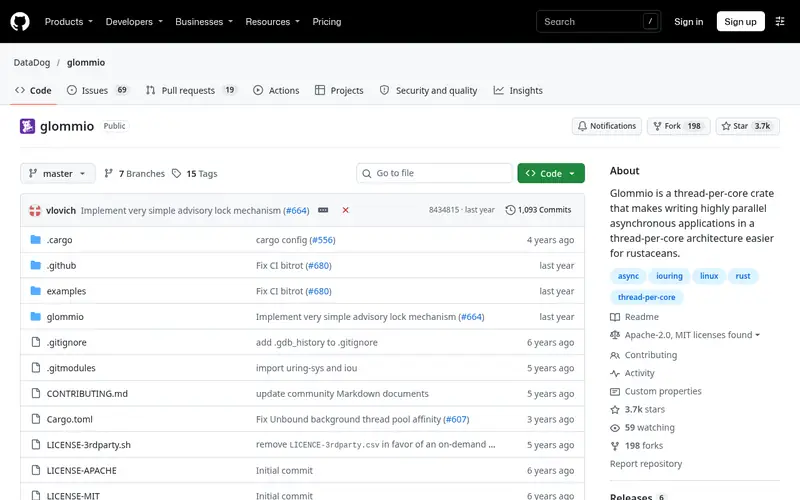
Glommio is a thread-per-core async runtime from DataDog built on Linux io_uring. Each core runs its own executor, which reduces synchronization and cache contention compared with work-stealing designs. It provides async filesystem, networking and timer APIs tuned for high-throughput I/O.
It runs only on Linux and needs a kernel with io_uring support. The crate is licensed under Apache-2.0. Glommio suits storage engines, proxies and other I/O-heavy services where you control the deployment environment. It is a poor fit for cross-platform libraries, Windows or macOS targets, or teams that need broad framework support.
Standout: Thread-per-core design with low cross-core contention
Free (open source), as listed by the vendor (Glommio website). Confirm the current plan price before you buy.
Free plan. Plans change, so confirm on the vendor's pricing page before you buy.
Benefits
- Thread-per-core design with low cross-core contention
- Built directly on Linux io_uring
Drawbacks
- Linux-only and requires a recent kernel
- Smaller ecosystem and fewer integrations
Skip it if this limit matters to you: linux-only and requires a recent kernel.
Verdict. A sensible pick for linux services that need thread-per-core io_uring I/O.
monoio
Best for thread-per-core servers that need io_uring and cross-platform fallbacks
What it is and where it fits
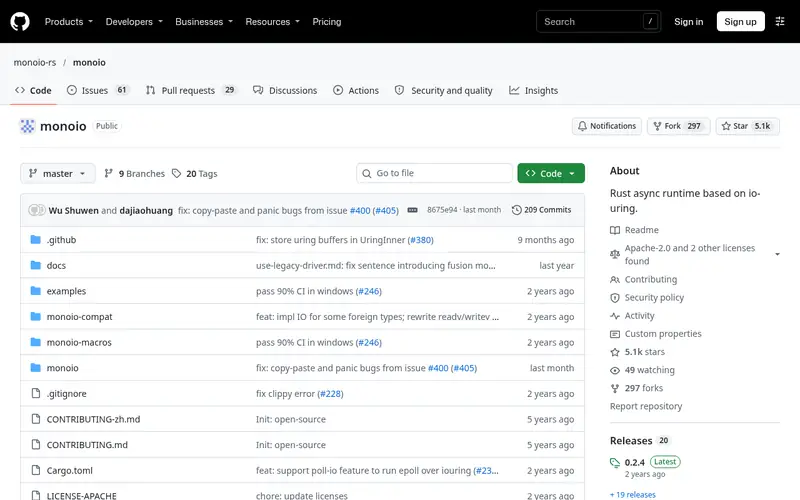
monoio is a thread-per-core async runtime from ByteDance. On Linux it uses io_uring; on other platforms it falls back to epoll or kqueue, which makes it more portable than Glommio. It provides async TCP, UDP, filesystem and timer APIs and is designed for high-throughput network services.
The crate is licensed under MIT or Apache-2.0. Because its API and task model differ from Tokio, existing code usually needs changes to move over. monoio fits teams building performance-sensitive servers that can own their runtime choice. Skip it if you depend on Tokio-specific libraries or need a large set of community examples.
Standout: Thread-per-core runtime with io_uring on Linux
Free (open source), as listed by the vendor (monoio website). Confirm the current plan price before you buy.
Free plan. Plans change, so confirm on the vendor's pricing page before you buy.
Benefits
- Thread-per-core runtime with io_uring on Linux
- Supports epoll and kqueue on other platforms
Drawbacks
- API differs from Tokio, so porting takes work
- Smaller community and fewer examples
Skip it if this limit matters to you: API differs from Tokio, so porting takes work.
Verdict. A sensible pick for thread-per-core servers that need io_uring and cross-platform fallbacks.
embassy
Best for embedded and no_std async projects on microcontrollers
What it is and where it fits
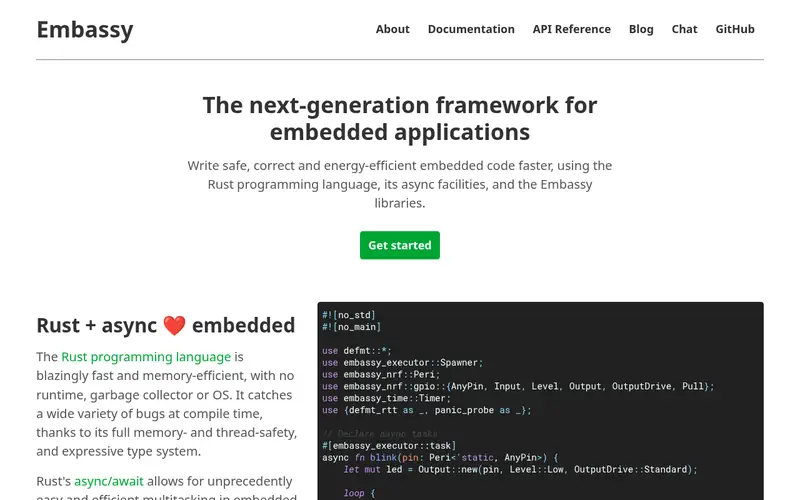
embassy is an async framework for embedded Rust. It includes an executor that works without a standard library and hardware abstraction layers for several microcontroller families, along with async drivers for common peripherals. It lets you write interrupt-driven firmware with async/await instead of manual state machines.
The project is free and open source, with crates published on crates.io and source on GitHub. It targets bare-metal and RTOS-style environments rather than desktop or server use. The main limits are platform scope and the learning curve around embedded toolchains and flashing. Choose it for firmware, not for backend services.
Standout: Designed for no_std and embedded targets
Free (open source), as listed by the vendor (embassy website). Confirm the current plan price before you buy.
Free plan. Plans change, so confirm on the vendor's pricing page before you buy.
Benefits
- Designed for no_std and embedded targets
- Hardware abstraction layers for common microcontroller families
Drawbacks
- Not intended for desktop or server workloads
- Requires embedded toolchain knowledge
Skip it if this limit matters to you: not intended for desktop or server workloads.
Verdict. A sensible pick for embedded and no_std async projects on microcontrollers.
futures-rs executor
Best for libraries and tests that need a minimal executor
What it is and where it fits
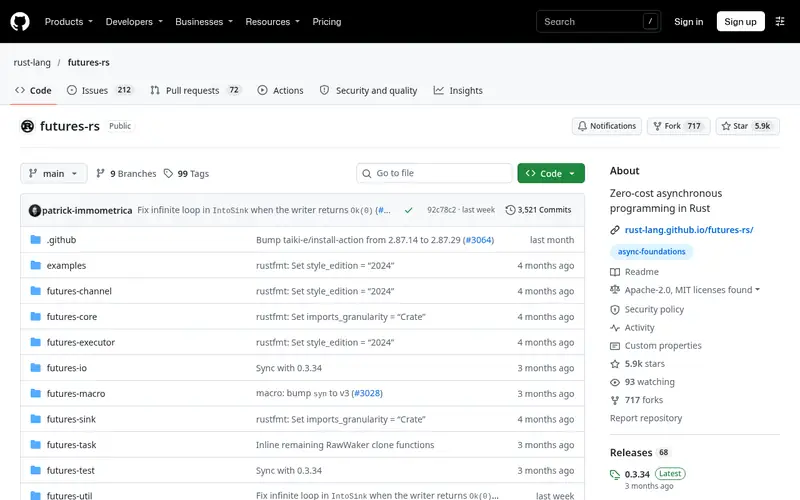
The futures-rs project provides the `futures` crate, which includes a minimal executor with `block_on` and a local thread pool. It is often used in tests, examples and libraries that want to run futures without depending on a full runtime. The crate also supplies core async traits and combinators used across the ecosystem.
It is dual licensed under MIT and Apache-2.0 and runs on any platform Rust supports, including no_std with alloc. The limit is scope: it has no async I/O, timers or networking, so production services usually pair it with another runtime. Use it when you need a tiny executor or shared async utilities, not as a server runtime.
Standout: Part of the widely used futures crate family
Free (open source), as listed by the vendor (futures-rs executor website). Confirm the current plan price before you buy.
Free plan. Plans change, so confirm on the vendor's pricing page before you buy.
Benefits
- Part of the widely used futures crate family
- Simple block_on and local pool executors
Drawbacks
- No built-in networking or timers
- Not a full runtime for production servers
Skip it if this limit matters to you: no built-in networking or timers.
Verdict. A sensible pick for libraries and tests that need a minimal executor.
Who should use what
If you are building a web service or API and want the largest library ecosystem, start with Tokio. If you want a small runtime for a CLI tool or a library with async I/O, try smol. If you run I/O-heavy Linux services and control the kernel, evaluate Glommio or monoio. If you write firmware for microcontrollers, use embassy. Avoid async-std for new projects because it is discontinued.
Questions to settle before you buy
What to check before you buy
- Confirm the runtime supports every target platform you ship to, including Windows and macOS.
- Check that your key dependencies (web framework, database driver, TLS) support the runtime.
- Review the licence and confirm it fits your distribution model.
- For io_uring runtimes, verify the minimum kernel version on your hosts.
- Plan how you will test async code, since executor choice affects test setup.
FAQ
Is Tokio the best Rust async runtime?
Tokio is the most widely used and has the largest ecosystem, which makes it the default choice for most applications. It is not the best fit for every case: embedded projects need embassy, and thread-per-core Linux services may prefer Glommio or monoio.
Is async-std still maintained?
No. The async-std project is discontinued and its repository states it is no longer maintained. Existing projects may still compile, but new projects should use a maintained runtime such as Tokio or smol.
Do these runtimes cost anything?
No. Tokio, smol, Glommio, monoio, embassy and futures-rs are free and open source, typically under MIT or Apache-2.0 licences. Your costs come from hosting and development time, not runtime licences.
Can I use more than one runtime in a project?
You can, but it adds complexity. Many async libraries are runtime-agnostic, while others depend on Tokio directly. Mixing runtimes usually means bridging executors, which is best avoided unless a dependency forces it.
Which runtime works on embedded targets?
embassy is designed for embedded and no_std use and includes hardware support for several microcontroller families. Tokio, smol and the io_uring runtimes target desktop and server platforms, so they are not suitable for bare-metal firmware.
Sources we checked
Method: how we score · editorial policy.
Change log. First published 27 Nov 2026.