Stage 03 · Host · Researched comparison
Best TypeScript ORMs in 2026
Prisma is the first pick for most teams that want a schema-first workflow, generated types and a mature migration tool, and it suits developers who value tooling over raw SQL control. Drizzle ORM is the alternative for teams that want a thin, SQL-like query builder with full type inference. TypeORM remains a reasonable choice for projects already built on it or for teams that prefer decorator-based entities.

By Shihab Mia
Published 27 Nov 2026 · 7 tools compared
We run no ads and no affiliate links at launch. The order of a list follows our published method. See how we score.
Prices are the starting prices vendors list publicly. Plans change, so confirm the current price on the vendor page before you buy.
Key takeaways
- Prisma, Drizzle, TypeORM, MikroORM, Sequelize, Kysely and Knex are all open source and free to use.
- Prisma and Drizzle give the strongest TypeScript inference out of the box; Knex has no built-in type inference for query results.
- Kysely and Knex are query builders rather than full ORMs, so you manage entities and relations yourself.
- All seven run on Node.js; check each project's docs for edge runtime and serverless support before you commit.
Who each pick is for
- Schema-first teams that want generated types and migrationsPrisma
- Teams that want SQL-like queries with full type inferenceDrizzle ORM
- Teams using decorator-based entities and Active Record patternsTypeORM
- Teams that want a full ORM with identity map and unit of workMikroORM
- Existing Node.js projects that already depend on SequelizeSequelize
- Teams that want a typed SQL query builder without an ORMKysely
- Teams that want a mature query builder with migration supportKnex
Comparison
| Tool | Best for | Standout feature | Listed starting price | Free plan or trial |
|---|---|---|---|---|
| 1Prisma | Schema-first teams that want generated types and migrations | Generated client types from a schema file | Free (open source) | Free plan |
| 2Drizzle ORM | Teams that want SQL-like queries with full type inference | Types inferred from TypeScript schema with no code generation | Free (open source) | Free plan |
| 3TypeORM | Teams using decorator-based entities and Active Record patterns | Supports Data Mapper and Active Record | Free (open source) | Free plan |
| 4MikroORM | Teams that want a full ORM with identity map and unit of work | Strong TypeScript typing across entities and queries | Free (open source) | Free plan |
| 5Sequelize | Existing Node.js projects that already depend on Sequelize | Long-established with broad database support | Free (open source) | Free plan |
| 6Kysely | Teams that want a typed SQL query builder without an ORM | Types flow from a database schema interface | Free (open source) | Free plan |
| 7Knex | Teams that want a mature query builder with migration support | Stable query builder with built-in migrations | Free (open source) | Free plan |
How we picked
We compared these tools on fit for TypeScript work, database and runtime support, licence and price, migration tooling, and the main limits each one states in its documentation. Sources are vendor pages, official documentation and project repositories. All listed projects are open source and free to use; paid hosted services are separate. Prices and features change, so confirm details on the vendor site before you commit.
The tools, one by one
Prisma
Best for schema-first teams that want generated types and migrations
What it is and where it fits
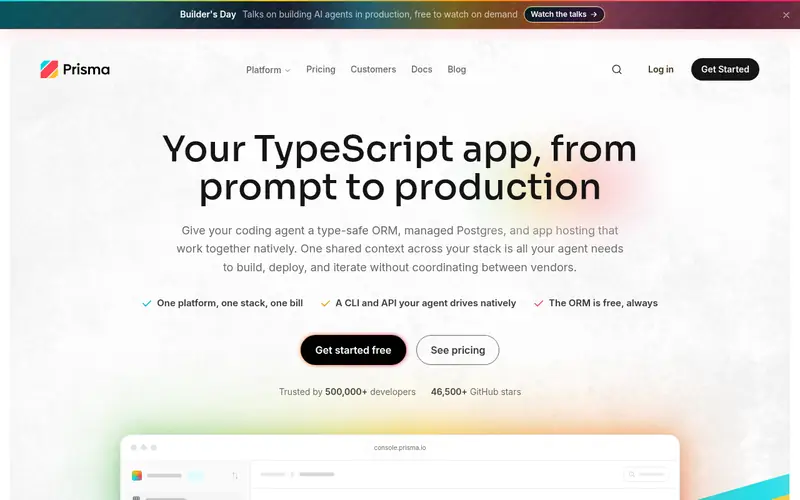
Prisma uses a schema file to define models, then generates a typed client. Queries are written through that client, so TypeScript catches field and relation mistakes at compile time. Prisma Migrate handles schema changes and Prisma Studio gives a browser view of data. It supports PostgreSQL, MySQL, SQLite, SQL Server, MongoDB and CockroachDB.
The project is open source under Apache 2.0, with a hosted Prisma Data Platform sold separately. The generated client is a real dependency, so builds and cold starts include it. Teams that want to write raw SQL or tune every query may find the abstraction in the way. Skip Prisma if you need a thin layer over SQL or work mostly in edge runtimes where the generated client is a poor fit.
Standout: Generated client types from a schema file
Free (open source), as listed by the vendor (Prisma website). Confirm the current plan price before you buy.
Free plan. Plans change, so confirm on the vendor's pricing page before you buy.
Benefits
- Generated client types from a schema file
- mature migration and introspection tooling
Drawbacks
- Generated client adds a build step
- less direct control over emitted SQL
Skip it if this limit matters to you: generated client adds a build step.
Verdict. A sensible pick for schema-first teams that want generated types and migrations.
Alternatives in this guide: Drizzle ORM, TypeORM, MikroORM
Drizzle ORM
Best for teams that want SQL-like queries with full type inference
What it is and where it fits
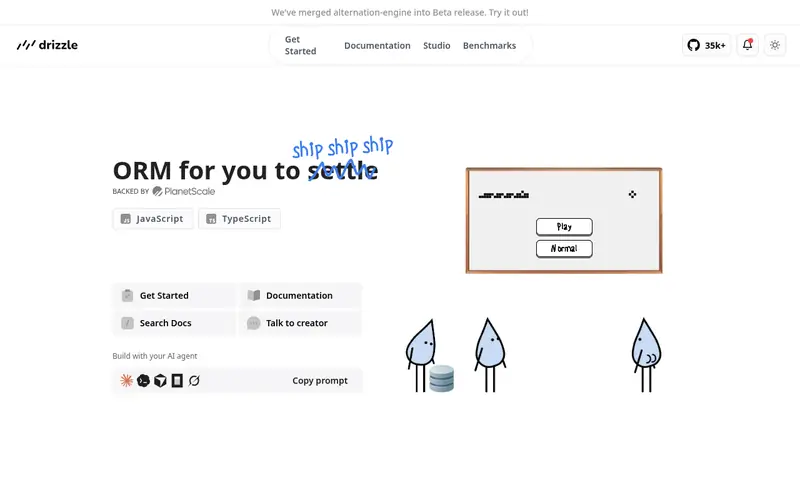
Drizzle ORM defines tables in TypeScript and infers types directly from that definition. Queries read like SQL, and the result types follow the select list. Drizzle Kit generates SQL migration files you can review and edit. It supports PostgreSQL, MySQL, SQLite and several serverless drivers.
The project is open source under Apache 2.0. Because there is no generated client, it works well in serverless and edge environments. The trade-off is that you write more SQL-shaped code than with Prisma, and the migration workflow expects you to inspect generated files. Skip Drizzle if you want a schema DSL that hides SQL or if your team prefers decorator-based entities.
Standout: Types inferred from TypeScript schema with no code generation
Free (open source), as listed by the vendor (Drizzle ORM website). Confirm the current plan price before you buy.
Free plan. Plans change, so confirm on the vendor's pricing page before you buy.
Benefits
- Types inferred from TypeScript schema with no code generation
- close to SQL
Drawbacks
- Younger ecosystem than Prisma
- migration tooling is less opinionated
Skip it if this limit matters to you: younger ecosystem than Prisma.
Verdict. A sensible pick for teams that want SQL-like queries with full type inference.
TypeORM
Best for teams using decorator-based entities and Active Record patterns
What it is and where it fits
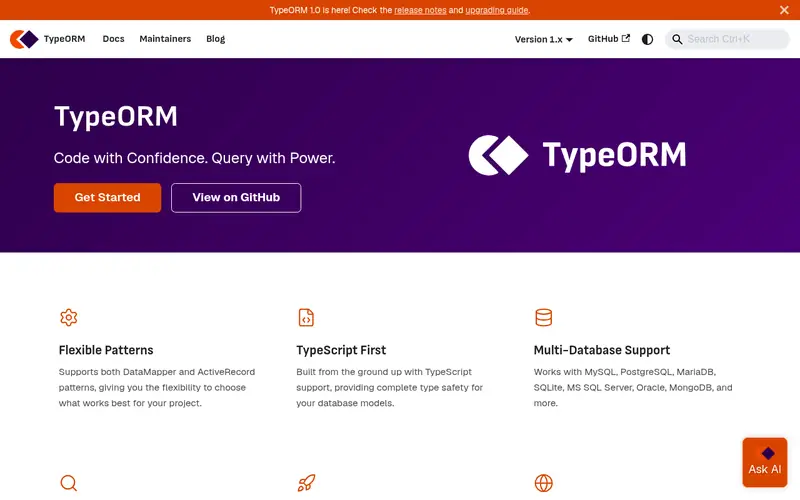
TypeORM defines entities as classes with decorators, and repositories or models run queries. It supports PostgreSQL, MySQL, MariaDB, SQLite, SQL Server, Oracle, MongoDB and more. Migrations are written by hand or generated and then edited.
The project is open source under MIT. It has a long history and a large body of existing code, which is why many teams still pick it. Type safety depends on how carefully entities are typed, and some query results need manual annotations. Skip TypeORM for new projects that want the strongest inference, and check the repository for current maintenance activity before adopting it.
Standout: Supports Data Mapper and Active Record
Free (open source), as listed by the vendor (TypeORM website). Confirm the current plan price before you buy.
Free plan. Plans change, so confirm on the vendor's pricing page before you buy.
Benefits
- Supports Data Mapper and Active Record
- works with many database drivers
Drawbacks
- Type inference is weaker than Prisma or Drizzle
- migration workflow is manual
Skip it if this limit matters to you: type inference is weaker than Prisma or Drizzle.
Verdict. A sensible pick for teams using decorator-based entities and Active Record patterns.
Alternatives in this guide: Prisma, Drizzle ORM, MikroORM
MikroORM
Best for teams that want a full ORM with identity map and unit of work
What it is and where it fits
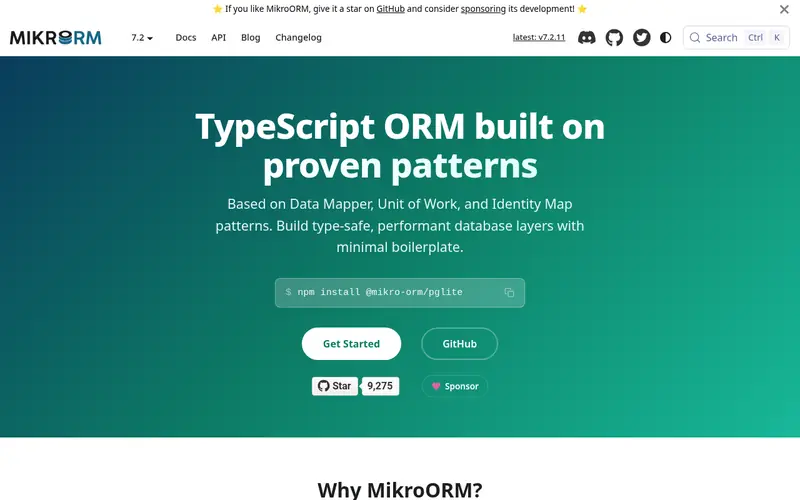
MikroORM is a full ORM built around the identity map and unit of work patterns. Entities are typed classes, and the query builder and repository APIs carry types through. It supports PostgreSQL, MySQL, MariaDB, SQLite, MongoDB and others, with migrations and schema diffing included.
The project is open source under MIT. It suits teams coming from Doctrine or Hibernate who expect change tracking and flush semantics. The concepts take time to learn, and documentation is dense. Skip MikroORM if you want a minimal query layer or if your team is new to ORM patterns and needs the shortest path to a working schema.
Standout: Strong TypeScript typing across entities and queries
Free (open source), as listed by the vendor (MikroORM website). Confirm the current plan price before you buy.
Free plan. Plans change, so confirm on the vendor's pricing page before you buy.
Benefits
- Strong TypeScript typing across entities and queries
- identity map and unit of work
Drawbacks
- Steeper learning curve
- smaller community than Prisma or TypeORM
Skip it if this limit matters to you: steeper learning curve.
Verdict. A sensible pick for teams that want a full ORM with identity map and unit of work.
Alternatives in this guide: Prisma, Drizzle ORM, TypeORM
Sequelize
Best for existing Node.js projects that already depend on Sequelize
What it is and where it fits
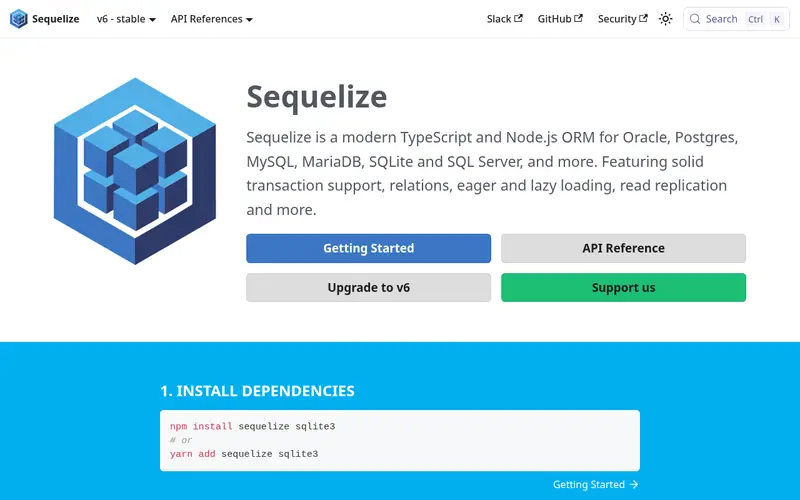
Sequelize is one of the oldest Node.js ORMs. It supports PostgreSQL, MySQL, MariaDB, SQLite, SQL Server and others, with models, associations and migrations through umzug. TypeScript support comes from bundled type definitions and community packages.
The project is open source under MIT. It is a common choice for legacy codebases and tutorials, and it still receives releases. Type inference is weaker than Prisma or Drizzle, and some APIs need explicit generics. Skip Sequelize for greenfield TypeScript projects unless you have a specific reason, such as an existing schema or team familiarity.
Standout: Long-established with broad database support
Free (open source), as listed by the vendor (Sequelize website). Confirm the current plan price before you buy.
Free plan. Plans change, so confirm on the vendor's pricing page before you buy.
Benefits
- Long-established with broad database support
- large amount of existing documentation
Drawbacks
- TypeScript types are maintained separately and can lag
- older API style
Skip it if this limit matters to you: typeScript types are maintained separately and can lag.
Verdict. A sensible pick for existing Node.js projects that already depend on Sequelize.
Alternatives in this guide: Prisma, Drizzle ORM, TypeORM
Kysely
Best for teams that want a typed SQL query builder without an ORM
What it is and where it fits
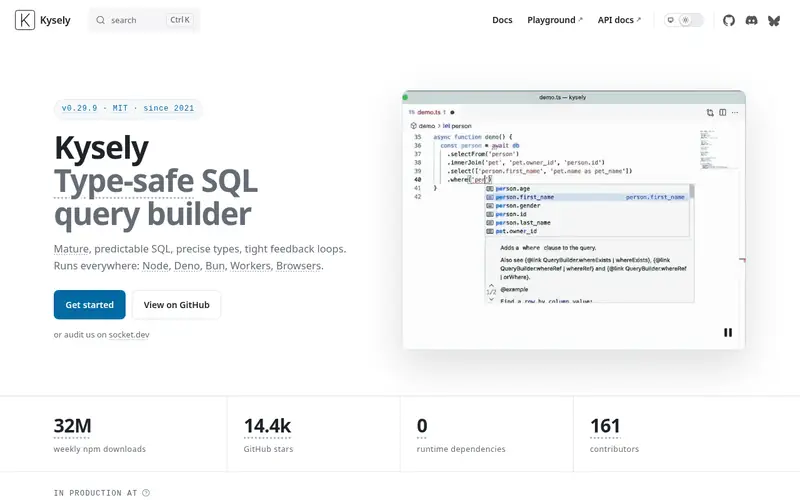
Kysely is a type-safe SQL query builder. You define a database interface in TypeScript, and every query is checked against it. It supports PostgreSQL, MySQL, SQLite, SQL Server and others through dialects. Migrations are handled by a separate package or an external tool.
The project is open source under MIT. It suits teams that want SQL control with compile-time checks and no ORM abstraction. There is no identity map, lazy loading or entity mapping, so relation loading is manual. Skip Kysely if you want an ORM to manage entities and relations for you, or if you need schema generation from models.
Standout: Types flow from a database schema interface
Free (open source), as listed by the vendor (Kysely website). Confirm the current plan price before you buy.
Free plan. Plans change, so confirm on the vendor's pricing page before you buy.
Benefits
- Types flow from a database schema interface
- no code generation at runtime
Drawbacks
- No entity or relation mapping
- you write migrations with another tool
Skip it if this limit matters to you: no entity or relation mapping.
Verdict. A sensible pick for teams that want a typed SQL query builder without an ORM.
Alternatives in this guide: Prisma, Drizzle ORM, TypeORM
Knex
Best for teams that want a mature query builder with migration support
What it is and where it fits
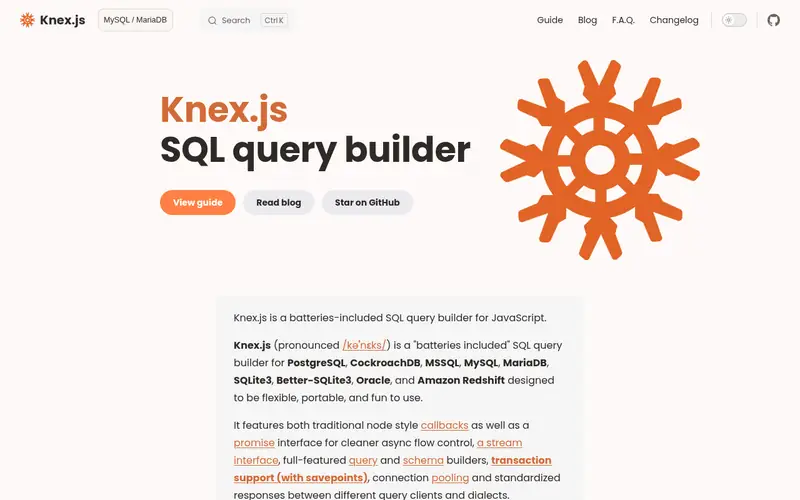
Knex is a SQL query builder for Node.js with a migration and seed system. It supports PostgreSQL, MySQL, MariaDB, SQLite, SQL Server, Oracle and others. TypeScript definitions exist, but result types are not inferred from the schema.
The project is open source under MIT. It is a dependable choice for teams that want to build SQL programmatically and manage migrations without an ORM. The lack of inference means you annotate results yourself, which adds work in large codebases. Skip Knex if compile-time query checking is a priority; Kysely covers that need with a similar style.
Standout: Stable query builder with built-in migrations
Free (open source), as listed by the vendor (Knex website). Confirm the current plan price before you buy.
Free plan. Plans change, so confirm on the vendor's pricing page before you buy.
Benefits
- Stable query builder with built-in migrations
- wide database support
Drawbacks
- No type inference for query results
- types must be added by hand
Skip it if this limit matters to you: no type inference for query results.
Verdict. A sensible pick for teams that want a mature query builder with migration support.
Alternatives in this guide: Prisma, Drizzle ORM, TypeORM
Who should use what
Choose Prisma if you want a schema file, generated types and a guided migration workflow. Choose Drizzle if you prefer SQL-shaped queries with inference and no code generation. Choose MikroORM if you need identity map and unit of work semantics. Choose Kysely or Knex if you want a query builder and will handle entities and relations yourself. Teams maintaining existing TypeORM or Sequelize code should weigh migration cost against the gains in type safety.
Questions to settle before you buy
What to check before you buy
- Confirm the tool supports your database engine and driver version.
- Check that your runtime (Node.js, serverless, edge) is supported by the client.
- Review how migrations are generated, reviewed and rolled back.
- Test type inference on a real query with joins and partial selects.
- Read the licence and any paid hosted service terms.
FAQ
Are these TypeScript ORMs free?
Yes. Prisma, Drizzle, TypeORM, MikroORM, Sequelize, Kysely and Knex are open source and free to use. Some vendors sell hosted platforms or support plans separately. Check each project's licence and any commercial terms on its website.
Which TypeScript ORM has the best type inference?
Prisma and Drizzle infer types most directly from their schema definitions. MikroORM also carries strong types through entities and queries. TypeORM and Sequelize rely more on manual annotations. Knex does not infer result types at all. Test with your own queries before deciding.
Can I use these ORMs with serverless or edge runtimes?
Support varies. Drizzle and Kysely are often used in serverless and edge setups because they avoid a generated client. Prisma has drivers for serverless databases, but the generated client adds size. Check each project's documentation for your specific runtime and driver.
Do I need an ORM or is a query builder enough?
An ORM maps entities and relations and often handles change tracking. A query builder like Kysely or Knex gives you typed or untyped SQL without entity mapping. If your team is comfortable writing SQL and managing relations, a query builder may be enough.
How do I migrate from one TypeScript ORM to another?
Run both tools against the same schema during a transition, move queries module by module, and keep migrations in one place. Test relation loading and transactions carefully. The cost depends on how much of your code depends on ORM-specific features like decorators or lazy loading.
Sources we checked
Method: how we score · editorial policy.
Change log. First published 27 Nov 2026.