Stage 03 · Host · Researched comparison
Best Ruby Web Servers in 2026
Puma is the default choice for most Ruby teams. It runs on MRI and JRuby, handles threads well and ships with Rails by default. Pick Falcon if your app is built around fibers and the async model. Pick Phusion Passenger if you want a server that also handles process management and multi-app hosting. Unicorn and Pitchfork suit teams that prefer forking workers over threads.

By Shihab Mia
Published 27 Nov 2026 · 6 tools compared
We run no ads and no affiliate links at launch. The order of a list follows our published method. See how we score.
Prices are the starting prices vendors list publicly. Plans change, so confirm the current price on the vendor page before you buy.
Key takeaways
- Puma is the most common Ruby app server and is free and open source under a BSD licence.
- Unicorn and Pitchfork use forking workers, which isolates memory per worker but uses more RAM.
- Falcon targets fiber-based concurrency and works with Rack 3.
- Phusion Passenger is open source, with a separate paid Enterprise edition for advanced features.
Who each pick is for
- Most Rails and Rack apps on MRI or JRubyPuma
- Apps that want forking workers and a simple designUnicorn
- Fiber-based Ruby apps built on Rack 3Falcon
- Multi-app hosting with process management built inPhusion Passenger
- Teams that want Unicorn-style forking with refinementsPitchfork
- Ruby apps that need an event-driven server with websocketsIodine
Comparison
| Tool | Best for | Standout feature | Listed starting price | Free plan or trial |
|---|---|---|---|---|
| 1Puma | Most Rails and Rack apps on MRI or JRuby | Ships with Rails by default | Free (open source) | Free plan |
| 2Unicorn | Apps that want forking workers and a simple design | Forking worker model isolates each request process | Free (open source) | Free plan |
| 3Falcon | Fiber-based Ruby apps built on Rack 3 | Built around fibers and async I/O | Free (open source) | Free plan |
| 4Phusion Passenger | Multi-app hosting with process management built in | Manages app processes and restarts | Free (open source) | Free plan |
| 5Pitchfork | Teams that want Unicorn-style forking with refinements | Forking worker model with worker timeouts and reforking | Free (open source) | Free plan |
| 6Iodine | Ruby apps that need an event-driven server with websockets | Event-driven design with websocket support | Free (open source) | Free plan |
How we picked
We picked servers that are actively maintained, run Rack or Rails apps, and have clear documentation or a public repository. We looked at concurrency model (threads, forking, fibers, events), platform support, licence and price, and the main operational limits. Sources are vendor pages, project documentation and public repositories. Prices and plan terms change, so confirm them on the vendor site before you decide.
The tools, one by one
Puma
Best for most Rails and Rack apps on MRI or JRuby
What it is and where it fits
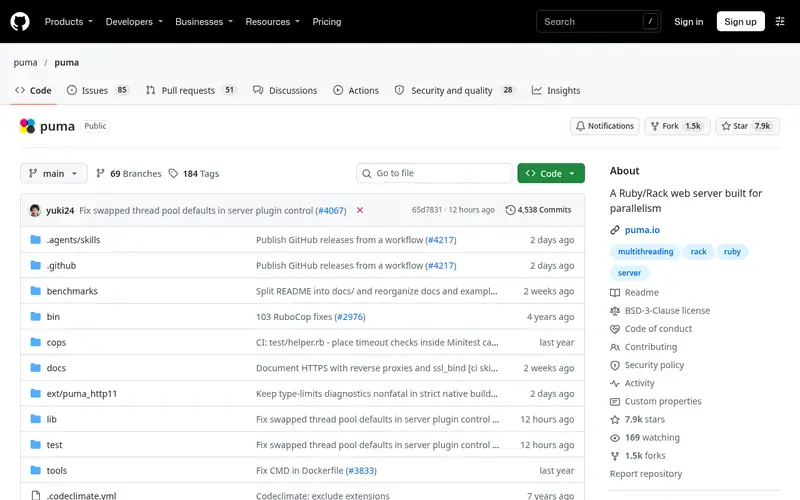
Puma is a Ruby web server built for Rack apps. It runs a thread pool inside each process and can also run in cluster mode with multiple worker processes. It works on MRI and JRuby. Rails includes Puma as the default server, so most teams start with it without extra setup.
Puma is free and open source under a BSD-style licence. You configure workers, threads, timeouts and bind addresses in a config file or on the command line. The main limit is that threaded concurrency depends on your app and gems being thread-safe. Teams that cannot guarantee that should look at a forking server. Skip Puma if you need fiber-based concurrency as the primary model.
Standout: Ships with Rails by default
Free (open source), as listed by the vendor (Puma website). Confirm the current plan price before you buy.
Free plan. Plans change, so confirm on the vendor's pricing page before you buy.
Benefits
- Ships with Rails by default
- thread pool with clustered workers
Drawbacks
- Threaded model needs thread-safe app code
- tuning workers and threads takes care
Skip it if this limit matters to you: threaded model needs thread-safe app code.
Verdict. A sensible pick for most Rails and Rack apps on MRI or JRuby.
Alternatives in this guide: Unicorn, Falcon, Phusion Passenger
Unicorn
Best for apps that want forking workers and a simple design
What it is and where it fits
Unicorn is a Rack HTTP server that uses forking worker processes. Each worker handles one request at a time, and a master process manages the workers. This design keeps memory isolated per worker and avoids thread-safety issues in app code. It runs on Unix-like systems and is distributed as a Ruby gem.
Unicorn is free and open source. It is often paired with nginx, which buffers slow clients so workers are not held up. The main limit is concurrency: throughput depends on the number of workers, and each worker uses its own memory. It is a reasonable choice for apps that already run well under a forking model. Skip it if you need high concurrency per process or run on Windows.
Standout: Forking worker model isolates each request process
Free (open source), as listed by the vendor (Unicorn website). Confirm the current plan price before you buy.
Free plan. Plans change, so confirm on the vendor's pricing page before you buy.
Benefits
- Forking worker model isolates each request process
- mature and stable design
Drawbacks
- One request per worker at a time
- slow clients can tie up workers
Skip it if this limit matters to you: one request per worker at a time.
Verdict. A sensible pick for apps that want forking workers and a simple design.
Alternatives in this guide: Puma, Falcon, Phusion Passenger
Falcon
Best for fiber-based Ruby apps built on Rack 3
What it is and where it fits
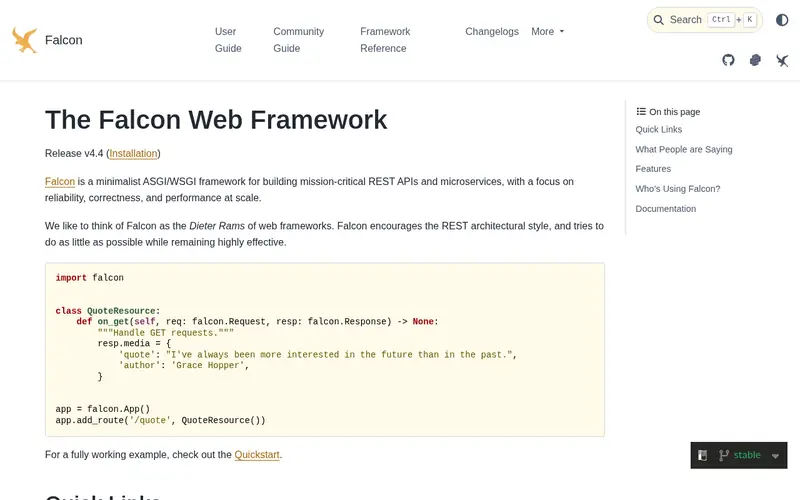
Falcon is a Ruby web server built on the async framework. It uses fibers rather than a thread-per-request model, which can reduce memory use under many concurrent connections. It supports Rack 3, HTTP/2 and TLS, and it runs on MRI. It is distributed as a Ruby gem.
Falcon is free and open source. The main limit is that your app and its gems need to work well with fiber-based concurrency. Blocking calls can stall the event loop. It is a good fit for teams already using async Ruby or building new services around it. Skip it if your app depends on gems that block or are not fiber-safe.
Standout: Built around fibers and async I/O
Free (open source), as listed by the vendor (Falcon website). Confirm the current plan price before you buy.
Free plan. Plans change, so confirm on the vendor's pricing page before you buy.
Benefits
- Built around fibers and async I/O
- supports HTTP/2 and TLS
Drawbacks
- Requires an async-friendly app and gems
- smaller user base than Puma
Skip it if this limit matters to you: requires an async-friendly app and gems.
Verdict. A sensible pick for fiber-based Ruby apps built on Rack 3.
Alternatives in this guide: Puma, Unicorn, Phusion Passenger
Phusion Passenger
Best for multi-app hosting with process management built in
What it is and where it fits
Phusion Passenger is an application server that runs Ruby apps and manages their processes. It integrates with nginx or Apache and can host multiple apps on one server. It handles spawning, restarting and idle process cleanup. It supports Ruby and other languages.
The open source version is free. A separate Enterprise edition adds features such as advanced monitoring and support; check the vendor pricing page for current terms. The main limit is setup complexity: you configure it through the web server module rather than as a standalone gem process. It suits teams that want process management and multi-app hosting in one place. Skip it if you want a minimal single-process server.
Standout: Manages app processes and restarts
Free (open source), as listed by the vendor (Phusion Passenger website). Confirm the current plan price before you buy.
Free plan. Plans change, so confirm on the vendor's pricing page before you buy.
Benefits
- Manages app processes and restarts
- runs behind nginx or Apache
Drawbacks
- More moving parts than a plain gem server
- Enterprise features cost money
Skip it if this limit matters to you: more moving parts than a plain gem server.
Verdict. A sensible pick for multi-app hosting with process management built in.
Pitchfork
Best for teams that want Unicorn-style forking with refinements
What it is and where it fits
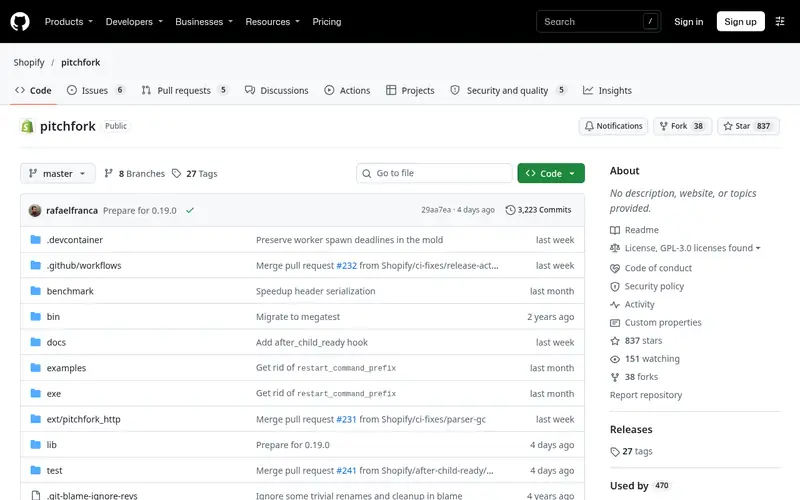
Pitchfork is a Rack HTTP server derived from Unicorn. It keeps the forking worker model and adds features such as worker timeouts, reforking to share memory, and better handling of stuck workers. It runs on Unix-like systems and is distributed as a Ruby gem.
Pitchfork is free and open source. It is maintained by Shopify and used in production there. The main limit is the same as Unicorn: each worker handles one request at a time, so concurrency comes from running more workers. It suits teams already comfortable with a forking model who want the extra controls. Skip it if you need threaded or fiber-based concurrency.
Standout: Forking worker model with worker timeouts and reforking
Free (open source), as listed by the vendor (Pitchfork website). Confirm the current plan price before you buy.
Free plan. Plans change, so confirm on the vendor's pricing page before you buy.
Benefits
- Forking worker model with worker timeouts and reforking
- maintained by Shopify
Drawbacks
- Still one request per worker
- not a threaded server
Skip it if this limit matters to you: still one request per worker.
Verdict. A sensible pick for teams that want Unicorn-style forking with refinements.
Iodine
Best for ruby apps that need an event-driven server with websockets
What it is and where it fits
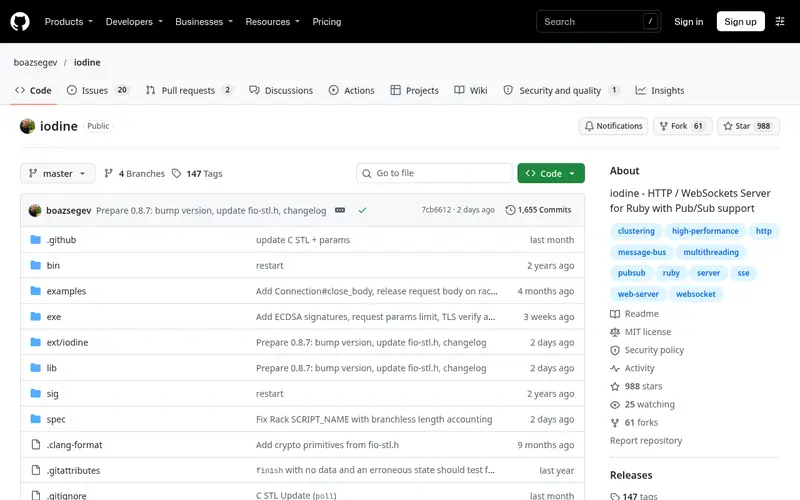
Iodine is a Ruby web server built on an event-driven core. It can serve Rack apps and also supports websockets and pub/sub features. It runs on MRI and is distributed as a Ruby gem. It is an option for apps that need long-lived connections alongside normal HTTP requests.
Iodine is free and open source. The main limit is community size and maintenance activity: check the repository's recent commits before you commit to it for a production service. It suits teams that need websocket support from the Ruby process itself. Skip it if you want the most widely used and best-documented option.
Standout: Event-driven design with websocket support
Free (open source), as listed by the vendor (Iodine website). Confirm the current plan price before you buy.
Free plan. Plans change, so confirm on the vendor's pricing page before you buy.
Benefits
- Event-driven design with websocket support
- runs as a Rack server
Drawbacks
- Smaller community than Puma
- check recent commit activity before adopting
Skip it if this limit matters to you: smaller community than Puma.
Verdict. A sensible pick for ruby apps that need an event-driven server with websockets.
Who should use what
If you run a standard Rails app on MRI and want the default path, use Puma. If your app and gems are built for async and fibers, use Falcon. If you host several apps on one server and want process management, use Phusion Passenger. If you prefer forking workers and want extra worker controls, use Pitchfork or Unicorn. If you need websockets handled inside the Ruby process, look at Iodine, but check its recent activity first.
Questions to settle before you buy
What to check before you buy
- Confirm the server supports your Ruby version and platform, including JRuby if you use it.
- Check whether your app and gems are safe under the server's concurrency model.
- Review the licence and any paid edition terms on the vendor page.
- Test worker and thread settings under realistic load before production.
- Check the repository's recent commit activity for maintenance.
FAQ
Is Puma the default Ruby web server?
Rails includes Puma as its default application server in new apps. It is free and open source and runs on MRI and JRuby. Many teams keep it unless they have a specific reason to switch to a forking or fiber-based server.
What is the difference between Puma and Unicorn?
Puma uses threads inside each process and can also run clustered workers. Unicorn uses forking workers, with one request per worker at a time. Puma needs thread-safe app code; Unicorn avoids that but uses more memory per worker.
Do I need nginx in front of my Ruby server?
Not always, but it is common. nginx can buffer slow clients, serve static files and handle TLS. With Unicorn or Pitchfork, nginx buffering helps prevent slow clients from tying up workers.
Is Phusion Passenger free?
The open source version is free. A separate Enterprise edition adds features such as advanced monitoring and support. Check the vendor pricing page for current terms and limits.
Can I use these servers with Rack 3?
Puma, Falcon and others have added Rack 3 support. Check each project's documentation for the version you plan to run, and test your middleware stack before deploying.
Sources we checked
Method: how we score · editorial policy.
Change log. First published 27 Nov 2026.