Stage 03 · Host · Researched comparison
Best Python Dataframe Libraries in 2026
pandas is the first pick for most developers because it has the widest ecosystem and the most documentation. Polars suits teams that want fast columnar processing with a smaller memory footprint. DuckDB fits analysts who prefer SQL over dataframe methods and want to query files directly. All three are open source and free to use.

By Shihab Mia
Published 27 Nov 2026 · 8 tools compared
We run no ads and no affiliate links at launch. The order of a list follows our published method. See how we score.
Prices are the starting prices vendors list publicly. Plans change, so confirm the current price on the vendor page before you buy.
Key takeaways
- pandas remains the default dataframe library and works with the largest set of Python data tools.
- Polars, DuckDB and PyArrow are free and open source, so cost is not a factor when choosing between them.
- Dask, PySpark and Modin target larger-than-memory or distributed workloads and add operational overhead.
- These libraries run locally in your Python process, so your data stays on your machine unless you send it elsewhere.
Who each pick is for
- General-purpose tabular data work in Pythonpandas
- Fast columnar processing on a single machinePolars
- SQL-first analysis of local files and dataframesDuckDB Python API
- Columnar interchange and in-memory analyticsPyArrow
- Scaling pandas code across CPU coresModin
- Parallel pandas-style work on larger-than-memory dataDask DataFrame
- Distributed data processing at cluster scalePySpark
- One dataframe API across many backendsIbis
Comparison
| Tool | Best for | Standout feature | Listed starting price | Free plan or trial |
|---|---|---|---|---|
| 1pandas | General-purpose tabular data work in Python | Largest ecosystem and documentation | Free (open source) | Free plan |
| 2Polars | Fast columnar processing on a single machine | Lazy query engine with query optimization | Free (open source) | Free plan |
| 3DuckDB Python API | SQL-first analysis of local files and dataframes | Runs full SQL in-process with no server | Free (open source) | Free plan |
| 4PyArrow | Columnar interchange and in-memory analytics | Shared memory format used by pandas, Polars and DuckDB | Free (open source) | Free plan |
| 5Modin | Scaling pandas code across CPU cores | Drop-in pandas API for many operations | Free (open source) | Free plan |
| 6Dask DataFrame | Parallel pandas-style work on larger-than-memory data | Scales pandas-like code across cores and clusters | Free (open source) | Free plan |
| 7PySpark | Distributed data processing at cluster scale | Mature distributed engine | Free (open source) | Free plan |
| 8Ibis | One dataframe API across many backends | Portable expressions across 15+ backends | Free (open source) | Free plan |
How we picked
We picked libraries that are actively maintained and genuinely used for dataframe work in Python. Criteria were fit for the job, supported platforms, license and price, whether data stays local, and the main practical limits. Sources are vendor pages, official documentation and project repositories. Prices and free plan terms can change, so confirm details on the vendor site before you commit.
The tools, one by one
pandas
Best for general-purpose tabular data work in Python
What it is and where it fits
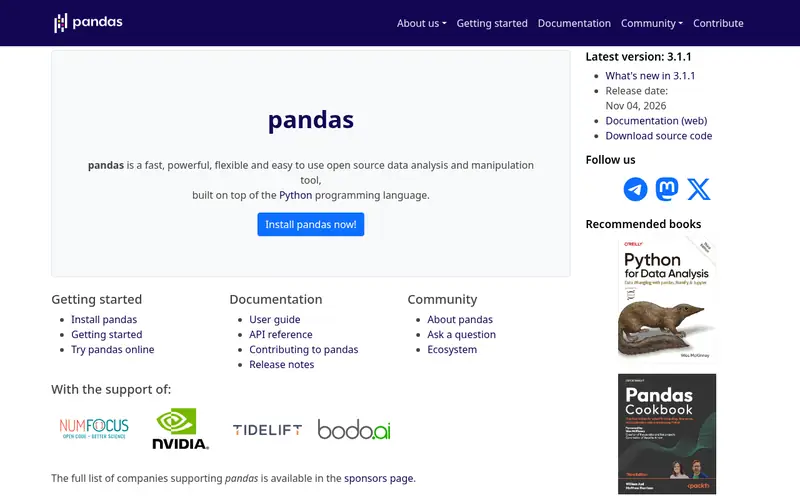
pandas is the reference dataframe library for Python. It provides labeled Series and DataFrame objects, indexing, joins, groupby aggregation, time series tools and readers for CSV, Parquet, Excel, SQL and more. It runs on any platform with a Python interpreter, including Windows, macOS and Linux.
The project is BSD-3 licensed and maintained on GitHub. Its main limit is scale: operations generally run in a single process and memory use can grow quickly with wide frames or object dtypes. Teams with datasets that do not fit in RAM often move to Dask, PySpark or Polars. Skip pandas if you need distributed execution out of the box.
Standout: Largest ecosystem and documentation
Free (open source), as listed by the vendor (pandas website). Confirm the current plan price before you buy.
Free plan. Plans change, so confirm on the vendor's pricing page before you buy.
Benefits
- Largest ecosystem and documentation
- broad file format and I/O support
Drawbacks
- Higher memory use on large frames
- single-threaded for many operations
Skip it if this limit matters to you: higher memory use on large frames.
Verdict. A sensible pick for general-purpose tabular data work in Python.
Alternatives in this guide: Polars, DuckDB Python API, PyArrow
Polars
Best for fast columnar processing on a single machine
What it is and where it fits
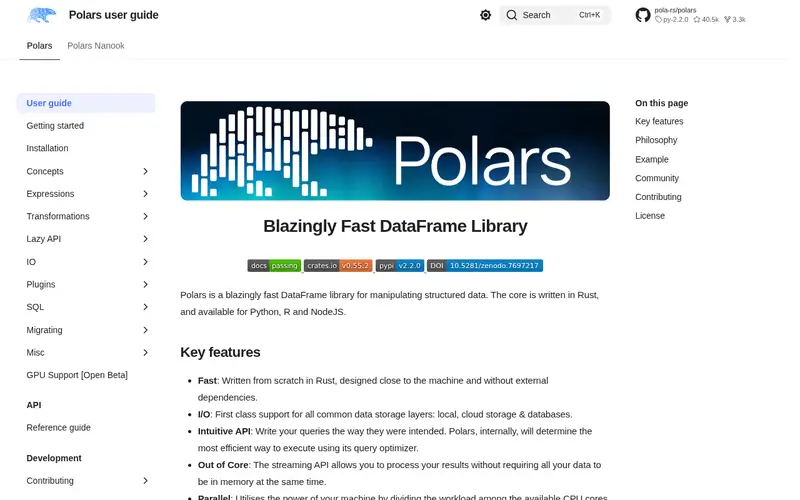
Polars is a dataframe library built on Apache Arrow memory and a Rust core. It offers both eager and lazy APIs, and the lazy engine plans and optimizes queries before running them. It handles larger-than-memory data through streaming execution.
It installs from PyPI and runs on Windows, macOS and Linux. The core is MIT licensed. The main tradeoff is ecosystem maturity: fewer third-party libraries assume Polars, and migrating pandas code takes work. Skip it if your codebase depends heavily on pandas-specific extensions.
Standout: Lazy query engine with query optimization
Free (open source), as listed by the vendor (Polars website). Confirm the current plan price before you buy.
Free plan. Plans change, so confirm on the vendor's pricing page before you buy.
Benefits
- Lazy query engine with query optimization
- written in Rust with multithreaded execution
Drawbacks
- Smaller ecosystem than pandas
- some pandas idioms do not translate directly
Skip it if this limit matters to you: smaller ecosystem than pandas.
Verdict. A sensible pick for fast columnar processing on a single machine.
Alternatives in this guide: pandas, DuckDB Python API, PyArrow
DuckDB Python API
Best for sQL-first analysis of local files and dataframes
What it is and where it fits
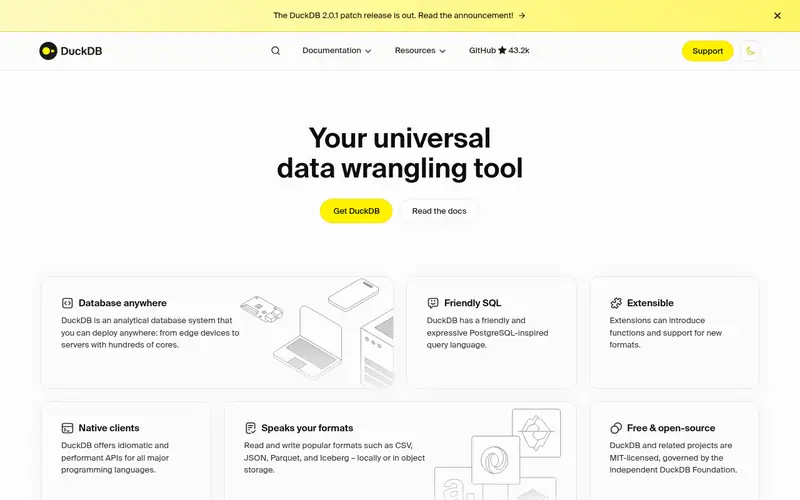
DuckDB is an in-process analytical database with a Python client. You can query pandas and Polars dataframes, Parquet and CSV files, and combine them in SQL. It uses a columnar engine and handles aggregation-heavy workloads well on a single machine.
It installs from PyPI and runs on Windows, macOS and Linux. The project is MIT licensed. The Python API returns results as relations or converts them to pandas, Polars or Arrow. The limit is that it is a SQL engine, not a dataframe library, so heavy Python-side transformation still needs another tool.
Standout: Runs full SQL in-process with no server
Free (open source), as listed by the vendor (DuckDB Python API website). Confirm the current plan price before you buy.
Free plan. Plans change, so confirm on the vendor's pricing page before you buy.
Benefits
- Runs full SQL in-process with no server
- queries Parquet and CSV files directly
Drawbacks
- Not a general dataframe API
- SQL knowledge required for most work
Skip it if this limit matters to you: not a general dataframe API.
Verdict. A sensible pick for SQL-first analysis of local files and dataframes.
PyArrow
Best for columnar interchange and in-memory analytics
What it is and where it fits
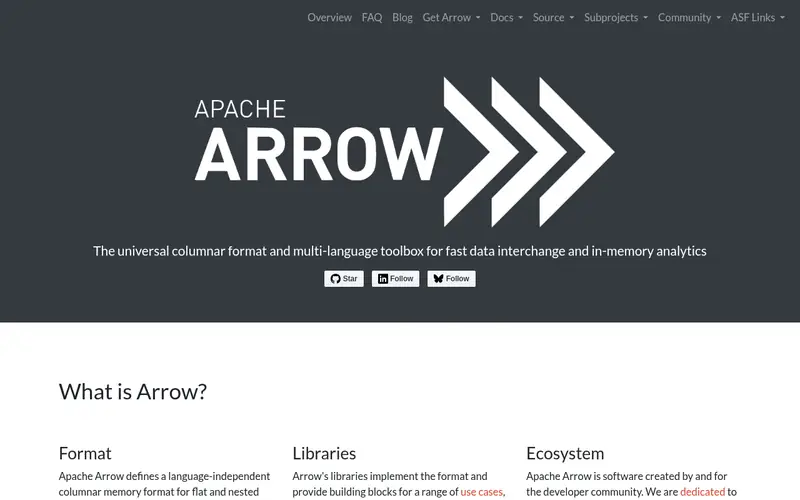
PyArrow is the Python binding for Apache Arrow. It provides columnar arrays, tables and compute functions, plus readers and writers for Parquet, Feather, IPC and other formats. Many dataframe libraries use Arrow as their in-memory representation or interchange layer.
It installs from PyPI and runs on Windows, macOS and Linux. The project is Apache-2.0 licensed. PyArrow is often the fastest path to read Parquet or move data between libraries without copying. Its limit is ergonomics: the API is closer to a column store than a dataframe, and users wanting groupby-style workflows usually pair it with pandas or Polars.
Standout: Shared memory format used by pandas, Polars and DuckDB
Free (open source), as listed by the vendor (PyArrow website). Confirm the current plan price before you buy.
Free plan. Plans change, so confirm on the vendor's pricing page before you buy.
Benefits
- Shared memory format used by pandas, Polars and DuckDB
- fast Parquet and IPC readers
Drawbacks
- Lower-level API than pandas
- fewer high-level convenience methods
Skip it if this limit matters to you: lower-level API than pandas.
Verdict. A sensible pick for columnar interchange and in-memory analytics.
Alternatives in this guide: pandas, Polars, DuckDB Python API
Modin
Best for scaling pandas code across CPU cores
What it is and where it fits
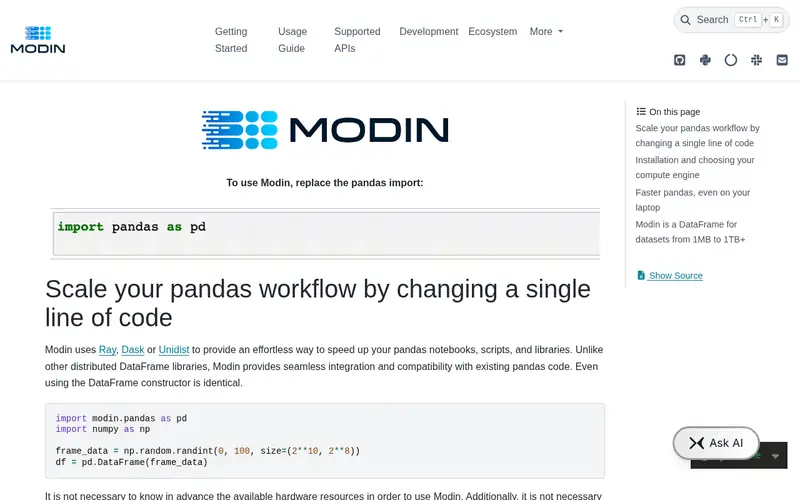
Modin is a dataframe library that aims to speed up pandas code by parallelizing it across cores. It exposes a pandas-compatible API and uses Ray or Dask as the execution engine. In many cases you change one import line and the rest of your pandas code runs unchanged.
It installs from PyPI and runs on Windows, macOS and Linux. The project is Apache-2.0 licensed. Coverage of the pandas API is broad but not complete, and performance gains depend on data size and the operations used. Skip Modin for small frames, where the parallel overhead can make it slower than pandas.
Standout: Drop-in pandas API for many operations
Free (open source), as listed by the vendor (Modin website). Confirm the current plan price before you buy.
Free plan. Plans change, so confirm on the vendor's pricing page before you buy.
Benefits
- Drop-in pandas API for many operations
- uses Ray or Dask as an execution backend
Drawbacks
- Not every pandas function is supported
- overhead on small data
Skip it if this limit matters to you: not every pandas function is supported.
Verdict. A sensible pick for scaling pandas code across CPU cores.
Alternatives in this guide: pandas, Polars, DuckDB Python API
Dask DataFrame
Best for parallel pandas-style work on larger-than-memory data
What it is and where it fits
Dask DataFrame splits a dataset into partitions and processes them in parallel. It offers a pandas-like API for common operations and can run on a laptop or a distributed cluster. It works alongside the rest of the Dask ecosystem for arrays and task graphs.
It installs from PyPI and runs on Windows, macOS and Linux. The project is BSD-3 licensed. The main limits are partition management and shuffle-heavy operations, which can dominate runtime. Skip Dask if your data fits comfortably in memory and single-machine tools like Polars meet your needs.
Standout: Scales pandas-like code across cores and clusters
Free (open source), as listed by the vendor (Dask DataFrame website). Confirm the current plan price before you buy.
Free plan. Plans change, so confirm on the vendor's pricing page before you buy.
Benefits
- Scales pandas-like code across cores and clusters
- integrates with the Dask scheduler
Drawbacks
- Partitioning and shuffle costs
- API differs from pandas in places
Skip it if this limit matters to you: partitioning and shuffle costs.
Verdict. A sensible pick for parallel pandas-style work on larger-than-memory data.
Alternatives in this guide: pandas, Polars, DuckDB Python API
PySpark
Best for distributed data processing at cluster scale
What it is and where it fits
PySpark is the Python API for Apache Spark. Its DataFrame API supports SQL-style transformations, and jobs run across a cluster or in local mode. It is a common choice for pipelines that process terabytes of data.
It installs from PyPI and requires a Java runtime. The project is Apache-2.0 licensed. Managed Spark services from cloud vendors are billed separately. The main limits are operational weight and startup latency, which make it a poor fit for small datasets or quick interactive analysis. Skip PySpark when a single machine is enough.
Standout: Mature distributed engine
Free (open source), as listed by the vendor (PySpark website). Confirm the current plan price before you buy.
Free plan. Plans change, so confirm on the vendor's pricing page before you buy.
Benefits
- Mature distributed engine
- SQL, streaming and ML libraries in one stack
Drawbacks
- Heavy setup and JVM dependency
- high latency for small jobs
Skip it if this limit matters to you: heavy setup and JVM dependency.
Verdict. A sensible pick for distributed data processing at cluster scale.
Alternatives in this guide: pandas, Polars, DuckDB Python API
Ibis
Best for one dataframe API across many backends
What it is and where it fits
Ibis lets you write dataframe-style Python code once and run it against many backends, including DuckDB, PostgreSQL, BigQuery, Snowflake and pandas. Expressions are lazy and compile to SQL or native execution for the target engine.
It installs from PyPI and runs on Windows, macOS and Linux. The project is Apache-2.0 licensed. The main limit is portability: not every operation is supported on every backend, so code that runs on one engine may need changes on another. Skip Ibis if you only ever use one engine and want its native API.
Standout: Portable expressions across 15+ backends
Free (open source), as listed by the vendor (Ibis website). Confirm the current plan price before you buy.
Free plan. Plans change, so confirm on the vendor's pricing page before you buy.
Benefits
- Portable expressions across 15+ backends
- compiles to SQL for database engines
Drawbacks
- Backend feature gaps
- debugging generated SQL takes practice
Skip it if this limit matters to you: backend feature gaps.
Verdict. A sensible pick for one dataframe API across many backends.
Alternatives in this guide: pandas, Polars, DuckDB Python API
Who should use what
If you are doing everyday analysis and want the widest tooling, start with pandas. If speed and memory matter on a single machine, use Polars. If you prefer SQL and query Parquet or CSV files directly, use DuckDB, with PyArrow as the interchange layer between libraries. For data that does not fit in memory, choose Dask or PySpark; for speeding up existing pandas code across cores, try Modin. If you need one API across several database backends, use Ibis.
Questions to settle before you buy
What to check before you buy
- Confirm the library supports the file formats and data sources you actually read from.
- Check that the operations you rely on are implemented, not just the common ones.
- Measure memory use on a realistic sample, not a toy dataset.
- Review the license terms if you redistribute code or ship a product.
- Confirm the project has recent releases and an active issue tracker.
FAQ
Is pandas still the best Python dataframe library?
pandas remains the most widely used and best documented option. It is not always the fastest, but its ecosystem and compatibility make it a safe default. Polars and DuckDB are strong alternatives for speed or SQL-first work.
Are these dataframe libraries free?
Yes. All eight libraries listed here are open source and free to use under their respective licenses. Paid support, managed cloud services and commercial distributions are sold separately by some vendors.
Can I use Polars and pandas together?
Yes. Polars can convert to and from pandas dataframes, and both can exchange data through Apache Arrow. Mixing them in one project is common during migration, though you should pick one as the primary API.
Do I need a cluster to use Dask or PySpark?
No. Both run in local mode on a single machine. A cluster helps when data or compute needs exceed one machine, but it adds setup and operational cost.
Is my data sent anywhere when I use these libraries?
These libraries run in your Python process, so data stays local unless your code sends it elsewhere. Be careful with any web-based notebook or hosted service you use alongside them.
Sources we checked
Method: how we score · editorial policy.
Change log. First published 27 Nov 2026.