Stage 03 · Host · Researched comparison
Best Ruby Web Frameworks in 2026
Ruby on Rails is the first pick for most teams building a full web application, because it ships with routing, an ORM, migrations, background jobs and a mature ecosystem in one framework. Sinatra suits small services and prototypes where you want a thin layer over Rack. Hanami is the alternative for teams that want a modular, lightweight framework with clearer boundaries between components.

By Shihab Mia
Published 27 Nov 2026 · 6 tools compared
We run no ads and no affiliate links at launch. The order of a list follows our published method. See how we score.
Prices are the starting prices vendors list publicly. Plans change, so confirm the current price on the vendor page before you buy.
Key takeaways
- Ruby on Rails is the most complete option and is free under the MIT license.
- Sinatra and Roda are minimal frameworks built on Rack, best for small apps and APIs.
- Hanami offers a modular architecture with fewer built-in defaults than Rails.
- Every framework listed here is open source and free to use; hosting and support costs are separate.
Who each pick is for
- Full-stack web applications and teams that want conventionsRuby on Rails
- Small web apps, prototypes and simple HTTP servicesSinatra
- Teams that want a modular, lightweight full-stack frameworkHanami
- Developers who want a fast, routing-tree-based Rack frameworkRoda
- Building REST-style JSON APIs in RubyGrape
- Sinatra-based apps that need more structurePadrino
Comparison
| Tool | Best for | Standout feature | Listed starting price | Free plan or trial |
|---|---|---|---|---|
| 1Ruby on Rails | Full-stack web applications and teams that want conventions | Batteries-included stack with ORM, routing and jobs | Free (open source) | Free plan |
| 2Sinatra | Small web apps, prototypes and simple HTTP services | Very small API surface that is quick to learn | Free (open source) | Free plan |
| 3Hanami | Teams that want a modular, lightweight full-stack framework | Clear separation between app layers | Free (open source) | Free plan |
| 4Roda | Developers who want a fast, routing-tree-based Rack framework | Routing tree design keeps code organized as apps grow | Free (open source) | Free plan |
| 5Grape | Building REST-style JSON APIs in Ruby | Declarative API definitions with parameter validation | Free (open source) | Free plan |
| 6Padrino | Sinatra-based apps that need more structure | Adds generators, helpers and admin tools on top of Sinatra | Free (open source) | Free plan |
How we picked
We selected frameworks that are real, standalone Ruby projects and are currently maintained or documented for current Ruby versions. Criteria were fit for building web applications, supported platforms, license and price, the size and clarity of the documentation, and the main limits of each framework. Sources are official project sites, repositories and documentation. Prices and version requirements change, so confirm details on the vendor or project site before you commit.
The tools, one by one
Ruby on Rails
Best for full-stack web applications and teams that want conventions
What it is and where it fits
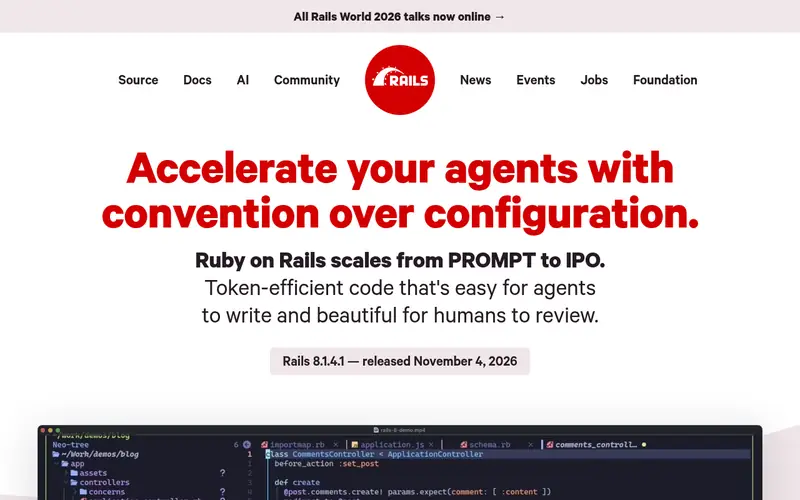
Rails is a full-stack framework built around the model-view-controller pattern. It includes Active Record for database access, Action Pack for routing and controllers, Action Mailer, Active Job and other components that cover most of a typical web application. It runs on any platform with a supported Ruby version, including Linux, macOS and Windows.
Rails is released under the MIT license and is free to use. The Rails Guides and API documentation are public. New major versions arrive on a regular schedule, and each version has its own Ruby version requirements and upgrade notes. Teams that want a small API with few dependencies may find the framework larger than they need; Sinatra or Roda may fit better there.
Standout: Batteries-included stack with ORM, routing and jobs
Free (open source), as listed by the vendor (Ruby on Rails website). Confirm the current plan price before you buy.
Free plan. Plans change, so confirm on the vendor's pricing page before you buy.
Benefits
- Batteries-included stack with ORM, routing and jobs
- large ecosystem of gems and guides
Drawbacks
- Opinionated defaults take time to learn
- can feel heavy for small services
Skip it if this limit matters to you: opinionated defaults take time to learn.
Verdict. A sensible pick for full-stack web applications and teams that want conventions.
Sinatra
Best for small web apps, prototypes and simple HTTP services
What it is and where it fits
Sinatra is a domain-specific language for building web applications on top of Rack. A route is a few lines of Ruby, which makes it useful for prototypes, webhooks and small internal tools. It runs anywhere Rack runs and works with most Ruby application servers.
Sinatra is MIT licensed and free. It does not include an ORM, migration tool or asset pipeline, so you add the gems you need. The project documents its routes, helpers, configuration and testing approach on its site. Teams building a large application with many models and background jobs will usually spend more time assembling components than they would with Rails.
Standout: Very small API surface that is quick to learn
Free (open source), as listed by the vendor (Sinatra website). Confirm the current plan price before you buy.
Free plan. Plans change, so confirm on the vendor's pricing page before you buy.
Benefits
- Very small API surface that is quick to learn
- runs directly on Rack
Drawbacks
- No built-in ORM or admin layer
- larger apps need extra gems and structure
Skip it if this limit matters to you: no built-in ORM or admin layer.
Verdict. A sensible pick for small web apps, prototypes and simple HTTP services.
Alternatives in this guide: Ruby on Rails, Hanami, Roda
Hanami
Best for teams that want a modular, lightweight full-stack framework
What it is and where it fits
Hanami is a full-stack Ruby framework built around small, composable components. It provides routing, actions, views, a persistence layer and a dependency injection container, with an emphasis on explicit structure rather than convention-driven magic. It runs on standard Ruby platforms and is deployed like other Rack applications.
Hanami is MIT licensed and free. The project publishes guides and API documentation. Its ecosystem of third-party gems and tutorials is smaller than Rails, and major versions have introduced breaking changes, so check the current version's documentation before starting. Teams that want Rails-level tooling and hiring depth may prefer Rails; teams that want tighter control over structure often choose Hanami.
Standout: Clear separation between app layers
Free (open source), as listed by the vendor (Hanami website). Confirm the current plan price before you buy.
Free plan. Plans change, so confirm on the vendor's pricing page before you buy.
Benefits
- Clear separation between app layers
- designed to be lighter than Rails
Drawbacks
- Smaller ecosystem and fewer learning resources
- API has changed across major versions
Skip it if this limit matters to you: smaller ecosystem and fewer learning resources.
Verdict. A sensible pick for teams that want a modular, lightweight full-stack framework.
Alternatives in this guide: Ruby on Rails, Sinatra, Roda
Roda
Best for developers who want a fast, routing-tree-based Rack framework
What it is and where it fits
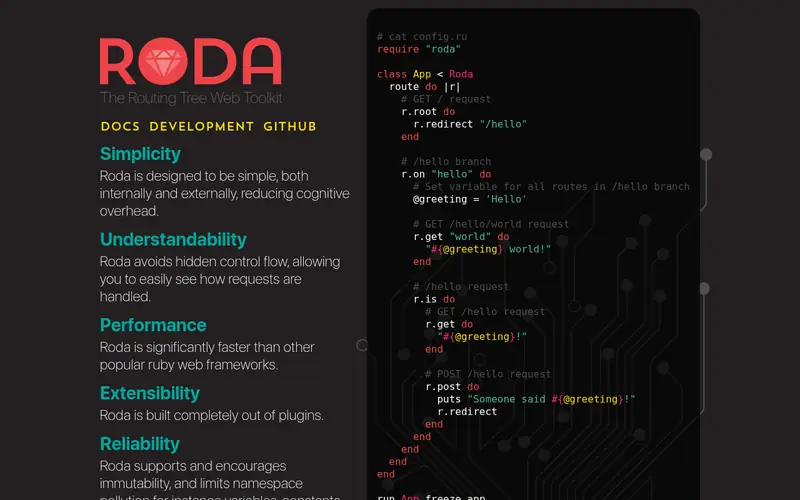
Roda is a routing-tree web framework built on Rack. Routes are matched as a tree, which lets you share code between related branches and keep large applications organized without a full-stack framework. It ships with a plugin system for features like rendering, sessions, assets and security headers.
Roda is MIT licensed and free. It runs on any Ruby platform that supports Rack. The documentation and plugin list are on the project site. It is a good fit for developers who understand Rack and want control over request handling. Beginners looking for a guided, convention-heavy path will find Rails easier to start with.
Standout: Routing tree design keeps code organized as apps grow
Free (open source), as listed by the vendor (Roda website). Confirm the current plan price before you buy.
Free plan. Plans change, so confirm on the vendor's pricing page before you buy.
Benefits
- Routing tree design keeps code organized as apps grow
- many plugins for common needs
Drawbacks
- Fewer tutorials than Rails
- requires comfort with Rack and Ruby blocks
Skip it if this limit matters to you: fewer tutorials than Rails.
Verdict. A sensible pick for developers who want a fast, routing-tree-based Rack framework.
Alternatives in this guide: Ruby on Rails, Sinatra, Hanami
Grape
Best for building REST-style JSON APIs in Ruby
What it is and where it fits
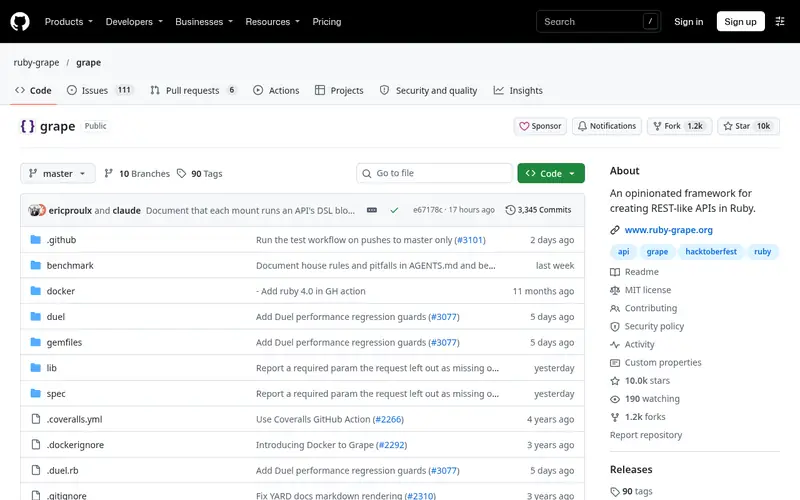
Grape is a REST-like API framework for Ruby. It lets you describe endpoints, parameters, validation and versioning in a compact DSL, and it can run standalone on Rack or inside a Rails or Sinatra app. It is a common choice for JSON APIs that need strict parameter handling.
Grape is MIT licensed and free. It runs wherever Rack runs. It does not provide views, an ORM or an admin interface, so it is usually paired with other libraries. The repository includes documentation and examples. Teams building a full server-rendered application should look at Rails or Hanami instead.
Standout: Declarative API definitions with parameter validation
Free (open source), as listed by the vendor (Grape website). Confirm the current plan price before you buy.
Free plan. Plans change, so confirm on the vendor's pricing page before you buy.
Benefits
- Declarative API definitions with parameter validation
- designed for versioned APIs
Drawbacks
- Focused on APIs, not full web apps
- smaller community than Rails
Skip it if this limit matters to you: focused on APIs, not full web apps.
Verdict. A sensible pick for building REST-style JSON APIs in Ruby.
Alternatives in this guide: Ruby on Rails, Sinatra, Hanami
Padrino
Best for sinatra-based apps that need more structure
What it is and where it fits
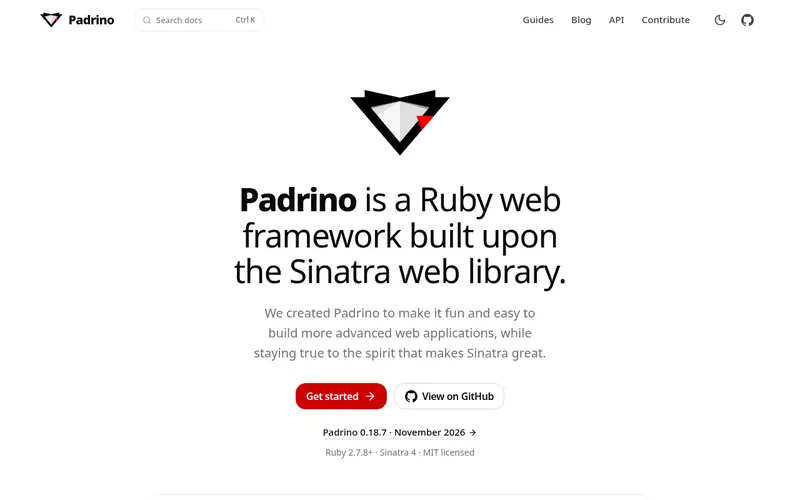
Padrino is a framework built on top of Sinatra that adds structure for larger applications. It provides generators, routing helpers, mailers, caching, an admin interface and optional ORM integrations. It is aimed at developers who like Sinatra's style but want more built-in organization.
Padrino is MIT licensed and free. It runs on standard Ruby platforms and deploys as a Rack application. The project site documents its modules and generators. Compared with Rails, the community is smaller and the release cadence is slower, so check that the current version supports your Ruby version before committing.
Standout: Adds generators, helpers and admin tools on top of Sinatra
Free (open source), as listed by the vendor (Padrino website). Confirm the current plan price before you buy.
Free plan. Plans change, so confirm on the vendor's pricing page before you buy.
Benefits
- Adds generators, helpers and admin tools on top of Sinatra
- modular component choices
Drawbacks
- Smaller community and slower release cadence
- fewer current tutorials
Skip it if this limit matters to you: smaller community and slower release cadence.
Verdict. A sensible pick for sinatra-based apps that need more structure.
Alternatives in this guide: Ruby on Rails, Sinatra, Hanami
Who should use what
Teams building a full application with models, views and background jobs should start with Rails. Developers writing a small API, webhook or prototype should look at Sinatra or Roda. Teams that want explicit structure and lighter defaults should evaluate Hanami. Developers building JSON APIs with strict parameter validation should consider Grape, often alongside a larger framework.
Questions to settle before you buy
What to check before you buy
- Confirm the framework supports your current Ruby version and your deployment target.
- Check that the license (MIT for all options here) fits your organization's policy.
- Review the upgrade notes for the last major version before starting.
- Confirm the gems you need (ORM, authentication, background jobs) are compatible.
- Check documentation activity and issue response in the project repository.
FAQ
Is Rails still the best Ruby web framework?
Rails remains the most complete and widely used option for full-stack Ruby applications. It is not always the best fit for small services or teams that want minimal defaults. Sinatra, Roda and Hanami are reasonable alternatives depending on the size and structure of your project.
Are these Ruby web frameworks free?
All frameworks listed here are open source and free to use under the MIT license. You still pay for hosting, database services and any commercial support you choose. Check each project's license file for the exact terms.
Can I use these frameworks to build APIs only?
Yes. Grape is designed for REST-style APIs. Rails, Sinatra, Roda and Hanami can all serve JSON APIs, with or without views. Choose based on how much structure and tooling you want.
Do I need to paste secrets into any web tool to use these frameworks?
No. These are libraries you install and run on your own machines and servers. If you use online code formatters or validators alongside them, avoid pasting secrets, tokens or production data into third-party web pages.
Which framework is easiest to learn?
Sinatra has the smallest API and is quick to read. Rails has more concepts but far more tutorials and guides. Hanami and Roda sit in between, with clear documentation but smaller communities.
Sources we checked
Method: how we score · editorial policy.
Change log. First published 27 Nov 2026.