Stage 03 · Host · Researched comparison
Best PHP Queue Libraries in 2026
Laravel Queues with Horizon is the first pick if you build on Laravel and want Redis-backed background jobs with a dashboard. Symfony Messenger suits Symfony applications that need multiple transports and a message bus. Enqueue is the choice for framework-neutral code that must talk to several brokers, and php-amqplib fits teams that want a thin AMQP client without a framework.

By Shihab Mia
Published 27 Nov 2026 · 5 tools compared
We run no ads and no affiliate links at launch. The order of a list follows our published method. See how we score.
Prices are the starting prices vendors list publicly. Plans change, so confirm the current price on the vendor page before you buy.
Key takeaways
- All five options are free and open source, so cost is not the deciding factor; fit with your framework and broker is.
- Laravel Queues and Symfony Messenger are tied to their frameworks, while Enqueue, php-amqplib and Pheanstalk work in any PHP project.
- Horizon only manages Redis queues; Laravel Queues also supports database, SQS, Beanstalkd and other backends.
- Queue workers process sensitive job payloads, so keep broker credentials out of source control and restrict dashboard access.
Who each pick is for
- Laravel teams running Redis-backed background jobsLaravel Queues (with Horizon)
- Symfony apps needing a message bus and multiple transportsSymfony Messenger
- Framework-neutral code that targets several brokersEnqueue
- Projects that need a direct AMQP client for RabbitMQphp-amqplib
- PHP projects using beanstalkd as a simple work queuePheanstalk
Comparison
| Tool | Best for | Standout feature | Listed starting price | Free plan or trial |
|---|---|---|---|---|
| 1Laravel Queues (with Horizon) | Laravel teams running Redis-backed background jobs | Built into Laravel with jobs, retries and failed-job handling | Free (open source) | Free plan |
| 2Symfony Messenger | Symfony apps needing a message bus and multiple transports | Message bus with middleware, retries and failure transport | Free (open source) | Free plan |
| 3Enqueue | Framework-neutral code that targets several brokers | One API across AMQP, Redis, SQS, Beanstalkd and others | Free (open source) | Free plan |
| 4php-amqplib | Projects that need a direct AMQP client for RabbitMQ | Pure PHP AMQP 0-9-1 client with no framework dependency | Free (open source) | Free plan |
| 5Pheanstalk | PHP projects using beanstalkd as a simple work queue | Small, focused client for the beanstalkd protocol | Free (open source) | Free plan |
How we picked
We picked libraries that genuinely run background jobs or messages in PHP applications and are currently maintained. Criteria were fit for the job, supported platforms and brokers, licence and price, and the main limits each option imposes. Sources are vendor documentation, project repositories and public pricing pages. All five are open source and free, so price was not a differentiator. Prices and features change, so confirm details on the vendor or repository page before you commit.
The tools, one by one
Laravel Queues (with Horizon)
Best for laravel teams running Redis-backed background jobs
What it is and where it fits
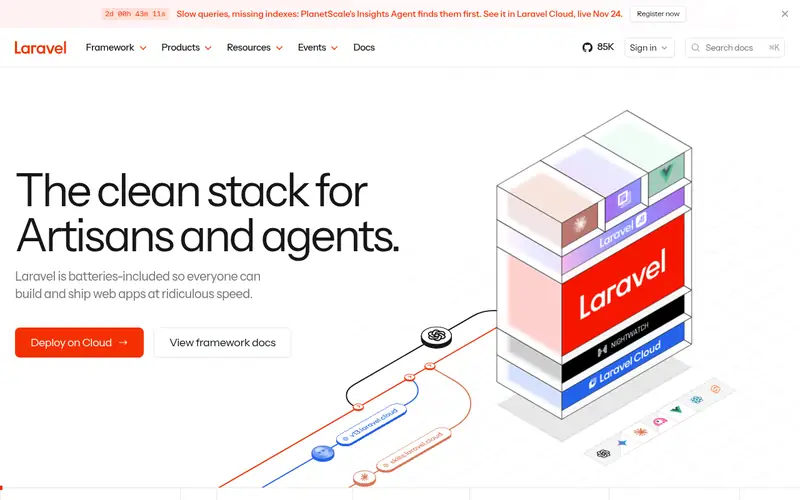
Laravel Queues is the background job layer shipped with the Laravel framework. You write a job class, dispatch it, and a worker process runs it. The queue supports several backends, including Redis, database, Amazon SQS and Beanstalkd, so you can start on the database driver and move to Redis later. Failed jobs are stored and can be retried from the command line.
Horizon is the companion package for Redis queues. It runs your workers, balances them across queues, and provides a web dashboard showing throughput, runtime and failed jobs. Horizon is configured through code and needs a Redis instance plus a process supervisor such as Supervisor to stay running.
Both are MIT-licensed and free. The main limit is scope: Horizon only works with Redis, and the whole stack assumes a Laravel application. Teams on plain PHP or another framework should skip it. The dashboard exposes job data, so put it behind authentication and keep it off public networks.
Standout: Built into Laravel with jobs, retries and failed-job handling
Free (open source), as listed by the vendor (Laravel Queues (with Horizon) website). Confirm the current plan price before you buy.
Free plan. Plans change, so confirm on the vendor's pricing page before you buy.
Benefits
- Built into Laravel with jobs, retries and failed-job handling
- Horizon adds a dashboard and metrics for Redis queues
Drawbacks
- Horizon requires Redis
- the queue API is tied to the Laravel framework
Skip it if this limit matters to you: horizon requires Redis.
Verdict. A sensible pick for laravel teams running Redis-backed background jobs.
Alternatives in this guide: Symfony Messenger, Enqueue, php-amqplib
Symfony Messenger
Best for symfony apps needing a message bus and multiple transports
What it is and where it fits
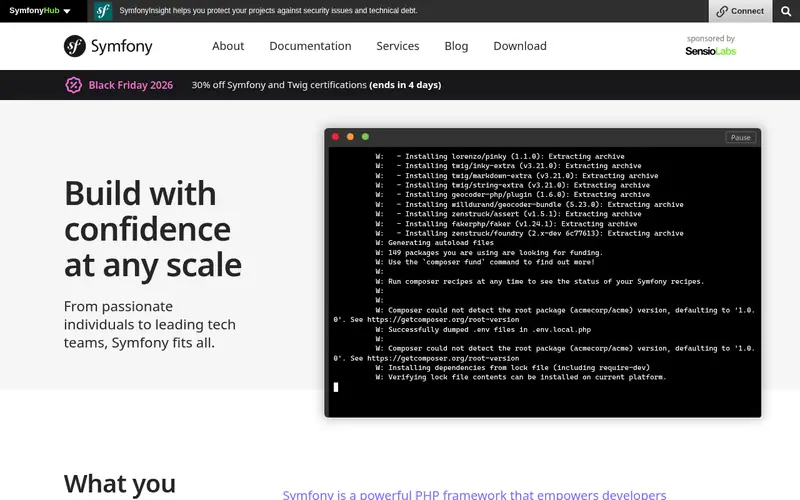
Symfony Messenger provides a message bus and a worker system for Symfony applications. You define message classes and handlers, dispatch messages, and consume them with a worker command. Middleware lets you add behaviour such as validation, logging or transactions around message handling.
Transports are pluggable. The component ships integrations for Doctrine, Redis, AMQP (via php-amqplib), Amazon SQS and Beanstalkd, among others. A failure transport stores messages that exhaust their retries so you can inspect and replay them. The component is MIT-licensed and free.
The main constraint is that Messenger is a Symfony component. It can be used standalone with some wiring, but it is designed around the framework's service container and configuration. Teams outside Symfony usually get less value from it. Running workers in production requires a supervisor, and the failure transport needs monitoring so messages do not pile up silently.
Standout: Message bus with middleware, retries and failure transport
Free (open source), as listed by the vendor (Symfony Messenger website). Confirm the current plan price before you buy.
Free plan. Plans change, so confirm on the vendor's pricing page before you buy.
Benefits
- Message bus with middleware, retries and failure transport
- many transports including Doctrine, Redis, AMQP and Beanstalkd
Drawbacks
- Requires Symfony
- configuration has a learning curve for newcomers
Skip it if this limit matters to you: requires Symfony.
Verdict. A sensible pick for symfony apps needing a message bus and multiple transports.
Alternatives in this guide: Laravel Queues (with Horizon), Enqueue, php-amqplib
Enqueue
Best for framework-neutral code that targets several brokers
What it is and where it fits
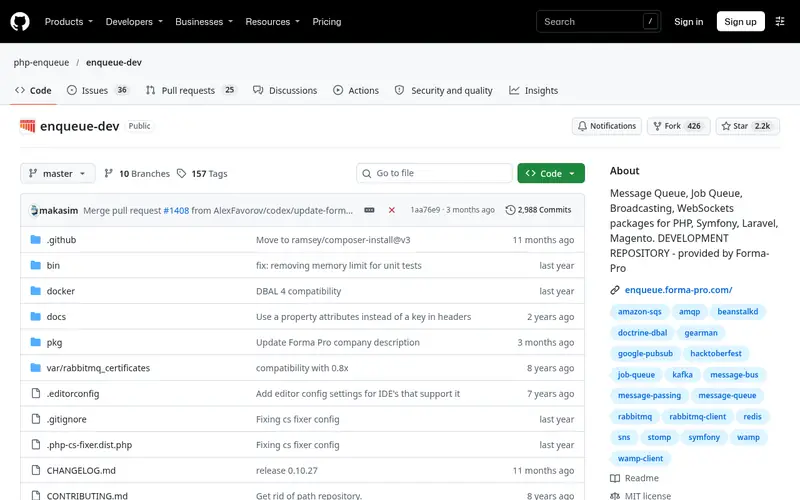
Enqueue is a set of PHP packages that give you a single messaging API over many brokers. It supports AMQP (RabbitMQ), Redis, Amazon SQS, Beanstalkd, Google Pub/Sub and others through separate transport packages. You can also run it over a database or filesystem for simple cases.
The project offers framework integrations for Symfony, Laravel and Magento, plus a consumption layer with commands and a client for producing messages. It follows the queue-interop interfaces, which means code written against the abstraction can switch brokers with configuration changes rather than rewrites. Everything is MIT-licensed and free.
The trade-off is complexity. The abstraction adds concepts you must learn, and each transport is a separate package with its own release cadence, so check that your broker's package is current before committing. Teams that only ever use one broker may find a direct client simpler. It suits projects that expect to change brokers or support several environments.
Standout: One API across AMQP, Redis, SQS, Beanstalkd and others
Free (open source), as listed by the vendor (Enqueue website). Confirm the current plan price before you buy.
Free plan. Plans change, so confirm on the vendor's pricing page before you buy.
Benefits
- One API across AMQP, Redis, SQS, Beanstalkd and others
- integrates with Symfony, Laravel and Magento
Drawbacks
- More abstraction to learn
- some transport packages lag behind broker changes
Skip it if this limit matters to you: more abstraction to learn.
Verdict. A sensible pick for framework-neutral code that targets several brokers.
Alternatives in this guide: Laravel Queues (with Horizon), Symfony Messenger, php-amqplib
php-amqplib
Best for projects that need a direct AMQP client for RabbitMQ
What it is and where it fits
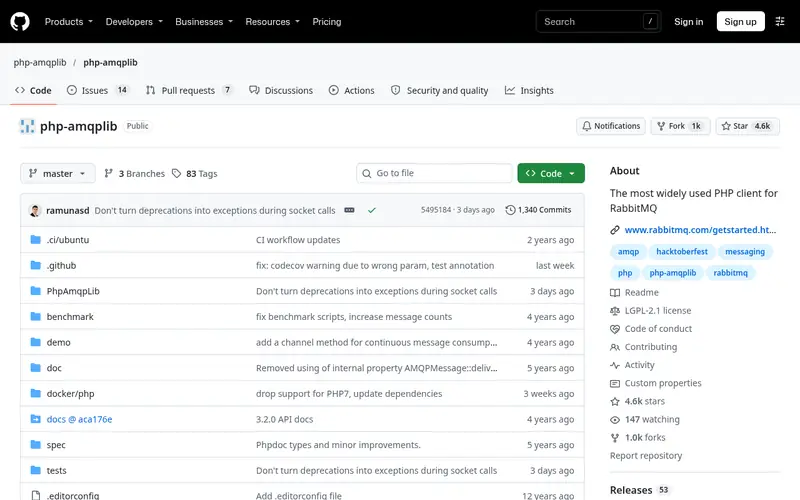
php-amqplib is a pure PHP implementation of the AMQP 0-9-1 protocol, the protocol used by RabbitMQ. It gives you channels, exchanges, queues, bindings, publishers and consumers directly, without a framework or an abstraction layer. It is the AMQP client that Symfony Messenger and other tools build on.
Because it is low-level, you control the details: acknowledgements, prefetch counts, heartbeats and connection recovery. That is useful when you need behaviour that higher-level libraries hide. The library is MIT-licensed and free, and it installs through Composer.
The cost is that you write more code. There is no built-in job retry policy, no failure queue and no dashboard; you implement those patterns yourself or add another library. It also only speaks AMQP, so it is not a fit for Redis, SQS or database queues. Choose it when RabbitMQ is fixed and you want minimal dependencies.
Standout: Pure PHP AMQP 0-9-1 client with no framework dependency
Free (open source), as listed by the vendor (php-amqplib website). Confirm the current plan price before you buy.
Free plan. Plans change, so confirm on the vendor's pricing page before you buy.
Benefits
- Pure PHP AMQP 0-9-1 client with no framework dependency
- widely used and documented
Drawbacks
- Low-level API
- you build retry and worker management yourself
Skip it if this limit matters to you: low-level API.
Verdict. A sensible pick for projects that need a direct AMQP client for RabbitMQ.
Alternatives in this guide: Laravel Queues (with Horizon), Symfony Messenger, Enqueue
Pheanstalk
Best for pHP projects using beanstalkd as a simple work queue
What it is and where it fits
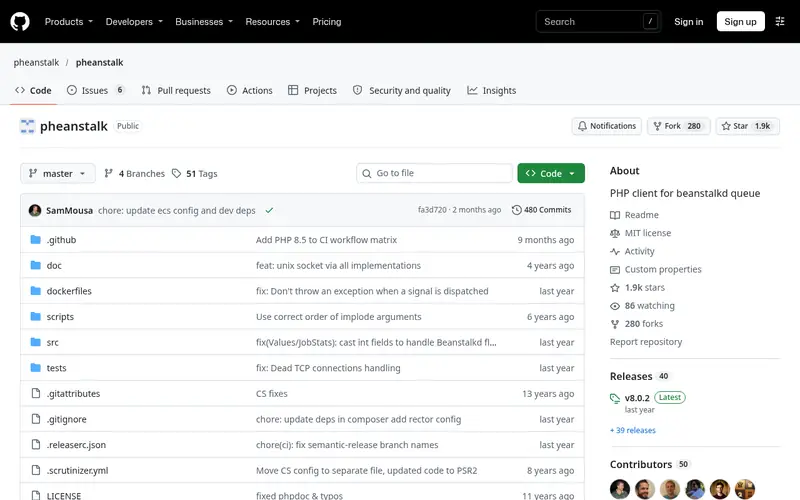
Pheanstalk is a PHP client for beanstalkd, a lightweight work queue server. It covers the protocol's operations: putting jobs into tubes, reserving them, deleting, releasing, burying and touching. The API is small, so producers and workers are short and readable.
beanstalkd itself is a separate server process you install and run. It keeps jobs in memory, with an optional binary log for persistence. That makes it fast and simple, but it is not a full message broker: there are no exchanges, routing rules or built-in clustering. Pheanstalk is MIT-licensed and free.
This is a good fit when you want a minimal queue and are comfortable running beanstalkd. It is a poor fit if you need durable storage guarantees, complex routing or a management UI, since those are outside its scope. You also manage worker supervision, retries and monitoring yourself, or pair it with a framework that does.
Standout: Small, focused client for the beanstalkd protocol
Free (open source), as listed by the vendor (Pheanstalk website). Confirm the current plan price before you buy.
Free plan. Plans change, so confirm on the vendor's pricing page before you buy.
Benefits
- Small, focused client for the beanstalkd protocol
- simple API for producers and workers
Drawbacks
- Only works with beanstalkd
- no built-in retry policy or monitoring
Skip it if this limit matters to you: only works with beanstalkd.
Verdict. A sensible pick for PHP projects using beanstalkd as a simple work queue.
Alternatives in this guide: Laravel Queues (with Horizon), Symfony Messenger, Enqueue
Who should use what
If you build on Laravel and want Redis queues with a dashboard, use Laravel Queues with Horizon. If you are on Symfony and need a message bus with several transports, use Symfony Messenger. If your code must stay framework-neutral or may switch brokers, use Enqueue. If RabbitMQ is fixed and you want a thin client, use php-amqplib. If you run beanstalkd and want a small client, use Pheanstalk. Teams with no framework and a single broker are usually best served by the direct client for that broker.
Questions to settle before you buy
What to check before you buy
- Confirm the library supports your broker and PHP version, and check the last release date.
- Decide whether you need a framework integration or a standalone client.
- Plan worker supervision, retries, failure handling and monitoring before going live.
- Keep broker credentials in environment variables and restrict access to any queue dashboard.
- Check the licence terms and how transport packages are versioned alongside the core library.
FAQ
Are these PHP queue libraries free?
Yes. Laravel Queues, Horizon, Symfony Messenger, Enqueue, php-amqplib and Pheanstalk are all open source under permissive licences and cost nothing to use. You still pay for infrastructure such as Redis, RabbitMQ or beanstalkd hosting and for the servers that run workers.
Do I need a separate queue server?
It depends on the library and driver. Laravel Queues can use the database as a queue with no extra server. Enqueue can run over a database or filesystem. php-amqplib needs RabbitMQ, Pheanstalk needs beanstalkd, and Horizon needs Redis. Plan for running and monitoring that server.
Can I use these libraries outside Laravel or Symfony?
Enqueue, php-amqplib and Pheanstalk work in any PHP project. Laravel Queues and Horizon assume a Laravel application, and Symfony Messenger is designed around Symfony. Messenger can be wired standalone, but you lose much of the convenience the framework provides.
How do I handle failed jobs?
Laravel Queues stores failed jobs and lets you retry them. Symfony Messenger has a failure transport for messages that exhaust retries. Enqueue and the direct clients leave retry and failure handling to your code, so build a dead-letter or failure queue and monitor it.
What about security of job payloads?
Job payloads often contain user data or credentials. Use encrypted connections to the broker, keep secrets in environment variables, and restrict access to dashboards and management interfaces. Do not paste production payloads or broker credentials into third-party web tools; run checks locally instead.
Sources we checked
Method: how we score · editorial policy.
Change log. First published 27 Nov 2026.