Stage 03 · Host · Researched comparison
Best PHP Caching Libraries in 2026
Symfony Cache is the first pick for most teams. It implements PSR-6 and PSR-16, ships many adapters, and works outside Symfony. Laravel Cache suits projects already on Laravel and its facades. Stash is a good alternative when you want a framework-independent PSR-6 pool with tag support. All three are free and open source.

By Shihab Mia
Published 27 Nov 2026 · 7 tools compared
We run no ads and no affiliate links at launch. The order of a list follows our published method. See how we score.
Prices are the starting prices vendors list publicly. Plans change, so confirm the current price on the vendor page before you buy.
Key takeaways
- Symfony Cache, Laravel Cache, Stash, laminas-cache and phpFastCache are free open-source libraries; APCu and phpredis are free PHP extensions.
- Symfony Cache and Stash implement PSR-6 and PSR-16, so you can swap backends without rewriting application code.
- Laravel Cache is tied to the Laravel framework; outside Laravel, use illuminate/cache only if you accept its dependencies.
- APCu is in-process shared memory on one server only; phpredis needs a Redis server and gives you a shared cache across machines.
Who each pick is for
- Framework-agnostic apps that want PSR-6 and PSR-16Symfony Cache
- Laravel applications already using the frameworkLaravel Cache
- Framework-independent PSR-6 caching with tagsStash
- Laminas and Mezzio applications, or PSR-6/PSR-16 userslaminas-cache
- Quick multi-driver caching with a simple APIphpFastCache
- Single-server in-process caching of computed valuesAPCu
- PHP apps that need a shared Redis cachephpredis
Comparison
| Tool | Best for | Standout feature | Listed starting price | Free plan or trial |
|---|---|---|---|---|
| 1Symfony Cache | Framework-agnostic apps that want PSR-6 and PSR-16 | Implements PSR-6 and PSR-16 | Free (open source) | Free plan |
| 2Laravel Cache | Laravel applications already using the framework | Simple facade and helpers | Free (open source) | Free plan |
| 3Stash | Framework-independent PSR-6 caching with tags | PSR-6 compliant | Free (open source) | Free plan |
| 4laminas-cache | Laminas and Mezzio applications, or PSR-6/PSR-16 users | PSR-6 and PSR-16 implementations | Free (open source) | Free plan |
| 5phpFastCache | Quick multi-driver caching with a simple API | One API across many drivers | Free (open source) | Free plan |
| 6APCu | Single-server in-process caching of computed values | Very low latency | Free | Free plan |
| 7phpredis | PHP apps that need a shared Redis cache | Native C extension, faster than pure-PHP clients | Free (open source) | Free plan |
How we picked
We picked libraries and extensions that are currently maintained and that genuinely provide caching for PHP applications. Criteria were standards support (PSR-6 and PSR-16), available backends, framework coupling, licence, and the practical limits of each option. Sources are vendor documentation, project repositories and public pricing pages. All entries here are free or open source. Prices and plan details change, so confirm on the vendor site before you commit.
The tools, one by one
Symfony Cache
Best for framework-agnostic apps that want PSR-6 and PSR-16
What it is and where it fits
Symfony Cache is the cache component of the Symfony framework, published as symfony/cache. You can install it with Composer in any PHP project, not just Symfony apps. It provides PSR-6 pools and PSR-16 simple caches, plus adapters for filesystem, APCu, Redis, Memcached, Doctrine and others. Chain and proxy adapters let you layer a fast local cache over a shared one.
The component also includes cache contracts, which reduce boilerplate with callback-based get and recompute methods. Tag-based invalidation is available on supported adapters, so check the adapter docs before you rely on it. The licence is MIT. Teams that want one API across several backends, or that plan to move off a framework later, get the most from it. If you only cache inside Laravel, the built-in cache is less setup.
Standout: Implements PSR-6 and PSR-16
Free (open source), as listed by the vendor (Symfony Cache website). Confirm the current plan price before you buy.
Free plan. Plans change, so confirm on the vendor's pricing page before you buy.
Benefits
- Implements PSR-6 and PSR-16
- many adapters (filesystem, Redis, APCu, Memcached, database)
- works standalone
Drawbacks
- More configuration than a framework facade
- tag support is limited to certain adapters
Skip it if this limit matters to you: more configuration than a framework facade.
Verdict. A sensible pick for framework-agnostic apps that want PSR-6 and PSR-16.
Alternatives in this guide: Laravel Cache, Stash, laminas-cache
Laravel Cache
Best for laravel applications already using the framework

What it is and where it fits
Laravel Cache is the caching layer in the Laravel framework, also available as the illuminate/cache package. It offers a Cache facade, the cache() helper and a repository API with get, put, remember, increment and lock methods. Drivers include file, database, array, Redis, Memcached, APCu and DynamoDB. Cache tags work on Redis, Memcached and other tag-capable stores, not on the file driver.
Configuration lives in config/cache.php, and the default driver is set through the CACHE_STORE environment variable. The framework is MIT licensed. The main limit is coupling: pulling illuminate/cache into a non-Laravel project brings container and support packages with it. For a Laravel codebase, it is the shortest path and needs no extra library.
Standout: Simple facade and helpers
Free (open source), as listed by the vendor (Laravel Cache website). Confirm the current plan price before you buy.
Free plan. Plans change, so confirm on the vendor's pricing page before you buy.
Benefits
- Simple facade and helpers
- drivers for file, database, Redis, Memcached, APCu and array
- cache tags on supported stores
Drawbacks
- Tied to Laravel and its dependencies
- tag support depends on the driver
Skip it if this limit matters to you: tied to Laravel and its dependencies.
Verdict. A sensible pick for laravel applications already using the framework.
Alternatives in this guide: Symfony Cache, Stash, laminas-cache
Stash
Best for framework-independent PSR-6 caching with tags
What it is and where it fits
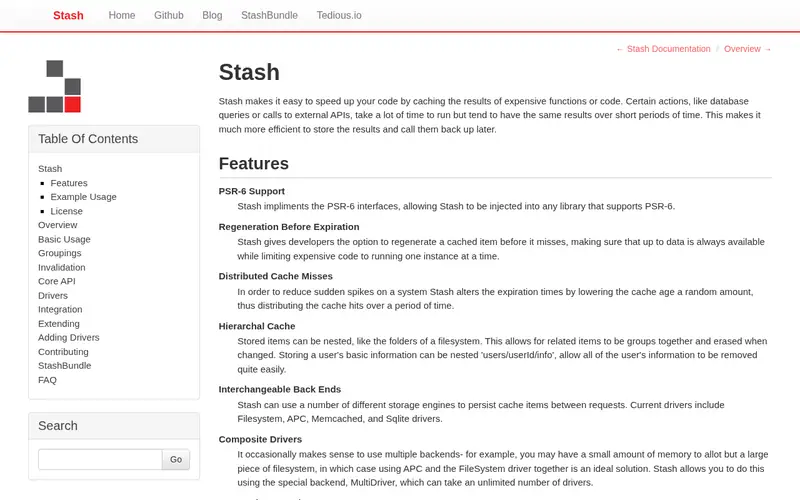
Stash is a standalone PHP caching library by Tedious. It implements PSR-6 and adds features beyond the standard, including tag support across drivers, stampede protection and session storage helpers. Drivers cover FileSystem, Redis, Memcached, SQLite, APCu, Ephemeral and others, and you can register custom drivers.
Because it is not tied to a framework, Stash fits legacy codebases and libraries that need a cache pool without pulling in a full framework. The project is MIT licensed. Its community and release cadence are smaller than Symfony's, so check the repository for recent activity before adopting it for a long-lived project. Teams that need only PSR-16 may prefer a lighter package.
Standout: PSR-6 compliant
Free (open source), as listed by the vendor (Stash website). Confirm the current plan price before you buy.
Free plan. Plans change, so confirm on the vendor's pricing page before you buy.
Benefits
- PSR-6 compliant
- tag and stampede protection built in
- drivers for filesystem, Redis, Memcached, SQLite, APCu and more
Drawbacks
- Smaller community than Symfony Cache
- less frequent release cadence
Skip it if this limit matters to you: smaller community than Symfony Cache.
Verdict. A sensible pick for framework-independent PSR-6 caching with tags.
Alternatives in this guide: Symfony Cache, Laravel Cache, laminas-cache
laminas-cache
Best for laminas and Mezzio applications, or PSR-6/PSR-16 users
What it is and where it fits
laminas-cache is the caching component maintained by the Laminas project, the continuation of Zend Framework. It provides PSR-6 cache pools and PSR-16 simple cache implementations, with storage adapters such as filesystem, Redis, Memcached, APCu, memory and MongoDB. Each adapter is its own package, so you install only what you use.
The component uses a plugin manager, which lets you register custom adapters and serializers. It is BSD-3-Clause licensed. The split-package design keeps dependencies small but means more Composer entries and more version constraints to track. It is the natural choice inside Laminas MVC or Mezzio, and it works in other projects if you want a PSR-compliant pool with a long-maintained lineage.
Standout: PSR-6 and PSR-16 implementations
Free (open source), as listed by the vendor (laminas-cache website). Confirm the current plan price before you buy.
Free plan. Plans change, so confirm on the vendor's pricing page before you buy.
Benefits
- PSR-6 and PSR-16 implementations
- storage adapters split into separate packages
- plugin manager for custom adapters
Drawbacks
- Adapters installed as separate Composer packages
- documentation assumes Laminas familiarity
Skip it if this limit matters to you: adapters installed as separate Composer packages.
Verdict. A sensible pick for laminas and Mezzio applications, or PSR-6/PSR-16 users.
Alternatives in this guide: Symfony Cache, Laravel Cache, Stash
phpFastCache
Best for quick multi-driver caching with a simple API
What it is and where it fits
phpFastCache is a caching library from PHPSocialNetwork that wraps many backends behind one API. Drivers include files, APCu, Redis, Memcached, SQLite, MongoDB, Couchbase and others. It offers PSR-6 and PSR-16 interfaces alongside its own simpler methods, and it can fall back to another driver when the preferred one is unavailable.
The library is MIT licensed and installs with Composer. It suits small projects and scripts that want caching with little setup, and it is a reasonable bridge when you are unsure which backend you will end up with. The trade-off is a smaller ecosystem and fewer integrations than Symfony Cache. Check that the driver you need is still maintained before you commit.
Standout: One API across many drivers
Free (open source), as listed by the vendor (phpFastCache website). Confirm the current plan price before you buy.
Free plan. Plans change, so confirm on the vendor's pricing page before you buy.
Benefits
- One API across many drivers
- automatic fallback between backends
- PSR-6 and PSR-16 support
Drawbacks
- Smaller ecosystem than Symfony Cache
- some drivers need extra PHP extensions
Skip it if this limit matters to you: smaller ecosystem than Symfony Cache.
Verdict. A sensible pick for quick multi-driver caching with a simple API.
Alternatives in this guide: Symfony Cache, Laravel Cache, Stash
APCu
Best for single-server in-process caching of computed values
What it is and where it fits
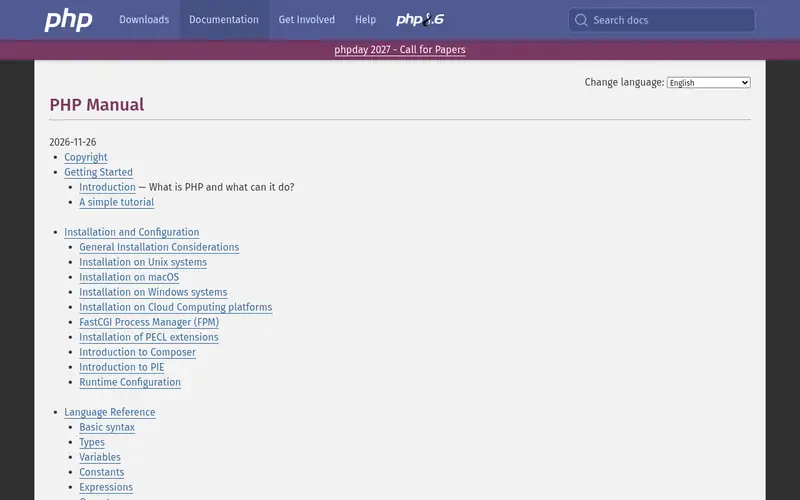
APCu is a PHP extension that provides an in-memory key-value store shared across requests on one server. It is the user cache successor to APC, and it is used through functions such as apcu_store, apcu_fetch and apcu_delete, or through PSR adapters that wrap it. It is free and open source and ships with the PHP project.
APCu does not persist across restarts and does not share data between servers. That makes it a poor fit for multi-node deployments unless each node can tolerate its own cache. It is enabled with the apcu.enabled ini setting and is not compiled in by default in many distributions, so check your build. Use it for small, frequently read values such as config or computed lookups on a single host.
Standout: Very low latency
Free, as listed by the vendor (APCu website). Confirm the current plan price before you buy.
Free plan. Plans change, so confirm on the vendor's pricing page before you buy.
Benefits
- Very low latency
- simple apcu_fetch and apcu_store API
- no external service to run
Drawbacks
- Per-server only, not shared across machines
- not enabled by default in most PHP builds
Skip it if this limit matters to you: per-server only, not shared across machines.
Verdict. A sensible pick for single-server in-process caching of computed values.
Alternatives in this guide: Symfony Cache, Laravel Cache, Stash
phpredis
Best for pHP apps that need a shared Redis cache
What it is and where it fits
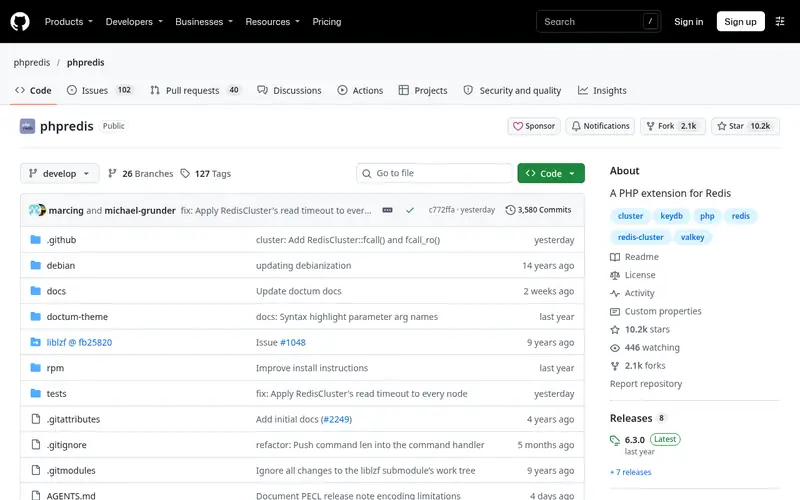
phpredis is the PHP extension for Redis, maintained on GitHub. It gives PHP code a native client for a shared cache that many app servers can read and write. You use it directly with methods such as set, get and expire, or indirectly through the Redis adapters in Symfony Cache, Laravel Cache, Stash or laminas-cache.
The extension is PHP-licensed and free. It needs a running Redis server, which you operate and monitor separately, and the extension version must support the Redis features you use. It is the right choice when cache data must be shared across machines or survive PHP process restarts. For a single server with no external service, APCu is simpler.
Standout: Native C extension, faster than pure-PHP clients
Free (open source), as listed by the vendor (phpredis website). Confirm the current plan price before you buy.
Free plan. Plans change, so confirm on the vendor's pricing page before you buy.
Benefits
- Native C extension, faster than pure-PHP clients
- supports Redis data types, pub/sub, Lua and clusters
Drawbacks
- Requires a Redis server and the extension installed
- version must match your Redis server features
Skip it if this limit matters to you: requires a Redis server and the extension installed.
Verdict. A sensible pick for PHP apps that need a shared Redis cache.
Alternatives in this guide: Symfony Cache, Laravel Cache, Stash
Who should use what
A Laravel team should start with Laravel Cache and add Redis as the driver when it runs more than one server. A framework-agnostic codebase, or one planning a framework move, fits Symfony Cache or Stash, both PSR-6 and PSR-16. A Laminas or Mezzio project should use laminas-cache to stay within its ecosystem. Small scripts that want caching with minimal setup can try phpFastCache. On a single host, APCu handles small computed values; once you need a shared cache across machines, add phpredis and a Redis server.
Questions to settle before you buy
What to check before you buy
- Confirm the library supports the PSR interface your code expects, PSR-6, PSR-16 or both.
- Check that an adapter exists for your backend: filesystem, APCu, Redis, Memcached or database.
- Verify the package is actively maintained by checking recent commits and releases in its repository.
- Test tag or group invalidation on your chosen driver, since support varies by adapter.
- Plan for cache stampede and expiry behaviour, and confirm the library offers protection or that you handle it.
FAQ
Do I need both a caching library and a backend?
Usually yes. A library such as Symfony Cache or Stash gives you a consistent API, while a backend such as APCu, Redis or the filesystem stores the data. Some libraries include a filesystem driver so you can start with no external service.
Is APCu enough for a multi-server setup?
No. APCu stores data in the memory of one PHP process group on one machine. Other servers cannot read it. For a shared cache across machines, use Redis through phpredis or a library adapter, or Memcached.
Can I use Symfony Cache outside Symfony?
Yes. symfony/cache installs with Composer in any PHP project and provides PSR-6 and PSR-16 implementations without the full framework. You configure the adapters yourself instead of relying on framework config.
Which library supports cache tags?
Stash supports tags across its drivers. Symfony Cache and Laravel Cache support tags on some adapters but not all, for example Laravel's file driver does not support tags. Check the adapter documentation for your backend before relying on tag invalidation.
Are these libraries free?
Yes. All the libraries and extensions listed here are free and open source under licences such as MIT, BSD-3-Clause or the PHP licence. Costs come from infrastructure such as a Redis server or managed cache service, not from the libraries.
Sources we checked
Method: how we score · editorial policy.
Change log. First published 27 Nov 2026.