Stage 03 · Host · Researched comparison
Best PHP Application Servers in 2026
PHP-FPM is the default pick for most teams. It ships with PHP, works with every major web server, and needs no extra runtime. Choose FrankenPHP if you want a modern all-in-one server with built-in HTTPS and worker mode. Choose RoadRunner or Swoole if you need long-running workers and higher throughput under load. Laravel Octane is the easiest path for Laravel teams that want to run on any of these.

By Shihab Mia
Published 27 Nov 2026 · 7 tools compared
We run no ads and no affiliate links at launch. The order of a list follows our published method. See how we score.
Prices are the starting prices vendors list publicly. Plans change, so confirm the current price on the vendor page before you buy.
Key takeaways
- PHP-FPM is free, bundled with PHP, and the safest baseline for standard request-per-process hosting.
- FrankenPHP, RoadRunner, Swoole and OpenSwoole are free open-source projects that keep PHP workers alive between requests.
- Laravel Octane is a free open-source package that runs Laravel apps on FrankenPHP, RoadRunner or Swoole.
- Long-running workers change memory and state behavior, so test your app for leaks and shared state before switching.
Who each pick is for
- Standard PHP hosting with any web serverPHP-FPM
- Teams wanting a modern all-in-one PHP serverFrankenPHP
- High-throughput services needing workers and pluginsRoadRunner
- PHP teams building coroutine-based concurrent servicesSwoole
- Teams wanting a Swoole fork with commercial supportOpenSwoole
- Laravel apps that want worker-mode performanceLaravel Octane
- Event-driven PHP services and custom serversReactPHP
Comparison
| Tool | Best for | Standout feature | Listed starting price | Free plan or trial |
|---|---|---|---|---|
| 1PHP-FPM | Standard PHP hosting with any web server | Bundled with PHP and widely supported | Free (open source) | Free plan |
| 2FrankenPHP | Teams wanting a modern all-in-one PHP server | Single binary with HTTP/2, HTTP/3 and automatic HTTPS | Free (open source) | Free plan |
| 3RoadRunner | High-throughput services needing workers and plugins | Written in Go with a plugin system for jobs, metrics and gRPC | Free (open source) | Free plan |
| 4Swoole | PHP teams building coroutine-based concurrent services | Coroutines, async I/O and built-in server in one extension | Free (open source) | Free plan |
| 5OpenSwoole | Teams wanting a Swoole fork with commercial support | Coroutine and async server features with an open-source core | See vendor pricing page | Free plan |
| 6Laravel Octane | Laravel apps that want worker-mode performance | One command to run on FrankenPHP, RoadRunner or Swoole | Free (open source) | Free plan |
| 7ReactPHP | Event-driven PHP services and custom servers | Event loop and async components installable with Composer | Free (open source) | Free plan |
How we picked
We compared these tools on fit for serving PHP in production, supported platforms, license and pricing, and the main limits of each model. Sources are vendor documentation, project repositories and public pricing pages. We did not run benchmarks or collect user reviews. Prices and plan limits change, so confirm details on the vendor site before you commit.
The tools, one by one
PHP-FPM
Best for standard PHP hosting with any web server
What it is and where it fits
PHP-FPM is the FastCGI process manager included with PHP. It pools worker processes, manages them, and passes requests from a web server such as Nginx or Apache. It runs on Linux, macOS and Windows, and most distributions package it directly. There is no separate license or pricing.
Its main strength is predictability. Each request gets a clean process state, so global variables and static caches do not leak between requests. Configuration lives in a pool file where you set process counts, timeouts and user accounts. Tuning pm.max_children to available memory is the usual task.
Skip PHP-FPM if you need persistent workers for high request volume or want to keep framework bootstrapping out of every request. For most sites, it remains the correct default.
Standout: Bundled with PHP and widely supported
Free (open source), as listed by the vendor (PHP-FPM website). Confirm the current plan price before you buy.
Free plan. Plans change, so confirm on the vendor's pricing page before you buy.
Benefits
- Bundled with PHP and widely supported
- Works with Apache, Nginx and Caddy
Drawbacks
- One process per request model
- No built-in worker persistence
Skip it if this limit matters to you: one process per request model.
Verdict. A sensible pick for standard PHP hosting with any web server.
Alternatives in this guide: FrankenPHP, RoadRunner, Swoole
FrankenPHP
Best for teams wanting a modern all-in-one PHP server
What it is and where it fits
FrankenPHP is a PHP application server built on the Caddy web server. It runs as a single Go binary and embeds the PHP interpreter, so you do not need a separate web server or FastCGI pool. It supports HTTP/2, HTTP/3, automatic TLS certificates and compression out of the box.
Worker mode keeps your application bootstrapped across requests, which cuts overhead for frameworks. It also supports the classic CGI mode for compatibility. The project is open source under the MIT license and runs on Linux, macOS and Windows, with official Docker images.
Consider skipping FrankenPHP if your host only supports PHP-FPM, or if you depend on extensions that are not in the standard build. Check the documentation for the extension list before committing.
Standout: Single binary with HTTP/2, HTTP/3 and automatic HTTPS
Free (open source), as listed by the vendor (FrankenPHP website). Confirm the current plan price before you buy.
Free plan. Plans change, so confirm on the vendor's pricing page before you buy.
Benefits
- Single binary with HTTP/2, HTTP/3 and automatic HTTPS
- Worker mode and early hints support
Drawbacks
- Younger project than PHP-FPM
- Some extensions need a custom build
Skip it if this limit matters to you: younger project than PHP-FPM.
Verdict. A sensible pick for teams wanting a modern all-in-one PHP server.
Alternatives in this guide: PHP-FPM, RoadRunner, Swoole
RoadRunner
Best for high-throughput services needing workers and plugins
What it is and where it fits
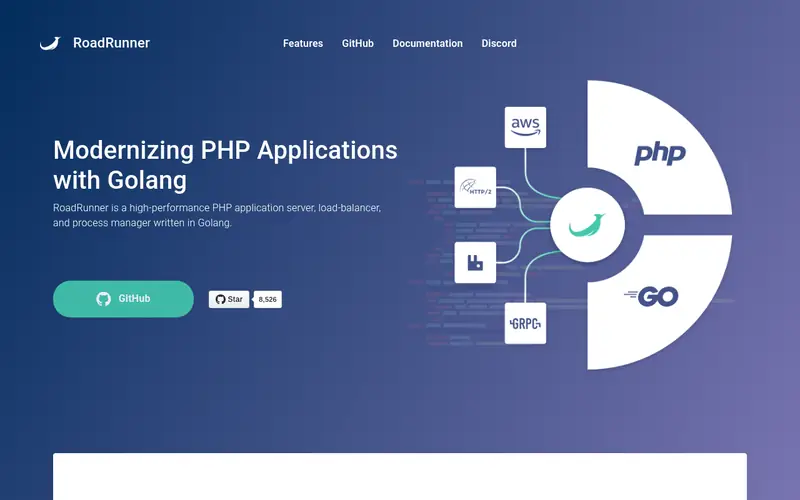
RoadRunner is an application server and process manager written in Go. It runs PHP workers and communicates with them over a protocol, so the Go side handles HTTP, queues, WebSockets and gRPC while PHP handles application logic. It is open source under the MIT license.
Configuration lives in a .rr.yaml file where you define server plugins, worker pools and limits. It runs on Linux, macOS and Windows and ships as a single binary. Because workers stay alive, you must reset state between requests and watch for memory growth.
Skip RoadRunner if you want a minimal setup with no extra binary, or if your team is not ready to manage long-running worker state. It fits services that need queue or gRPC support alongside HTTP.
Standout: Written in Go with a plugin system for jobs, metrics and gRPC
Free (open source), as listed by the vendor (RoadRunner website). Confirm the current plan price before you buy.
Free plan. Plans change, so confirm on the vendor's pricing page before you buy.
Benefits
- Written in Go with a plugin system for jobs, metrics and gRPC
- Worker mode with configurable pools
Drawbacks
- Requires a separate binary and config file
- Debugging worker state takes practice
Skip it if this limit matters to you: requires a separate binary and config file.
Verdict. A sensible pick for high-throughput services needing workers and plugins.
Alternatives in this guide: PHP-FPM, FrankenPHP, Swoole
Swoole
Best for pHP teams building coroutine-based concurrent services
What it is and where it fits
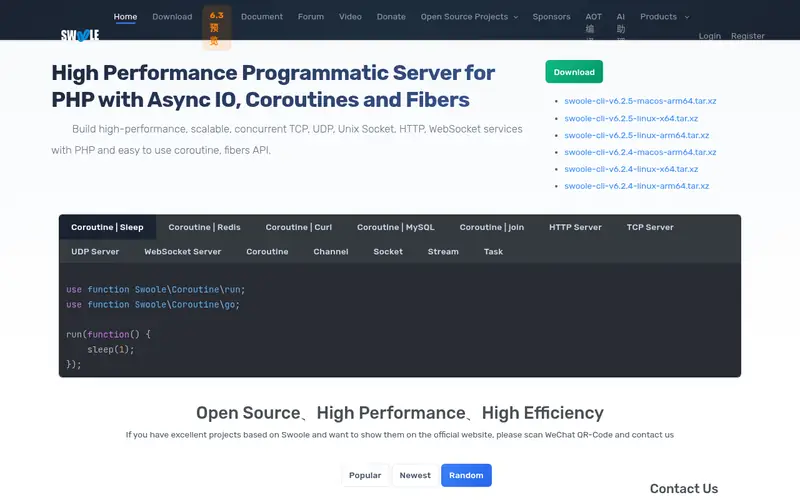
Swoole is a PHP extension that adds coroutines, asynchronous I/O, timers and a built-in HTTP and WebSocket server. It lets PHP handle many concurrent connections without one process per request. It is open source under the Apache 2.0 license and runs on Linux and macOS.
You install it as a PECL or compiled extension, then run your application through the Swoole server. Frameworks such as Laravel and Symfony can use it through adapters. Because coroutines change execution flow, blocking calls and shared state need review.
Skip Swoole if you cannot install PHP extensions on your host, or if your application relies heavily on blocking libraries. It suits teams that want concurrency inside PHP rather than in a separate proxy.
Standout: Coroutines, async I/O and built-in server in one extension
Free (open source), as listed by the vendor (Swoole website). Confirm the current plan price before you buy.
Free plan. Plans change, so confirm on the vendor's pricing page before you buy.
Benefits
- Coroutines, async I/O and built-in server in one extension
- Mature ecosystem with wide framework support
Drawbacks
- Requires a PHP extension and specific PHP versions
- Coroutine code needs careful review
Skip it if this limit matters to you: requires a PHP extension and specific PHP versions.
Verdict. A sensible pick for PHP teams building coroutine-based concurrent services.
Alternatives in this guide: PHP-FPM, FrankenPHP, RoadRunner
OpenSwoole
Best for teams wanting a Swoole fork with commercial support
What it is and where it fits
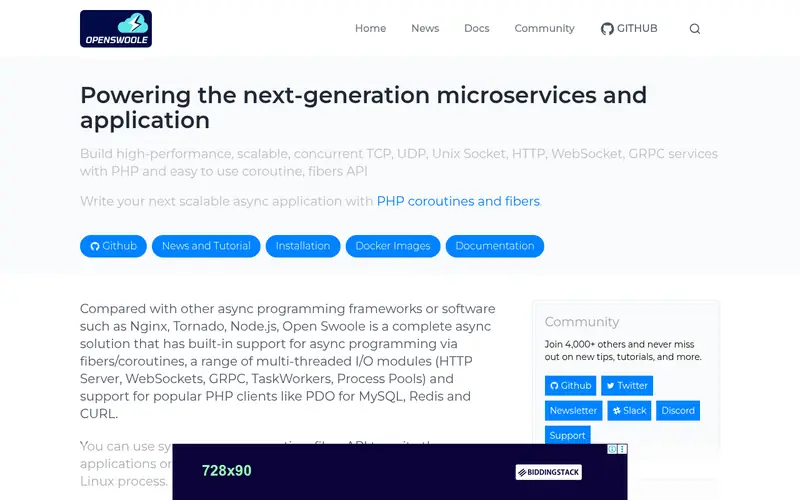
OpenSwoole is a fork of Swoole maintained by a separate team. It provides coroutines, async I/O and a built-in server as a PHP extension, and it keeps an open-source core while offering commercial support plans. It runs on Linux and macOS.
Installation follows the same pattern as Swoole: add the extension, then start your app through the server. Framework integrations exist for Laravel and others. Because it is a fork, extension APIs and release timing differ from Swoole, so pick one and stay consistent.
Skip OpenSwoole if you need the largest community or the widest third-party integration list; Swoole is more common there. It fits teams that value a supported commercial option alongside the open-source code.
Standout: Coroutine and async server features with an open-source core
See vendor pricing page, as listed by the vendor (OpenSwoole website). Confirm the current plan price before you buy.
Free plan. Plans change, so confirm on the vendor's pricing page before you buy.
Benefits
- Coroutine and async server features with an open-source core
- Commercial support and services available
Drawbacks
- Smaller community than Swoole
- Extension install and version matching required
Skip it if this limit matters to you: smaller community than Swoole.
Verdict. A sensible pick for teams wanting a Swoole fork with commercial support.
Alternatives in this guide: PHP-FPM, FrankenPHP, RoadRunner
Laravel Octane
Best for laravel apps that want worker-mode performance

What it is and where it fits
Laravel Octane is an official Laravel package that serves your application through FrankenPHP, RoadRunner or Swoole. It keeps the framework bootstrapped between requests, which reduces per-request overhead. It is open source under the MIT license and installs with Composer.
Octane adds commands to start, stop and reload workers, and it documents which services should be reset between requests. It runs wherever the underlying server runs. Because workers persist, you must check for static state, singletons and memory growth in your code.
Skip Octane if you are not on Laravel, or if your app depends on per-request globals that are hard to reset. It is the lowest-friction route to worker mode for Laravel teams.
Standout: One command to run on FrankenPHP, RoadRunner or Swoole
Free (open source), as listed by the vendor (Laravel Octane website). Confirm the current plan price before you buy.
Free plan. Plans change, so confirm on the vendor's pricing page before you buy.
Benefits
- One command to run on FrankenPHP, RoadRunner or Swoole
- Built-in tools for worker reloads and state resets
Drawbacks
- Laravel only, not for other frameworks
- Requires reviewing app state for long-running workers
Skip it if this limit matters to you: laravel only, not for other frameworks.
Verdict. A sensible pick for laravel apps that want worker-mode performance.
Alternatives in this guide: PHP-FPM, FrankenPHP, RoadRunner
ReactPHP
Best for event-driven PHP services and custom servers
What it is and where it fits
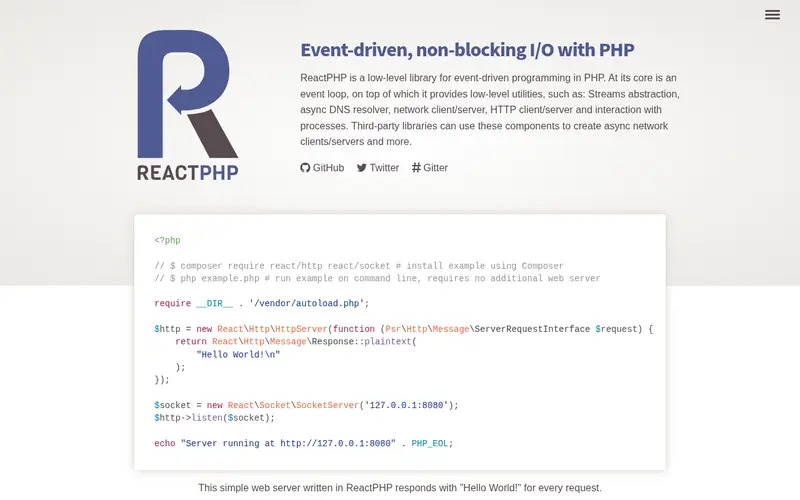
ReactPHP is an event-driven, non-blocking I/O library for PHP. It provides an event loop plus components for HTTP, sockets, DNS and streams. It installs with Composer and runs on any platform where PHP runs, with no extension needed.
It is not an application server by itself. You build a server or worker around the event loop, or use it inside a long-running process. That flexibility means more code to write and maintain compared with FrankenPHP or RoadRunner.
Skip ReactPHP if you want a ready-made server with config files and process management. It fits teams that need custom async services or want to embed an event loop in an existing worker.
Standout: Event loop and async components installable with Composer
Free (open source), as listed by the vendor (ReactPHP website). Confirm the current plan price before you buy.
Free plan. Plans change, so confirm on the vendor's pricing page before you buy.
Benefits
- Event loop and async components installable with Composer
- No PHP extension required
Drawbacks
- A library, not a full application server
- You assemble the HTTP stack yourself
Skip it if this limit matters to you: A library, not a full application server.
Verdict. A sensible pick for event-driven PHP services and custom servers.
Alternatives in this guide: PHP-FPM, FrankenPHP, RoadRunner
Who should use what
If you run a standard site on shared or VPS hosting, stay with PHP-FPM. If you want a single binary with automatic HTTPS and worker mode, try FrankenPHP. If you need queues, gRPC or metrics alongside HTTP, look at RoadRunner. If you are on Laravel and want worker mode with minimal setup, use Laravel Octane on top of FrankenPHP, RoadRunner or Swoole. Teams building coroutine-heavy services should compare Swoole and OpenSwoole, and teams writing custom async services can start with ReactPHP.
Questions to settle before you buy
What to check before you buy
- Confirm your host allows the PHP extension or binary the server needs.
- Test your app for static state and memory growth under long-running workers.
- Check that required PHP extensions are available in the server build.
- Review how you will reload workers on deploy without dropping requests.
- Verify the license and support terms if you need commercial backing.
FAQ
Is PHP-FPM still the best default in 2026?
Yes for most sites. It ships with PHP, works with every major web server, and keeps request state isolated. Move to a worker-mode server only when you have measured a need and tested your app for state leaks.
Do worker-mode servers break normal PHP code?
They can. Code that relies on globals, static caches or per-request shutdown behavior may behave differently when workers stay alive. Review framework guidance and reset services between requests.
Is FrankenPHP a replacement for Nginx and PHP-FPM?
It can replace both for many setups because it includes a web server and embeds PHP. Check extension support and your hosting options first, since some environments only allow PHP-FPM.
Can I use Laravel Octane with any server?
Octane supports FrankenPHP, RoadRunner and Swoole. You pick one when starting Octane. It is Laravel-only and does not work with other frameworks.
Are these tools free?
PHP-FPM, FrankenPHP, RoadRunner, Swoole, Laravel Octane and ReactPHP are free and open source. OpenSwoole has an open-source core and paid support options; see its pricing page for current terms.
Sources we checked
Method: how we score · editorial policy.
Change log. First published 27 Nov 2026.