Stage 03 · Host · Researched comparison
Best JavaScript Dataframe Libraries in 2026
Arquero is the first pick for most developers who want a dataframe library that runs in the browser and in Node.js, with a small API for filtering, grouping and aggregating. Danfo.js suits teams that want a pandas-like API and tensor support. nodejs-polars is the better fit when you need fast columnar processing on the server and can accept a native binary dependency.

By Shihab Mia
Published 27 Nov 2026 · 7 tools compared
We run no ads and no affiliate links at launch. The order of a list follows our published method. See how we score.
Prices are the starting prices vendors list publicly. Plans change, so confirm the current price on the vendor page before you buy.
Key takeaways
- Arquero, Danfo.js, tidy.js and data-forge are written in JavaScript, so they install with npm and run in Node.js or the browser.
- nodejs-polars and DuckDB-Wasm give you columnar engines; Polars binds to a native library, while DuckDB-Wasm runs as WebAssembly in the browser.
- Apache Arrow JS is a columnar memory format and IPC library, not a full dataframe API, so pair it with a query layer for most work.
- All the libraries listed here are free and open source; check each repository for its current licence before shipping.
Who each pick is for
- Browser and Node.js tabular transforms with a small APIArquero
- Teams that want a pandas-like API in JavaScriptDanfo.js
- Fast server-side columnar processing in Node.jsnodejs-polars
- SQL over local files and Arrow data in the browserDuckDB-Wasm
- Columnar memory format and IPC between systemsApache Arrow JS
- Small, typed tidy-data transforms in TypeScripttidy.js
- Chainable data transforms in older JavaScript projectsdata-forge
Comparison
| Tool | Best for | Standout feature | Listed starting price | Free plan or trial |
|---|---|---|---|---|
| 1Arquero | Browser and Node.js tabular transforms with a small API | Runs in the browser and Node.js | Free (open source) | Free plan |
| 2Danfo.js | Teams that want a pandas-like API in JavaScript | Familiar DataFrame and Series API for pandas users | Free (open source) | Free plan |
| 3nodejs-polars | Fast server-side columnar processing in Node.js | Rust Polars engine behind a Node API | Free (open source) | Free plan |
| 4DuckDB-Wasm | SQL over local files and Arrow data in the browser | Full SQL engine compiled to WebAssembly | Free (open source) | Free plan |
| 5Apache Arrow JS | Columnar memory format and IPC between systems | Standard columnar format with cross-language support | Free (open source) | Free plan |
| 6tidy.js | Small, typed tidy-data transforms in TypeScript | Typed TypeScript API | Free (open source) | Free plan |
| 7data-forge | Chainable data transforms in older JavaScript projects | Long-standing library with a chainable API | Free (open source) | Free plan |
How we picked
We picked libraries that handle table-shaped data in JavaScript or TypeScript and are currently maintained. Criteria were fit for the job, platforms supported (browser, Node.js, both), licence and price, how data is processed locally rather than sent to a third party, and the main limits such as native dependencies or bundle size. Sources are vendor pages, project documentation and public repositories. Prices and licences can change, so confirm on the project site before you commit.
The tools, one by one
Arquero
Best for browser and Node.js tabular transforms with a small API
What it is and where it fits
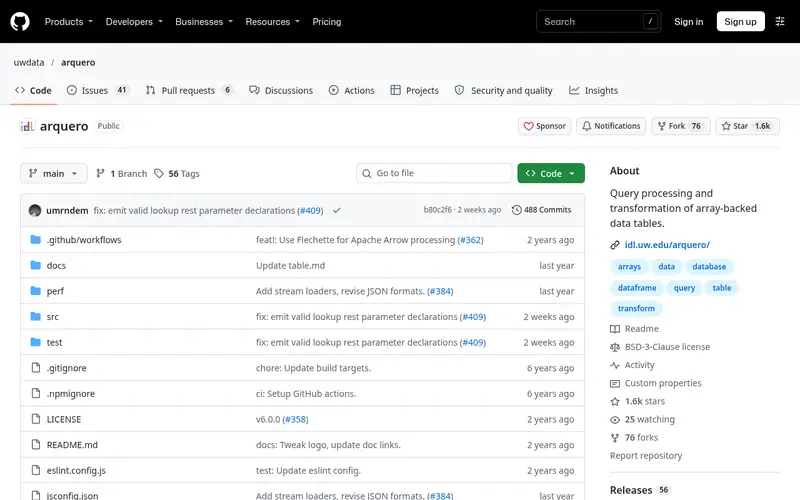
Arquero is a JavaScript library for relational and tabular data transforms. It uses a chainable, verb-based API modelled on dplyr ideas: filter, derive, groupby, rollup, join and orderby. Tables are backed by arrays of objects or by Apache Arrow columns, so it can read Arrow data without a full copy in some paths. It runs in modern browsers and in Node.js, and it installs from npm.
The library focuses on transformation rather than plotting or machine learning. It handles CSV and JSON input through helper functions, and it can output Arrow or plain JavaScript objects. Documentation lives in the repository and on the project site, with an API reference and examples. Because it is pure JavaScript, performance is good for moderate data sizes but below native engines on large datasets.
Choose Arquero when you want dataframe-style transforms in a web app or a Node service without native dependencies. Skip it if you need a pandas-compatible API or heavy numerical routines.
Standout: Runs in the browser and Node.js
Free (open source), as listed by the vendor (Arquero website). Confirm the current plan price before you buy.
Free plan. Plans change, so confirm on the vendor's pricing page before you buy.
Benefits
- Runs in the browser and Node.js
- verb-based API for filter, groupby and derive
Drawbacks
- Not a pandas clone, so pandas habits need relearning
- smaller ecosystem than Danfo.js
Skip it if this limit matters to you: not a pandas clone, so pandas habits need relearning.
Verdict. A sensible pick for browser and Node.js tabular transforms with a small API.
Alternatives in this guide: Danfo.js, nodejs-polars, DuckDB-Wasm
Danfo.js
Best for teams that want a pandas-like API in JavaScript
What it is and where it fits
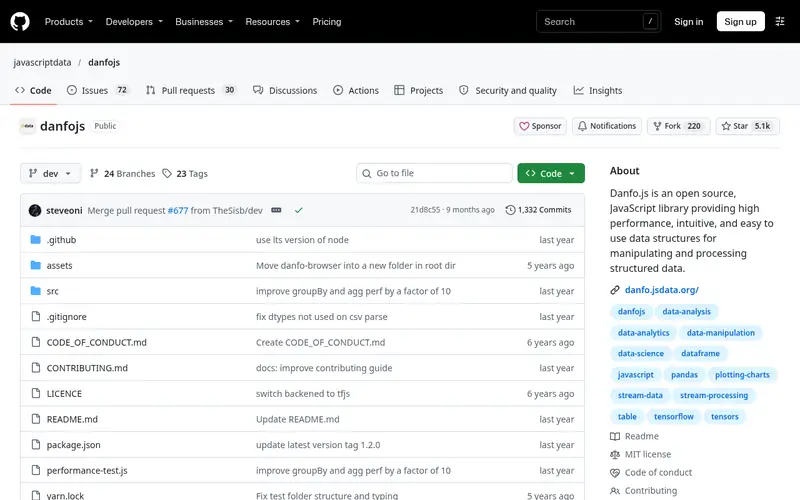
Danfo.js provides DataFrame and Series structures with an API that follows pandas conventions. You can read CSV, JSON and other formats, select and filter columns, group and aggregate, handle missing values, and merge frames. It also connects to TensorFlow.js for tensor conversion, which suits teams doing light preprocessing before a model runs in the browser or Node.js.
The project ships as an npm package and works in browsers and Node.js. Documentation covers the main classes and methods, with examples for common tasks. The bundle is larger than a minimal transform library, so check the size impact if you ship it to the browser. Performance is reasonable for typical app data but does not match a native columnar engine on multi-million-row tables.
Pick Danfo.js if your team already knows pandas and wants that mental model in JavaScript. Skip it if bundle size is tight or you need the fastest possible large-table scans.
Standout: Familiar DataFrame and Series API for pandas users
Free (open source), as listed by the vendor (Danfo.js website). Confirm the current plan price before you buy.
Free plan. Plans change, so confirm on the vendor's pricing page before you buy.
Benefits
- Familiar DataFrame and Series API for pandas users
- integrates with TensorFlow.js
Drawbacks
- Larger bundle than minimal libraries
- some operations are slower than native engines
Skip it if this limit matters to you: larger bundle than minimal libraries.
Verdict. A sensible pick for teams that want a pandas-like API in JavaScript.
Alternatives in this guide: Arquero, nodejs-polars, DuckDB-Wasm
nodejs-polars
Best for fast server-side columnar processing in Node.js
What it is and where it fits
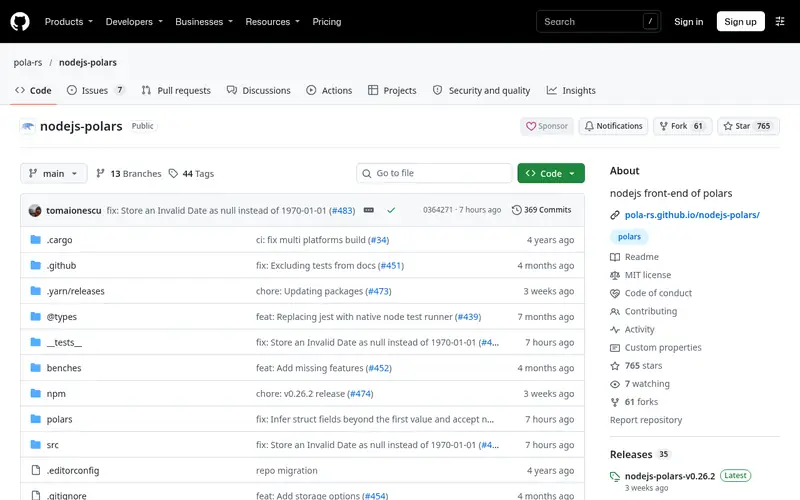
nodejs-polars binds the Rust Polars engine to Node.js. You get DataFrame and Series types, expression-based column operations, lazy queries, joins, groupbys and CSV, Parquet and JSON reading. Because the heavy work happens in native code, it handles large tables faster than pure JavaScript libraries in most cases.
The trade-off is a native binary. Installation pulls a prebuilt binary for common platforms, and deployment targets need a matching build. Serverless environments and some container images can be awkward. The API follows Polars, so it differs from pandas and from the JavaScript libraries here. Documentation is in the repository, and the project tracks upstream Polars releases.
Use nodejs-polars for backend jobs that process large files or need Parquet support. Skip it if you need browser execution or cannot manage native dependencies in your deploy pipeline.
Standout: Rust Polars engine behind a Node API
Free (open source), as listed by the vendor (nodejs-polars website). Confirm the current plan price before you buy.
Free plan. Plans change, so confirm on the vendor's pricing page before you buy.
Benefits
- Rust Polars engine behind a Node API
- lazy queries and expression syntax
Drawbacks
- Native binary dependency complicates deployment
- API tracks Polars and can change
Skip it if this limit matters to you: native binary dependency complicates deployment.
Verdict. A sensible pick for fast server-side columnar processing in Node.js.
Alternatives in this guide: Arquero, Danfo.js, DuckDB-Wasm
DuckDB-Wasm
Best for sQL over local files and Arrow data in the browser
What it is and where it fits
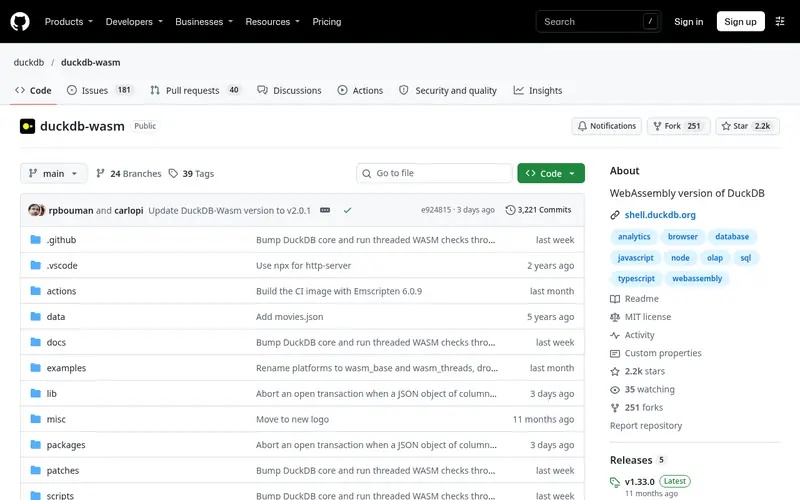
DuckDB-Wasm compiles the DuckDB analytical database to WebAssembly so it runs in the browser and in Node.js. You query Parquet, CSV and Arrow data with SQL, including joins, window functions and aggregations. Results come back as Arrow tables that you can pass to other libraries or render.
This is a different model from a dataframe API: you write SQL instead of chained method calls. That suits analysts and developers comfortable with SQL, and it keeps large-file work off the server. In the browser, memory is bounded by the tab and by the WebAssembly heap, so very large datasets need care. The project documents bundle variants and worker setup.
Choose DuckDB-Wasm when SQL fits your problem and you want local, offline-capable querying. Skip it if you want a method-chaining dataframe API or need to avoid WebAssembly startup cost.
Standout: Full SQL engine compiled to WebAssembly
Free (open source), as listed by the vendor (DuckDB-Wasm website). Confirm the current plan price before you buy.
Free plan. Plans change, so confirm on the vendor's pricing page before you buy.
Benefits
- Full SQL engine compiled to WebAssembly
- reads Parquet, CSV and Arrow
Drawbacks
- SQL rather than a dataframe API
- memory limits in the browser tab
Skip it if this limit matters to you: SQL rather than a dataframe API.
Verdict. A sensible pick for SQL over local files and Arrow data in the browser.
Alternatives in this guide: Arquero, Danfo.js, nodejs-polars
Apache Arrow JS
Best for columnar memory format and IPC between systems
What it is and where it fits
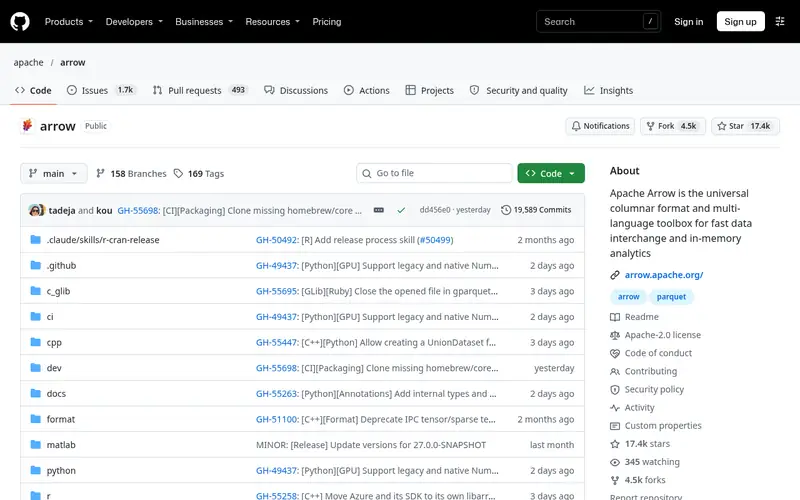
Apache Arrow JS implements the Arrow columnar memory format in JavaScript. It provides Table, RecordBatch and Vector types, plus readers and writers for the Arrow IPC format and helpers for CSV and JSON conversion. It is the interchange layer that many other tools use, including Arquero and DuckDB-Wasm.
Arrow JS is not a dataframe library in the pandas sense. It gives you typed columns and efficient transfer, but filtering, grouping and joining are left to you or to a library built on top. That makes it a building block rather than a daily driver for analysis. Documentation sits in the Apache Arrow repository under the js directory.
Use Arrow JS when you need a shared columnar format across services or want to feed another library. Skip it if you expect a ready-made transform API.
Standout: Standard columnar format with cross-language support
Free (open source), as listed by the vendor (Apache Arrow JS website). Confirm the current plan price before you buy.
Free plan. Plans change, so confirm on the vendor's pricing page before you buy.
Benefits
- Standard columnar format with cross-language support
- zero-copy reads from Arrow sources
Drawbacks
- Not a full dataframe API
- you add a query or transform layer yourself
Skip it if this limit matters to you: not a full dataframe API.
Verdict. A sensible pick for columnar memory format and IPC between systems.
Alternatives in this guide: Arquero, Danfo.js, nodejs-polars
tidy.js
Best for small, typed tidy-data transforms in TypeScript
What it is and where it fits
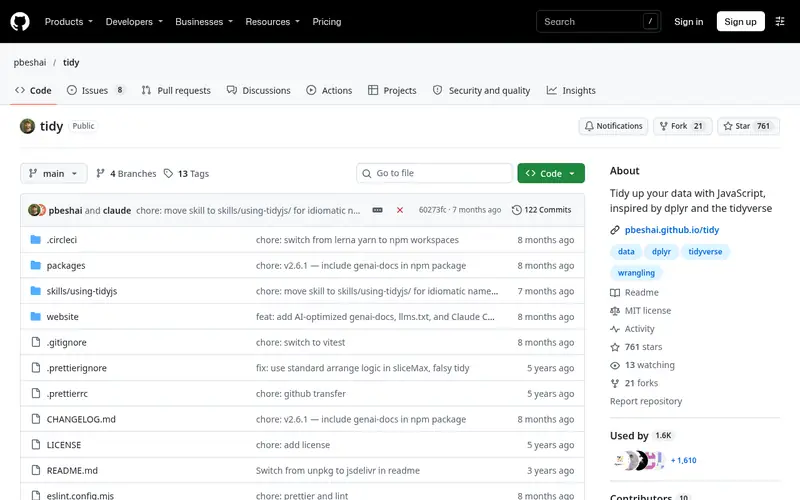
tidy.js provides tidy-data verbs for JavaScript and TypeScript: select, filter, mutate, arrange, summarize, groupBy and joins. It is written in TypeScript and ships types, which helps in typed codebases. The API is compact and the library is small, so it fits into front-end bundles without much weight.
The scope is deliberately narrow. It handles in-memory arrays of objects well, but it does not aim to be a full analytical engine, and it lacks the breadth of pandas-style libraries. Documentation is in the repository with examples for each verb. Performance is fine for app-scale data and not intended for very large tables.
Pick tidy.js when you want typed, minimal transforms inside a TypeScript app. Skip it if you need Parquet, lazy queries or large-file processing.
Standout: Typed TypeScript API
Free (open source), as listed by the vendor (tidy.js website). Confirm the current plan price before you buy.
Free plan. Plans change, so confirm on the vendor's pricing page before you buy.
Benefits
- Typed TypeScript API
- small surface for common tidy operations
Drawbacks
- Narrower feature set than Danfo.js or Polars
- smaller community
Skip it if this limit matters to you: narrower feature set than Danfo.js or Polars.
Verdict. A sensible pick for small, typed tidy-data transforms in TypeScript.
Alternatives in this guide: Arquero, Danfo.js, nodejs-polars
data-forge
Best for chainable data transforms in older JavaScript projects
What it is and where it fits
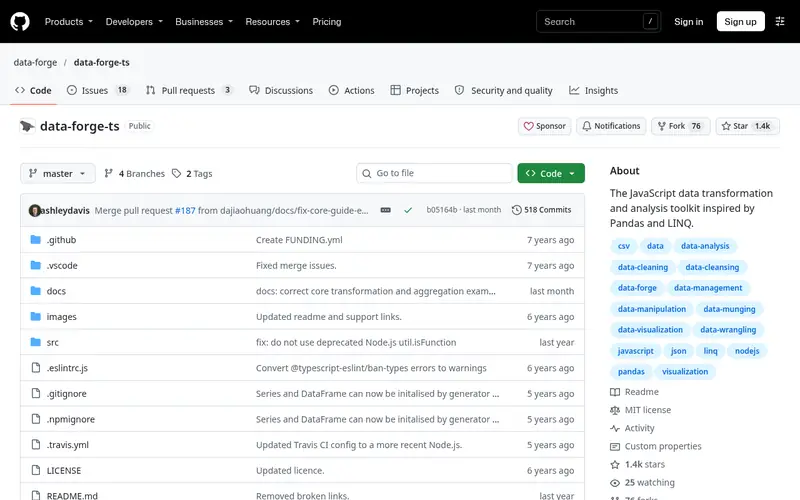
data-forge is one of the older JavaScript dataframe libraries. It offers DataFrame and Series types with a chainable API for filtering, selecting, grouping, joining and transforming data, plus CSV and JSON input and output. It runs in Node.js and the browser and installs from npm.
The project has been around for years, and its release cadence is slower than newer options. That does not stop it from working, but check the repository for recent commits and open issues before adopting it for a new project. Documentation covers the core API and common recipes. It is a reasonable fit for maintaining existing code that already depends on it.
Choose data-forge for legacy projects already using it. For new work, compare Arquero or tidy.js first, since they see more active development.
Standout: Long-standing library with a chainable API
Free (open source), as listed by the vendor (data-forge website). Confirm the current plan price before you buy.
Free plan. Plans change, so confirm on the vendor's pricing page before you buy.
Benefits
- Long-standing library with a chainable API
- reads CSV and JSON
Drawbacks
- Development pace has slowed
- fewer recent updates than newer libraries
Skip it if this limit matters to you: development pace has slowed.
Verdict. A sensible pick for chainable data transforms in older JavaScript projects.
Alternatives in this guide: Arquero, Danfo.js, nodejs-polars
Who should use what
For a web dashboard that filters and groups CSV data in the browser, Arquero is the straightforward choice. For a team porting pandas notebooks to JavaScript, Danfo.js keeps the mental model. For a backend job that reads Parquet files at scale, nodejs-polars is the fit. For analysts who prefer SQL over method chains, DuckDB-Wasm runs queries locally in the browser or in Node.js. If you need a shared columnar format between services, start with Apache Arrow JS and add a transform layer.
Questions to settle before you buy
What to check before you buy
- Confirm the library runs where you need it: browser, Node.js, serverless or edge.
- Check the licence in the repository and whether it fits your distribution model.
- Measure bundle size impact if the library ships to the browser.
- Test with your real data size and column types, including missing values and dates.
- Review native dependency or WebAssembly requirements against your deploy pipeline.
- Verify the project has recent commits and responsive issue handling.
FAQ
Do I need a dataframe library if I already use arrays and map/filter?
Not always. Plain arrays and array methods handle small tables well. A dataframe library helps when you need joins, groupbys, typed columns, CSV or Parquet parsing, or lazy queries. For a few hundred rows, built-in methods are often simpler and add no dependency.
Which library works best in the browser?
Arquero, Danfo.js, tidy.js and DuckDB-Wasm all run in the browser. Arquero and tidy.js are small and focused on transforms. Danfo.js brings a pandas-like API and TensorFlow.js integration. DuckDB-Wasm gives you SQL and can read Parquet locally, but it carries a larger WebAssembly payload.
Can these libraries read Parquet files?
nodejs-polars and DuckDB-Wasm read Parquet directly. Apache Arrow JS handles the Arrow IPC format and can be paired with readers for other formats. Pure JavaScript libraries like Arquero and Danfo.js focus on CSV and JSON, so convert Parquet first or use a library that supports it.
Is my data sent anywhere when I use these tools?
These are libraries you install and run, not hosted services. Processing happens in your process, whether that is a browser tab or a Node.js server. That keeps data local, but review each library's dependencies and any optional remote features before using it with sensitive data.
What about TypeScript support?
tidy.js is written in TypeScript and ships types. Arquero, Danfo.js, nodejs-polars and Apache Arrow JS include type definitions in their packages. Check the version you install, since type coverage can lag behind runtime features in some projects.
Sources we checked
Method: how we score · editorial policy.
Change log. First published 27 Nov 2026.