Stage 03 · Host · Researched comparison
Best Java Caching Libraries in 2026
Caffeine is the first pick for most teams that need a fast in-process cache, because it is small, well documented and widely used behind Spring and other frameworks. Choose Ehcache when you need a JSR-107 provider with disk spillover and a long track record. Choose Hazelcast or Infinispan when the cache must be distributed across several JVMs and you also want clustering features.

By Shihab Mia
Published 27 Nov 2026 · 7 tools compared
We run no ads and no affiliate links at launch. The order of a list follows our published method. See how we score.
Prices are the starting prices vendors list publicly. Plans change, so confirm the current price on the vendor page before you buy.
Key takeaways
- Caffeine, Ehcache, Guava Cache, Infinispan and cache2k are free and open source; Hazelcast and Redisson mix open-source and commercial editions.
- Caffeine is the usual successor to Guava Cache, and the Guava project itself points users to Caffeine for new work.
- In-process caches such as Caffeine and cache2k keep data inside one JVM, so each node has its own copy and invalidation is your job.
- Distributed caches such as Hazelcast, Redisson and Infinispan add network hops and operational cost, so adopt them only when one JVM is not enough.
Who each pick is for
- Fast in-process caches in single-JVM servicesCaffeine
- JSR-107 caches with heap, off-heap and disk tiersEhcache
- Existing codebases already built on GuavaGuava Cache
- Distributed in-memory caches across a cluster of JVMsHazelcast
- Java teams that already run Redis and want cache semanticsRedisson
- Distributed caches with persistence and JCache supportInfinispan
- Lightweight in-process caches with low overheadcache2k
Comparison
| Tool | Best for | Standout feature | Listed starting price | Free plan or trial |
|---|---|---|---|---|
| 1Caffeine | Fast in-process caches in single-JVM services | High hit rates from the Window TinyLFU eviction policy | Free (open source) | Free plan |
| 2Ehcache | JSR-107 caches with heap, off-heap and disk tiers | Tiered storage from heap to off-heap to disk | Free (open source) | Free plan |
| 3Guava Cache | Existing codebases already built on Guava | Familiar API for teams already using Guava | Free (open source) | Free plan |
| 4Hazelcast | Distributed in-memory caches across a cluster of JVMs | Distributed maps with near-cache support | See vendor pricing page | Free plan |
| 5Redisson | Java teams that already run Redis and want cache semantics | Rich Redis client with maps, locks and JCache support | See vendor pricing page | Free plan |
| 6Infinispan | Distributed caches with persistence and JCache support | Distributed and replicated modes with persistence | Free (open source) | Free plan |
| 7cache2k | Lightweight in-process caches with low overhead | Small footprint with a focus on low latency | Free (open source) | Free plan |
How we picked
We picked libraries that are actively maintained and genuinely provide caching for Java, then compared them on fit for in-process versus distributed use, supported platforms and JDK versions, licence and pricing model, and the main operational limits. Sources are vendor websites, official documentation and project repositories. We did not run benchmarks or collect user reviews. Prices and edition features change, so confirm current terms on the vendor site before you commit.
The tools, one by one
Caffeine
Best for fast in-process caches in single-JVM services
What it is and where it fits
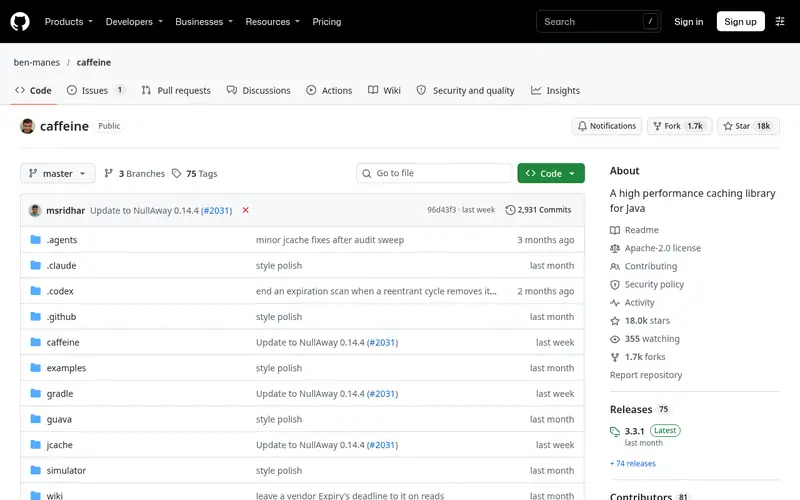
Caffeine is a Java caching library for in-memory caches. You build a cache with a maximum size or weight, an expiry policy and an optional loader, and Caffeine handles eviction and refresh. It uses the Window TinyLFU policy, which combines a small admission window with a frequency sketch to decide what to keep. The API covers synchronous and asynchronous caches, manual and loading caches, and removal listeners.
It runs on any current JVM and integrates with Spring Cache through a community adapter. The project is Apache License 2.0. Because it is in-process, every application node holds its own copy of the data, so you need a separate mechanism to invalidate entries across nodes. Teams that need a shared cache across many JVMs should look at a distributed option instead.
Standout: High hit rates from the Window TinyLFU eviction policy
Free (open source), as listed by the vendor (Caffeine website). Confirm the current plan price before you buy.
Free plan. Plans change, so confirm on the vendor's pricing page before you buy.
Benefits
- High hit rates from the Window TinyLFU eviction policy
- simple builder API with async loading and expiry
Drawbacks
- Data lives in one JVM only
- no built-in distributed mode
Skip it if this limit matters to you: data lives in one JVM only.
Verdict. A sensible pick for fast in-process caches in single-JVM services.
Alternatives in this guide: Ehcache, Guava Cache, Hazelcast
Ehcache
Best for jSR-107 caches with heap, off-heap and disk tiers
What it is and where it fits
Ehcache is one of the older Java caching libraries and still widely deployed. Version 3 is a complete rewrite that stores entries in tiers: heap, off-heap memory and disk. You can set a size limit per tier and let entries move down as they age. It ships a JSR-107 provider, so code written against the standard caching API can run on Ehcache without changes.
Ehcache 3 is Apache License 2.0. The main caveat is clustering: the version 3 line dropped the clustered cache that existed in version 2, so a shared cache across nodes needs another product. Configuration through XML or the builder API takes more effort than Caffeine. It suits teams that need disk spillover for large data sets or a standards-based provider.
Standout: Tiered storage from heap to off-heap to disk
Free (open source), as listed by the vendor (Ehcache website). Confirm the current plan price before you buy.
Free plan. Plans change, so confirm on the vendor's pricing page before you buy.
Benefits
- Tiered storage from heap to off-heap to disk
- a JSR-107 (JCache) provider with a long history
Drawbacks
- Configuration is verbose
- clustering support was removed in version 3
Skip it if this limit matters to you: configuration is verbose.
Verdict. A sensible pick for JSR-107 caches with heap, off-heap and disk tiers.
Alternatives in this guide: Caffeine, Guava Cache, Hazelcast
Guava Cache
Best for existing codebases already built on Guava
What it is and where it fits
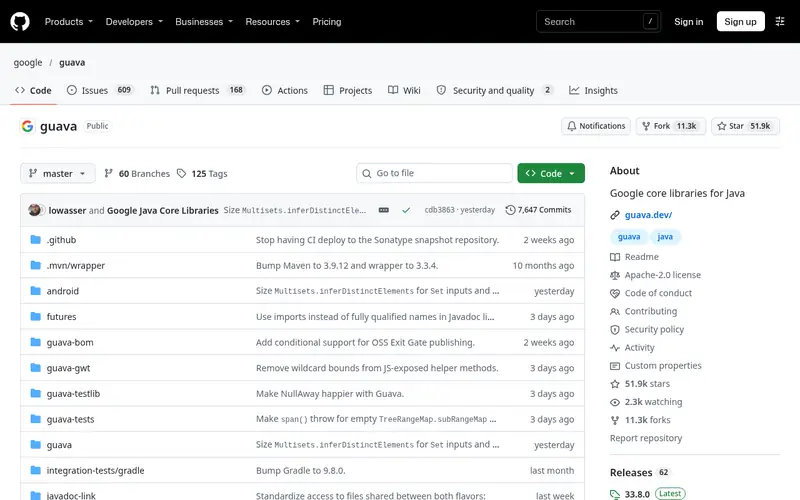
Guava Cache is part of the Google Guava libraries. It offers loading caches, size-based eviction, time-based expiry and removal listeners. For years it was the default choice for a simple in-process cache in Java projects, and a large amount of existing code still uses it.
The Guava project documentation now points readers to Caffeine for new caching work. Caffeine was written by the same author and offers better hit rates under size limits. Guava Cache remains Apache License 2.0 and still works, so there is no urgent need to migrate a stable codebase. For new services, start with Caffeine unless you are already deep in the Guava API.
Standout: Familiar API for teams already using Guava
Free (open source), as listed by the vendor (Guava Cache website). Confirm the current plan price before you buy.
Free plan. Plans change, so confirm on the vendor's pricing page before you buy.
Benefits
- Familiar API for teams already using Guava
- loading caches, size limits and expiry built in
Drawbacks
- Google recommends Caffeine for new caches
- the cache API is in maintenance mode
Skip it if this limit matters to you: google recommends Caffeine for new caches.
Verdict. A sensible pick for existing codebases already built on Guava.
Hazelcast
Best for distributed in-memory caches across a cluster of JVMs

What it is and where it fits
Hazelcast is an in-memory data grid. Its distributed map works as a cache shared across cluster members, with configurable backups and a near-cache option that keeps a local copy on each client to cut network calls. It integrates with JCache and with Spring Cache, and it can run embedded in your application or as a separate cluster.
The core is open source under the Apache License 2.0. Hazelcast also sells commercial editions with extra management, security and support features; check the vendor pricing page for current terms. The trade-off is complexity: you now run a cluster, plan for network partitions and size the heap across nodes. Teams with a single JVM or modest traffic should stay with an in-process cache.
Standout: Distributed maps with near-cache support
See vendor pricing page, as listed by the vendor (Hazelcast website). Confirm the current plan price before you buy.
Free plan. Plans change, so confirm on the vendor's pricing page before you buy.
Benefits
- Distributed maps with near-cache support
- clustering, partitioning and backups built in
Drawbacks
- Distributed setup adds operational work
- some management features sit in paid editions
Skip it if this limit matters to you: distributed setup adds operational work.
Verdict. A sensible pick for distributed in-memory caches across a cluster of JVMs.
Alternatives in this guide: Caffeine, Ehcache, Guava Cache
Redisson
Best for java teams that already run Redis and want cache semantics

What it is and where it fits
Redisson is a Redis client for Java that exposes Redis data structures as Java objects. For caching, it provides RMap, RMapCache with time-to-live and max-size settings, and a JSR-107 provider. Because the data lives in Redis, it is shared across all application nodes and survives restarts, which makes it a fit for session data and shared reference data.
The client is Apache License 2.0. Redisson Pro is a paid edition with extra features and support; see the vendor pricing page. The main cost is latency and infrastructure: each cache access is a network call, and you must run and monitor Redis. If your data fits in one JVM and you can tolerate per-node copies, an in-process cache is simpler and faster.
Standout: Rich Redis client with maps, locks and JCache support
See vendor pricing page, as listed by the vendor (Redisson website). Confirm the current plan price before you buy.
Free plan. Plans change, so confirm on the vendor's pricing page before you buy.
Benefits
- Rich Redis client with maps, locks and JCache support
- data survives JVM restarts
Drawbacks
- Requires a Redis server
- every cache read is a network round trip
Skip it if this limit matters to you: requires a Redis server.
Verdict. A sensible pick for java teams that already run Redis and want cache semantics.
Alternatives in this guide: Caffeine, Ehcache, Guava Cache
Infinispan
Best for distributed caches with persistence and JCache support

What it is and where it fits
Infinispan is a distributed in-memory key/value store from Red Hat. It can run embedded in a JVM or as a separate server cluster, and it supports replicated, distributed and invalidation cache modes. It offers persistence to disk, transactions and a JCache-compliant API, and it underlies several Red Hat middleware products.
The project is open source under the Apache License 2.0. Commercial support comes through Red Hat subscriptions; see the vendor pricing page. Infinispan is powerful but not lightweight: the configuration surface is large, and running a cluster means planning for discovery, rebalancing and upgrades. Small services are usually better served by Caffeine or cache2k, with Infinispan reserved for cases that need a shared, persistent data grid.
Standout: Distributed and replicated modes with persistence
Free (open source), as listed by the vendor (Infinispan website). Confirm the current plan price before you buy.
Free plan. Plans change, so confirm on the vendor's pricing page before you buy.
Benefits
- Distributed and replicated modes with persistence
- JCache-compliant and used inside Red Hat products
Drawbacks
- Heavy for small apps
- configuration and tuning take real effort
Skip it if this limit matters to you: heavy for small apps.
Verdict. A sensible pick for distributed caches with persistence and JCache support.
Alternatives in this guide: Caffeine, Ehcache, Guava Cache
cache2k
Best for lightweight in-process caches with low overhead
What it is and where it fits
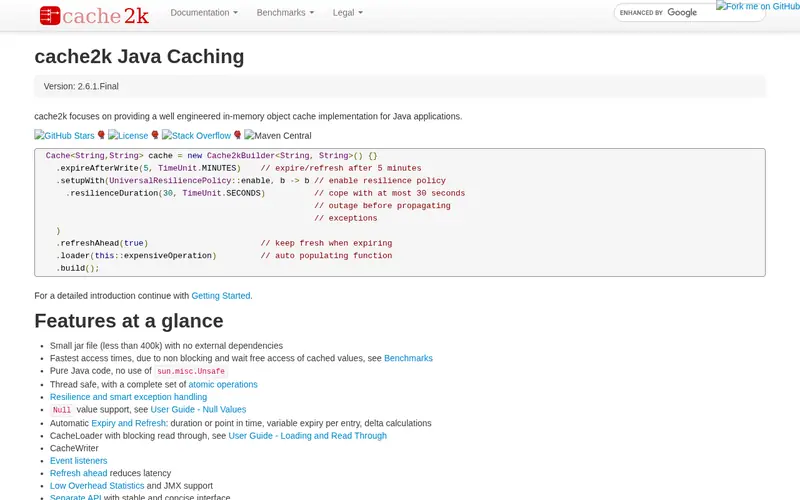
cache2k is an in-memory Java cache library built for speed and a small dependency footprint. It provides a builder API, expiry, size limits, loaders and statistics, plus a JCache implementation and Spring Cache integration. The project publishes benchmarks and tuning notes on its site, and the design targets low per-operation overhead.
cache2k is Apache License 2.0. Like Caffeine, it keeps data inside one JVM, so cross-node invalidation is your responsibility. The community and ecosystem are smaller than Caffeine's, which matters when you need examples or third-party adapters. It is a reasonable pick for teams that want a compact cache and are willing to evaluate hit rates against Caffeine on their own workload.
Standout: Small footprint with a focus on low latency
Free (open source), as listed by the vendor (cache2k website). Confirm the current plan price before you buy.
Free plan. Plans change, so confirm on the vendor's pricing page before you buy.
Benefits
- Small footprint with a focus on low latency
- JCache support and Spring integration
Drawbacks
- Smaller community than Caffeine
- fewer third-party integrations
Skip it if this limit matters to you: smaller community than Caffeine.
Verdict. A sensible pick for lightweight in-process caches with low overhead.
Alternatives in this guide: Caffeine, Ehcache, Guava Cache
Who should use what
A single Spring Boot service that needs a fast local cache should start with Caffeine, and can add cache2k if it wants a smaller dependency. A team that must avoid vendor lock-in and already has a provider in place should code against JCache. An application that needs disk spillover for large data sets should look at Ehcache. A platform with many JVMs that must share cached data should evaluate Hazelcast, Redisson on existing Redis, or Infinispan, and accept the extra operational work that comes with each.
Questions to settle before you buy
What to check before you buy
- Confirm whether one JVM holds the data or several nodes must share it, since that decides in-process versus distributed.
- Check the licence of the exact artifact you depend on, including any paid edition features you rely on.
- Measure your own hit rate and memory use under a realistic key distribution before choosing an eviction policy.
- Plan how entries are invalidated across nodes if you run more than one instance.
- Verify JDK version support and the maintenance status of the project's last release.
FAQ
Is Caffeine a drop-in replacement for Guava Cache?
No. The APIs are similar but not identical, and Caffeine's builder differs from Guava's CacheBuilder. Porting usually means changing construction code and a few method calls. Google's own documentation recommends Caffeine for new caches, so new code should start there rather than with Guava Cache.
Do I need a distributed cache?
Only if more than one JVM must read the same cached data and stale copies are not acceptable. A single service with one or a few nodes can often use an in-process cache and accept short-lived staleness. Distributed caches add a cluster, network latency and new failure modes, so adopt one when the shared state requirement is real.
What is JCache and should I use it?
JCache is the JSR-107 standard caching API for Java. It lets you write cache code against a standard interface and swap providers such as Ehcache, Hazelcast, Infinispan or Redisson. Use it when portability across providers matters. If you are happy with one library, its native API usually exposes more features.
Can these libraries cache data to disk?
Ehcache 3 can spill entries to disk as part of its tiered storage. Infinispan supports persistence to disk in both embedded and server modes. Caffeine, Guava Cache, cache2k and Redisson keep data in memory, or in Redis for Redisson, and do not offer a local disk tier.
Does caching sensitive data raise privacy issues?
Yes. Cached values sit in heap, off-heap memory or a shared server, and may be dumped in heap dumps or logs. Avoid caching secrets and personal data unless you control access and expiry. For any online formatter or converter you use alongside your code, do not paste tokens or production data into third-party pages.
Sources we checked
Method: how we score · editorial policy.
Change log. First published 27 Nov 2026.