Stage 03 · Host · Researched comparison
Best Haskell Web Frameworks in 2026
Yesod is the first pick for teams that want a full, type-safe framework with routing, templates and database helpers in one package. Servant suits projects where the API is the product and types should describe the endpoints. IHP is a good alternative for developers who want a batteries-included framework with a built-in dev server and code generator. All are open source.

By Shihab Mia
Published 27 Nov 2026 · 6 tools compared
We run no ads and no affiliate links at launch. The order of a list follows our published method. See how we score.
Prices are the starting prices vendors list publicly. Plans change, so confirm the current price on the vendor page before you buy.
Key takeaways
- Yesod, Servant, IHP, Scotty, Spock and Snap are all free and open source, so cost is not a selection factor.
- Yesod and IHP are full frameworks; Servant, Scotty, Spock and Snap give you routing and leave the rest to libraries.
- Check commit activity and release history on each repository before adopting a smaller framework, since maintenance pace varies.
Who each pick is for
- Teams wanting a full, type-safe framework with conventionsYesod
- Type-level API definitions that generate servers and clientsServant
- Rapid full-stack apps with a built-in dev environmentIHP
- Small web apps and APIs with minimal ceremonyScotty
- Type-safe routing with a lightweight footprintSpock
- Older or template-driven apps already on the Snap stackSnap
Comparison
| Tool | Best for | Standout feature | Listed starting price | Free plan or trial |
|---|---|---|---|---|
| 1Yesod | Teams wanting a full, type-safe framework with conventions | Integrated routing, templates and persistence helpers | Free (open source) | Free plan |
| 2Servant | Type-level API definitions that generate servers and clients | API types drive server, client and docs | Free (open source) | Free plan |
| 3IHP | Rapid full-stack apps with a built-in dev environment | Code generator, dev server and live reload in one toolchain | Free (open source) | Free plan |
| 4Scotty | Small web apps and APIs with minimal ceremony | Small API and fast to learn | Free (open source) | Free plan |
| 5Spock | Type-safe routing with a lightweight footprint | Typed route parameters and clear handler types | Free (open source) | Free plan |
| 6Snap | Older or template-driven apps already on the Snap stack | Mature design with its own template and auth libraries | Free (open source) | Free plan |
How we picked
We compared projects on fit for building web applications and APIs in Haskell, supported platforms, licence and pricing, and the size of the maintained ecosystem around each. We looked at how much structure each framework provides, how actively its repository is maintained, and what you must assemble yourself. Sources are official project sites, documentation and repository pages. Prices and licences can change, so confirm details on the project site before you commit.
The tools, one by one
Yesod
Best for teams wanting a full, type-safe framework with conventions
What it is and where it fits
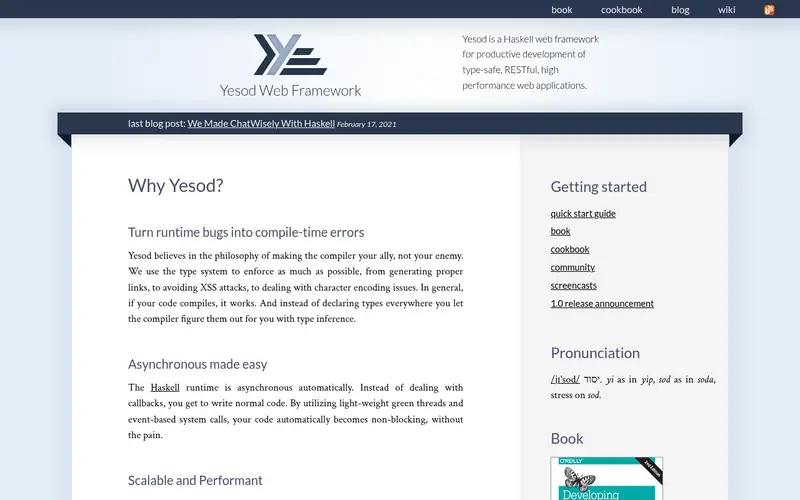
Yesod is a full-stack web framework built around compile-time safety. Routes are declared in a single file and checked by the compiler. It ships with Shakespeare templates (Hamlet, Lucius, Julius), Persistent for database access, and helpers for forms, authentication and sessions. It runs on Warp and works on Linux, macOS and Windows through GHC.
The framework is licensed under MIT and is free to use. Its main cost is complexity: the template Haskell machinery means longer builds and more upfront learning than a micro-framework. Documentation is thorough but assumes comfort with Haskell type-level concepts.
Choose Yesod when you want one framework to make most decisions for you and you value compile-time route checking. Skip it for a small JSON service, where Servant or Scotty will be lighter.
Standout: Integrated routing, templates and persistence helpers
Free (open source), as listed by the vendor (Yesod website). Confirm the current plan price before you buy.
Free plan. Plans change, so confirm on the vendor's pricing page before you buy.
Benefits
- Integrated routing, templates and persistence helpers
- strong compile-time safety
Drawbacks
- Steep learning curve
- template Haskell can slow builds
Skip it if this limit matters to you: steep learning curve.
Verdict. A sensible pick for teams wanting a full, type-safe framework with conventions.
Servant
Best for type-level API definitions that generate servers and clients
What it is and where it fits
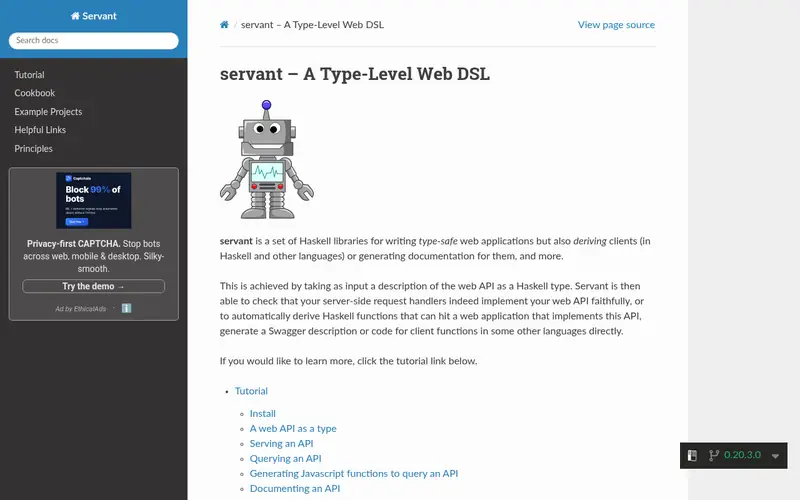
Servant describes a web API as a Haskell type. From that type you get a server implementation, client functions, and generated documentation through servant-swagger or OpenAPI tooling. It runs on Warp and is BSD-3-Clause licensed.
The framework is not opinionated about templates or databases. That makes it a good fit for JSON APIs, microservices and internal services where the contract matters. It is less suited to server-rendered sites, where Yesod or IHP give you more out of the box.
Expect a learning period. Servant's type errors are notorious for being verbose, and the ecosystem of companion packages takes time to map out. Once learned, the payoff is that a changed endpoint breaks compilation in both server and client code.
Standout: API types drive server, client and docs
Free (open source), as listed by the vendor (Servant website). Confirm the current plan price before you buy.
Free plan. Plans change, so confirm on the vendor's pricing page before you buy.
Benefits
- API types drive server, client and docs
- strong composition
Drawbacks
- Type errors can be hard to read
- no built-in frontend layer
Skip it if this limit matters to you: type errors can be hard to read.
Verdict. A sensible pick for type-level API definitions that generate servers and clients.
IHP
Best for rapid full-stack apps with a built-in dev environment
What it is and where it fits
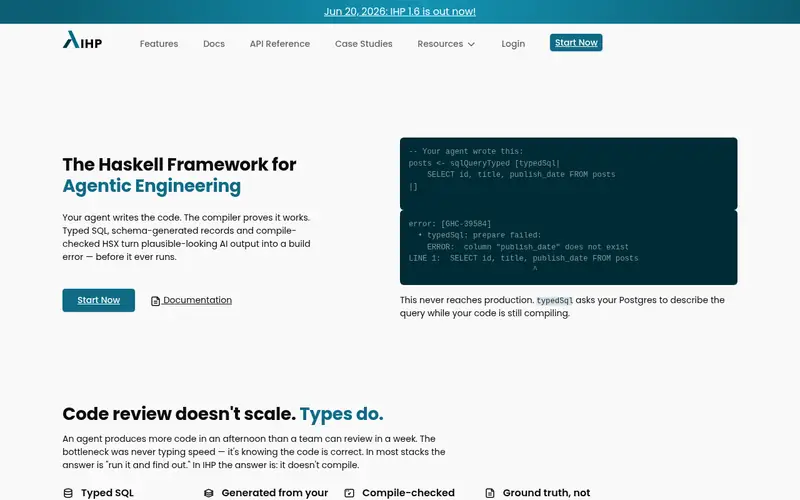
IHP (Integrated Haskell Platform) is a full-stack framework with its own development server, a code generator for controllers and views, and a PostgreSQL-first data layer. It uses HSX for markup and includes live reload during development. It is MIT licensed and free.
IHP targets developers who want to start a working app quickly without wiring together many libraries. The trade-off is that it brings its own conventions and tooling, so you are committing to the IHP way of doing things. The community is smaller than Yesod's, which matters when you need answers to unusual questions.
Pick IHP for new full-stack projects where speed of setup matters. Skip it if you need to fit into an existing stack or want minimal framework opinion.
Standout: Code generator, dev server and live reload in one toolchain
Free (open source), as listed by the vendor (IHP website). Confirm the current plan price before you buy.
Free plan. Plans change, so confirm on the vendor's pricing page before you buy.
Benefits
- Code generator, dev server and live reload in one toolchain
- guided project structure
Drawbacks
- Opinionated stack
- smaller ecosystem than Yesod
Skip it if this limit matters to you: opinionated stack.
Verdict. A sensible pick for rapid full-stack apps with a built-in dev environment.
Scotty
Best for small web apps and APIs with minimal ceremony
What it is and where it fits
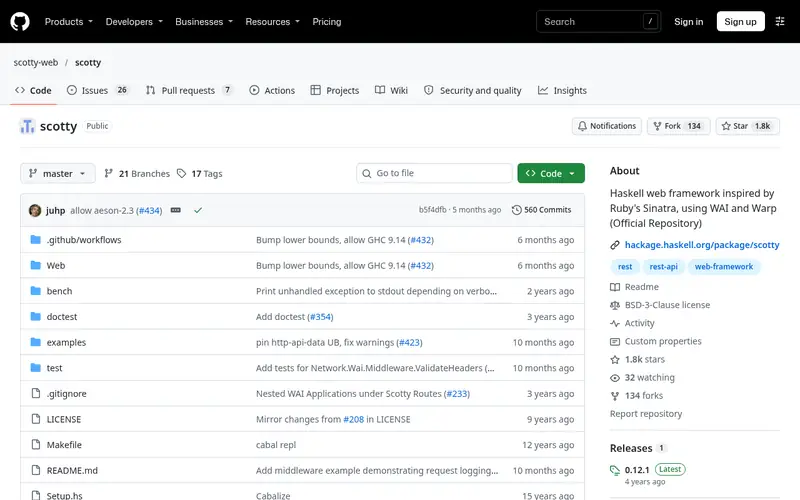
Scotty is a micro-framework in the style of Sinatra. You define routes with simple combinators and handlers, and it runs on Warp. It is BSD-3-Clause licensed and free.
Scotty is a good choice for small services, prototypes, internal tools and JSON endpoints where you do not want a full framework's structure. It does not include templates, an ORM or authentication; you add libraries such as lucid for HTML and persistent or postgresql-simple for data access.
The framework is actively used and maintained on its GitHub repository. Because it is small, the risk is not the framework itself but the assembly work: you own the choices for sessions, logging and error handling. Skip Scotty for large applications where a full framework's conventions would save time.
Standout: Small API and fast to learn
Free (open source), as listed by the vendor (Scotty website). Confirm the current plan price before you buy.
Free plan. Plans change, so confirm on the vendor's pricing page before you buy.
Benefits
- Small API and fast to learn
- easy to read route definitions
Drawbacks
- Few built-in features
- you choose and wire most libraries
Skip it if this limit matters to you: few built-in features.
Verdict. A sensible pick for small web apps and APIs with minimal ceremony.
Spock
Best for type-safe routing with a lightweight footprint
What it is and where it fits
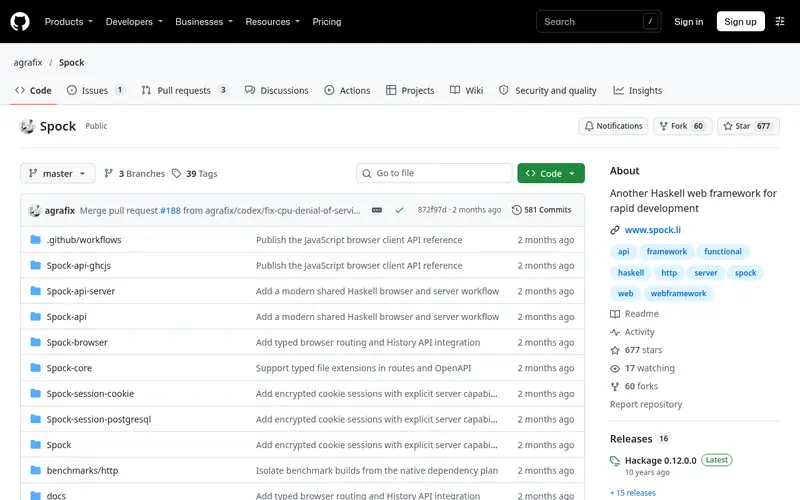
Spock is a lightweight framework built on Warp with a focus on type-safe routing. Route captures are typed, so parameters arrive in handlers with the right type. It is BSD-3-Clause licensed and free.
Spock sits between Scotty and the full frameworks. It offers more type safety in routing than Scotty but fewer batteries than Yesod. It supports sessions, cookies and basic middleware through companion packages.
Maintenance deserves care here. Check the repository's recent commits and release history before adopting Spock for a long-lived project. If steady release cadence is a hard requirement, Scotty or Servant may be safer picks. Spock still suits small services where its typed routing fits well.
Standout: Typed route parameters and clear handler types
Free (open source), as listed by the vendor (Spock website). Confirm the current plan price before you buy.
Free plan. Plans change, so confirm on the vendor's pricing page before you buy.
Benefits
- Typed route parameters and clear handler types
- small core
Drawbacks
- Slower release cadence
- smaller community than Scotty
Skip it if this limit matters to you: slower release cadence.
Verdict. A sensible pick for type-safe routing with a lightweight footprint.
Snap
Best for older or template-driven apps already on the Snap stack
What it is and where it fits
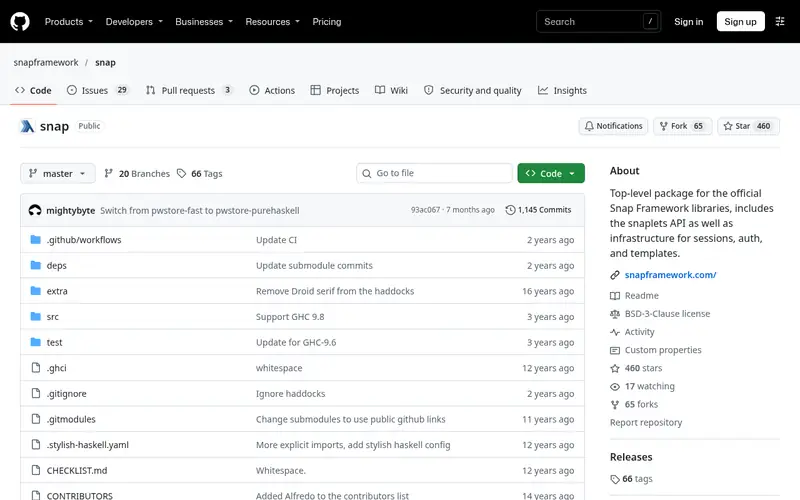
Snap is a web framework with its own HTTP server, a template system (Heist) and companion libraries for authentication and sessions. It is BSD-3-Clause licensed and free.
Snap was designed for performance and a clean handler model. It remains usable and documented, but its ecosystem and community are smaller than Yesod's or Servant's. New projects usually pick one of those instead.
Choose Snap if you maintain an existing Snap application or specifically want Heist templates. For greenfield work, weigh the smaller community and slower release cadence against the framework's stability. Check the repository activity before committing to a long project.
Standout: Mature design with its own template and auth libraries
Free (open source), as listed by the vendor (Snap website). Confirm the current plan price before you buy.
Free plan. Plans change, so confirm on the vendor's pricing page before you buy.
Benefits
- Mature design with its own template and auth libraries
- runs on its own server
Drawbacks
- Smaller ecosystem today
- slower pace of change than newer frameworks
Skip it if this limit matters to you: smaller ecosystem today.
Verdict. A sensible pick for older or template-driven apps already on the Snap stack.
Who should use what
If you are building a server-rendered application and want conventions, start with Yesod. If your product is a JSON API and you want the types to define the contract, use Servant. If you want a working full-stack app quickly with a guided toolchain, try IHP. For small services, prototypes or internal tools, Scotty keeps the code short. Teams maintaining an existing Snap app should stay on Snap, and anyone curious about the server layer under these frameworks should read the Warp documentation.
Questions to settle before you buy
What to check before you buy
- Confirm the framework's repository has recent commits and releases, especially for Spock and Snap.
- Check that the GHC versions you need are supported by the framework and its key libraries.
- Decide whether you want a full framework (Yesod, IHP) or routing only (Scotty, Servant, Spock).
- Review how database access, sessions and authentication are handled, since these differ per framework.
- Read the licence (MIT or BSD-3-Clause for all listed projects) and confirm it fits your organisation.
FAQ
Are these Haskell web frameworks free?
Yes. Yesod, Servant, IHP, Scotty, Spock and Snap are all open source under MIT or BSD-3-Clause licences. There is no paid tier for the frameworks themselves. Costs come from hosting, database services and developer time, not from framework licensing.
Should I use Yesod or Servant?
Use Yesod for server-rendered sites where you want routing, templates and persistence in one framework. Use Servant when the API contract is central and you want types to generate servers, clients and documentation. Some projects use both ideas, but most pick one as the primary structure.
Is Spock still maintained?
Spock's repository shows a slower release cadence than Scotty or Servant. Check the commit history and open issues before adopting it for a long-lived project. For new work where steady releases matter, Scotty or Servant are safer choices.
Do I need to worry about pasting data into these tools?
No. These are libraries and frameworks you install and run locally, not online web utilities. Your source code and data stay on your own machine and servers. The usual advice still applies: keep secrets out of source control and use environment variables for credentials.
Sources we checked
Method: how we score · editorial policy.
Change log. First published 27 Nov 2026.