Stage 03 · Host · Researched comparison
Best Go Task Queues for Background Jobs in 2026
Asynq is the first pick for most teams that already run Redis and want a simple background job queue in Go. River suits teams that want jobs stored and processed inside PostgreSQL with transactional enqueue. Temporal fits complex, long-running workflows that need durable state, and Watermill fits event-driven messaging between services. All four are open source, so the main cost is the infrastructure you already operate.

By Shihab Mia
Published 27 Nov 2026 · 6 tools compared
We run no ads and no affiliate links at launch. The order of a list follows our published method. See how we score.
Prices are the starting prices vendors list publicly. Plans change, so confirm the current price on the vendor page before you buy.
Key takeaways
- Asynq, River, Machinery, Temporal, Faktory and Watermill are all open source, so the libraries themselves are free to use.
- Asynq needs Redis, River needs PostgreSQL, and Watermill connects to a message broker such as Kafka, RabbitMQ or NATS.
- Temporal runs as a separate server cluster and adds operational work beyond a plain library.
- Faktory uses its own server and protocol, and the Go worker is a client library, not a full queue server.
Who each pick is for
Comparison
| Tool | Best for | Standout feature | Listed starting price | Free plan or trial |
|---|---|---|---|---|
| 1Asynq | Go teams already running Redis | Simple API backed by Redis | Free (open source) | Free plan |
| 2River | Teams that want jobs inside PostgreSQL | Enqueue jobs in the same transaction as your data | Free (open source) | Free plan |
| 3Machinery | Go services that need a broker-agnostic queue | Supports several brokers and backends | Free (open source) | Free plan |
| 4Temporal | Durable, long-running workflows in Go | Durable workflow state and automatic retries | See vendor pricing page | Free plan |
| 5Faktory Go worker | Polyglot shops using a Faktory server | Language-agnostic job server with a Go client | Free (open source) | Free plan |
| 6Watermill | Event-driven Go services using message brokers | Works with Kafka, RabbitMQ, NATS and more | Free (open source) | Free plan |
How we picked
We picked projects that are real, standalone Go libraries or servers for background jobs and task processing, and that are currently maintained. Criteria were fit for the job, supported backends and platforms, licence and pricing model, and the main operational limits. Sources are official project repositories, vendor documentation and public pricing pages. Prices and licence terms change, so confirm them on the vendor site before you commit.
The tools, one by one
Asynq
Best for go teams already running Redis
What it is and where it fits
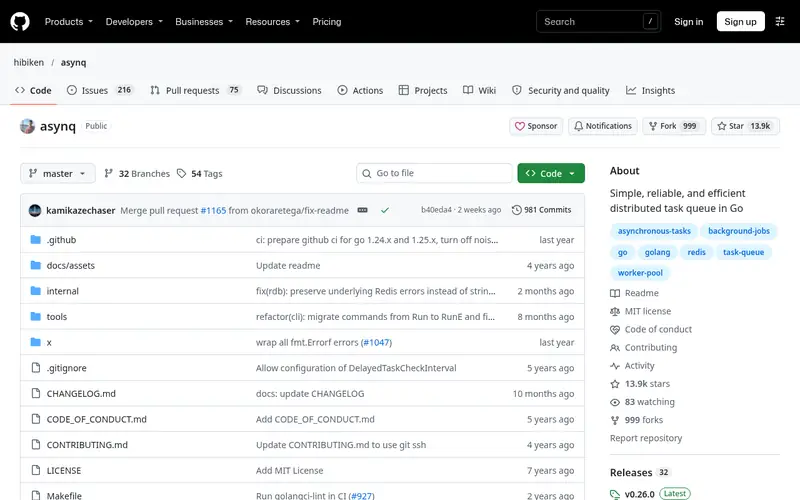
Asynq is a Go library for background task processing backed by Redis. You define tasks as structs, enqueue them with a client, and process them with a server that registers handlers per task type. It includes a scheduler for periodic jobs, configurable retries, priorities, timeouts and a web UI for inspecting queues.
It runs wherever your Go service runs, and Redis is the only external dependency. The project is open source under the MIT licence. It does not provide exactly-once delivery or durable workflow state, so it suits jobs that can be retried safely. Teams that need transactional enqueue tied to a database commit should look at River instead.
Standout: Simple API backed by Redis
Free (open source), as listed by the vendor (Asynq website). Confirm the current plan price before you buy.
Free plan. Plans change, so confirm on the vendor's pricing page before you buy.
Benefits
- Simple API backed by Redis
- built-in scheduler, retries and web UI
Drawbacks
- Requires a Redis deployment
- not a durable workflow engine
Skip it if this limit matters to you: requires a Redis deployment.
Verdict. A sensible pick for go teams already running Redis.
River
Best for teams that want jobs inside PostgreSQL
What it is and where it fits
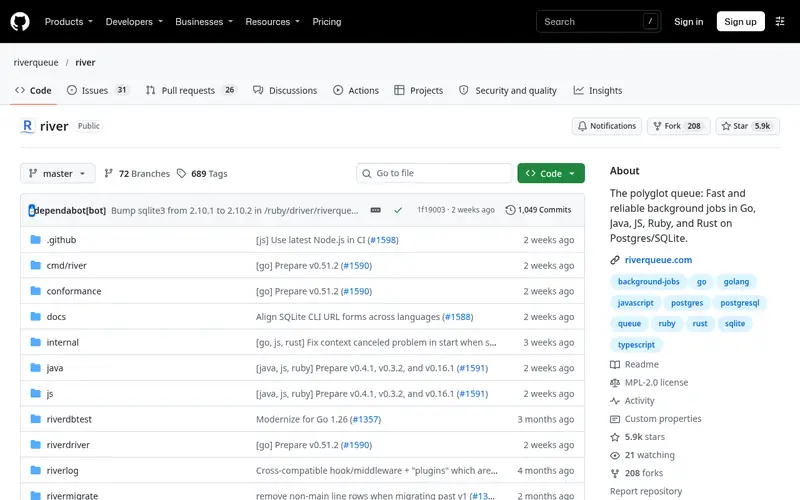
River is a job queue for Go that stores jobs in PostgreSQL. Because jobs live in the same database as your application data, you can insert a job in the same transaction as a business write, which avoids the dual-write problem common with Redis-backed queues. Workers poll the database and process jobs with registered handlers.
It is designed for Go services that already run PostgreSQL and want to avoid operating another datastore. The project is open source under the Mozilla Public License 2.0. Throughput depends on your database capacity, so very high job volumes may need tuning or a different backend. Teams without PostgreSQL, or with extreme throughput needs, should compare Asynq.
Standout: Enqueue jobs in the same transaction as your data
Free (open source), as listed by the vendor (River website). Confirm the current plan price before you buy.
Free plan. Plans change, so confirm on the vendor's pricing page before you buy.
Benefits
- Enqueue jobs in the same transaction as your data
- no extra datastore
Drawbacks
- Tied to PostgreSQL
- newer project with a smaller ecosystem
Skip it if this limit matters to you: tied to PostgreSQL.
Verdict. A sensible pick for teams that want jobs inside PostgreSQL.
Machinery
Best for go services that need a broker-agnostic queue
What it is and where it fits
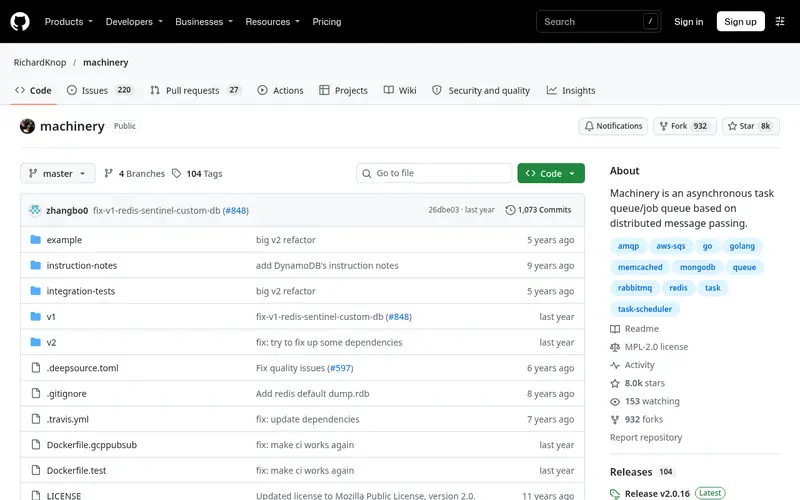
Machinery is an asynchronous task queue for Go built on distributed message passing. It supports AMQP (RabbitMQ), Redis and AWS SQS as brokers, with result backends including Redis, Memcached, MongoDB and AMQP. It offers task signatures, chains, groups, chords and periodic tasks.
It suits teams that want one library across different broker choices or that already run RabbitMQ. The project is open source. Its release cadence has been slower than some alternatives, so review the repository's recent activity and open issues before committing to it for new work. Teams that want an actively developed Redis queue should compare Asynq.
Standout: Supports several brokers and backends
Free (open source), as listed by the vendor (Machinery website). Confirm the current plan price before you buy.
Free plan. Plans change, so confirm on the vendor's pricing page before you buy.
Benefits
- Supports several brokers and backends
- task chains and groups
Drawbacks
- Slower release cadence
- check recent commits before adopting
Skip it if this limit matters to you: slower release cadence.
Verdict. A sensible pick for go services that need a broker-agnostic queue.
Temporal
Best for durable, long-running workflows in Go
What it is and where it fits
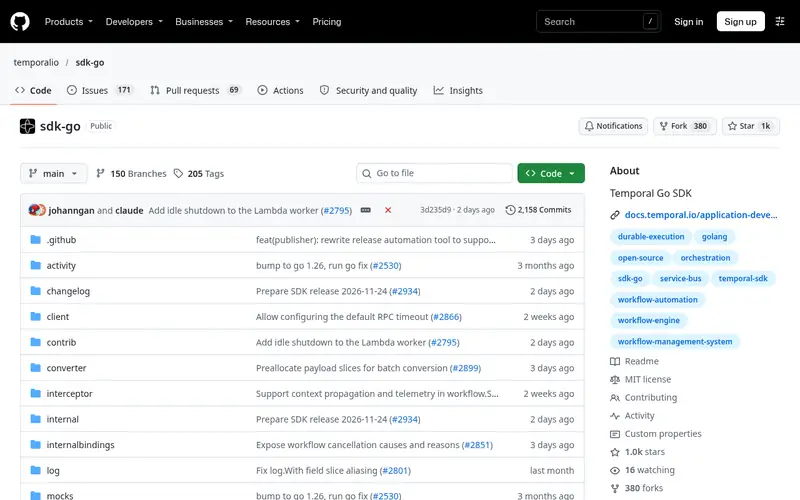
Temporal is a workflow engine, and the Temporal Go SDK lets you write workflows and activities in Go. Unlike a simple task queue, it persists workflow state, so long-running, multi-step processes survive crashes and restarts. It handles retries, timers and versioning of workflow code.
You run a Temporal server (self-hosted, open source) or use Temporal Cloud, which is a paid service with its own pricing page. The SDK is open source. The trade-off is operational overhead: a server cluster, worker deployments and a different programming model. Teams with simple fire-and-forget jobs will find Asynq or River lighter.
Standout: Durable workflow state and automatic retries
See vendor pricing page, as listed by the vendor (Temporal website). Confirm the current plan price before you buy.
Free plan. Plans change, so confirm on the vendor's pricing page before you buy.
Benefits
- Durable workflow state and automatic retries
- strong fit for multi-step processes
Drawbacks
- Requires running a Temporal server
- steeper learning curve than a job queue
Skip it if this limit matters to you: requires running a Temporal server.
Verdict. A sensible pick for durable, long-running workflows in Go.
Faktory Go worker
Best for polyglot shops using a Faktory server
What it is and where it fits
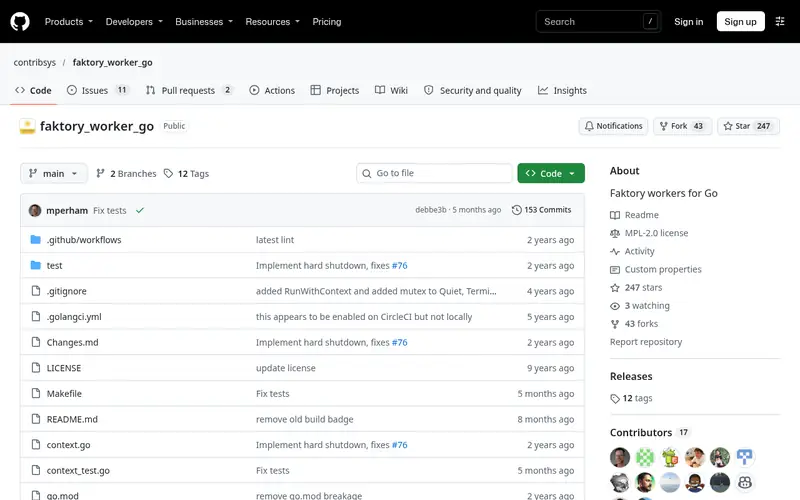
Faktory is a language-agnostic background job server, and faktory_worker_go is its official Go client. Jobs are pushed to a Faktory server and pulled by workers in any supported language, which helps teams that mix Go with Ruby, Python or other runtimes. It supports queues, retries and scheduled jobs.
The Go library is open source. The Faktory server itself is a separate product with its own licensing and pricing terms, so check the vendor page before deploying. Because jobs are JSON payloads handled by a central server, this is a good fit for polyglot environments but adds a component to operate compared with an embedded library like River.
Standout: Language-agnostic job server with a Go client
Free (open source), as listed by the vendor (Faktory Go worker website). Confirm the current plan price before you buy.
Free plan. Plans change, so confirm on the vendor's pricing page before you buy.
Benefits
- Language-agnostic job server with a Go client
- simple job model
Drawbacks
- Requires a separate Faktory server
- smaller Go ecosystem
Skip it if this limit matters to you: requires a separate Faktory server.
Verdict. A sensible pick for polyglot shops using a Faktory server.
Watermill
Best for event-driven Go services using message brokers
What it is and where it fits
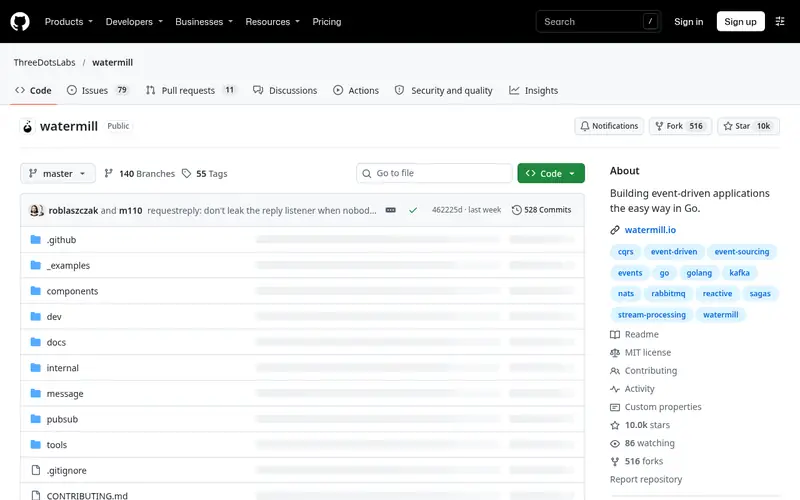
Watermill is a Go library for building event-driven applications. It provides a message abstraction over brokers including Kafka, RabbitMQ, NATS, Google Cloud Pub/Sub and AWS SQS, plus middleware for retries, correlation and logging. It is used for pub/sub messaging and event processing rather than as a classic task queue.
It suits teams building event-driven architectures where messages flow between services. The project is open source under the MIT licence. It does not ship a scheduler or a job inspection UI like Asynq, so if you need simple background jobs with retries and a dashboard, Asynq or River are a closer fit.
Standout: Works with Kafka, RabbitMQ, NATS and more
Free (open source), as listed by the vendor (Watermill website). Confirm the current plan price before you buy.
Free plan. Plans change, so confirm on the vendor's pricing page before you buy.
Benefits
- Works with Kafka, RabbitMQ, NATS and more
- clear message routing model
Drawbacks
- Not a job queue with retries out of the box
- you design delivery semantics
Skip it if this limit matters to you: not a job queue with retries out of the box.
Verdict. A sensible pick for event-driven Go services using message brokers.
Who should use what
If you run Redis and want a simple background queue with a dashboard, start with Asynq. If your data lives in PostgreSQL and you want jobs enqueued in the same transaction, use River. If you need durable, multi-step workflows with state that survives restarts, evaluate Temporal. If you are building event-driven services on Kafka or RabbitMQ, Watermill fits. Machinery and Faktory suit teams with existing broker or polyglot infrastructure.
Questions to settle before you buy
What to check before you buy
- Confirm which datastore or broker the library needs and whether you already operate it.
- Check whether jobs must be enqueued in the same transaction as your database writes.
- Review the repository's recent commits and open issues to judge maintenance activity.
- Decide whether you need a scheduler, retries and a web UI, or only pub/sub messaging.
- Read the licence and, for server products like Temporal and Faktory, the pricing terms.
FAQ
Do I need Redis for a Go task queue?
No. Asynq uses Redis, but River uses PostgreSQL, Machinery supports several brokers, and Watermill works with Kafka, RabbitMQ and NATS. Pick the backend you already run to avoid adding infrastructure.
Is Temporal a task queue?
Temporal is a workflow engine. It can run background work, but its main value is durable workflow state for long-running, multi-step processes. For simple fire-and-forget jobs, Asynq or River are lighter.
Are these Go task queues free?
The libraries are open source and free to use. Temporal Cloud and the Faktory server have their own pricing terms, so check the vendor pages. Self-hosting adds infrastructure cost.
Which queue works best with PostgreSQL?
River stores jobs directly in PostgreSQL and lets you enqueue a job in the same transaction as your data writes. That avoids the dual-write problem common with Redis-backed queues.
Can I use these with services written in other languages?
Faktory is designed for polyglot workers, and Temporal has SDKs for several languages. Asynq, River and Watermill are Go-focused, though their backends are language-agnostic.
Sources we checked
Method: how we score · editorial policy.
Change log. First published 27 Nov 2026.