Stage 03 · Host · Researched comparison
Best Go Cron Libraries in 2026
robfig/cron is the first pick for most teams: it is the long-standing in-process scheduler with a familiar cron syntax and a small API. Choose go-co-op/gocron when you want a more actively developed scheduler with job chaining and distributed locking options. Choose hibiken/asynq when scheduled work should run as background tasks through Redis rather than inside the process.

By Shihab Mia
Published 27 Nov 2026 · 5 tools compared
We run no ads and no affiliate links at launch. The order of a list follows our published method. See how we score.
Prices are the starting prices vendors list publicly. Plans change, so confirm the current price on the vendor page before you buy.
Key takeaways
- robfig/cron, go-co-op/gocron, reugn/go-quartz and adhocore/gronx are free open-source Go modules.
- hibiken/asynq is also free and open source, but it requires a Redis server to run.
- All five are libraries you add to a Go program; none is a hosted scheduling service.
- In-process schedulers stop when the process stops, so plan for restarts and multiple replicas.
Who each pick is for
- Simple in-process scheduled jobs in Go servicesrobfig/cron
- Go teams wanting an actively developed in-process schedulergo-co-op/gocron
- Scheduled background tasks backed by Redishibiken/asynq
- Go projects wanting a Quartz-style scheduler with pluggable storagereugn/go-quartz
- Parsing and validating cron expressions in Goadhocore/gronx
Comparison
| Tool | Best for | Standout feature | Listed starting price | Free plan or trial |
|---|---|---|---|---|
| 1robfig/cron | Simple in-process scheduled jobs in Go services | Widely used and stable | Free (open source) | Free plan |
| 2go-co-op/gocron | Go teams wanting an actively developed in-process scheduler | Active development | Free (open source) | Free plan |
| 3hibiken/asynq | Scheduled background tasks backed by Redis | Persistent task queue with retries and scheduling | Free (open source) | Free plan |
| 4reugn/go-quartz | Go projects wanting a Quartz-style scheduler with pluggable storage | Pluggable job queues and storage backends | Free (open source) | Free plan |
| 5adhocore/gronx | Parsing and validating cron expressions in Go | Focused cron expression parser and validator | Free (open source) | Free plan |
How we picked
We compared libraries on fit for scheduling work in Go, supported cron syntax, whether jobs persist across restarts, external dependencies such as Redis, licence terms and maintenance activity. All five projects are open source and free to use. We did not run benchmarks. Sources are the official repositories and their documentation. Prices and licences can change, so confirm on the project page before you commit.
The tools, one by one
robfig/cron
Best for simple in-process scheduled jobs in Go services
What it is and where it fits
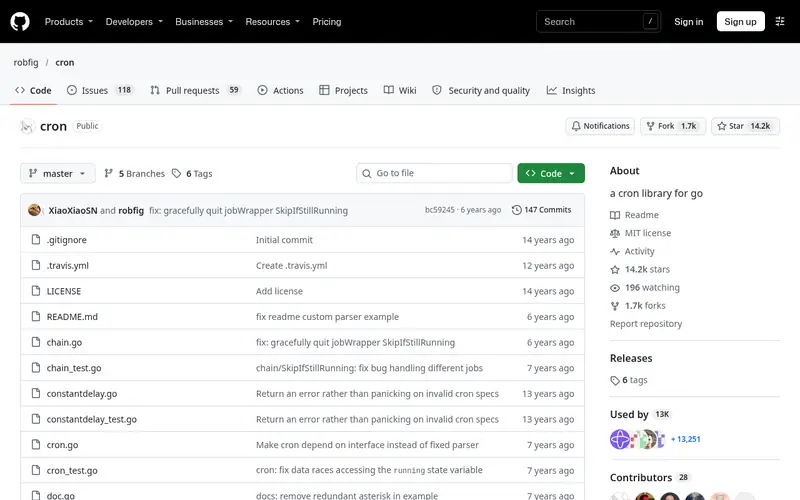
robfig/cron is a Go library that runs functions on a cron schedule inside your process. Version 3 supports the standard five-field cron format plus optional seconds, descriptors like @daily, and configurable time zones. You register jobs on a Cron instance and call Start, and the library runs them on goroutines.
It is a plain module with no external services. That keeps setup short, but it also means schedules live only in memory. If the process restarts, missed runs are not replayed, and if you run several replicas, each one fires its own copy of the job. There is no persistence, no job history and no retry logic.
The project is stable but receives infrequent updates. Teams that need active feature work, chaining or distributed locks should look at go-co-op/gocron. Teams that only need a dependable timer for a handful of jobs will find robfig/cron sufficient. It suits single-instance workers and internal tools more than clustered production systems.
Standout: Widely used and stable
Free (open source), as listed by the vendor (robfig/cron website). Confirm the current plan price before you buy.
Free plan. Plans change, so confirm on the vendor's pricing page before you buy.
Benefits
- Widely used and stable
- small API with standard cron syntax
Drawbacks
- Maintenance is slow
- no built-in distributed coordination
Skip it if this limit matters to you: maintenance is slow.
Verdict. A sensible pick for simple in-process scheduled jobs in Go services.
Alternatives in this guide: go-co-op/gocron, hibiken/asynq, reugn/go-quartz
go-co-op/gocron
Best for go teams wanting an actively developed in-process scheduler
What it is and where it fits
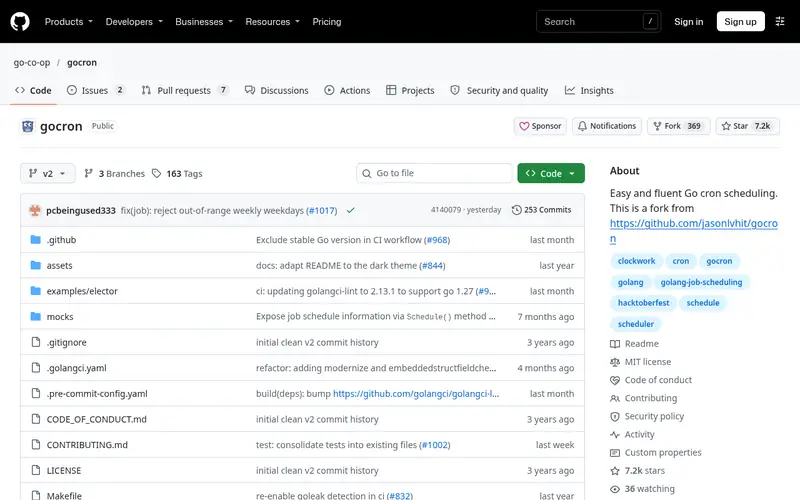
go-co-op/gocron is a scheduler for Go that runs jobs at intervals or cron expressions. It adds features beyond a basic timer: job chaining so one job can trigger the next, tags for grouping and starting subsets of jobs, singleton mode to prevent overlapping runs, and limiters that can coordinate work across processes using Redis or other backends.
It runs in-process like robfig/cron, so the same caveats apply: jobs stop with the process and are not persisted by default. The limiter support helps when you run multiple replicas and want only one instance to execute a given job, but that depends on the external backend you configure.
The project is actively maintained and has a broader feature set than robfig/cron. The trade-off is a bigger API and more concepts to learn. It suits teams that want in-process scheduling with more control over overlap and concurrency, and it is a reasonable default when you are starting a new Go service.
Standout: Active development
Free (open source), as listed by the vendor (go-co-op/gocron website). Confirm the current plan price before you buy.
Free plan. Plans change, so confirm on the vendor's pricing page before you buy.
Benefits
- Active development
- supports chaining, tags and distributed locking via limiters
Drawbacks
- Larger API surface to learn
- in-process by default
Skip it if this limit matters to you: larger API surface to learn.
Verdict. A sensible pick for go teams wanting an actively developed in-process scheduler.
Alternatives in this guide: robfig/cron, hibiken/asynq, reugn/go-quartz
hibiken/asynq
Best for scheduled background tasks backed by Redis
What it is and where it fits
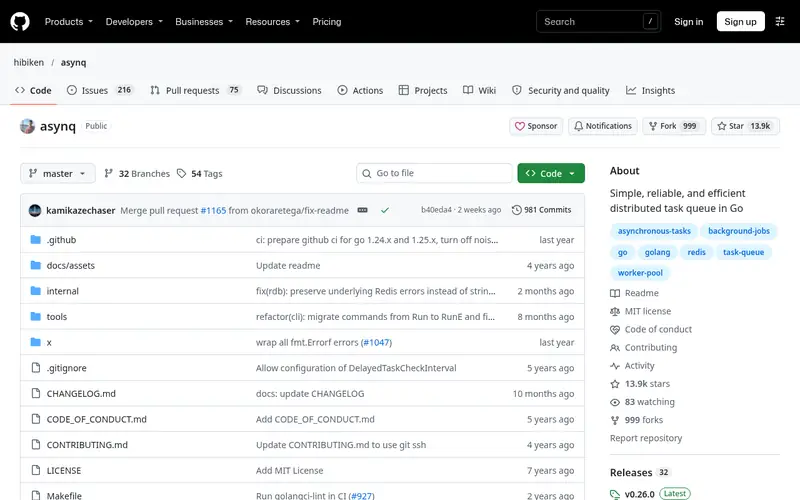
hibiken/asynq is a distributed task queue for Go built on Redis. It is not only a cron library, but it includes periodic task scheduling through a scheduler component. You define tasks, enqueue them, and run worker processes that consume and execute them. Scheduled tasks are stored in Redis, so they survive restarts and can be picked up by any worker.
Because state lives in Redis, asynq handles retries, timeouts and task visibility better than in-memory schedulers. Workers run as separate processes, which lets you scale execution independently of your web server. The cost is operational: you need a Redis instance, and you need to run and monitor worker processes.
It suits teams already using Redis that want durable scheduled work, such as sending emails or processing reports, rather than a few timers in a single binary. If you do not want to operate Redis or separate workers, an in-process scheduler is simpler.
Standout: Persistent task queue with retries and scheduling
Free (open source), as listed by the vendor (hibiken/asynq website). Confirm the current plan price before you buy.
Free plan. Plans change, so confirm on the vendor's pricing page before you buy.
Benefits
- Persistent task queue with retries and scheduling
- separate worker processes
Drawbacks
- Requires Redis
- more moving parts than an in-process timer
Skip it if this limit matters to you: requires Redis.
Verdict. A sensible pick for scheduled background tasks backed by Redis.
Alternatives in this guide: robfig/cron, go-co-op/gocron, reugn/go-quartz
reugn/go-quartz
Best for go projects wanting a Quartz-style scheduler with pluggable storage
What it is and where it fits
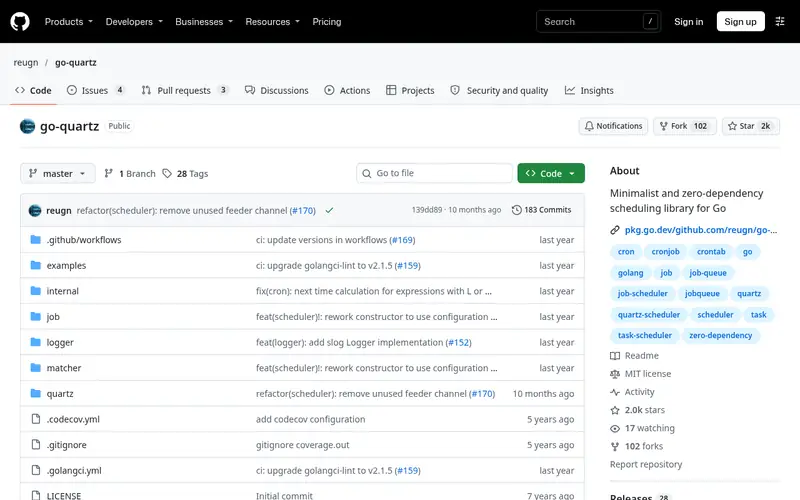
reugn/go-quartz is a Go scheduler modeled on the Quartz design. It separates the scheduler from the job queue and from storage, so you can run jobs in memory or persist them through a backing store. It supports cron triggers, simple interval triggers, and running or pausing jobs through a scheduler interface.
The pluggable design is its main advantage. If you need scheduled jobs that survive restarts, you can wire in a persistent queue rather than building that yourself. The abstraction also makes it easier to test scheduling logic separately from execution.
The trade-off is more configuration than a minimal library. The community is smaller than robfig/cron's, so examples are fewer. It suits teams that like the Quartz model from Java and want similar structure in Go, or that need storage flexibility. For a few timers in one binary, a simpler library is easier.
Standout: Pluggable job queues and storage backends
Free (open source), as listed by the vendor (reugn/go-quartz website). Confirm the current plan price before you buy.
Free plan. Plans change, so confirm on the vendor's pricing page before you buy.
Benefits
- Pluggable job queues and storage backends
- clean scheduler interface
Drawbacks
- Smaller community than robfig/cron
- more setup for persistence
Skip it if this limit matters to you: smaller community than robfig/cron.
Verdict. A sensible pick for go projects wanting a Quartz-style scheduler with pluggable storage.
Alternatives in this guide: robfig/cron, go-co-op/gocron, hibiken/asynq
adhocore/gronx
Best for parsing and validating cron expressions in Go
What it is and where it fits
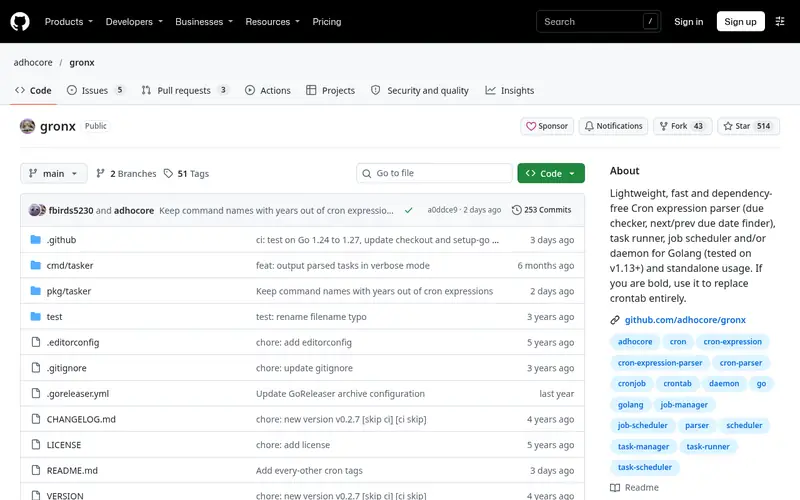
adhocore/gronx is a Go library for parsing, validating and working with cron expressions. It handles standard cron syntax and common extensions, and it can compute the next run time for an expression. It also includes a lightweight task runner for executing commands on a schedule, but its core strength is expression handling.
Use it when you need to validate user-supplied cron strings, convert between formats, or compute upcoming run times without pulling in a full scheduler. It is a small dependency and does one job well.
It is not a replacement for a scheduler with job management, retries or persistence. The project is smaller than the others here, so long-term maintenance is worth checking. It suits tools that accept cron input, such as admin panels or config validators, and developers who want expression logic separate from execution.
Standout: Focused cron expression parser and validator
Free (open source), as listed by the vendor (adhocore/gronx website). Confirm the current plan price before you buy.
Free plan. Plans change, so confirm on the vendor's pricing page before you buy.
Benefits
- Focused cron expression parser and validator
- also offers a task runner
Drawbacks
- Not a full-featured scheduler
- smaller project
Skip it if this limit matters to you: not a full-featured scheduler.
Verdict. A sensible pick for parsing and validating cron expressions in Go.
Alternatives in this guide: robfig/cron, go-co-op/gocron, hibiken/asynq
Who should use what
A single Go service with a few timers should start with robfig/cron. A team that wants active development, job chaining and cross-replica coordination should use go-co-op/gocron. A system that needs durable scheduled tasks with retries and separate workers should use hibiken/asynq with Redis. A project that only needs to parse or validate cron strings, such as an admin form, should use adhocore/gronx. Teams that prefer the Quartz model and pluggable storage should look at reugn/go-quartz.
Questions to settle before you buy
What to check before you buy
- Confirm the cron syntax you need, including seconds fields and descriptors like @daily.
- Decide whether jobs must survive process restarts, and whether you need external storage.
- Check how the library behaves when you run multiple replicas of the same service.
- Review the licence and the recent commit activity on the repository.
- Test time zone handling, since schedules often run in a different zone than the server.
FAQ
Do I need Redis to use a Go cron library?
No. robfig/cron, go-co-op/gocron, reugn/go-quartz and adhocore/gronx run without external services. hibiken/asynq requires Redis because it stores tasks there. Choose based on whether you need persistence and separate workers.
What happens to scheduled jobs when the process restarts?
With in-process schedulers, jobs stop with the process and missed runs are not replayed. Libraries that persist to storage, such as asynq with Redis, can keep scheduled work across restarts. Plan for this if missed runs matter.
How do I stop duplicate runs across multiple replicas?
In-process schedulers fire in every replica. go-co-op/gocron offers limiters that can coordinate through a shared backend. asynq avoids the issue by having workers pull tasks from a queue. Otherwise, run the scheduler in one instance only.
Can these libraries parse cron expressions without scheduling?
adhocore/gronx focuses on parsing, validating and computing next run times. robfig/cron also exposes a parser. Use a parser-only library if you just need to validate user input or show upcoming run times.
Are these libraries free?
Yes. All five projects listed here are open source and free to use under their respective licences. Check each repository for the exact licence terms before shipping.
Sources we checked
Method: how we score · editorial policy.
Change log. First published 27 Nov 2026.