Stage 03 · Host · Researched comparison
Best Elixir Background Job Libraries in 2026
Oban is the first pick for most teams that need durable background jobs backed by the database they already run. It suits apps on PostgreSQL, SQLite or MySQL that want retries, scheduling and a queue UI. Exq is a good alternative for teams already running Redis and Sidekiq-style queues. Broadway fits high-throughput data pipelines, while Quantum handles cron-style scheduling inside the app.

By Shihab Mia
Published 27 Nov 2026 · 5 tools compared
We run no ads and no affiliate links at launch. The order of a list follows our published method. See how we score.
Prices are the starting prices vendors list publicly. Plans change, so confirm the current price on the vendor page before you buy.
Key takeaways
- Oban is open source with a paid Pro tier; it stores jobs in your database and needs no separate queue service.
- Exq requires Redis and follows Sidekiq conventions, which helps teams migrating from Ruby.
- Broadway is built for data ingestion and processing pipelines, not one-off job dispatch.
- Quantum and OTP primitives (GenStage, Task.Supervisor) are free and suit narrow scheduling or in-process work.
Who each pick is for
- Durable database-backed jobs in Elixir appsOban
- Redis-backed jobs with Sidekiq-style conventionsExq
- High-throughput data ingestion and processing pipelinesBroadway
- Cron-style scheduled jobs inside an Elixir appQuantum
- Lightweight in-process concurrency and staged pipelinesTask.Supervisor and GenStage (OTP)
Comparison
| Tool | Best for | Standout feature | Listed starting price | Free plan or trial |
|---|---|---|---|---|
| 1Oban | Durable database-backed jobs in Elixir apps | Jobs stored in your existing database | Free (open source) | Free plan |
| 2Exq | Redis-backed jobs with Sidekiq-style conventions | Familiar Sidekiq model | Free (open source) | Free plan |
| 3Broadway | High-throughput data ingestion and processing pipelines | Built on GenStage for back-pressure | Free (open source) | Free plan |
| 4Quantum | Cron-style scheduled jobs inside an Elixir app | Cron syntax familiar to most teams | Free (open source) | Free plan |
| 5Task.Supervisor and GenStage (OTP) | Lightweight in-process concurrency and staged pipelines | Built into OTP with no dependencies | Free | Free plan |
How we picked
We picked libraries that genuinely run background work in Elixir and are currently maintained. Criteria were fit for the job (durable queues, Redis workers, pipelines, cron scheduling, OTP primitives), supported storage and platforms, licence and pricing structure, and the main operational limits. Sources are vendor pages, official documentation and project repositories. Prices and plan details change, so confirm current terms on the vendor site before you commit.
The tools, one by one
Oban
Best for durable database-backed jobs in Elixir apps
What it is and where it fits
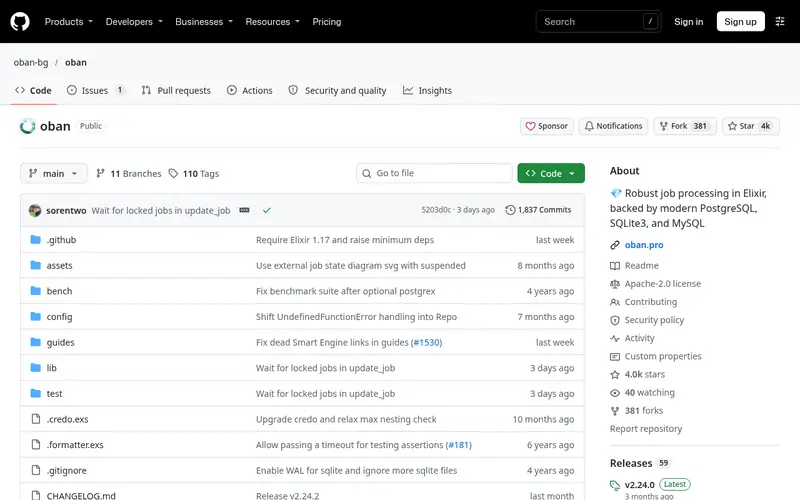
Oban runs background jobs from a table in your database. It supports PostgreSQL, SQLite and MySQL through separate adapters. Jobs are persisted, so they survive restarts, and the library handles retries, scheduling, uniqueness and concurrency limits. Because there is no separate broker, operations stay close to the database you already back up and monitor.
The core library is open source under the Apache 2.0 licence. Oban Pro is a paid add-on that adds features such as batch processing, dynamic queues and workflow support. The free core covers most queue needs. Check the repository and vendor pages for the current feature split.
Skip Oban if your app has no relational database or if you need a broker that scales independently of the database. For most Phoenix apps on Postgres, it is the default choice.
Standout: Jobs stored in your existing database
Free (open source), as listed by the vendor (Oban website). Confirm the current plan price before you buy.
Free plan. Plans change, so confirm on the vendor's pricing page before you buy.
Benefits
- Jobs stored in your existing database
- built-in retries, scheduling and unique jobs
Drawbacks
- Requires a supported database
- some features sit behind the paid Pro tier
Skip it if this limit matters to you: requires a supported database.
Verdict. A sensible pick for durable database-backed jobs in Elixir apps.
Exq
Best for redis-backed jobs with Sidekiq-style conventions
What it is and where it fits
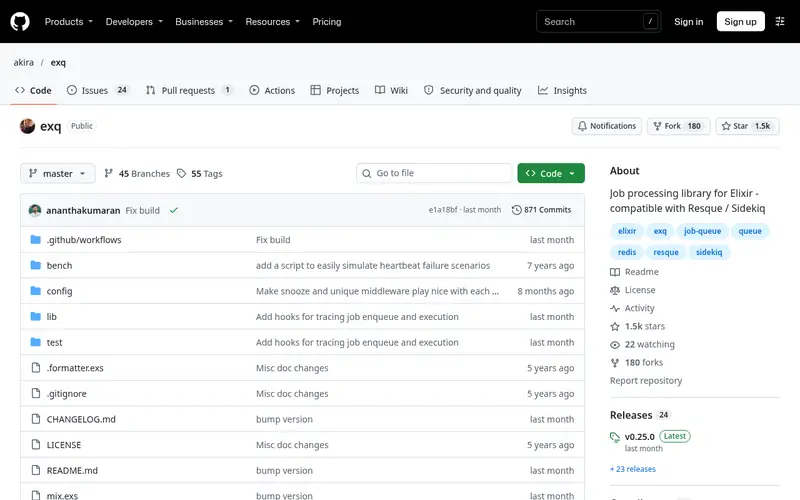
Exq is a job processing library that stores queues in Redis. Its API and conventions follow Sidekiq, so teams moving from Ruby on Rails can reuse familiar patterns for workers, retries and scheduled jobs. It integrates with Phoenix and works with the standard Redis setup most teams already operate.
Because jobs live in Redis, durability depends on how Redis is configured for persistence. If Redis loses data, queued jobs can be lost. You also take on the operational cost of running and monitoring Redis alongside your database.
Exq is a reasonable fit when Redis is already part of your stack and you want Sidekiq-compatible behavior. If you would rather not run a second data store, a database-backed option like Oban avoids that dependency.
Standout: Familiar Sidekiq model
Free (open source), as listed by the vendor (Exq website). Confirm the current plan price before you buy.
Free plan. Plans change, so confirm on the vendor's pricing page before you buy.
Benefits
- Familiar Sidekiq model
- Redis handles queue throughput
Drawbacks
- Requires a running Redis instance
- job durability depends on Redis configuration
Skip it if this limit matters to you: requires a running Redis instance.
Verdict. A sensible pick for redis-backed jobs with Sidekiq-style conventions.
Broadway
Best for high-throughput data ingestion and processing pipelines
What it is and where it fits
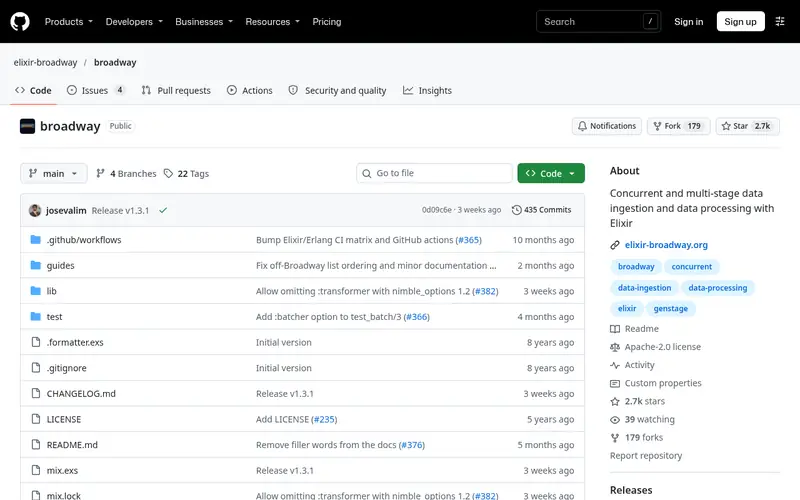
Broadway is a library for building data ingestion and processing pipelines. It sits on top of GenStage and handles back-pressure, batching and concurrency across stages. It ships with connectors for sources such as Amazon SQS, Google Cloud Pub/Sub and RabbitMQ, and you can write custom producers.
Broadway is not a general-purpose job queue. It is designed for continuous streams of messages, so using it for one-off background tasks means building more of the surrounding structure yourself. It shines when you need to move and transform large volumes of data with controlled concurrency.
Choose Broadway for event and data pipelines where throughput and back-pressure matter. For simple enqueue-and-run jobs, a queue library is a better fit.
Standout: Built on GenStage for back-pressure
Free (open source), as listed by the vendor (Broadway website). Confirm the current plan price before you buy.
Free plan. Plans change, so confirm on the vendor's pricing page before you buy.
Benefits
- Built on GenStage for back-pressure
- connectors for common data sources
Drawbacks
- Aimed at pipelines, not general job dispatch
- needs pipeline design work
Skip it if this limit matters to you: aimed at pipelines, not general job dispatch.
Verdict. A sensible pick for high-throughput data ingestion and processing pipelines.
Quantum
Best for cron-style scheduled jobs inside an Elixir app
What it is and where it fits
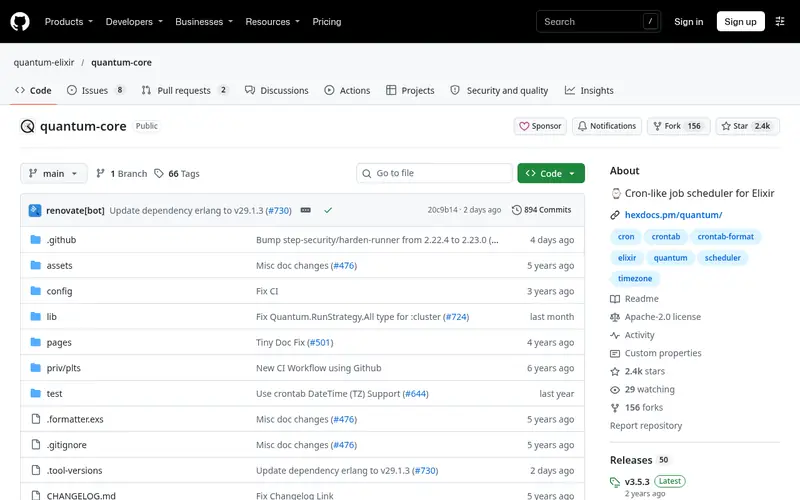
Quantum is a cron-like job scheduler for Elixir. You define jobs with cron syntax and Quantum runs them on schedule inside your application. It supports timezone handling and can run jobs across a cluster with a chosen node strategy.
Quantum schedules work; it does not provide durable queues, retries with persistence or a job table. If a scheduled job fails or the node restarts, there is no stored record to resume from. Many teams pair Quantum with a queue library so the scheduled trigger enqueues durable jobs.
Use Quantum when you need recurring tasks such as nightly cleanup or report generation and do not need a full queue. For work that must survive failures, combine it with a durable queue.
Standout: Cron syntax familiar to most teams
Free (open source), as listed by the vendor (Quantum website). Confirm the current plan price before you buy.
Free plan. Plans change, so confirm on the vendor's pricing page before you buy.
Benefits
- Cron syntax familiar to most teams
- runs inside the app without extra services
Drawbacks
- Focused on scheduling, not durable job queues
- jobs run in the app process
Skip it if this limit matters to you: focused on scheduling, not durable job queues.
Verdict. A sensible pick for cron-style scheduled jobs inside an Elixir app.
Task.Supervisor and GenStage (OTP)
Best for lightweight in-process concurrency and staged pipelines
What it is and where it fits
Task.Supervisor and GenStage are part of the Erlang/OTP runtime that ships with Elixir. Task.Supervisor starts supervised tasks for short-lived concurrent work. GenStage provides a framework for building staged, back-pressured pipelines of producers, processors and consumers.
Neither provides durable job storage, retries across restarts or a scheduling UI. They are primitives, and you assemble queue behavior on top. That is useful when you want minimal dependencies and full control, or when the work is in-process and short-lived.
Reach for these when you need simple concurrency or a custom pipeline and can accept that jobs are not persisted. For durable background jobs, a dedicated library saves significant work.
Standout: Built into OTP with no dependencies
Free, as listed by the vendor (Task.Supervisor and GenStage (OTP) website). Confirm the current plan price before you buy.
Free plan. Plans change, so confirm on the vendor's pricing page before you buy.
Benefits
- Built into OTP with no dependencies
- fine-grained control over processes
Drawbacks
- No persistence or retries out of the box
- you build queue behavior yourself
Skip it if this limit matters to you: no persistence or retries out of the box.
Verdict. A sensible pick for lightweight in-process concurrency and staged pipelines.
Who should use what
A Phoenix app on PostgreSQL that needs retries and scheduling should start with Oban. A team already running Redis and coming from Sidekiq will find Exq familiar. A service that ingests large message streams from SQS or Pub/Sub should use Broadway. An app that only needs recurring cron tasks can use Quantum, optionally paired with a durable queue. Teams that want minimal dependencies and in-process concurrency can build on Task.Supervisor and GenStage.
Questions to settle before you buy
What to check before you buy
- Confirm which data store the library needs and whether you already run it.
- Check how jobs survive restarts and what happens if the store loses data.
- Review the licence and whether needed features sit behind a paid tier.
- Verify retry, uniqueness and scheduling behavior match your workload.
- Check maintenance activity and compatibility with your Elixir and OTP versions.
FAQ
Does Oban require PostgreSQL?
Oban's core supports PostgreSQL, SQLite and MySQL through adapters. PostgreSQL is the most common setup. Confirm adapter support and versions in the official documentation before choosing it for a different database.
Is Exq a drop-in replacement for Sidekiq?
Exq follows Sidekiq conventions and uses Redis, which makes migration easier for Ruby teams. It is an Elixir library, so worker code is rewritten in Elixir. Treat it as a similar model, not a literal drop-in.
Can Broadway replace a job queue?
Broadway is built for data pipelines with back-pressure, not one-off job dispatch. It can process streams of work, but it does not provide a durable job table with retries in the way a queue library does.
Do I need Quantum if I use Oban?
Not necessarily. Oban supports scheduled jobs, so simple recurring work can be handled there. Quantum is useful when you want cron-style definitions and scheduling separate from the queue.
Are these libraries free?
Oban core, Exq, Broadway, Quantum and the OTP primitives are open source and free to use. Oban Pro is a paid add-on. Check each repository for the current licence and any paid tiers.
Sources we checked
Method: how we score · editorial policy.
Change log. First published 27 Nov 2026.