Stage 03 · Host · Researched comparison
Best .NET Caching Libraries in 2026
Microsoft.Extensions.Caching.Memory (IMemoryCache) is the first pick for most teams. It ships with the framework, needs no extra package, and covers simple in-process caching. Choose FusionCache when you need a hybrid memory-plus-distributed cache with fail-safe behavior and no extra infrastructure work. Choose StackExchange.Redis with IDistributedCache when several app instances must share cache state.

By Shihab Mia
Published 27 Nov 2026 · 6 tools compared
We run no ads and no affiliate links at launch. The order of a list follows our published method. See how we score.
Prices are the starting prices vendors list publicly. Plans change, so confirm the current price on the vendor page before you buy.
Key takeaways
- IMemoryCache and HybridCache are free and ship as Microsoft packages, so there is no licence cost.
- FusionCache, LazyCache and EasyCaching are open source and free to use.
- StackExchange.Redis is free and open source, but you pay for the Redis server or a managed Redis service.
- In-memory caches are per process. Use a distributed cache when more than one instance must see the same data.
Who each pick is for
- Simple in-process caching in ASP.NET Core appsMicrosoft.Extensions.Caching.Memory (IMemoryCache)
- Two-level caching in .NET 9 and later appsHybridCache (Microsoft.Extensions.Caching.H hybrid)
- Hybrid caching with fail-safe and backplane supportFusionCache
- Simple thread-safe caching with lazy loadingLazyCache
- Shared distributed caching across app instancesStackExchange.Redis with IDistributedCache
- One API across several cache providersEasyCaching
Comparison
| Tool | Best for | Standout feature | Listed starting price | Free plan or trial |
|---|---|---|---|---|
| 1Microsoft.Extensions.Caching.Memory (IMemoryCache) | Simple in-process caching in ASP.NET Core apps | Ships with ASP.NET Core | Free (open source) | Free plan |
| 2HybridCache (Microsoft.Extensions.Caching.H hybrid) | Two-level caching in .NET 9 and later apps | Combines memory and distributed caches | Free (open source) | Free plan |
| 3FusionCache | Hybrid caching with fail-safe and backplane support | Fail-safe defaults, soft timeouts and optional backplane | Free (open source) | Free plan |
| 4LazyCache | Simple thread-safe caching with lazy loading | Small API built on IMemoryCache | Free (open source) | Free plan |
| 5StackExchange.Redis with IDistributedCache | Shared distributed caching across app instances | Mature Redis client | Free (open source) | Free plan |
| 6EasyCaching | One API across several cache providers | Supports memory, Redis, Memcached and more behind one interface | Free (open source) | Free plan |
How we picked
We picked libraries that are currently maintained and genuinely do the caching job named here. Criteria were fit for common .NET caching tasks, supported platforms and .NET versions, licence and price, and the main limits of each option. Sources are vendor documentation, Microsoft Learn pages and project repositories. Prices and plan details change, so confirm them on the vendor site before you commit.
The tools, one by one
Microsoft.Extensions.Caching.Memory (IMemoryCache)
Best for simple in-process caching in ASP.NET Core apps

What it is and where it fits
IMemoryCache is the default in-memory cache for ASP.NET Core. You register it with AddMemoryCache and inject IMemoryCache. It supports absolute expiration, sliding expiration, priority and size limits. The cache lives inside one process, so each app instance has its own copy.
It runs anywhere .NET runs: Windows, Linux, macOS, containers and serverless hosts. The package is maintained by Microsoft and is free under the MIT licence. There is no paid tier.
Skip it when you run several instances and need shared state, or when you need cache entries to survive a restart. In those cases use a distributed cache or a hybrid cache.
Standout: Ships with ASP.NET Core
Free (open source), as listed by the vendor (Microsoft.Extensions.Caching.Memory (IMemoryCache) website). Confirm the current plan price before you buy.
Free plan. Plans change, so confirm on the vendor's pricing page before you buy.
Benefits
- Ships with ASP.NET Core
- simple IMemoryCache API with expiration and size limits
Drawbacks
- Per-process only
- no built-in distributed or fail-safe behavior
Skip it if this limit matters to you: per-process only.
Verdict. A sensible pick for simple in-process caching in ASP.NET Core apps.
Alternatives in this guide: HybridCache (Microsoft.Extensions.Caching.H hybrid), FusionCache, LazyCache
HybridCache (Microsoft.Extensions.Caching.H hybrid)
Best for two-level caching in .NET 9 and later apps
What it is and where it fits
HybridCache is a Microsoft package for .NET 9 and later. It reads from a fast in-memory layer and falls back to a distributed cache such as Redis or SQL Server. It handles cache stampede protection, so many concurrent requests for the same missing key trigger one factory call.
You configure it with AddHybridCache and set a default entry policy. It works with any IDistributedCache implementation. The package is free and open source.
Skip it if you are on .NET 8 or earlier, or if a single in-memory cache is enough. The API is newer than IMemoryCache, so fewer community examples exist.
Standout: Combines memory and distributed caches
Free (open source), as listed by the vendor (HybridCache (Microsoft.Extensions.Caching.H hybrid) website). Confirm the current plan price before you buy.
Free plan. Plans change, so confirm on the vendor's pricing page before you buy.
Benefits
- Combines memory and distributed caches
- built-in stampede protection
Drawbacks
- Requires .NET 9 or later
- newer API with fewer examples
Skip it if this limit matters to you: requires .NET 9 or later.
Verdict. A sensible pick for two-level caching in .NET 9 and later apps.
Alternatives in this guide: Microsoft.Extensions.Caching.Memory (IMemoryCache), FusionCache, LazyCache
FusionCache
Best for hybrid caching with fail-safe and backplane support
What it is and where it fits
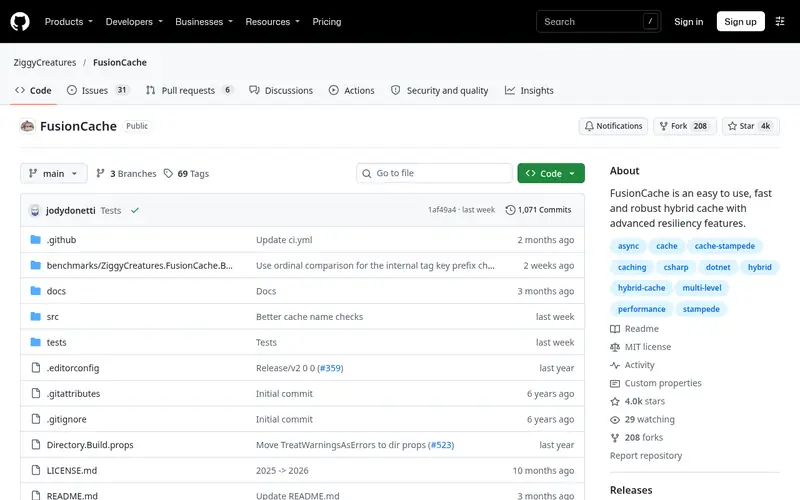
FusionCache is an open-source library from ZiggyCreatures. It provides a two-level cache: an in-memory layer plus an optional distributed layer such as Redis, Memcached or SQL Server. It adds fail-safe behavior, so stale values can be returned when the factory or the distributed cache fails.
It also supports soft and hard timeouts, cache stampede protection, eager refresh and an optional backplane for multi-node invalidation. It targets .NET Standard 2.0 and modern .NET, so it works in older and newer projects. The licence is MIT and there is no paid tier.
Skip it if you only need a basic in-memory cache. The feature set is large, and a small app may not need the extra configuration.
Standout: Fail-safe defaults, soft timeouts and optional backplane
Free (open source), as listed by the vendor (FusionCache website). Confirm the current plan price before you buy.
Free plan. Plans change, so confirm on the vendor's pricing page before you buy.
Benefits
- Fail-safe defaults, soft timeouts and optional backplane
- works on .NET Standard and modern .NET
Drawbacks
- Third-party project to track
- many options to configure
Skip it if this limit matters to you: third-party project to track.
Verdict. A sensible pick for hybrid caching with fail-safe and backplane support.
Alternatives in this guide: Microsoft.Extensions.Caching.Memory (IMemoryCache), HybridCache (Microsoft.Extensions.Caching.H hybrid), LazyCache
LazyCache
Best for simple thread-safe caching with lazy loading
What it is and where it fits
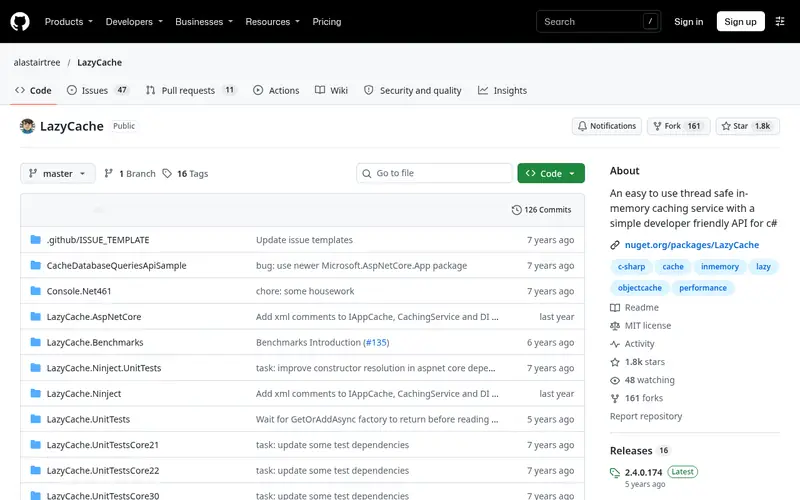
LazyCache is a small open-source wrapper around Microsoft.Extensions.Caching.Memory. It adds thread-safe lazy loading, so concurrent callers for a missing key wait for one factory call instead of all running it. The API is short: GetOrAdd and GetOrAddAsync.
It runs wherever IMemoryCache runs. The licence is MIT and there is no paid tier. Configuration is limited to what IMemoryCache supports, plus LazyCache's own options.
Skip it if you need a distributed cache or multi-node invalidation. It is a good fit for single-instance apps and background services that want simple, safe caching.
Standout: Small API built on IMemoryCache
Free (open source), as listed by the vendor (LazyCache website). Confirm the current plan price before you buy.
Free plan. Plans change, so confirm on the vendor's pricing page before you buy.
Benefits
- Small API built on IMemoryCache
- avoids duplicate factory calls
Drawbacks
- In-memory only
- fewer features than hybrid libraries
Skip it if this limit matters to you: in-memory only.
Verdict. A sensible pick for simple thread-safe caching with lazy loading.
Alternatives in this guide: Microsoft.Extensions.Caching.Memory (IMemoryCache), HybridCache (Microsoft.Extensions.Caching.H hybrid), FusionCache
StackExchange.Redis with IDistributedCache
Best for shared distributed caching across app instances
What it is and where it fits
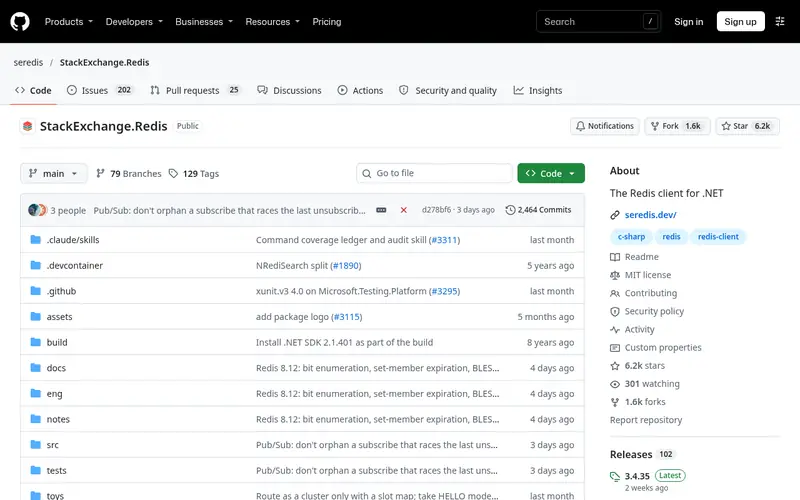
StackExchange.Redis is the main .NET client for Redis. You can use it directly or through Microsoft.Extensions.Caching.StackExchangeRedis, which implements IDistributedCache. That lets you swap in Redis without changing your caching code.
The client is free and open source under the MIT licence. The Redis server is separate: you run it yourself or pay a managed provider. Redis reads and writes cross the network, so latency is higher than an in-memory cache.
Skip it if a single process is enough, or if you cannot run or pay for a Redis server. For shared state across instances, it is the standard choice.
Standout: Mature Redis client
Free (open source), as listed by the vendor (StackExchange.Redis with IDistributedCache website). Confirm the current plan price before you buy.
Free plan. Plans change, so confirm on the vendor's pricing page before you buy.
Benefits
- Mature Redis client
- works with the IDistributedCache abstraction
Drawbacks
- Needs a Redis server or managed service
- network latency on every read
Skip it if this limit matters to you: needs a Redis server or managed service.
Verdict. A sensible pick for shared distributed caching across app instances.
Alternatives in this guide: Microsoft.Extensions.Caching.Memory (IMemoryCache), HybridCache (Microsoft.Extensions.Caching.H hybrid), FusionCache
EasyCaching
Best for one API across several cache providers
What it is and where it fits
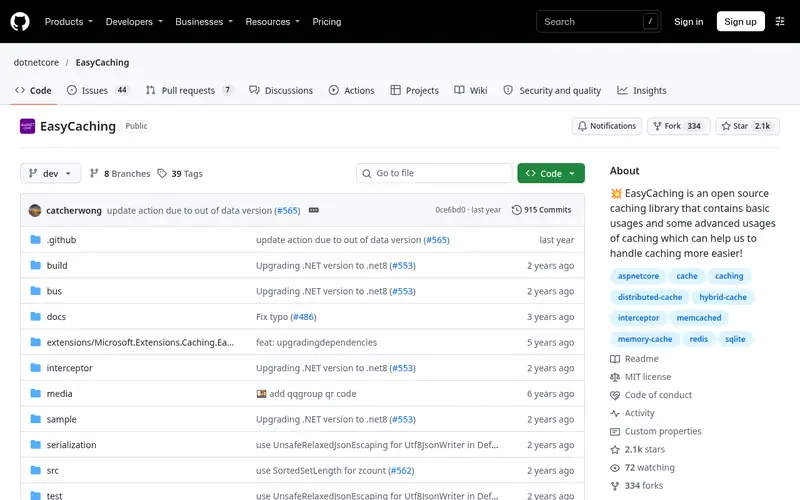
EasyCaching is an open-source library that puts several cache providers behind one interface. It supports in-memory, Redis, Memcached, SQLite and other providers, plus a bus for cross-node invalidation. You can switch providers without rewriting cache calls.
It targets modern .NET and integrates with ASP.NET Core dependency injection. The licence is MIT and there is no paid tier. The trade-off is more configuration than a single-provider library, and a smaller community than the Microsoft packages.
Skip it if you already know your provider and want the smallest dependency. It fits teams that expect to change cache backends over time.
Standout: Supports memory, Redis, Memcached and more behind one interface
Free (open source), as listed by the vendor (EasyCaching website). Confirm the current plan price before you buy.
Free plan. Plans change, so confirm on the vendor's pricing page before you buy.
Benefits
- Supports memory, Redis, Memcached and more behind one interface
- includes bus for invalidation
Drawbacks
- More setup than single-provider libraries
- smaller community than Microsoft packages
Skip it if this limit matters to you: more setup than single-provider libraries.
Verdict. A sensible pick for one API across several cache providers.
Alternatives in this guide: Microsoft.Extensions.Caching.Memory (IMemoryCache), HybridCache (Microsoft.Extensions.Caching.H hybrid), FusionCache
Who should use what
A single ASP.NET Core app with simple caching needs should start with IMemoryCache. A team on .NET 9 or later that wants memory plus distributed caching in one package should use HybridCache. A team that needs fail-safe behavior and multi-node invalidation should look at FusionCache. Apps that run several instances and must share cache state should use StackExchange.Redis with IDistributedCache. Teams that expect to switch cache backends should consider EasyCaching.
Questions to settle before you buy
What to check before you buy
- Confirm the library supports your target .NET version and hosting model.
- Decide whether the cache must be shared across instances or can stay per process.
- Check how the library handles cache stampede and stale data.
- Review the licence and any paid dependency, such as a Redis server.
- Test invalidation and expiration behavior under load before production.
FAQ
Do I need a distributed cache?
Only if more than one app instance must see the same cached data, or if the cache must survive a restart. A single instance can use an in-memory cache.
Is IMemoryCache enough for production?
For many single-instance apps, yes. It is maintained by Microsoft and supports expiration and size limits. Add a distributed layer when you scale out.
What is HybridCache?
HybridCache is a Microsoft package for .NET 9 and later. It combines an in-memory cache with a distributed cache and adds stampede protection.
Can I use FusionCache with Redis?
Yes. FusionCache supports Redis and other distributed backends as its second-level cache, plus an optional backplane for invalidation.
Are these libraries free?
All six listed here are free or open source. A distributed cache still needs a server or managed service, which may cost money.
Sources we checked
Method: how we score · editorial policy.
Change log. First published 27 Nov 2026.