Stage 01 · Write · Researched comparison
Best Swift Image Loading Libraries in 2026
Kingfisher is the first pick for most iOS projects that need remote image loading with caching, because it is Swift-native, open source and maintained. Nuke is a strong alternative when you want fine control over caching and image pipelines. SDWebImage suits projects that also target macOS or need Objective-C support. All three are free and open source, so the choice comes down to API style and platform needs.

By Shihab Mia
Published 27 Nov 2026 · 5 tools compared
We run no ads and no affiliate links at launch. The order of a list follows our published method. See how we score.
Prices are the starting prices vendors list publicly. Plans change, so confirm the current price on the vendor page before you buy.
Key takeaways
- Kingfisher, SDWebImage, Nuke and AlamofireImage are all free and open source.
- SwiftUI's built-in AsyncImage is free with no dependency, but it does no disk caching on its own.
- Nuke offers separate modules for caching, so you can keep the dependency small.
- Check the licence and minimum iOS version on each repository before you adopt a library.
Who each pick is for
- Swift-native image loading with caching for iOS and macOSKingfisher
- Projects needing Objective-C support and broad platform coverageSDWebImage
- Fine control over image pipelines and cachingNuke
- Teams already using Alamofire for networkingAlamofireImage
- Simple remote images in SwiftUI with no dependencySwiftUI AsyncImage
Comparison
| Tool | Best for | Standout feature | Listed starting price | Free plan or trial |
|---|---|---|---|---|
| 1Kingfisher | Swift-native image loading with caching for iOS and macOS | Pure Swift API | Free (open source) | Free plan |
| 2SDWebImage | Projects needing Objective-C support and broad platform coverage | Objective-C and Swift support | Free (open source) | Free plan |
| 3Nuke | Fine control over image pipelines and caching | Modular design | Free (open source) | Free plan |
| 4AlamofireImage | Teams already using Alamofire for networking | Integrates with Alamofire | Free (open source) | Free plan |
| 5SwiftUI AsyncImage | Simple remote images in SwiftUI with no dependency | Built into SwiftUI | Free | Free plan |
How we picked
We picked libraries that load remote images and cache them on Apple platforms, and that are actively maintained with a public repository. Criteria were fit for the job, platform support, licence and price, and the main limits of each option. Sources are vendor documentation, project repositories and public pricing pages. Prices and free plan limits can change, so confirm details on the vendor site before you commit.
The tools, one by one
Kingfisher
Best for swift-native image loading with caching for iOS and macOS
What it is and where it fits
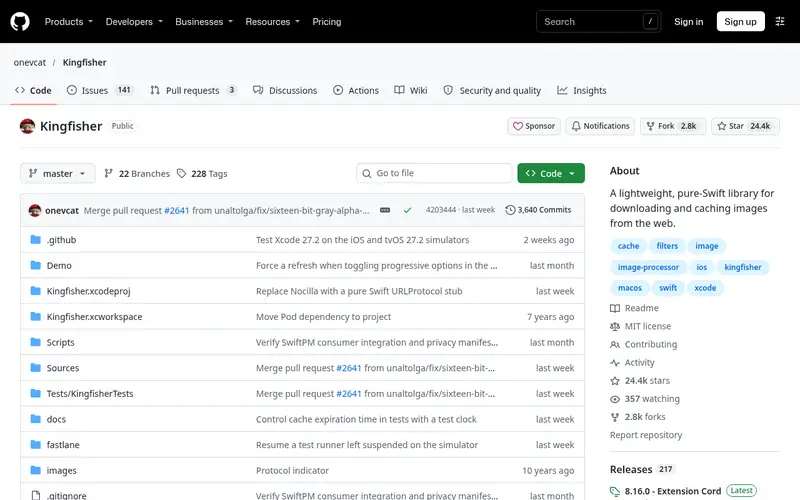
Kingfisher is a pure Swift library for downloading and caching images. It works with UIKit, SwiftUI and AppKit, so the same library covers iOS, macOS, tvOS and watchOS. It provides a memory cache and a disk cache, request cancellation, placeholder images and processors for resizing or rounding.
The API is built around extensions on UIImageView and SwiftUI views, which keeps call sites short. You can configure cache size, expiry and downloader behaviour. The project is open source under the MIT licence and is maintained on GitHub. It has no paid tier.
Skip Kingfisher if you need an Objective-C API or if you want a very small dependency with only the modules you use. In those cases SDWebImage or Nuke may fit better.
Standout: Pure Swift API
Free (open source), as listed by the vendor (Kingfisher website). Confirm the current plan price before you buy.
Free plan. Plans change, so confirm on the vendor's pricing page before you buy.
Benefits
- Pure Swift API
- built-in memory and disk cache
Drawbacks
- Tied to Apple platforms
- large feature surface to learn
Skip it if this limit matters to you: tied to Apple platforms.
Verdict. A sensible pick for swift-native image loading with caching for iOS and macOS.
Alternatives in this guide: SDWebImage, Nuke, AlamofireImage
SDWebImage
Best for projects needing Objective-C support and broad platform coverage
What it is and where it fits
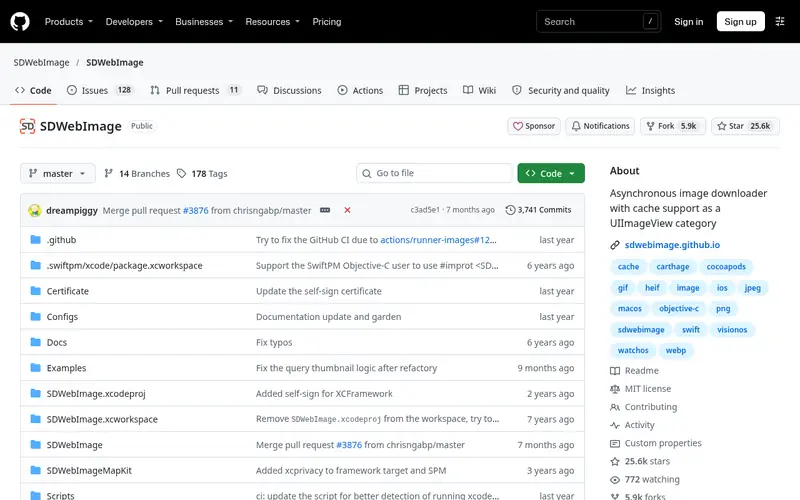
SDWebImage is one of the longest-running image loading libraries for Apple platforms. It supports UIKit and AppKit, and it can be used from both Objective-C and Swift. It handles asynchronous download, memory and disk caching, and decoding.
The library is split into a core and optional plugins, such as coders for extra formats and a SwiftUI view. That structure lets you add only what you need. It is open source under the MIT licence and maintained on GitHub, with no paid tier.
Choose SDWebImage when you maintain Objective-C code or need its plugin ecosystem. If your project is pure Swift and you want a smaller API, Kingfisher or Nuke may be simpler.
Standout: Objective-C and Swift support
Free (open source), as listed by the vendor (SDWebImage website). Confirm the current plan price before you buy.
Free plan. Plans change, so confirm on the vendor's pricing page before you buy.
Benefits
- Objective-C and Swift support
- many platform targets
Drawbacks
- Older API style
- more configuration to wire up
Skip it if this limit matters to you: older API style.
Verdict. A sensible pick for projects needing Objective-C support and broad platform coverage.
Alternatives in this guide: Kingfisher, Nuke, AlamofireImage
Nuke
Best for fine control over image pipelines and caching
What it is and where it fits
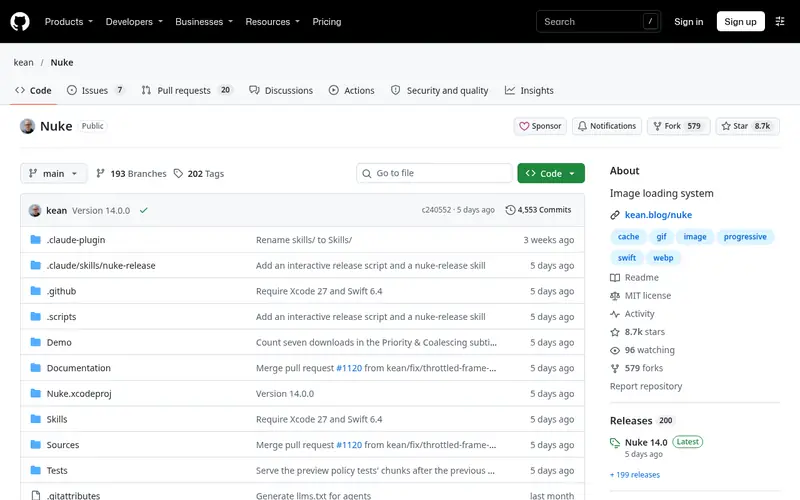
Nuke is a Swift image loading library built around an explicit pipeline. You create an image pipeline that combines a data loader, a decoder and caches. This design gives you control over how requests are deduplicated, how images are decoded and how caches are stored.
Nuke ships as several modules, including the core pipeline, a UI layer for UIKit and SwiftUI, and extensions for extra formats. You can include only the parts you need. It is open source under the MIT licence and maintained on GitHub, with no paid tier.
Nuke suits teams that want to tune caching and decoding rather than accept defaults. If you want a one-line setup, Kingfisher has a shorter path to a working implementation.
Standout: Modular design
Free (open source), as listed by the vendor (Nuke website). Confirm the current plan price before you buy.
Free plan. Plans change, so confirm on the vendor's pricing page before you buy.
Benefits
- Modular design
- detailed pipeline and cache control
Drawbacks
- More setup for basic cases
- Apple platforms only
Skip it if this limit matters to you: more setup for basic cases.
Verdict. A sensible pick for fine control over image pipelines and caching.
Alternatives in this guide: Kingfisher, SDWebImage, AlamofireImage
AlamofireImage
Best for teams already using Alamofire for networking
What it is and where it fits
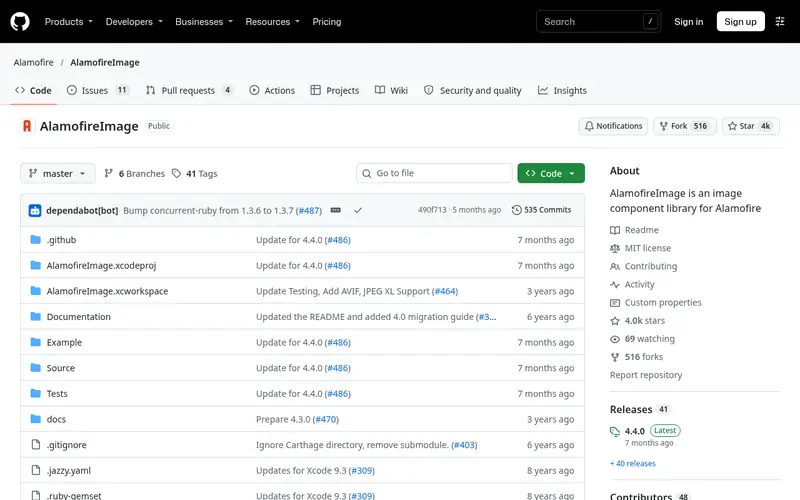
AlamofireImage is an image component built on top of Alamofire. It provides an image response serializer, a memory and disk cache, and a set of image filters such as scaling, cropping and blurring. It works with UIKit on iOS, tvOS and macOS.
The main reason to pick it is an existing Alamofire setup. If your networking layer already uses Alamofire, AlamofireImage reuses that stack instead of adding a second HTTP client. It is open source under the MIT licence and maintained on GitHub, with no paid tier.
Skip it if you do not use Alamofire, since it would add a dependency you otherwise do not need. Kingfisher, SDWebImage and Nuke each bring their own downloader.
Standout: Integrates with Alamofire
Free (open source), as listed by the vendor (AlamofireImage website). Confirm the current plan price before you buy.
Free plan. Plans change, so confirm on the vendor's pricing page before you buy.
Benefits
- Integrates with Alamofire
- includes image filters
Drawbacks
- Adds Alamofire as a dependency
- fewer releases
Skip it if this limit matters to you: adds Alamofire as a dependency.
Verdict. A sensible pick for teams already using Alamofire for networking.
Alternatives in this guide: Kingfisher, SDWebImage, Nuke
SwiftUI AsyncImage
Best for simple remote images in SwiftUI with no dependency
What it is and where it fits
AsyncImage is part of SwiftUI and loads an image from a URL. It handles the loading, success and failure states through a phase value, so you can show a placeholder or an error view. It requires no package and adds no dependency to your project.
The trade-off is control. AsyncImage does not provide a configurable disk cache, request deduplication or image processors. For lists with many images or apps that need offline caching, a dedicated library is usually a better fit. It is free and ships with the OS, so there is no licence or pricing to check.
Use AsyncImage for small screens with a few remote images, or as a fallback when you cannot add a package. Move to Kingfisher or Nuke when caching and cancellation matter.
Standout: Built into SwiftUI
Free, as listed by the vendor (SwiftUI AsyncImage website). Confirm the current plan price before you buy.
Free plan. Plans change, so confirm on the vendor's pricing page before you buy.
Benefits
- Built into SwiftUI
- no third-party dependency
Drawbacks
- No built-in disk cache
- limited control over loading
Skip it if this limit matters to you: no built-in disk cache.
Verdict. A sensible pick for simple remote images in SwiftUI with no dependency.
Alternatives in this guide: Kingfisher, SDWebImage, Nuke
Who should use what
A new SwiftUI app with a few remote images can start with AsyncImage and add a library later. A UIKit or mixed codebase that needs memory and disk caching should look at Kingfisher. A team that maintains Objective-C code or needs plugin-based format support should evaluate SDWebImage. A project that wants to tune decoding and cache behaviour should consider Nuke, and a codebase already on Alamofire can reuse that stack with AlamofireImage.
Questions to settle before you buy
What to check before you buy
- Confirm the library supports every platform you ship, including macOS, tvOS or watchOS if needed.
- Check the minimum iOS and Swift version against your deployment target.
- Read the licence and confirm it fits your distribution model.
- Review how the cache is configured, including size limits and expiry.
- Check that request cancellation works with your list and scrolling code.
FAQ
Is Kingfisher free to use?
Yes. Kingfisher is open source under the MIT licence. There is no paid tier. You can read the licence and source on its GitHub repository.
Does SwiftUI AsyncImage cache images on disk?
AsyncImage does not provide a configurable disk cache of its own. It relies on the system's URL loading behaviour. For predictable offline caching, use a library such as Kingfisher or Nuke that manages a disk cache.
Can I use SDWebImage from Swift?
Yes. SDWebImage supports both Objective-C and Swift. Its core and plugins can be added through Swift Package Manager, CocoaPods or Carthage.
Which library works on macOS as well as iOS?
Kingfisher, SDWebImage, Nuke and AlamofireImage all support Apple platforms beyond iOS to varying degrees. Check each repository's platform list, since tvOS, watchOS and macOS support differs by library.
Do these libraries send my images to a third party?
No. These libraries run in your app and download images from the URLs you provide. They do not route traffic through a vendor service.
Sources we checked
Method: how we score · editorial policy.
Change log. First published 27 Nov 2026.