Stage 02 · Test · Researched comparison
Best Vue Form Validation Libraries in 2026
VeeValidate is the first pick for most Vue 3 projects. It handles field-level and form-level validation, supports Composition API and Options API, and works with schema libraries like Yup. Vuelidate suits teams that want a lightweight, model-based validator with no component wrapper. FormKit fits projects that want form structure, inputs and validation in one package. All three are open source and free.

By Shihab Mia
Published 27 Nov 2026 · 5 tools compared
We run no ads and no affiliate links at launch. The order of a list follows our published method. See how we score.
Prices are the starting prices vendors list publicly. Plans change, so confirm the current price on the vendor page before you buy.
Key takeaways
- VeeValidate, Vuelidate, FormKit, Regle and TanStack Form are all free and open source, so cost is not the deciding factor.
- VeeValidate and Vuelidate both support Vue 3 and can validate against schema libraries such as Valibot or Yup.
- FormKit bundles form inputs and validation together, while Vuelidate and VeeValidate focus on validation logic alone.
- Schema layers like Valibot are companions, not replacements, for a Vue validation library in most setups.
Who each pick is for
- General Vue 3 form validation with schema supportVeeValidate
- Lightweight model-based validation without component wrappersVuelidate
- Full form framework with inputs and validation built inFormKit
- Type-safe Vue 3 validation with strong TypeScript inferenceRegle
- Framework-agnostic form state with a Vue adapterTanStack Form (Vue adapter)
Comparison
| Tool | Best for | Standout feature | Listed starting price | Free plan or trial |
|---|---|---|---|---|
| 1VeeValidate | General Vue 3 form validation with schema support | Works with Composition and Options API | Free (open source) | Free plan |
| 2Vuelidate | Lightweight model-based validation without component wrappers | Simple, declarative rules | Free (open source) | Free plan |
| 3FormKit | Full form framework with inputs and validation built in | Ships inputs, validation and form structure together | Free (open source) | Free plan |
| 4Regle | Type-safe Vue 3 validation with strong TypeScript inference | Built for Vue 3 and TypeScript | Free (open source) | Free plan |
| 5TanStack Form (Vue adapter) | Framework-agnostic form state with a Vue adapter | Same API across React, Vue and other frameworks | Free (open source) | Free plan |
How we picked
We compared libraries on fit for Vue 3 form validation, supported APIs (Composition and Options API), TypeScript support, licence and price, and whether they handle field state, async rules and schema integration. We also looked at how each fits alongside schema layers like Valibot. Sources are vendor documentation, project repositories and public pricing pages. Prices and plan terms change, so confirm details on the vendor site before you commit.
The tools, one by one
VeeValidate
Best for general Vue 3 form validation with schema support
What it is and where it fits
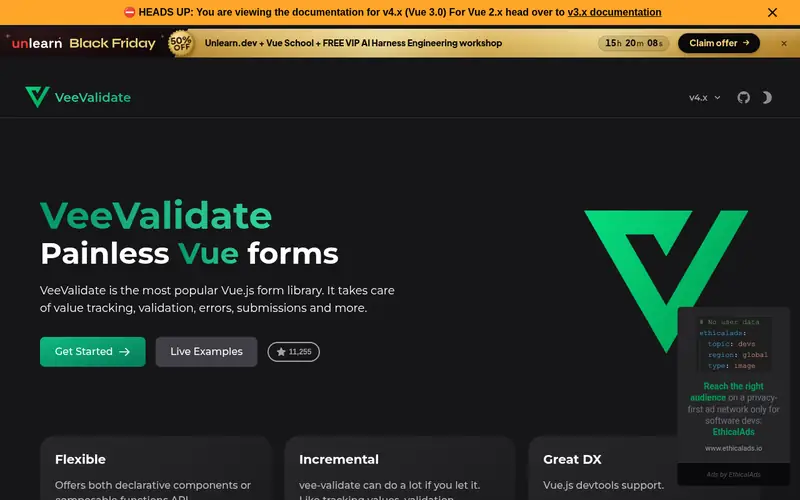
VeeValidate is a validation library for Vue 3 that provides composables like useField and useForm. It validates individual fields and whole forms, supports async rules, and can delegate schema checks to Zod, Valibot or Yup. It does not ship UI components, so you keep control of markup and styling.
It runs anywhere Vue 3 runs, including Vite, Nuxt and plain script setups. The project is MIT licensed and free. Documentation covers both Composition API and Options API patterns. Teams that want ready-made inputs or a visual form builder should look at FormKit instead.
Standout: Works with Composition and Options API
Free (open source), as listed by the vendor (VeeValidate website). Confirm the current plan price before you buy.
Free plan. Plans change, so confirm on the vendor's pricing page before you buy.
Benefits
- Works with Composition and Options API
- integrates with Zod, Valibot and Yup
Drawbacks
- No built-in input components
- some setup needed for complex forms
Skip it if this limit matters to you: no built-in input components.
Verdict. A sensible pick for general Vue 3 form validation with schema support.
Vuelidate
Best for lightweight model-based validation without component wrappers
What it is and where it fits
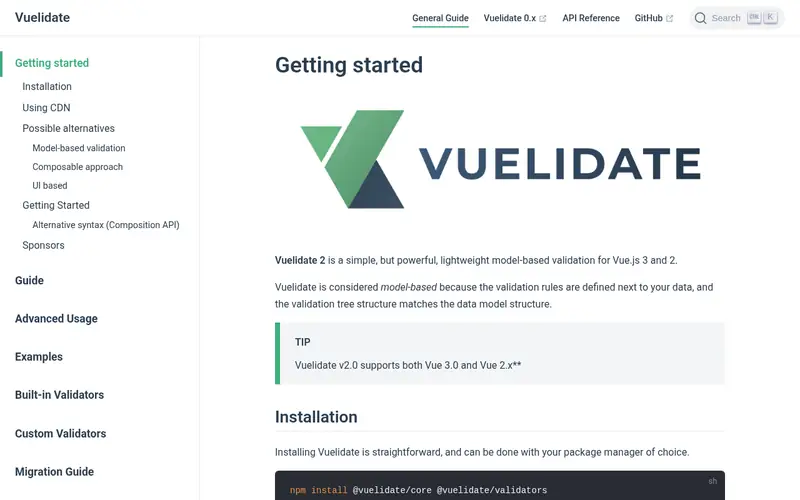
Vuelidate validates a reactive model rather than wrapping inputs. You define rules per property, and the library reports validation state you bind to in templates. It is small and has a narrow API, which makes it easy to read in existing codebases.
The Vue 3 version is documented separately from the older Vue 2 release, so check the version you install. It is MIT licensed and free. It does not provide input components or a schema-first workflow out of the box. Teams that want a full form toolkit or heavy TypeScript schema inference may prefer FormKit or a schema-driven setup.
Standout: Simple, declarative rules
Free (open source), as listed by the vendor (Vuelidate website). Confirm the current plan price before you buy.
Free plan. Plans change, so confirm on the vendor's pricing page before you buy.
Benefits
- Simple, declarative rules
- small API surface
Drawbacks
- Vue 3 support lives in the v2 line
- fewer built-in integrations than VeeValidate
Skip it if this limit matters to you: vue 3 support lives in the v2 line.
Verdict. A sensible pick for lightweight model-based validation without component wrappers.
Alternatives in this guide: VeeValidate, FormKit, Regle
FormKit
Best for full form framework with inputs and validation built in
What it is and where it fits
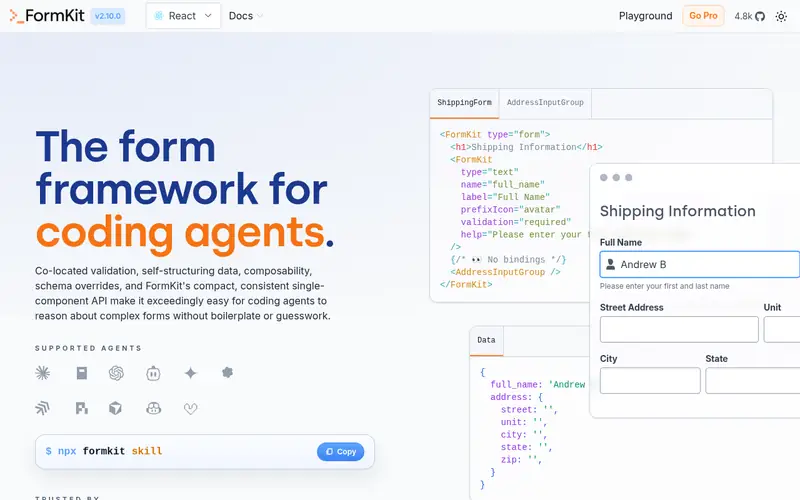
FormKit is a form framework for Vue 3. It provides form and input components, a validation rule system, and schema-driven form generation. Validation rules can be declared on inputs or added as custom plugins, and async rules are supported.
It runs in Vue 3 projects including Nuxt. The core package is open source and free, and the project also offers paid offerings on its site; confirm current terms on the vendor pricing page. Because it owns both inputs and validation, it suits teams starting fresh more than teams retrofitting validation into existing custom inputs.
Standout: Ships inputs, validation and form structure together
Free (open source), as listed by the vendor (FormKit website). Confirm the current plan price before you buy.
Free plan. Plans change, so confirm on the vendor's pricing page before you buy.
Benefits
- Ships inputs, validation and form structure together
- plugin-based rule system
Drawbacks
- Larger surface area to learn
- opinionated structure
Skip it if this limit matters to you: larger surface area to learn.
Verdict. A sensible pick for full form framework with inputs and validation built in.
Alternatives in this guide: VeeValidate, Vuelidate, Regle
Regle
Best for type-safe Vue 3 validation with strong TypeScript inference
What it is and where it fits
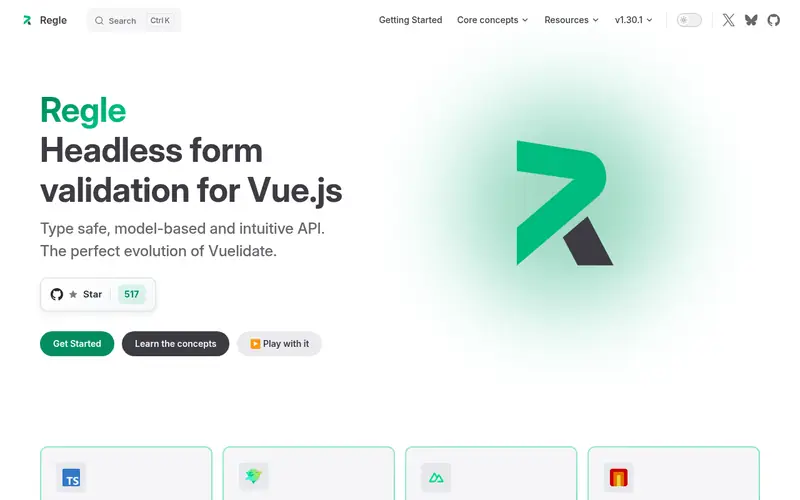
Regle is a Vue 3 validation library built around TypeScript inference. It uses composables to define rules on a reactive state object and exposes typed validation results. It targets the Composition API and modern Vue 3 setups.
It is open source and free. The project is newer than VeeValidate and Vuelidate, so community examples and integrations are fewer. It does not provide UI components. Teams that need a long track record or many third-party tutorials may prefer a more established library, while TypeScript-heavy codebases may find the typed approach useful.
Standout: Built for Vue 3 and TypeScript
Free (open source), as listed by the vendor (Regle website). Confirm the current plan price before you buy.
Free plan. Plans change, so confirm on the vendor's pricing page before you buy.
Benefits
- Built for Vue 3 and TypeScript
- composable-based API
Drawbacks
- Younger project with a smaller ecosystem
- fewer third-party guides
Skip it if this limit matters to you: younger project with a smaller ecosystem.
Verdict. A sensible pick for type-safe Vue 3 validation with strong TypeScript inference.
Alternatives in this guide: VeeValidate, Vuelidate, FormKit
TanStack Form (Vue adapter)
Best for framework-agnostic form state with a Vue adapter
What it is and where it fits
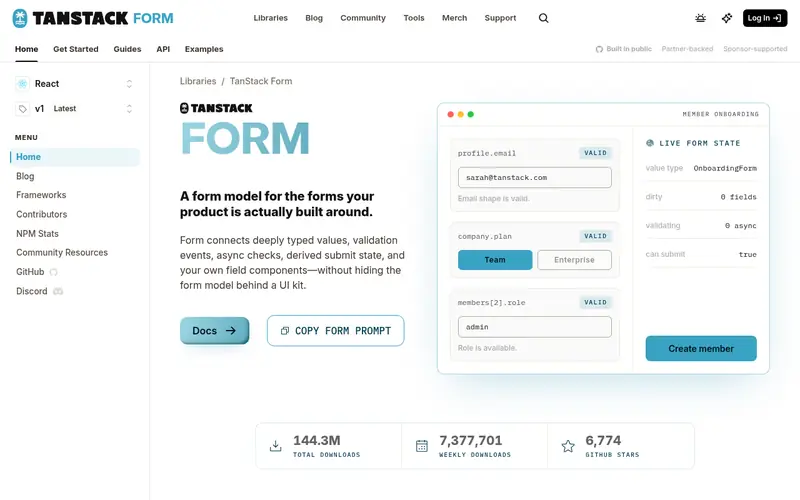
TanStack Form is a form state library with adapters for multiple frameworks, including Vue 3. It manages field state, validation and submission, and it is typed. Validation can be synchronous or asynchronous and attached at field or form level.
The Vue adapter runs in Vue 3 projects. The core project is open source and free. Because the API is shared across frameworks, it suits teams that work in more than one framework or want consistent form patterns. Teams that want Vue-specific conventions and examples may find VeeValidate or Vuelidate a closer fit.
Standout: Same API across React, Vue and other frameworks
Free (open source), as listed by the vendor (TanStack Form (Vue adapter) website). Confirm the current plan price before you buy.
Free plan. Plans change, so confirm on the vendor's pricing page before you buy.
Benefits
- Same API across React, Vue and other frameworks
- typed field state
Drawbacks
- Vue adapter is one of several targets
- validation patterns differ from Vue-native libraries
Skip it if this limit matters to you: vue adapter is one of several targets.
Verdict. A sensible pick for framework-agnostic form state with a Vue adapter.
Alternatives in this guide: VeeValidate, Vuelidate, FormKit
Who should use what
If you are starting a Vue 3 app and want validation without extra components, start with VeeValidate. If you want inputs, form structure and validation in one package, use FormKit. If you prefer validating a reactive model with a small API, use Vuelidate. If your codebase is TypeScript-heavy and you want typed inference, look at Regle or pair VeeValidate with a schema library. Teams working across frameworks may prefer TanStack Form for a shared API.
Questions to settle before you buy
What to check before you buy
- Confirm the library supports Vue 3 and the API style your team uses.
- Check whether you need schema integration (Valibot, Yup) and that it is documented.
- Verify TypeScript support and how field types are inferred.
- Read the licence and confirm the package is still maintained.
- Check bundle size and whether the library ships UI components you do not need.
FAQ
Do I need a schema library with VeeValidate?
No. VeeValidate can validate with its own rules. A schema library like Valibot adds typed schema definitions and can centralize rules shared with server code. Many teams use both, with VeeValidate handling field state and the schema library handling the rules.
Is Vuelidate still maintained for Vue 3?
Yes. The Vue 3 line is documented separately from the older Vue 2 release. Check that you install the correct version for your Vue release and review the current documentation before adopting it.
Can I use these libraries with Nuxt?
VeeValidate, FormKit and the others listed run in Vue 3 projects, and Nuxt is built on Vue 3. Check each project's documentation for any Nuxt-specific setup notes, especially around auto-imports and plugins.
Are these libraries free?
VeeValidate, Vuelidate, FormKit, Regle and TanStack Form are open source and free to use. FormKit also lists paid offerings on its site; confirm current terms on the vendor pricing page.
Should I paste production data into online form demos?
No. Do not paste secrets, tokens or production data into third-party web pages. Prefer tools and demos that run locally in the browser or offline, and test with sample data.
Sources we checked
Method: how we score · editorial policy.
Change log. First published 27 Nov 2026.