Stage 01 · Write · Researched comparison
Best Vue State Management Libraries in 2026
Pinia is the first pick for most Vue 3 projects. It is the official state library, works with the Composition API and TypeScript, and supports devtools and server-side rendering. For teams that mostly fetch and cache server data, TanStack Query for Vue is a better fit than a general store. For small shared state, VueUse composables such as createGlobalState keep things simple. Vuex still works for legacy Vue 2 codebases but is in maintenance mode.

By Shihab Mia
Published 27 Nov 2026 · 5 tools compared
We run no ads and no affiliate links at launch. The order of a list follows our published method. See how we score.
Prices are the starting prices vendors list publicly. Plans change, so confirm the current price on the vendor page before you buy.
Key takeaways
- Pinia is the official Vue store, is free and open source, and is the default choice for new Vue 3 apps.
- Vuex is in maintenance mode; it receives fixes but no new features, so use it only to support existing code.
- TanStack Query for Vue handles server state, caching and refetching, and is free and open source.
- VueUse createGlobalState is free and needs no extra library, but suits only small, simple shared state.
Who each pick is for
- Official store for new Vue 3 appsPinia
- Existing Vue 2 codebases already using itVuex
- Server data caching, refetching and syncTanStack Query for Vue
- Small shared state without a store libraryVueUse (createGlobalState and composables)
- Complex state machines and flowsXState (Vue bindings)
Comparison
| Tool | Best for | Standout feature | Listed starting price | Free plan or trial |
|---|---|---|---|---|
| 1Pinia | Official store for new Vue 3 apps | Official Vue recommendation | Free (open source) | Free plan |
| 2Vuex | Existing Vue 2 codebases already using it | Mature and widely documented | Free (open source) | Free plan |
| 3TanStack Query for Vue | Server data caching, refetching and sync | Handles caching, retries and background refetch | Free (open source) | Free plan |
| 4VueUse (createGlobalState and composables) | Small shared state without a store library | No extra store layer | Free (open source) | Free plan |
| 5XState (Vue bindings) | Complex state machines and flows | Explicit states and transitions | Free (open source) | Free plan |
How we picked
We compared libraries on fit for Vue state management, supported Vue versions, licence and price, maintenance status, TypeScript and devtools support, and the main limits each one documents. Sources are official project documentation, repositories and vendor pages. Prices and plan terms change, so confirm them on the vendor site before you rely on them.
The tools, one by one
Pinia
Best for official store for new Vue 3 apps

What it is and where it fits
Pinia is the official state management library for Vue. It provides stores with state, getters and actions, and it works with both the Options API and the Composition API. Stores are modular by default, and each one can be imported where it is needed. It integrates with Vue devtools for time-travel debugging and state inspection.
It supports TypeScript with type inference on stores, and it works with server-side rendering through Nuxt and other setups. Pinia is maintained by the Vue core team and is free under the MIT license. The main limit is scope: it manages client state, not server data fetching or caching, so most apps pair it with a data-fetching library. Teams on Vue 2 should check the documented setup path before migrating.
Standout: Official Vue recommendation
Free (open source), as listed by the vendor (Pinia website). Confirm the current plan price before you buy.
Free plan. Plans change, so confirm on the vendor's pricing page before you buy.
Benefits
- Official Vue recommendation
- strong TypeScript and devtools support
Drawbacks
- Built for Vue 3, so Vue 2 needs a different setup
- no built-in server cache layer
Skip it if this limit matters to you: built for Vue 3, so Vue 2 needs a different setup.
Verdict. A sensible pick for official store for new Vue 3 apps.
Alternatives in this guide: Vuex, TanStack Query for Vue, VueUse (createGlobalState and composables)
Vuex
Best for existing Vue 2 codebases already using it
What it is and where it fits
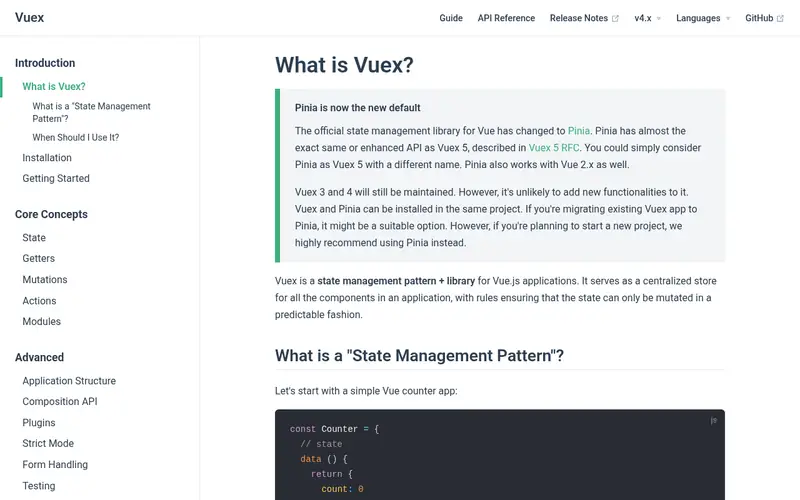
Vuex is the earlier official state library for Vue. It uses a single store with state, mutations, actions and getters, and it has broad documentation and a large body of existing code. The project is in maintenance mode: it still receives fixes, but new features are not planned, and the Vue team points new projects to Pinia.
For teams maintaining a Vue 2 application that already uses Vuex, staying on it is reasonable. For new work, or for a migration to Vue 3, Pinia is the documented path forward. Vuex is free under the MIT license. Skip it if you are starting fresh, since the extra boilerplate buys nothing over Pinia.
Standout: Mature and widely documented
Free (open source), as listed by the vendor (Vuex website). Confirm the current plan price before you buy.
Free plan. Plans change, so confirm on the vendor's pricing page before you buy.
Benefits
- Mature and widely documented
- familiar mutations-and-actions model
Drawbacks
- In maintenance mode with no new features
- more boilerplate than Pinia
Skip it if this limit matters to you: in maintenance mode with no new features.
Verdict. A sensible pick for existing Vue 2 codebases already using it.
Alternatives in this guide: Pinia, TanStack Query for Vue, VueUse (createGlobalState and composables)
TanStack Query for Vue
Best for server data caching, refetching and sync
What it is and where it fits
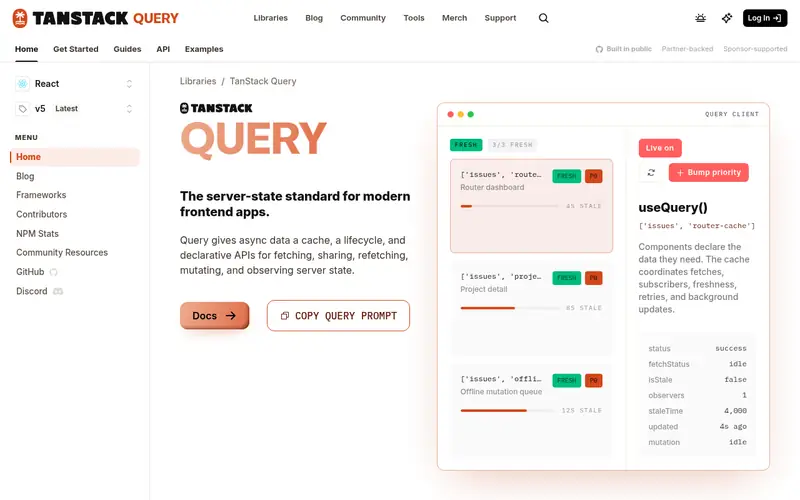
TanStack Query for Vue manages server state: fetching, caching, background refetching, retries and cache invalidation. It returns reactive loading, error and data states that fit Vue components directly. It is often used alongside Pinia, with Pinia holding client state and TanStack Query holding remote data.
The library is free and open source under the MIT license, and it is part of the wider TanStack Query project with adapters for other frameworks. It is not a replacement for a general store, so UI state such as modals or filters still needs a store or composable. Teams with heavy server data and manual cache code should look at it first.
Standout: Handles caching, retries and background refetch
Free (open source), as listed by the vendor (TanStack Query for Vue website). Confirm the current plan price before you buy.
Free plan. Plans change, so confirm on the vendor's pricing page before you buy.
Benefits
- Handles caching, retries and background refetch
- clear loading and error states
Drawbacks
- Not a general client-state store
- adds concepts to learn
Skip it if this limit matters to you: not a general client-state store.
Verdict. A sensible pick for server data caching, refetching and sync.
Alternatives in this guide: Pinia, Vuex, VueUse (createGlobalState and composables)
VueUse (createGlobalState and composables)
Best for small shared state without a store library
What it is and where it fits
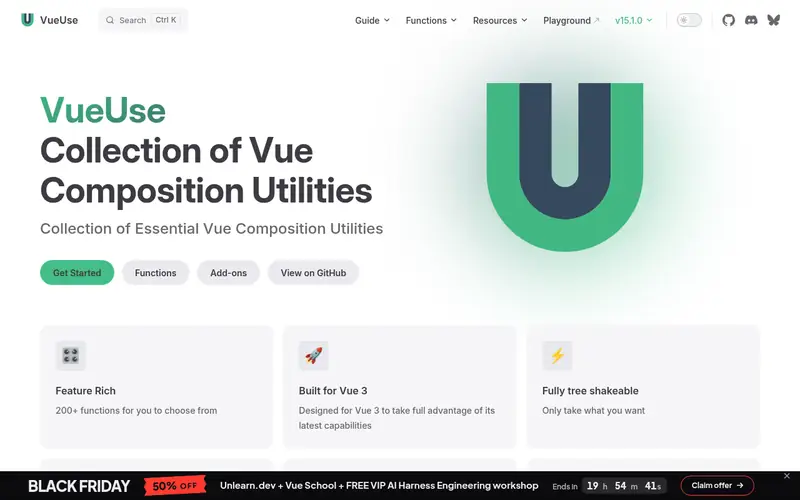
VueUse is a collection of Composition API utilities. For state, createGlobalState turns a composable into a shared singleton, which covers simple cases such as a theme toggle or a user preference. Other composables handle storage sync, browser APIs and reactive helpers. It is free and open source under the MIT license.
This approach suits small apps and prototypes where a full store is overhead. The limits appear as state grows: there is no store devtools view, no built-in module structure, and no conventions for actions. For larger apps, a dedicated store such as Pinia is easier to reason about. VueUse is best treated as a complement, not a full replacement.
Standout: No extra store layer
Free (open source), as listed by the vendor (VueUse (createGlobalState and composables) website). Confirm the current plan price before you buy.
Free plan. Plans change, so confirm on the vendor's pricing page before you buy.
Benefits
- No extra store layer
- large set of composables in one package
Drawbacks
- No devtools store inspection
- manual structure as state grows
Skip it if this limit matters to you: no devtools store inspection.
Verdict. A sensible pick for small shared state without a store library.
Alternatives in this guide: Pinia, Vuex, TanStack Query for Vue
XState (Vue bindings)
Best for complex state machines and flows
What it is and where it fits
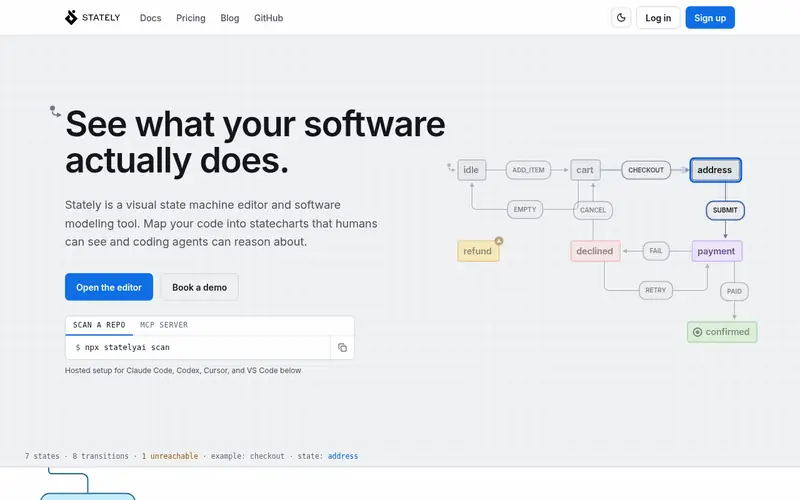
XState is a state machine and statechart library with official Vue bindings. It models state as explicit states and transitions, which helps with complex flows such as checkout, onboarding or multi-step forms where invalid transitions must be blocked. The core library is free and open source.
It is not a drop-in replacement for a general store. The mental model takes time to learn, and simple shared values do not need it. Use it when the logic is genuinely stateful and the number of states is large. The Stately tools offer visual editing and inspection, with paid plans for team features; check the vendor pricing page for current terms.
Standout: Explicit states and transitions
Free (open source), as listed by the vendor (XState (Vue bindings) website). Confirm the current plan price before you buy.
Free plan. Plans change, so confirm on the vendor's pricing page before you buy.
Benefits
- Explicit states and transitions
- visual editing tools available
Drawbacks
- Steeper learning curve
- overkill for simple shared state
Skip it if this limit matters to you: steeper learning curve.
Verdict. A sensible pick for complex state machines and flows.
Alternatives in this guide: Pinia, Vuex, TanStack Query for Vue
Who should use what
New Vue 3 apps should start with Pinia. Teams with heavy server data should add TanStack Query for Vue and keep Pinia for client state. Small apps and prototypes can use VueUse createGlobalState and skip a store library. Teams maintaining Vue 2 code with Vuex should stay put until a planned migration. Projects with complex multi-step flows should evaluate XState.
Questions to settle before you buy
What to check before you buy
- Confirm the library supports your Vue version, especially if you are still on Vue 2.
- Check the maintenance status and recent repository activity before adopting.
- Decide whether you need client state, server state, or both, and pick tools for each.
- Verify TypeScript support and devtools integration match your workflow.
- Read the licence and any paid tier terms on the vendor page.
FAQ
Is Pinia the official Vue state library?
Yes. Pinia is the official state management library for Vue and is recommended by the Vue documentation for new projects. It is free and open source under the MIT license.
Should I still use Vuex?
Use Vuex for existing Vue 2 applications that already depend on it. It is in maintenance mode, so new projects should use Pinia instead. Vuex still receives fixes but no new features.
Do I need both Pinia and TanStack Query?
Many apps use both. Pinia holds client state such as UI settings, while TanStack Query handles server data, caching and refetching. Using only one is fine if your app does not need the other kind of state.
Can I manage state without a library?
Yes. VueUse createGlobalState and plain composables cover small shared state. As state grows, a store library adds structure, devtools inspection and conventions that are harder to maintain by hand.
Is XState a replacement for Pinia?
No. XState models state machines and suits complex flows with many states and transitions. It is not a general-purpose store, and simple shared state does not need it.
Sources we checked
Method: how we score · editorial policy.
Change log. First published 27 Nov 2026.