Stage 01 · Write · Researched comparison
Best Svelte Form Libraries in 2026
Superforms (sveltekit-superforms) is the first pick for most SvelteKit projects that need server-side validation, progressive enhancement and typed form data. It suits teams building full-stack apps with actions and load functions. Felte is a lighter alternative for plain Svelte apps that want client-side validation without SvelteKit coupling. Formsnap is the better fit when you want accessible, prebuilt form components on top of Superforms.

By Shihab Mia
Published 27 Nov 2026 · 5 tools compared
We run no ads and no affiliate links at launch. The order of a list follows our published method. See how we score.
Prices are the starting prices vendors list publicly. Plans change, so confirm the current price on the vendor page before you buy.
Key takeaways
- Superforms is free and open source, and it is built around SvelteKit server actions and validation.
- Felte is free and open source, works in plain Svelte and SvelteKit, and focuses on client-side form state.
- Formsnap is free and open source, and it wraps Superforms with accessible component primitives.
- TanStack Form is free and open source, and its Svelte adapter is a newer option than its React version.
Who each pick is for
- SvelteKit apps with server-side validationSuperforms
- Plain Svelte apps that need client-side form stateFelte
- Accessible prebuilt form components on SuperformsFormsnap
- Teams already using TanStack toolsTanStack Form
- Signal-based forms with schema validationModular Forms
Comparison
| Tool | Best for | Standout feature | Listed starting price | Free plan or trial |
|---|---|---|---|---|
| 1Superforms | SvelteKit apps with server-side validation | Tight SvelteKit integration with actions and load | Free (open source) | Free plan |
| 2Felte | Plain Svelte apps that need client-side form state | Works in Svelte and SvelteKit | Free (open source) | Free plan |
| 3Formsnap | Accessible prebuilt form components on Superforms | Accessible component primitives | Free (open source) | Free plan |
| 4TanStack Form | Teams already using TanStack tools | Framework-agnostic core with a Svelte adapter | Free (open source) | Free plan |
| 5Modular Forms | Signal-based forms with schema validation | Small API with schema validation support | Free (open source) | Free plan |
How we picked
We picked libraries that are real, currently maintained Svelte or SvelteKit form packages and that genuinely handle form state, validation or submission. Criteria were fit for the job, how well each works with SvelteKit versus plain Svelte, license and price, and the main limits such as maintenance pace and ecosystem size. Sources are vendor documentation, project repositories and public license information. Prices and plan details change, so confirm on each vendor or repository page before you commit.
The tools, one by one
Superforms
Best for svelteKit apps with server-side validation
What it is and where it fits
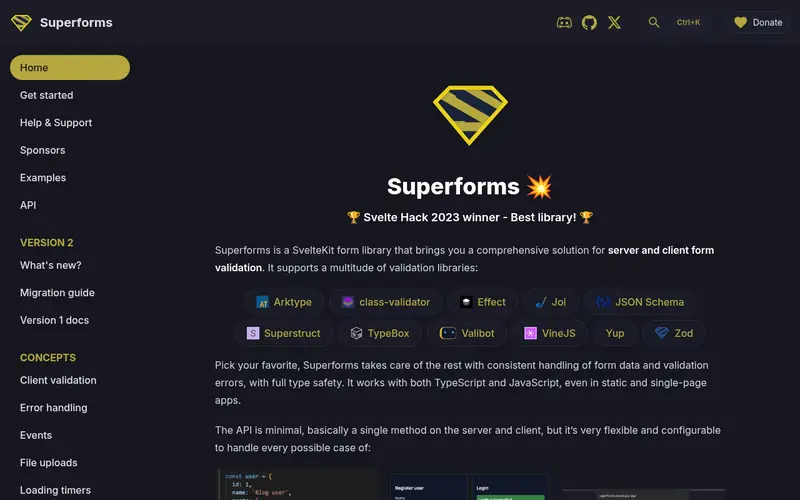
Superforms is a form library built for SvelteKit. It handles form data on the server, validates it with a schema library such as Zod, Valibot or ArkType, and sends typed data and errors back to the client. It supports progressive enhancement, so forms work without JavaScript, and it covers nested data, file uploads and multi-step forms. The package is published as sveltekit-superforms and is free under an open-source license. Its main limit is scope: it assumes SvelteKit routing and actions, so it is a poor fit for a plain Svelte single-page app. Teams that want one consistent validation path from server to client should start here.
Standout: Tight SvelteKit integration with actions and load
Free (open source), as listed by the vendor (Superforms website). Confirm the current plan price before you buy.
Free plan. Plans change, so confirm on the vendor's pricing page before you buy.
Benefits
- Tight SvelteKit integration with actions and load
- typed schema validation with Zod and others
Drawbacks
- Mostly aimed at SvelteKit, so plain Svelte apps get less value
- concepts take time to learn
Skip it if this limit matters to you: mostly aimed at SvelteKit, so plain Svelte apps get less value.
Verdict. A sensible pick for svelteKit apps with server-side validation.
Alternatives in this guide: Felte, Formsnap, TanStack Form
Felte
Best for plain Svelte apps that need client-side form state
What it is and where it fits
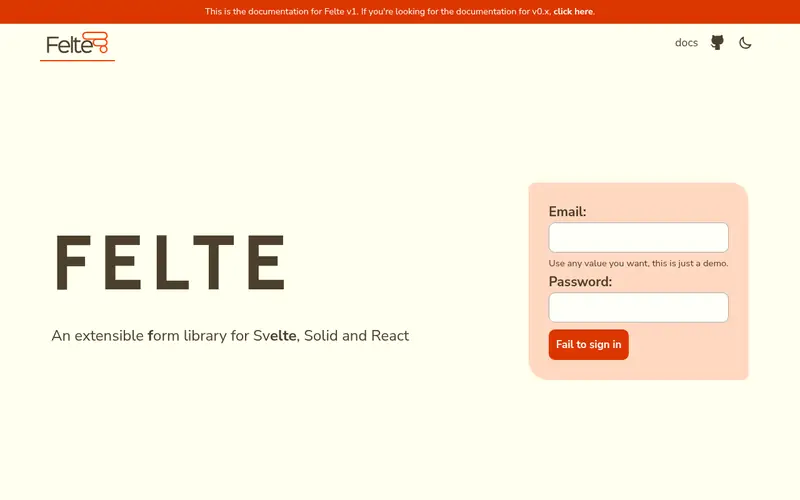
Felte is a form library for Svelte that manages form state, validation and error reporting on the client. It works with plain Svelte and with SvelteKit, and it connects to validation libraries including Zod, Yup and Vest, or to a custom validation function. It ships helpers for reporters, which show errors in the UI, and it supports dynamic fields and arrays. The project is free and open source. Because it is client-focused, you handle server-side validation and submission yourself, which is fine for simpler forms but adds work for full-stack apps. It suits developers who want a small, flexible layer without SvelteKit assumptions.
Standout: Works in Svelte and SvelteKit
Free (open source), as listed by the vendor (Felte website). Confirm the current plan price before you buy.
Free plan. Plans change, so confirm on the vendor's pricing page before you buy.
Benefits
- Works in Svelte and SvelteKit
- integrates with several validation libraries
Drawbacks
- Server-side handling is left to you
- smaller ecosystem than Superforms
Skip it if this limit matters to you: server-side handling is left to you.
Verdict. A sensible pick for plain Svelte apps that need client-side form state.
Alternatives in this guide: Superforms, Formsnap, TanStack Form
Formsnap
Best for accessible prebuilt form components on Superforms
What it is and where it fits
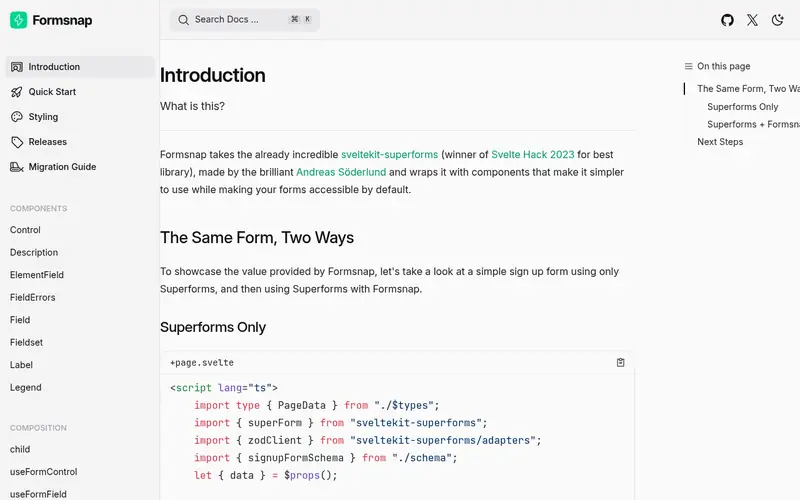
Formsnap provides form components for Svelte that build on Superforms. It supplies field, label, description and error components that wire ARIA attributes and IDs for you, which cuts down on repetitive markup and improves accessibility. Because it depends on Superforms, it inherits that library's SvelteKit focus and schema-based validation. It is free and open source. The trade-off is an extra abstraction: you need to understand Superforms first, and you take on Formsnap's component conventions. It suits teams that want consistent, accessible form markup without writing it by hand, and it is a poor fit if you prefer minimal dependencies or do not use Superforms.
Standout: Accessible component primitives
Free (open source), as listed by the vendor (Formsnap website). Confirm the current plan price before you buy.
Free plan. Plans change, so confirm on the vendor's pricing page before you buy.
Benefits
- Accessible component primitives
- reduces boilerplate on top of Superforms
Drawbacks
- Requires Superforms and SvelteKit
- adds a component layer to learn
Skip it if this limit matters to you: requires Superforms and SvelteKit.
Verdict. A sensible pick for accessible prebuilt form components on Superforms.
Alternatives in this guide: Superforms, Felte, TanStack Form
TanStack Form
Best for teams already using TanStack tools
What it is and where it fits
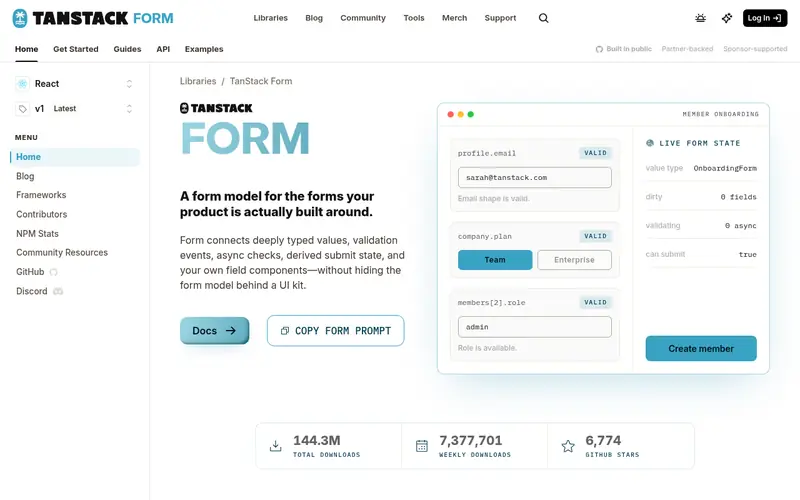
TanStack Form is a form state library from the TanStack project, with adapters for several frameworks including Svelte. It manages field state, validation and submission, and it is built around strong TypeScript inference. The core is framework-agnostic, so concepts carry over if you also work in React or Vue. It is free and open source. For Svelte, the adapter is newer and has fewer examples and community answers than the React version, so expect to read the source and docs. It suits teams already using TanStack Query or Table who want one mental model, and it is less proven for SvelteKit-specific server workflows than Superforms.
Standout: Framework-agnostic core with a Svelte adapter
Free (open source), as listed by the vendor (TanStack Form website). Confirm the current plan price before you buy.
Free plan. Plans change, so confirm on the vendor's pricing page before you buy.
Benefits
- Framework-agnostic core with a Svelte adapter
- strong TypeScript typing
Drawbacks
- Svelte adapter is less mature than the React version
- fewer Svelte-specific examples
Skip it if this limit matters to you: svelte adapter is less mature than the React version.
Verdict. A sensible pick for teams already using TanStack tools.
Alternatives in this guide: Superforms, Felte, Formsnap
Modular Forms
Best for signal-based forms with schema validation
What it is and where it fits
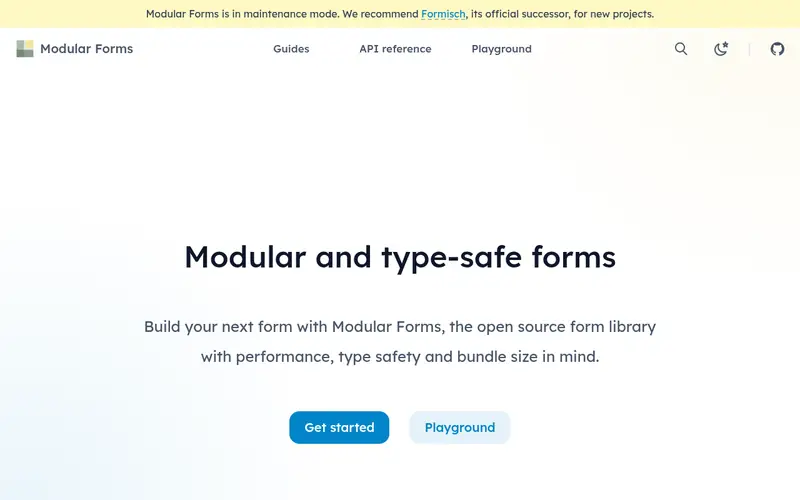
Modular Forms is a lightweight, signal-based form library. It has a framework-agnostic core and packages for several frameworks, including Svelte. It handles values, errors and validation, and it works with schema libraries such as Zod and Valibot. It is free and open source. The API is small, which keeps the learning curve short, but the community and number of SvelteKit-specific examples are smaller than Superforms. It suits developers who want a compact library and are comfortable reading documentation and source. Teams that need deep SvelteKit server-action integration and progressive enhancement should compare it against Superforms before committing.
Standout: Small API with schema validation support
Free (open source), as listed by the vendor (Modular Forms website). Confirm the current plan price before you buy.
Free plan. Plans change, so confirm on the vendor's pricing page before you buy.
Benefits
- Small API with schema validation support
- framework-agnostic core with a Svelte package
Drawbacks
- Smaller community than Superforms
- fewer SvelteKit-specific recipes
Skip it if this limit matters to you: smaller community than Superforms.
Verdict. A sensible pick for signal-based forms with schema validation.
Alternatives in this guide: Superforms, Felte, Formsnap
Who should use what
If you are building a SvelteKit app with server actions and schema validation, start with Superforms. If you want accessible form components without writing markup by hand, add Formsnap on top of it. If you work in plain Svelte or want a client-side layer with minimal SvelteKit coupling, Felte is the simpler choice. If your team already uses TanStack Query or Table and wants one mental model, try TanStack Form's Svelte adapter. Modular Forms fits developers who prefer a compact, signal-based API.
Questions to settle before you buy
What to check before you buy
- Confirm the library supports your current Svelte and SvelteKit versions.
- Check whether you need server-side validation and progressive enhancement or only client state.
- Review the repository for recent commits, open issues and release cadence.
- Confirm the license fits your project, since all listed options are open source.
- Read the docs for schema support if you use Zod, Valibot or ArkType.
FAQ
Do I need SvelteKit to use these libraries?
No. Felte, TanStack Form and Modular Forms work in plain Svelte. Superforms and Formsnap are built around SvelteKit, so they add less value outside it. Pick based on whether your app uses SvelteKit actions and load functions.
Are these form libraries free?
Yes. All five options listed are free and open source. Check each repository's license if you need specific terms for commercial use. None of them require a paid plan to use the core library.
Which library works best with TypeScript?
Superforms and TanStack Form put strong emphasis on typed data and inference. Felte and Modular Forms also support TypeScript. The best fit depends on whether you validate with a schema library and whether you need server-side types.
Can I use a schema library like Zod with these?
Superforms, Felte, Modular Forms and Formsnap support schema validation, including Zod and similar libraries. TanStack Form supports validators as well. Check each project's docs for the exact adapters and versions supported.
How do I choose between Superforms and Felte?
Pick Superforms if your app uses SvelteKit actions and needs server-side validation with progressive enhancement. Pick Felte if you want a small client-side form state layer that works in plain Svelte without SvelteKit assumptions. Both are free and open source, so the deciding factor is how much server integration you need.
Sources we checked
Method: how we score · editorial policy.
Change log. First published 27 Nov 2026.