Stage 01 · Write · Researched comparison
Best Scala JSON Libraries in 2026
circe is the first pick for most teams that want a mature, pure-functional JSON library with wide ecosystem support and automatic derivation for case classes. Play JSON suits projects already on the Play Framework or teams that prefer a simpler, imperative API. uPickle is a good alternative for cross-platform code and small projects that want fast, low-ceremony serialization. All three are open source and free to use.

By Shihab Mia
Published 27 Nov 2026 · 6 tools compared
We run no ads and no affiliate links at launch. The order of a list follows our published method. See how we score.
Prices are the starting prices vendors list publicly. Plans change, so confirm the current price on the vendor page before you buy.
Key takeaways
- circe, Play JSON, uPickle, jsoniter-scala, zio-json and json4s are all free and open source, so cost is not the deciding factor.
- circe and zio-json lean on type class derivation and functional abstractions; Play JSON and json4s use a more direct, mutable-style API.
- jsoniter-scala targets high throughput and low allocation, which matters for services that parse large payloads.
- json4s is older and best kept for legacy code that already depends on it.
Who each pick is for
- Functional Scala teams that want automatic codec derivationcirce
- Play Framework projects and teams that prefer a direct APIPlay JSON
- Cross-platform projects and small services that want low ceremonyuPickle
- High-throughput services that need fast parsing and low allocationjsoniter-scala
- ZIO-based applications that want integrated codecszio-json
- Legacy codebases that need a stable, familiar JSON APIjson4s
Comparison
| Tool | Best for | Standout feature | Listed starting price | Free plan or trial |
|---|---|---|---|---|
| 1circe | Functional Scala teams that want automatic codec derivation | Mature ecosystem with modules for many libraries | Free (open source) | Free plan |
| 2Play JSON | Play Framework projects and teams that prefer a direct API | Simple Reads and Writes API | Free (open source) | Free plan |
| 3uPickle | Cross-platform projects and small services that want low ceremony | Works on JVM, Scala.js and Scala Native | Free (open source) | Free plan |
| 4jsoniter-scala | High-throughput services that need fast parsing and low allocation | Designed for speed and low garbage output | Free (open source) | Free plan |
| 5zio-json | ZIO-based applications that want integrated codecs | Fits naturally into ZIO services | Free (open source) | Free plan |
| 6json4s | Legacy codebases that need a stable, familiar JSON API | Long history and wide use in older Scala projects | Free (open source) | Free plan |
How we picked
We compared libraries on fit for common Scala JSON tasks, supported Scala versions and platforms, licence and cost, derivation approach, integration with effect systems and frameworks, and known limits. Sources are official project repositories, vendor documentation and public licence files. All listed projects are open source and free. Performance claims were not benchmarked by us; check project documentation and profile your own workload. Prices and project activity can change, so confirm details on each repository.
The tools, one by one
circe
Best for functional Scala teams that want automatic codec derivation
What it is and where it fits
circe is a JSON library built around type classes. You define an Encoder and Decoder for each type, or derive them automatically with circe-generic. It supports Scala 2 and Scala 3 and publishes modules for Cats, HTTP clients, database libraries and streaming parsers. The project is Apache 2.0 licensed and free to use.
The library is pure and composable, which fits codebases that already use Cats or Cats Effect. Derivation removes most boilerplate for plain case classes. The main friction is compile-time error output when a nested type fails to derive, and the conceptual overhead if your team is not used to type classes. Teams that want a minimal, imperative API may prefer Play JSON instead.
Standout: Mature ecosystem with modules for many libraries
Free (open source), as listed by the vendor (circe website). Confirm the current plan price before you buy.
Free plan. Plans change, so confirm on the vendor's pricing page before you buy.
Benefits
- Mature ecosystem with modules for many libraries
- automatic and semi-automatic derivation for case classes
Drawbacks
- Error messages from derivation can be hard to read
- the type class style has a learning curve
Skip it if this limit matters to you: error messages from derivation can be hard to read.
Verdict. A sensible pick for functional Scala teams that want automatic codec derivation.
Alternatives in this guide: Play JSON, uPickle, jsoniter-scala
Play JSON
Best for play Framework projects and teams that prefer a direct API
What it is and where it fits
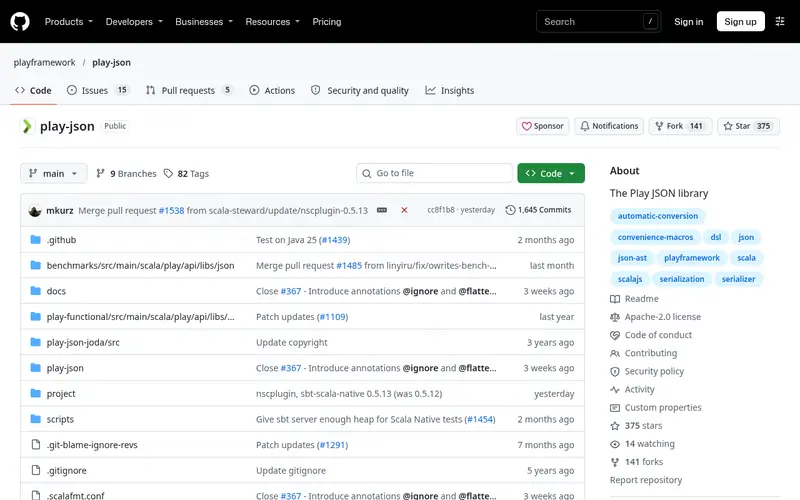
Play JSON is the JSON library used by the Play Framework. It represents JSON as a JsValue tree and uses Reads and Writes type classes for conversion. You can use it outside Play, but most users encounter it inside a Play application. It is Apache 2.0 licensed and free.
The API is approachable: pattern matching on JsValue and writing Reads instances is straightforward for developers new to Scala. It supports Scala 2 and Scala 3. The trade-off is that its ecosystem is narrower than circe's, and some teams find the mutable-style JsObject handling less clean. If you are not on Play and want maximum library support, circe or zio-json is usually a better fit.
Standout: Simple Reads and Writes API
Free (open source), as listed by the vendor (Play JSON website). Confirm the current plan price before you buy.
Free plan. Plans change, so confirm on the vendor's pricing page before you buy.
Benefits
- Simple Reads and Writes API
- ships with the Play Framework and is well documented
Drawbacks
- Tied to the Play ecosystem in practice
- fewer standalone integrations than circe
Skip it if this limit matters to you: tied to the Play ecosystem in practice.
Verdict. A sensible pick for play Framework projects and teams that prefer a direct API.
Alternatives in this guide: circe, uPickle, jsoniter-scala
uPickle
Best for cross-platform projects and small services that want low ceremony
What it is and where it fits
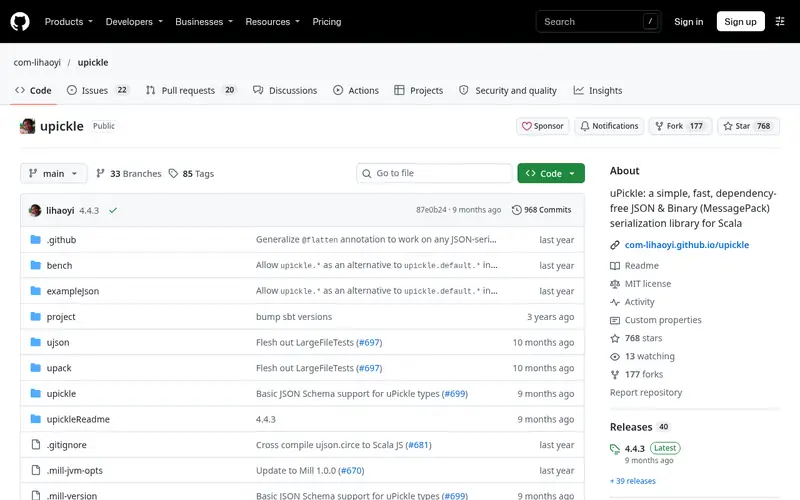
uPickle is a serialization library from the com-lihaoyi project. It handles JSON and also MessagePack. Derivation is macro-based, so a single call gives you a ReadWriter for a case class. It runs on the JVM, Scala.js and Scala Native, which makes it a practical choice for cross-platform code. It is MIT licensed and free.
The API is small and the documentation is practical. It is a good default for scripts, small services and front-end Scala.js code. The limits: it has fewer adapters for other libraries than circe, and customizing output for unusual formats takes more work. Large teams with complex schema needs often outgrow it.
Standout: Works on JVM, Scala.js and Scala Native
Free (open source), as listed by the vendor (uPickle website). Confirm the current plan price before you buy.
Free plan. Plans change, so confirm on the vendor's pricing page before you buy.
Benefits
- Works on JVM, Scala.js and Scala Native
- simple macro-based derivation
Drawbacks
- Fewer third-party integrations than circe
- API is less flexible for custom formats
Skip it if this limit matters to you: fewer third-party integrations than circe.
Verdict. A sensible pick for cross-platform projects and small services that want low ceremony.
Alternatives in this guide: circe, Play JSON, jsoniter-scala
jsoniter-scala
Best for high-throughput services that need fast parsing and low allocation
What it is and where it fits
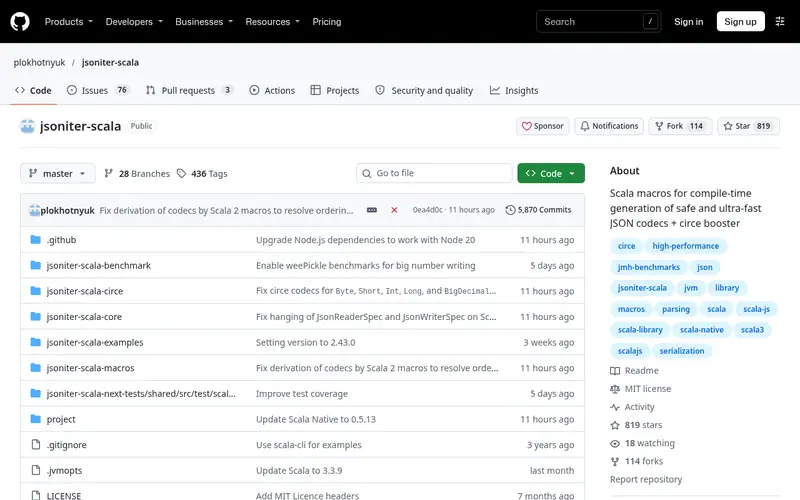
jsoniter-scala is a JSON library focused on performance. It generates codecs at compile time and is designed to reduce allocations during parsing and serialization. It supports Scala 2.13 and Scala 3 and is MIT licensed.
It is a reasonable choice for services that parse large or frequent JSON payloads and have measured a bottleneck. The cost is complexity: codec generation adds compile time, and the configuration options take time to learn. For typical CRUD services, the speed difference may not justify the extra setup. Teams should profile before switching.
Standout: Designed for speed and low garbage output
Free (open source), as listed by the vendor (jsoniter-scala website). Confirm the current plan price before you buy.
Free plan. Plans change, so confirm on the vendor's pricing page before you buy.
Benefits
- Designed for speed and low garbage output
- compile-time codec generation
Drawbacks
- Codec macros add compile time
- configuration is more involved than circe
Skip it if this limit matters to you: codec macros add compile time.
Verdict. A sensible pick for high-throughput services that need fast parsing and low allocation.
zio-json
Best for zIO-based applications that want integrated codecs
What it is and where it fits
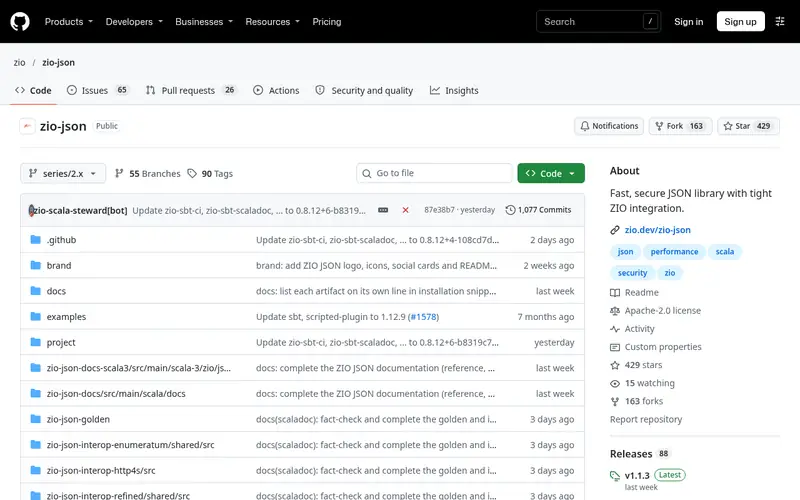
zio-json is the JSON library from the ZIO project. It provides codecs, automatic derivation and streaming support, and integrates with ZIO streams and schemas. It supports Scala 2.13 and Scala 3 and is Apache 2.0 licensed.
If your application is built on ZIO, zio-json keeps dependencies consistent and avoids mixing effect systems. It handles derivation for case classes and offers a codec-based API similar in spirit to circe. Outside ZIO projects, the benefit is smaller, and circe has broader ecosystem support. Teams not using ZIO should compare carefully before adopting it.
Standout: Fits naturally into ZIO services
Free (open source), as listed by the vendor (zio-json website). Confirm the current plan price before you buy.
Free plan. Plans change, so confirm on the vendor's pricing page before you buy.
Benefits
- Fits naturally into ZIO services
- supports automatic derivation
Drawbacks
- Best value only if you already use ZIO
- smaller community than circe
Skip it if this limit matters to you: best value only if you already use ZIO.
Verdict. A sensible pick for ZIO-based applications that want integrated codecs.
json4s
Best for legacy codebases that need a stable, familiar JSON API
What it is and where it fits
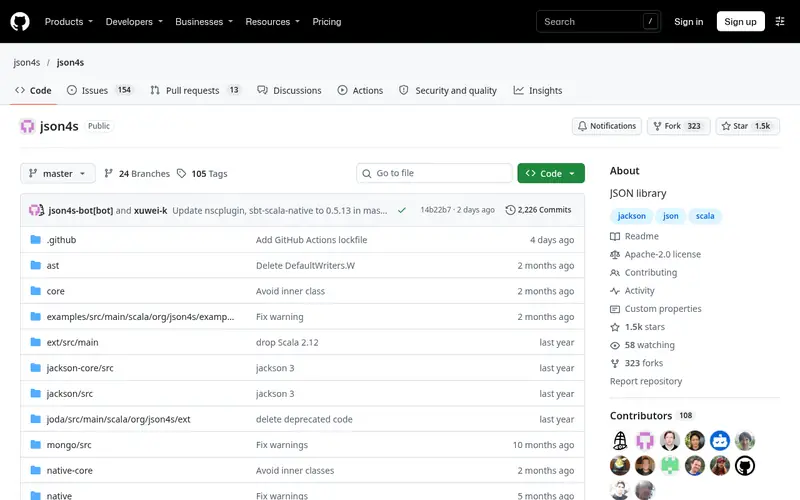
json4s is one of the older Scala JSON libraries. It offers a JValue tree model and can use different parser backends. It has been used widely in Scala projects and remains maintained. It is Apache 2.0 licensed and free.
It is a practical choice when you maintain an existing codebase that already depends on it, or when you need its specific extraction syntax. For new projects, circe, Play JSON or uPickle offer cleaner APIs and more active development. The library's design predates modern derivation patterns, so expect more manual work for custom types.
Standout: Long history and wide use in older Scala projects
Free (open source), as listed by the vendor (json4s website). Confirm the current plan price before you buy.
Free plan. Plans change, so confirm on the vendor's pricing page before you buy.
Benefits
- Long history and wide use in older Scala projects
- supports multiple backends
Drawbacks
- API style feels dated
- less active development than newer libraries
Skip it if this limit matters to you: API style feels dated.
Verdict. A sensible pick for legacy codebases that need a stable, familiar JSON API.
Who should use what
If your team uses Cats or Cats Effect, start with circe for its ecosystem and derivation. If you are on the Play Framework or want a simpler API, Play JSON is the natural fit. For Scala.js, Scala Native or small services, uPickle keeps setup light. If you have measured JSON parsing as a bottleneck, evaluate jsoniter-scala. ZIO applications should consider zio-json, and legacy codebases should stay on json4s until a planned migration.
Questions to settle before you buy
What to check before you buy
- Confirm the library supports your Scala version (2.13 or 3) and target platform (JVM, JS, Native).
- Check how derivation handles nested case classes, sealed traits and default values.
- Review error messages for malformed input; good errors save debugging time.
- Check integration with your HTTP layer, database library and effect system.
- Confirm the licence and the project's recent commit activity before adopting it.
FAQ
Is circe the best Scala JSON library?
circe is the most widely used general-purpose choice, but "best" depends on context. Play JSON fits Play projects, uPickle fits cross-platform code, and jsoniter-scala fits performance-sensitive services. Compare derivation style and ecosystem support for your stack.
Are these Scala JSON libraries free?
Yes. circe, Play JSON, uPickle, jsoniter-scala, zio-json and json4s are all open source and free to use under their respective licences, including Apache 2.0 and MIT. There are no paid tiers for the libraries themselves.
Should I still use json4s?
Use it if you maintain existing code that depends on it. For new projects, newer libraries offer cleaner derivation and more active development. Migration is often simple for plain case classes, but plan it as a separate task.
Do these libraries work with Scala 3?
circe, Play JSON, uPickle, jsoniter-scala and zio-json support Scala 3. json4s is older and its Scala 3 support is more limited. Check the repository for the current cross-build list before you commit.
Can I paste production JSON into an online formatter to debug it?
Avoid pasting secrets, tokens or production payloads into third-party web pages. Prefer tools that run locally in the browser or offline, or parse the data with one of these libraries in a local script. Redact sensitive fields before sharing samples.
Sources we checked
Method: how we score · editorial policy.
Change log. First published 27 Nov 2026.