Stage 01 · Write · Researched comparison
Best Rust JSON Libraries for Parsing and Validation in 2026
serde_json is the default choice for most Rust projects. It works with serde derive macros, handles parsing and serialization, and fits almost any codebase. If raw parse speed matters, simd-json and sonic-rs offer faster paths that trade some portability or API simplicity. For validating JSON against a schema, the jsonschema crate is the practical pick. Start with serde_json and move to a faster crate only when profiling shows JSON handling is a real cost.

By Shihab Mia
Published 27 Nov 2026 · 5 tools compared
We run no ads and no affiliate links at launch. The order of a list follows our published method. See how we score.
Prices are the starting prices vendors list publicly. Plans change, so confirm the current price on the vendor page before you buy.
Key takeaways
- serde_json is the most widely used Rust JSON crate and the safest default for new projects.
- simd-json and sonic-rs target speed and may need extra setup or platform support.
- jsonschema handles JSON Schema validation and is separate from parsing crates.
- All six libraries listed here are free and open source.
Who each pick is for
- General parsing and serialization in most Rust projectsserde_json
- High-throughput parsing where SIMD support is availablesimd-json
- Fast JSON parsing and serialization on x86_64 and aarch64sonic-rs
- Minimal serialization and deserialization with low compile costminiserde
- Validating JSON documents against JSON Schemajsonschema
Comparison
| Tool | Best for | Standout feature | Listed starting price | Free plan or trial |
|---|---|---|---|---|
| 1serde_json | General parsing and serialization in most Rust projects | Works with serde derive macros | Free (open source) | Free plan |
| 2simd-json | High-throughput parsing where SIMD support is available | Uses SIMD instructions for faster parsing | Free (open source) | Free plan |
| 3sonic-rs | Fast JSON parsing and serialization on x86_64 and aarch64 | Uses SIMD and other low-level techniques for speed | Free (open source) | Free plan |
| 4miniserde | Minimal serialization and deserialization with low compile cost | Small code size and fast compiles | Free (open source) | Free plan |
| 5jsonschema | Validating JSON documents against JSON Schema | Supports multiple JSON Schema drafts | Free (open source) | Free plan |
How we picked
We picked crates that are real, standalone and currently maintained, and that do the job named for this keyword: parsing, serialization or validation of JSON in Rust. Criteria were fit for the task, platform support, licence and price, API compatibility with serde, and documented limits. Sources are vendor pages, crate documentation and project repositories. Prices and licences can change, so confirm on the project site before you commit.
The tools, one by one
serde_json
Best for general parsing and serialization in most Rust projects
What it is and where it fits
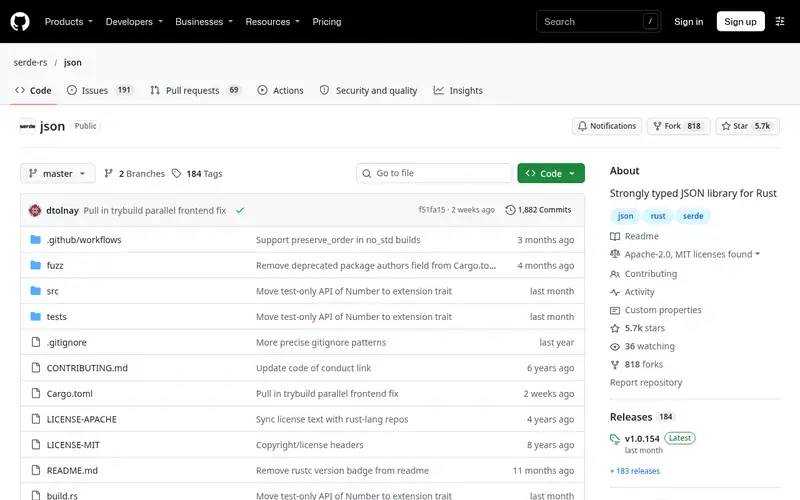
serde_json is the standard JSON crate in the Rust ecosystem. It provides a Value type for untyped access, typed deserialization through serde, and serialization back to strings or writers. It runs on any platform the Rust compiler supports and has no special hardware requirements.
The crate is dual licensed under MIT and Apache-2.0. It integrates with the broader serde ecosystem, so structs, enums and custom types work with derive attributes. Streaming support exists through serde_json::Deserializer and StreamDeserializer for reading multiple values.
Skip serde_json only if you have measured JSON parsing as a bottleneck and need a faster crate, or if you want a minimal dependency footprint.
Standout: Works with serde derive macros
Free (open source), as listed by the vendor (serde_json website). Confirm the current plan price before you buy.
Free plan. Plans change, so confirm on the vendor's pricing page before you buy.
Benefits
- Works with serde derive macros
- stable, widely used API
Drawbacks
- Not the fastest parser for large payloads
- pulls in serde as a dependency
Skip it if this limit matters to you: not the fastest parser for large payloads.
Verdict. A sensible pick for general parsing and serialization in most Rust projects.
simd-json
Best for high-throughput parsing where SIMD support is available
What it is and where it fits
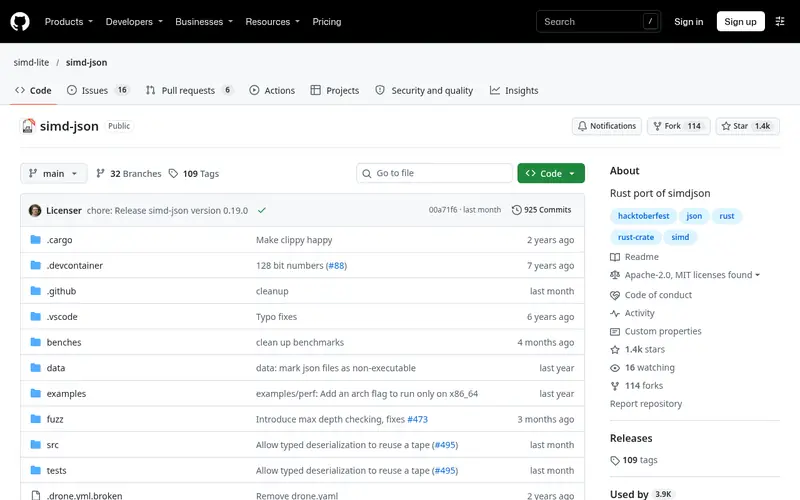
simd-json is a JSON parser built around SIMD instructions. It parses into its own value type and can deserialize into serde-compatible types. The crate checks CPU features at runtime and falls back when SIMD is not available.
It is licensed under MIT and Apache-2.0. The API is not a drop-in replacement for serde_json, so code that uses serde_json::Value needs changes. It suits services that parse large JSON documents at high volume and have profiled parsing as a cost.
Do not pick it for small payloads or projects that value API familiarity over throughput.
Standout: Uses SIMD instructions for faster parsing
Free (open source), as listed by the vendor (simd-json website). Confirm the current plan price before you buy.
Free plan. Plans change, so confirm on the vendor's pricing page before you buy.
Benefits
- Uses SIMD instructions for faster parsing
- supports serde-style deserialization
Drawbacks
- Needs runtime CPU feature detection
- API differs from serde_json
Skip it if this limit matters to you: needs runtime CPU feature detection.
Verdict. A sensible pick for high-throughput parsing where SIMD support is available.
Alternatives in this guide: serde_json, sonic-rs, miniserde
sonic-rs
Best for fast JSON parsing and serialization on x86_64 and aarch64
What it is and where it fits
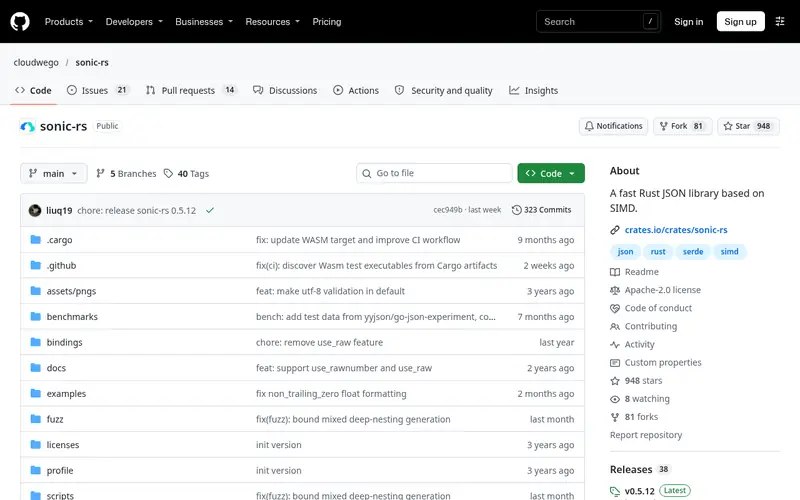
sonic-rs is a JSON library from CloudWeGo that aims for high performance using SIMD and related techniques. It offers a serde-compatible interface and supports both parsing and serialization. The project documents support for x86_64 and aarch64 platforms.
It is open source under the Apache-2.0 license. Because it relies on architecture-specific code, check platform support before adopting it. It fits latency-sensitive services and data pipelines where JSON handling is hot.
For portable code or teams that want the most established crate, serde_json remains the safer choice.
Standout: Uses SIMD and other low-level techniques for speed
Free (open source), as listed by the vendor (sonic-rs website). Confirm the current plan price before you buy.
Free plan. Plans change, so confirm on the vendor's pricing page before you buy.
Benefits
- Uses SIMD and other low-level techniques for speed
- serde-compatible API
Drawbacks
- Targets specific architectures
- less mature than serde_json
Skip it if this limit matters to you: targets specific architectures.
Verdict. A sensible pick for fast JSON parsing and serialization on x86_64 and aarch64.
Alternatives in this guide: serde_json, simd-json, miniserde
miniserde
Best for minimal serialization and deserialization with low compile cost
What it is and where it fits
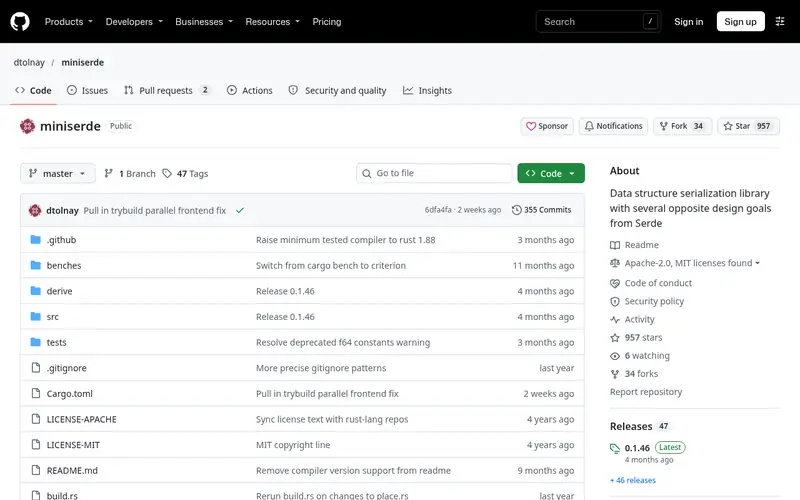
miniserde is a lightweight alternative to serde for JSON serialization and deserialization. It provides derive macros for structs and enums and focuses on keeping compile times and binary size low. It does not aim to cover every serde feature.
The crate is dual licensed under MIT and Apache-2.0 and is maintained by the same author as serde. It fits small binaries, command-line tools and projects where compile time is a concern.
It is not a general-purpose JSON value library, so tasks that need dynamic JSON manipulation should use serde_json instead.
Standout: Small code size and fast compiles
Free (open source), as listed by the vendor (miniserde website). Confirm the current plan price before you buy.
Free plan. Plans change, so confirm on the vendor's pricing page before you buy.
Benefits
- Small code size and fast compiles
- simple derive-based API
Drawbacks
- Limited feature set compared with serde
- no untyped Value type for general use
Skip it if this limit matters to you: limited feature set compared with serde.
Verdict. A sensible pick for minimal serialization and deserialization with low compile cost.
Alternatives in this guide: serde_json, simd-json, sonic-rs
jsonschema
Best for validating JSON documents against JSON Schema
What it is and where it fits
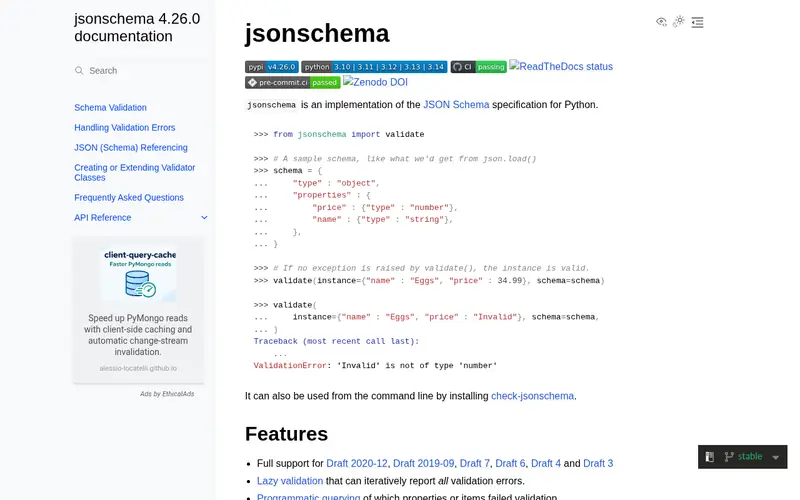
The jsonschema crate validates JSON documents against JSON Schema. It works with serde_json values and supports several schema drafts. It is a validation tool, not a parser, so pair it with a parsing crate.
It is licensed under MIT. Validation cost depends on schema complexity and document size, so test with realistic inputs. It suits API request validation, config file checks and test fixtures.
Skip it if you only need to parse JSON and have no schema to enforce.
Standout: Supports multiple JSON Schema drafts
Free (open source), as listed by the vendor (jsonschema website). Confirm the current plan price before you buy.
Free plan. Plans change, so confirm on the vendor's pricing page before you buy.
Benefits
- Supports multiple JSON Schema drafts
- works with serde_json values
Drawbacks
- Validation adds runtime cost
- schema support varies by draft
Skip it if this limit matters to you: validation adds runtime cost.
Verdict. A sensible pick for validating JSON documents against JSON Schema.
Alternatives in this guide: serde_json, simd-json, sonic-rs
Who should use what
If you are starting a new Rust service, use serde_json. It is the default and integrates with serde. If you run a high-volume parser and have profiled JSON as a bottleneck, evaluate simd-json or sonic-rs and check platform support first. If you need to validate incoming JSON against a schema, add the jsonschema crate alongside serde_json. If you are building a small tool and want fewer dependencies, look at miniserde or the json crate, but check maintenance activity before relying on them long term.
Questions to settle before you buy
What to check before you buy
- Confirm the crate supports your target platforms, including any SIMD requirements.
- Check the licence (MIT, Apache-2.0 or dual) against your project's policy.
- Verify serde compatibility if your code relies on derive macros.
- Review the repository's recent activity and open issues.
- Test with your real payload sizes, since speed claims depend on input.
FAQ
Is serde_json fast enough for most projects?
For most applications, yes. Parsing is rarely the main cost unless you handle large volumes of JSON. Profile before switching to a faster crate.
Can I use simd-json as a drop-in replacement for serde_json?
No. simd-json has its own API and value type, though it can deserialize into serde-compatible types. Expect code changes.
Do I need a separate crate for JSON Schema validation?
Yes. Parsing crates like serde_json do not validate against JSON Schema. The jsonschema crate handles that and works with serde_json values.
Are these libraries free?
All six are free and open source under MIT, Apache-2.0 or dual licences. Check each repository for the exact terms.
Which crate should I avoid for new projects?
The json crate and miniserde are fine for narrow use cases, but they are not general replacements for serde_json. Check maintenance activity before adopting them.
Sources we checked
Method: how we score · editorial policy.
Change log. First published 27 Nov 2026.