Stage 01 · Write · Researched comparison
Best Ruby JSON Libraries in 2026
Start with the json gem that ships with Ruby. It is the default parser and generator, needs no install, and suits most applications. Add Oj when parsing speed on large payloads matters, since it is a C extension with a wide feature set. For turning Ruby objects into JSON responses, use Alba or Blueprinter as serializer layers. Yajl-ruby is still available but older, so pick it only for existing code that already depends on it.

By Shihab Mia
Published 27 Nov 2026 · 7 tools compared
We run no ads and no affiliate links at launch. The order of a list follows our published method. See how we score.
Prices are the starting prices vendors list publicly. Plans change, so confirm the current price on the vendor page before you buy.
Key takeaways
- The json gem is bundled with Ruby and is the baseline for parsing and generating JSON in almost every project.
- Oj is a C extension with a documented set of modes and options; check its README for compatibility details before switching.
- Alba, Blueprinter, jsonapi-serializer and Jbuilder all target serialization, not parsing, so they solve a different problem than Oj.
- All seven libraries are open source and free to use; confirm the licence terms on each repository before shipping.
Who each pick is for
- Default JSON parsing and generation in any Ruby appjson (Ruby stdlib gem)
- Fast JSON parsing and generation via a C extensionOj
- Streaming JSON parsing in existing Ruby codebasesYajl-ruby
- JSON serialization of Ruby objects with a clean DSLAlba
- Declarative JSON serialization in Rails and plain RubyBlueprinter
- Producing JSON:API-compliant responses in Rubyjsonapi-serializer
- Building JSON in Rails views with Ruby blocksJbuilder
Comparison
| Tool | Best for | Standout feature | Listed starting price | Free plan or trial |
|---|---|---|---|---|
| 1json (Ruby stdlib gem) | Default JSON parsing and generation in any Ruby app | Ships with Ruby, so no extra dependency | Free (open source) | Free plan |
| 2Oj | Fast JSON parsing and generation via a C extension | C extension with several parsing modes and options | Free (open source) | Free plan |
| 3Yajl-ruby | Streaming JSON parsing in existing Ruby codebases | Streaming parser interface for large documents | Free (open source) | Free plan |
| 4Alba | JSON serialization of Ruby objects with a clean DSL | Lightweight serializer with a simple resource DSL | Free (open source) | Free plan |
| 5Blueprinter | Declarative JSON serialization in Rails and plain Ruby | Simple blueprint DSL with views for different output shapes | Free (open source) | Free plan |
| 6jsonapi-serializer | Producing JSON:API-compliant responses in Ruby | Follows the JSON:API spec for documents, relationships and links | Free (open source) | Free plan |
| 7Jbuilder | Building JSON in Rails views with Ruby blocks | Familiar block syntax inside Rails views | Free (open source) | Free plan |
How we picked
We picked libraries that are real, standalone and currently maintained, and that do one of two jobs: parsing and generating JSON, or serializing Ruby objects to JSON. Criteria were fit for the job, supported Ruby platforms, licence and price, and documented limits. Sources are vendor and project documentation plus the public repositories linked below. We did not run benchmarks. Prices and licences can change, so confirm on the project page before you commit.
The tools, one by one
json (Ruby stdlib gem)
Best for default JSON parsing and generation in any Ruby app
What it is and where it fits
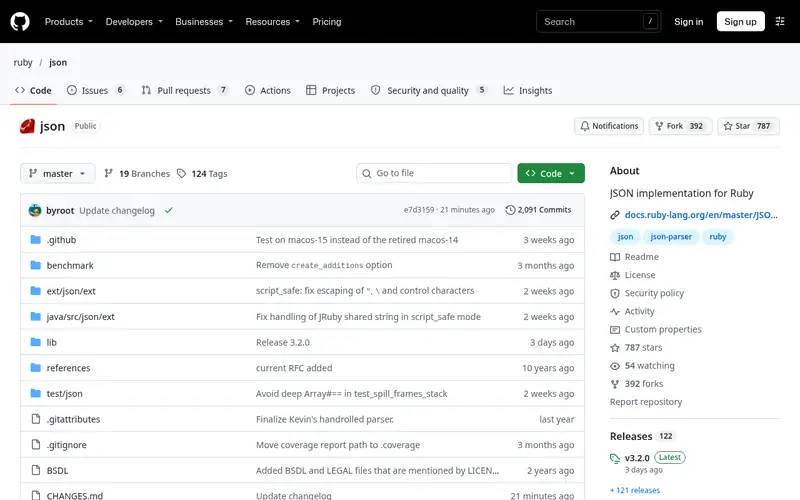
The json gem is the reference JSON implementation for Ruby. It provides JSON.parse and JSON.generate, plus streaming support through its own API. Because it is a default gem, most applications already have it and many other libraries depend on it. It runs wherever Ruby runs, including MRI, and is maintained in the ruby/json repository.
The licence is the Ruby licence, which is permissive. There is no paid tier and no usage limit. The main trade-off is speed on very large payloads compared with C extensions. If your app parses small API responses, this is usually enough. Skip it only when profiling shows JSON parsing is a real bottleneck and you need a faster parser.
Standout: Ships with Ruby, so no extra dependency
Free (open source), as listed by the vendor (json (Ruby stdlib gem) website). Confirm the current plan price before you buy.
Free plan. Plans change, so confirm on the vendor's pricing page before you buy.
Benefits
- Ships with Ruby, so no extra dependency
- stable API used across the ecosystem
Drawbacks
- Pure-Ruby paths are slower than C extensions on large documents
- fewer tuning options than Oj
Skip it if this limit matters to you: pure-Ruby paths are slower than C extensions on large documents.
Verdict. A sensible pick for default JSON parsing and generation in any Ruby app.
Oj
Best for fast JSON parsing and generation via a C extension
What it is and where it fits
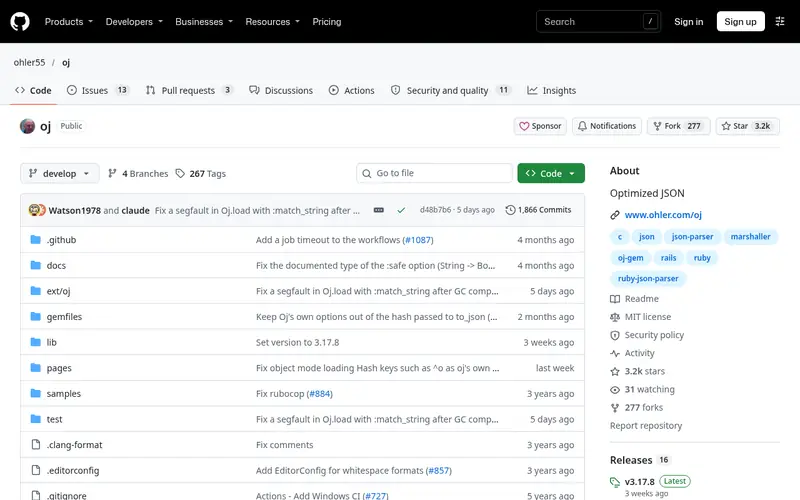
Oj is a JSON parser and object marshaller written as a C extension. It offers multiple modes, including a strict mode and a compatibility mode that mimics the json gem. It can also serialize Ruby objects directly, which some teams use for caching and storage. The project is maintained by Peter Ohler in the ohler55/oj repository.
It runs on MRI and other Rubies that support C extensions, and installation compiles native code. The licence is MIT. There is no paid version. The main caution is mode behavior: output and parsing edge cases differ from the stdlib, so test against your real payloads. Choose Oj when JSON handling shows up in profiles; otherwise the stdlib is simpler.
Standout: C extension with several parsing modes and options
Free (open source), as listed by the vendor (Oj website). Confirm the current plan price before you buy.
Free plan. Plans change, so confirm on the vendor's pricing page before you buy.
Benefits
- C extension with several parsing modes and options
- supports both strict and compatibility modes
Drawbacks
- Mode differences can surprise you when switching from the stdlib
- native build required
Skip it if this limit matters to you: mode differences can surprise you when switching from the stdlib.
Verdict. A sensible pick for fast JSON parsing and generation via a C extension.
Alternatives in this guide: json (Ruby stdlib gem), Yajl-ruby, Alba
Yajl-ruby
Best for streaming JSON parsing in existing Ruby codebases
What it is and where it fits
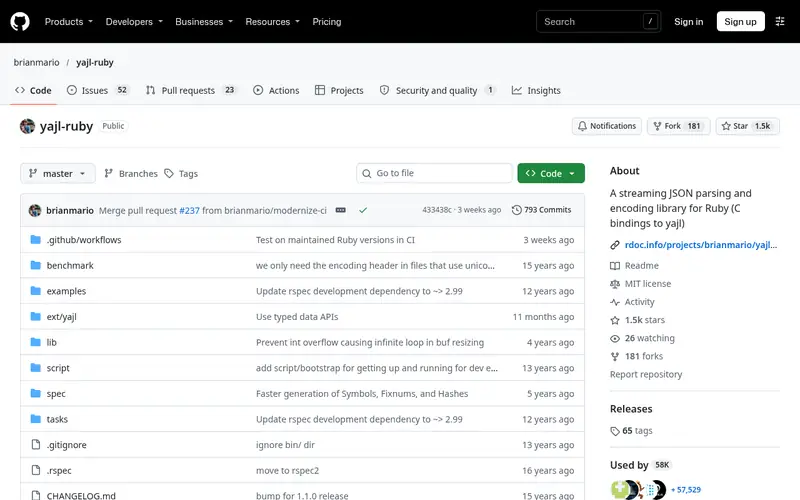
Yajl-ruby is a C binding to the Yajl JSON parsing library. It supports both a full-document parse and a streaming interface, which helps when a document is too large to load at once. It also provides encoding. The project lives in the brianmario/yajl-ruby repository and is MIT licensed.
It requires compiling native code and works on standard MRI setups. The library is older and receives fewer updates than Oj or the stdlib, so treat it as a fit for existing code rather than a first choice for new projects. If you are starting fresh and need speed, compare Oj first. If you already depend on Yajl-ruby's streaming API, keep it and pin the version.
Standout: Streaming parser interface for large documents
Free (open source), as listed by the vendor (Yajl-ruby website). Confirm the current plan price before you buy.
Free plan. Plans change, so confirm on the vendor's pricing page before you buy.
Benefits
- Streaming parser interface for large documents
- long-standing C binding to Yajl
Drawbacks
- Older project with slower release cadence
- native build and fewer recent updates
Skip it if this limit matters to you: older project with slower release cadence.
Verdict. A sensible pick for streaming JSON parsing in existing Ruby codebases.
Alternatives in this guide: json (Ruby stdlib gem), Oj, Alba
Alba
Best for jSON serialization of Ruby objects with a clean DSL
What it is and where it fits
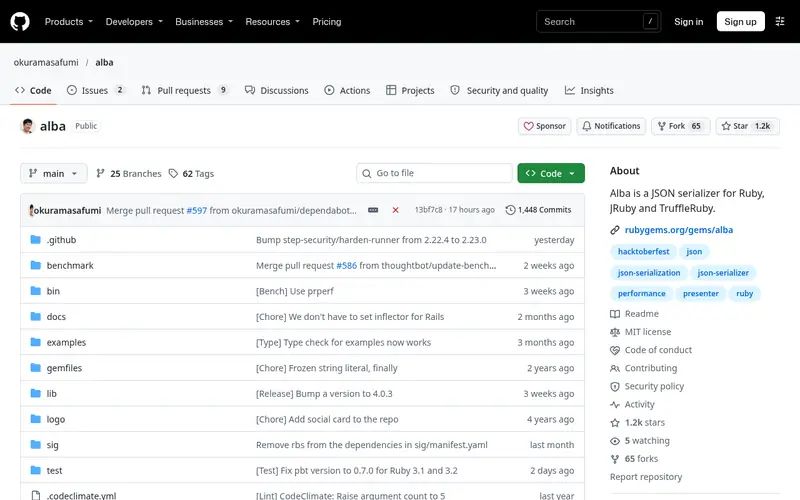
Alba is a JSON serializer for Ruby objects. You define resource classes that list attributes and associations, then render objects to JSON or a hash. It is not tied to Rails, so it works in plain Ruby, Sinatra or background jobs. The project is maintained in the okuramasafumi/alba repository under the MIT licence.
Alba focuses on serialization only; it does not parse JSON. It supports features like conditional attributes and key transforms, which you configure in the resource class. There is no paid tier. The trade-off is that you write and maintain the serializer definitions, and the community is smaller than for Rails-oriented tools. It suits teams that want a small dependency and control over output shape.
Standout: Lightweight serializer with a simple resource DSL
Free (open source), as listed by the vendor (Alba website). Confirm the current plan price before you buy.
Free plan. Plans change, so confirm on the vendor's pricing page before you buy.
Benefits
- Lightweight serializer with a simple resource DSL
- works outside Rails as a plain gem
Drawbacks
- Smaller ecosystem than Rails-native options
- you define serializers yourself
Skip it if this limit matters to you: smaller ecosystem than Rails-native options.
Verdict. A sensible pick for JSON serialization of Ruby objects with a clean DSL.
Alternatives in this guide: json (Ruby stdlib gem), Oj, Yajl-ruby
Blueprinter
Best for declarative JSON serialization in Rails and plain Ruby
What it is and where it fits
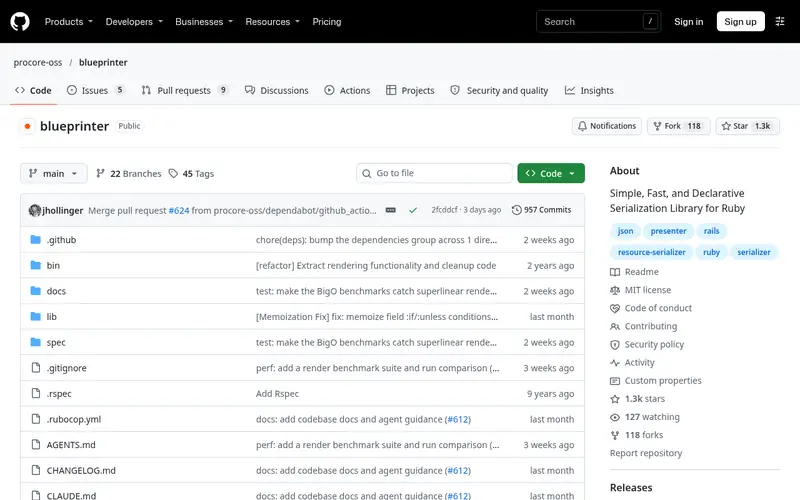
Blueprinter is a declarative serializer. You define a blueprint class with fields, associations and views, then call render on an object or collection. Views let one blueprint produce several JSON shapes, such as a summary and a detail response. It is maintained under procore-oss/blueprinter and is MIT licensed.
It works in Rails and in plain Ruby and does not depend on ActiveModel for basic use. It handles serialization only. There is no paid plan. The main limit is that complex conditional output can make blueprints hard to read, so keep views small. It fits teams that want explicit, testable serializer classes without a heavy framework dependency.
Standout: Simple blueprint DSL with views for different output shapes
Free (open source), as listed by the vendor (Blueprinter website). Confirm the current plan price before you buy.
Free plan. Plans change, so confirm on the vendor's pricing page before you buy.
Benefits
- Simple blueprint DSL with views for different output shapes
- usable with or without Rails
Drawbacks
- No parsing features
- view logic can grow complex in large APIs
Skip it if this limit matters to you: no parsing features.
Verdict. A sensible pick for declarative JSON serialization in Rails and plain Ruby.
Alternatives in this guide: json (Ruby stdlib gem), Oj, Yajl-ruby
jsonapi-serializer
Best for producing JSON:API-compliant responses in Ruby
What it is and where it fits
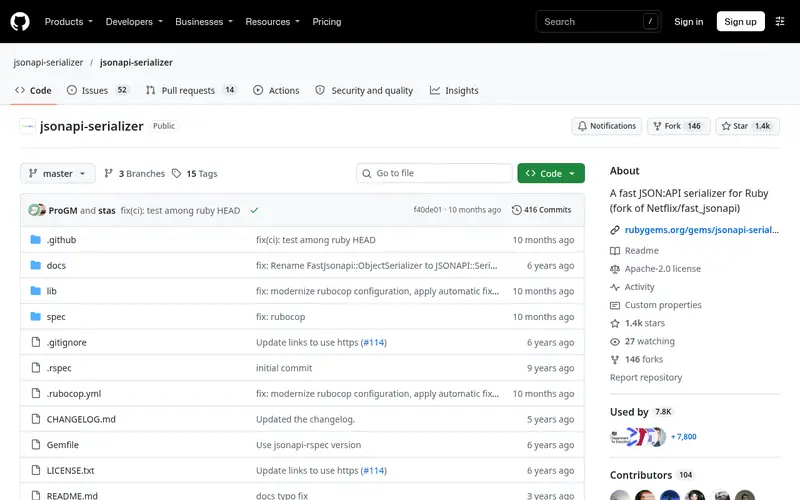
jsonapi-serializer builds JSON:API documents from Ruby objects. It handles resource objects, relationships, links and meta, so clients that expect the JSON:API format get consistent output. The project continues the line of the older fast_jsonapi serializer and lives in the jsonapi-serializer/jsonapi-serializer repository under the Apache-2.0 licence.
It runs in Rails and plain Ruby and covers serialization only. If your API does not follow JSON:API, the structure adds overhead you do not need. If it does, this library saves you from hand-building the document shape. There is no paid tier. Check the spec version your clients expect and test relationship output before rolling it out.
Standout: Follows the JSON:API spec for documents, relationships and links
Free (open source), as listed by the vendor (jsonapi-serializer website). Confirm the current plan price before you buy.
Free plan. Plans change, so confirm on the vendor's pricing page before you buy.
Benefits
- Follows the JSON:API spec for documents, relationships and links
- active fork of a widely used serializer
Drawbacks
- Output is tied to JSON:API conventions
- overkill if you do not use that spec
Skip it if this limit matters to you: output is tied to JSON:API conventions.
Verdict. A sensible pick for producing JSON:API-compliant responses in Ruby.
Alternatives in this guide: json (Ruby stdlib gem), Oj, Yajl-ruby
Jbuilder
Best for building JSON in Rails views with Ruby blocks
What it is and where it fits
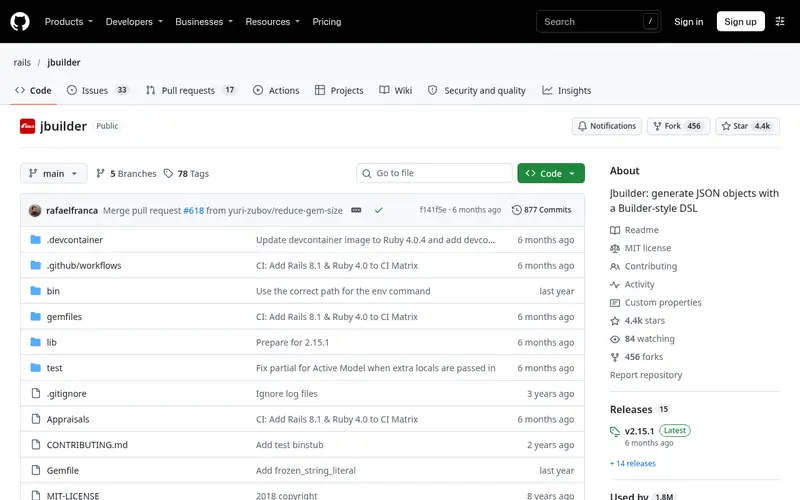
Jbuilder builds JSON with Ruby blocks, usually inside Rails view templates. You call json.name and json.items, and the library assembles the document. It is maintained in the rails/jbuilder repository under the MIT licence and is designed for Rails applications.
It handles generation only. There is no parser and no paid plan. Because it lives in views, logic tends to spread across templates, which can be harder to test than serializer classes. It suits small Rails APIs and teams already comfortable with view templates. For larger APIs, compare Alba or Blueprinter, which keep serialization in plain classes. For parsing, pair any of these with the stdlib json gem or Oj.
Standout: Familiar block syntax inside Rails views
Free (open source), as listed by the vendor (Jbuilder website). Confirm the current plan price before you buy.
Free plan. Plans change, so confirm on the vendor's pricing page before you buy.
Benefits
- Familiar block syntax inside Rails views
- ships as a Rails component with simple setup
Drawbacks
- Tied to Rails view conventions
- block-based templates can get verbose for large payloads
Skip it if this limit matters to you: tied to Rails view conventions.
Verdict. A sensible pick for building JSON in Rails views with Ruby blocks.
Alternatives in this guide: json (Ruby stdlib gem), Oj, Yajl-ruby
Who should use what
If you just need to parse and generate JSON in a typical Rails or plain Ruby app, use the stdlib json gem. If profiling shows JSON handling is a bottleneck on large payloads, try Oj and test its modes against your data. If you need to shape API responses from Ruby objects, use Alba or Blueprinter for plain serializer classes, or Jbuilder if you prefer Rails view templates. If your API must follow the JSON:API spec, use jsonapi-serializer. Keep Yajl-ruby only where existing code already relies on its streaming interface.
Questions to settle before you buy
What to check before you buy
- Confirm the library is still maintained and check the date of its latest release.
- Read the licence and make sure it fits your distribution model.
- Test parsing edge cases (large numbers, nulls, unicode) against your real payloads.
- Check native build requirements if you deploy to restricted or minimal environments.
- Pin the version in your Gemfile and review the changelog before upgrading.
FAQ
Do I need a gem for JSON in Ruby?
No. The json gem ships with Ruby and covers parsing and generation for most apps. Add a third-party library only when you need more speed, streaming, or object serialization.
Is Oj a drop-in replacement for the json gem?
Not exactly. Oj has a compatibility mode that mimics the stdlib, but default behavior and options differ. Test output and parsing against your payloads before switching.
Which library should I use for JSON:API?
Use jsonapi-serializer. It builds JSON:API documents with resource objects, relationships and links. If your API does not follow that spec, a plain serializer like Alba or Blueprinter is simpler.
Are these libraries free?
Yes. All seven are open source and free to use. Each has its own licence, such as MIT, Apache-2.0 or the Ruby licence, so read the terms on the repository before shipping.
Can I use a serializer without Rails?
Yes. Alba and Blueprinter work in plain Ruby, and jsonapi-serializer also runs outside Rails. Jbuilder is built around Rails view conventions, so it fits Rails apps best.
Sources we checked
Method: how we score · editorial policy.
Change log. First published 27 Nov 2026.