Stage 01 · Write · Researched comparison
Best Python Email Libraries in 2026
The standard library pair smtplib and email is the first pick for most projects because it ships with Python and needs no install. It suits scripts and simple senders that talk to an SMTP server directly. yagmail is a lighter wrapper for Gmail-style accounts, and aiosmtplib fits async applications that need non-blocking sends. For parsing incoming mail, mail-parser handles raw messages and MIME parts.

By Shihab Mia
Published 27 Nov 2026 · 7 tools compared
We run no ads and no affiliate links at launch. The order of a list follows our published method. See how we score.
Prices are the starting prices vendors list publicly. Plans change, so confirm the current price on the vendor page before you buy.
Key takeaways
- smtplib and email are part of the Python standard library, so they are free and need no dependency.
- yagmail, Flask-Mail, fastapi-mail, aiosmtplib and mail-parser are open-source projects under permissive licences.
- Django email and django-anymail are only useful inside Django projects; skip them in other frameworks.
- Libraries send through your own SMTP server or provider, so credentials stay in your code or environment, not a third-party web page.
Who each pick is for
- Simple senders and parsers with no extra dependenciessmtplib + email (standard library)
- Quick sends from Gmail or similar accountsyagmail
- Sending mail inside Django projectsDjango email (django.core.mail)
- Sending mail from Flask applicationsFlask-Mail
- Async email in FastAPI applicationsfastapi-mail
- Async SMTP sends with full protocol controlaiosmtplib
- Parsing raw email and MIME contentmail-parser
Comparison
| Tool | Best for | Standout feature | Listed starting price | Free plan or trial |
|---|---|---|---|---|
| 1smtplib + email (standard library) | Simple senders and parsers with no extra dependencies | Ships with Python | Free | Free plan |
| 2yagmail | Quick sends from Gmail or similar accounts | Short API for HTML and attachments | Free (open source) | Free plan |
| 3Django email (django.core.mail) | Sending mail inside Django projects | Reads SMTP settings from Django settings | Free (open source) | Free plan |
| 4Flask-Mail | Sending mail from Flask applications | Configured through Flask app config | Free (open source) | Free plan |
| 5fastapi-mail | Async email in FastAPI applications | Async sending that fits FastAPI | Free (open source) | Free plan |
| 6aiosmtplib | Async SMTP sends with full protocol control | Asyncio-native SMTP client | Free (open source) | Free plan |
| 7mail-parser | Parsing raw email and MIME content | Turns raw messages into structured fields and parts | Free (open source) | Free plan |
How we picked
We picked libraries that genuinely send or parse email from Python code, not marketing platforms. Criteria were fit for the job, supported platforms and frameworks, licence and price, how credentials are handled, and the main limits of each. Sources are vendor documentation, official project repositories and public licence information. Prices and maintenance status change, so confirm details on the project page before you commit.
The tools, one by one
smtplib + email (standard library)
Best for simple senders and parsers with no extra dependencies
What it is and where it fits
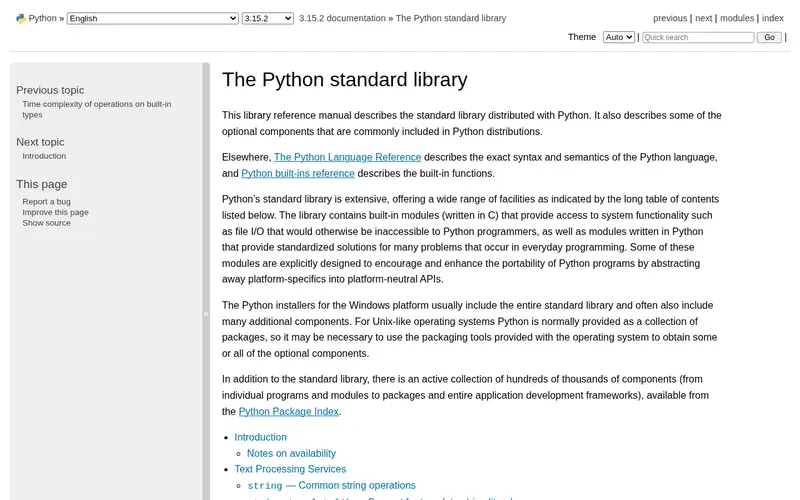
The smtplib module sends mail over SMTP, and the email package builds and parses messages. Together they handle plain text, HTML, attachments and multipart bodies. Because both are in the standard library, there is nothing to install and no version to pin. That makes them a safe base for scripts, cron jobs and small services.
The trade-off is verbosity. Building an HTML message with an attachment takes more lines than a wrapper library. You also handle TLS, authentication and error cases directly. There is no built-in template system or config file. Teams that send a lot of mail often wrap these modules or move to a higher-level library. Skip this pair if you want minimal code for rich messages.
Standout: Ships with Python
Free, as listed by the vendor (smtplib + email (standard library) website). Confirm the current plan price before you buy.
Free plan. Plans change, so confirm on the vendor's pricing page before you buy.
Benefits
- Ships with Python
- full control over MIME structure and headers
Drawbacks
- Verbose for attachments and HTML
- you manage connection and auth yourself
Skip it if this limit matters to you: verbose for attachments and HTML.
Verdict. A sensible pick for simple senders and parsers with no extra dependencies.
Alternatives in this guide: yagmail, Django email (django.core.mail), Flask-Mail
yagmail
Best for quick sends from Gmail or similar accounts
What it is and where it fits
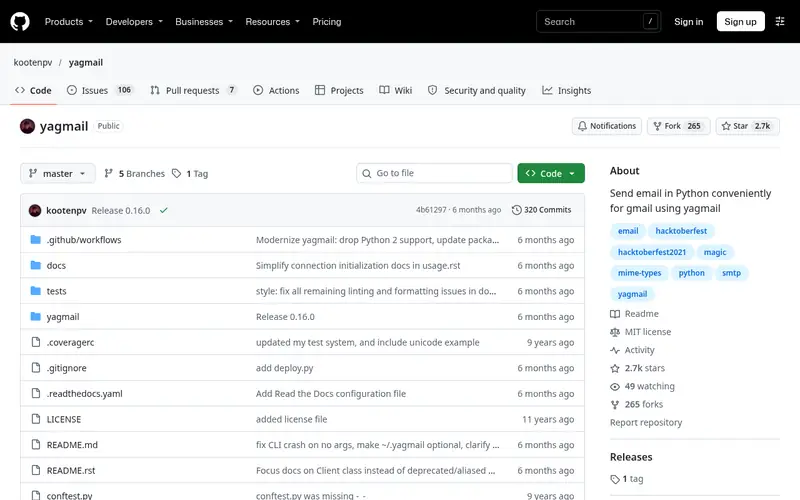
yagmail is a small wrapper that cuts the boilerplate for sending mail. A typical send is one or two lines, with HTML bodies and attachments passed as arguments. It can read credentials from the system keyring so passwords are not hard-coded in scripts. Defaults point at Gmail's SMTP host, and you can override the host and port for other providers.
It runs anywhere Python runs and is installed from PyPI. The project is open source. The convenience comes with assumptions: Gmail-style settings, simple message shapes and limited control over low-level MIME details. For bulk or highly customized mail, a lower-level library gives more control. It suits small tools, personal scripts and internal notifications.
Standout: Short API for HTML and attachments
Free (open source), as listed by the vendor (yagmail website). Confirm the current plan price before you buy.
Free plan. Plans change, so confirm on the vendor's pricing page before you buy.
Benefits
- Short API for HTML and attachments
- stores credentials in a keyring
Drawbacks
- Tuned for Gmail defaults
- less suited to complex multi-provider setups
Skip it if this limit matters to you: tuned for Gmail defaults.
Verdict. A sensible pick for quick sends from Gmail or similar accounts.
Alternatives in this guide: smtplib + email (standard library), Django email (django.core.mail), Flask-Mail
Django email (django.core.mail)
Best for sending mail inside Django projects
What it is and where it fits
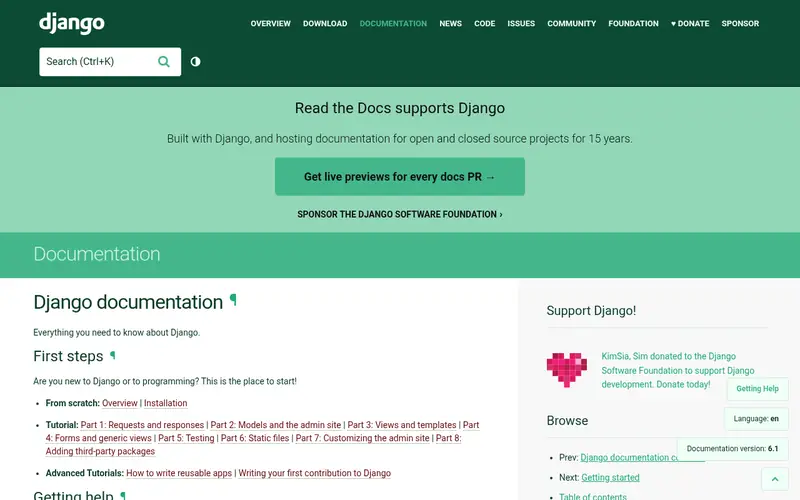
Django ships its own email module built on smtplib. It reads host, port, user and TLS options from your settings file, so configuration lives in one place. Helper functions like send_mail, send_mass_mail and mail_admins cover common cases. The EmailMessage class handles attachments, HTML alternatives and custom headers.
Because it is part of Django, there is no separate install and no extra dependency to track. It follows the framework's release cycle and security updates. The catch is scope: it only makes sense in a Django project. In Flask, FastAPI or plain scripts you would use a standalone library instead. For Django teams it is the default choice before reaching for a third-party package.
Standout: Reads SMTP settings from Django settings
Free (open source), as listed by the vendor (Django email (django.core.mail) website). Confirm the current plan price before you buy.
Free plan. Plans change, so confirm on the vendor's pricing page before you buy.
Benefits
- Reads SMTP settings from Django settings
- helpers for mail admins and managers
Drawbacks
- Only works inside Django
- tied to the Django release cycle
Skip it if this limit matters to you: only works inside Django.
Verdict. A sensible pick for sending mail inside Django projects.
Alternatives in this guide: smtplib + email (standard library), yagmail, Flask-Mail
Flask-Mail
Best for sending mail from Flask applications
What it is and where it fits
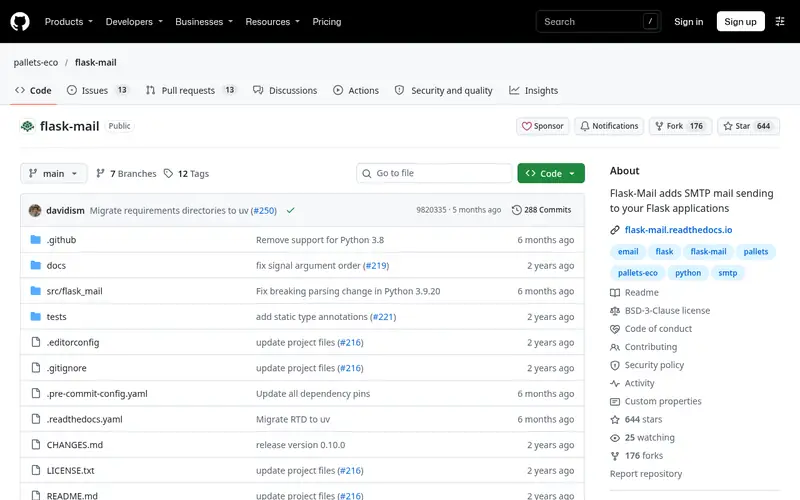
Flask-Mail adds email support to Flask apps. You set MAIL_SERVER, MAIL_PORT, credentials and TLS flags in the app config, then create a Mail object and call send. The Message class supports recipients, CC and BCC, HTML bodies and attachments. It builds on smtplib and the standard email package underneath.
It is open source and installed from PyPI. The integration is the main draw: settings follow Flask conventions and the extension fits the app factory pattern. Limits are clear. It does nothing outside Flask, and it does not parse incoming mail. Projects that need async sends or heavy templating often pair it with other tools. It suits small to medium Flask apps that send notifications and transactional mail.
Standout: Configured through Flask app config
Free (open source), as listed by the vendor (Flask-Mail website). Confirm the current plan price before you buy.
Free plan. Plans change, so confirm on the vendor's pricing page before you buy.
Benefits
- Configured through Flask app config
- Message class for attachments and HTML
Drawbacks
- Flask-only
- small API surface compared with general libraries
Skip it if this limit matters to you: flask-only.
Verdict. A sensible pick for sending mail from Flask applications.
Alternatives in this guide: smtplib + email (standard library), yagmail, Django email (django.core.mail)
fastapi-mail
Best for async email in FastAPI applications
What it is and where it fits
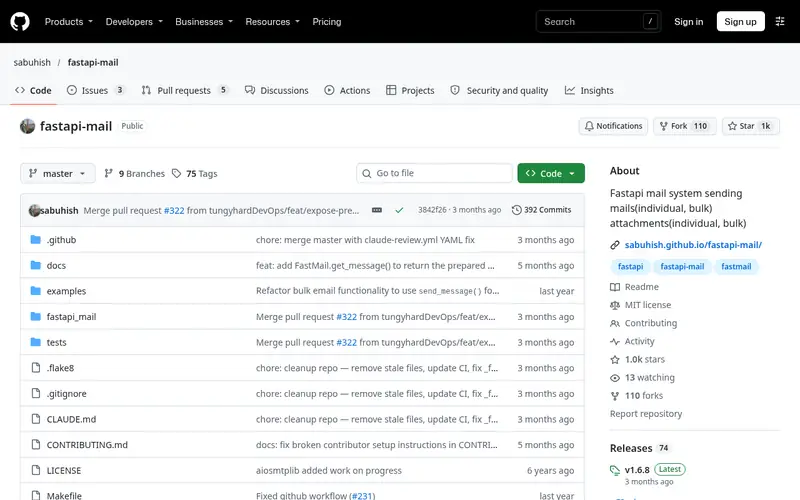
fastapi-mail sends mail from async Python, with FastAPI as the main target. It uses Pydantic models to describe connections and messages, so configuration is validated. It supports plain text and HTML bodies, attachments, templates through Jinja2 and multiple recipients. Sending is awaited, so it does not block the event loop.
The library is open source and installed from PyPI. It works with standard SMTP servers and providers that expose SMTP. Because it is async-first, it fits request handlers that must stay responsive. The trade-off is a narrower audience: outside async frameworks the benefit is smaller. Check the project repository for current maintenance status and supported Python versions before adopting it in a long-lived service.
Standout: Async sending that fits FastAPI
Free (open source), as listed by the vendor (fastapi-mail website). Confirm the current plan price before you buy.
Free plan. Plans change, so confirm on the vendor's pricing page before you buy.
Benefits
- Async sending that fits FastAPI
- Pydantic models for message config
Drawbacks
- FastAPI-oriented
- smaller community than older libraries
Skip it if this limit matters to you: fastAPI-oriented.
Verdict. A sensible pick for async email in FastAPI applications.
Alternatives in this guide: smtplib + email (standard library), yagmail, Django email (django.core.mail)
aiosmtplib
Best for async SMTP sends with full protocol control
What it is and where it fits
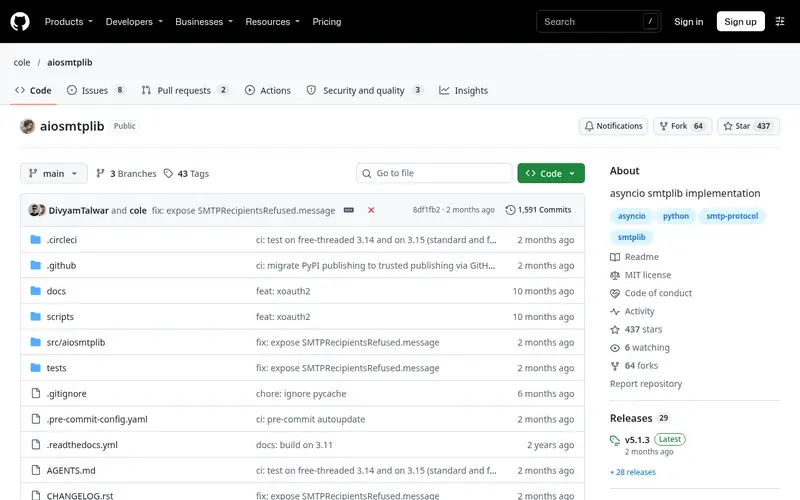
aiosmtplib is an asyncio version of smtplib. It connects to an SMTP server, handles STARTTLS and authentication, and sends messages you build with the standard email package. Because it mirrors smtplib's design, developers who know the standard library can move over quickly. It returns proper awaitables, so sends do not block the event loop.
It is open source and installed from PyPI. The library stays close to the protocol, which means you keep full control over headers, encoding and MIME structure. That control costs code: there is no template layer or config file. It suits async services, workers and scripts that need precise behavior. If you want one-line sends, a wrapper is easier. If you want a dependable async SMTP client, this is a direct fit.
Standout: Asyncio-native SMTP client
Free (open source), as listed by the vendor (aiosmtplib website). Confirm the current plan price before you buy.
Free plan. Plans change, so confirm on the vendor's pricing page before you buy.
Benefits
- Asyncio-native SMTP client
- works with the standard email package
Drawbacks
- Low-level like smtplib
- you build messages yourself
Skip it if this limit matters to you: low-level like smtplib.
Verdict. A sensible pick for async SMTP sends with full protocol control.
Alternatives in this guide: smtplib + email (standard library), yagmail, Django email (django.core.mail)
mail-parser
Best for parsing raw email and MIME content
What it is and where it fits
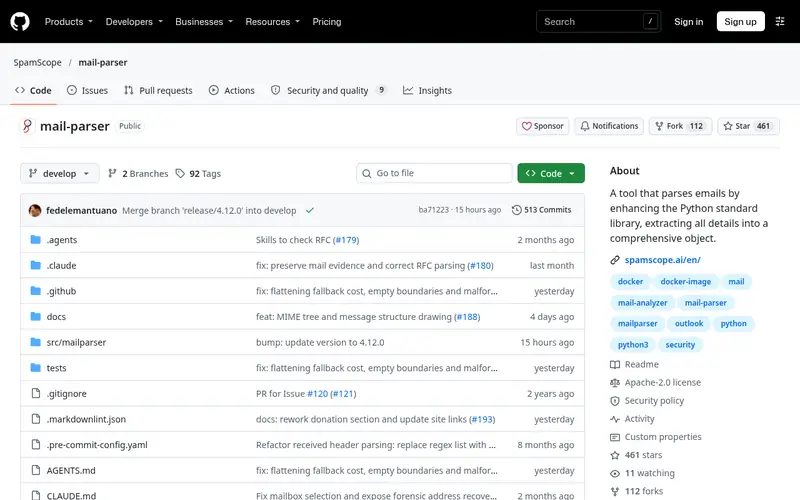
mail-parser takes a raw email message and returns structured data: headers, sender and recipients, subject, body text and HTML, and attachments. It handles MIME multipart messages, encoded headers and common content types. That makes it useful for inbox processing, ticket systems and mail archives where you receive messages rather than send them.
It is open source and installed from PyPI. It runs wherever Python runs and does not depend on a mail server. The scope is parsing, so pair it with a sending library if you also reply. Malformed or unusual messages can still need manual handling, and you should check the repository for current maintenance. It is the practical pick when the job is reading mail, not writing it.
Standout: Turns raw messages into structured fields and parts
Free (open source), as listed by the vendor (mail-parser website). Confirm the current plan price before you buy.
Free plan. Plans change, so confirm on the vendor's pricing page before you buy.
Benefits
- Turns raw messages into structured fields and parts
- handles common MIME cases
Drawbacks
- Parsing only, no sending
- edge-case messages may need manual handling
Skip it if this limit matters to you: parsing only, no sending.
Verdict. A sensible pick for parsing raw email and MIME content.
Alternatives in this guide: smtplib + email (standard library), yagmail, Django email (django.core.mail)
Who should use what
Plain scripts and small tools should start with smtplib and email, then move to yagmail if Gmail-style sends get repetitive. Django projects get the built-in django.core.mail, and Flask apps use Flask-Mail. Async services should look at aiosmtplib, with fastapi-mail as a convenience layer in FastAPI. Teams that process incoming mail need mail-parser alongside a sender. Pick the library that matches your framework first, then your message complexity.
Questions to settle before you buy
What to check before you buy
- Confirm the library supports your Python version and framework.
- Check the licence and whether the project is actively maintained.
- Decide whether you need sync or async sends before choosing.
- Keep SMTP credentials in environment variables or a secret store, not in source.
- Test with your real provider's SMTP limits, such as message size and rate caps.
FAQ
Do I need a third-party library to send email in Python?
No. smtplib and the email package are in the standard library and can send plain text, HTML and attachments. Wrapper libraries reduce code for common cases, but they are optional. Start with the standard library and add a library only when the boilerplate becomes a burden.
Are these libraries email marketing services?
No. They are code libraries that connect to an SMTP server or provider you already have. They do not manage lists, campaigns or analytics. For bulk marketing mail you would use a dedicated service and call it from code.
Which library is best for async Python?
aiosmtplib is the direct async SMTP client and works with the standard email package. fastapi-mail adds Pydantic models and templates for FastAPI projects. Both avoid blocking the event loop. Choose aiosmtplib for control and fastapi-mail for convenience.
Can these libraries read incoming email?
Only mail-parser in this list focuses on parsing. It turns raw messages into headers, bodies and attachments. Sending libraries do not fetch mail from a mailbox; you would combine mail-parser with a protocol client or provider API for that.
Is it safe to put SMTP passwords in my code?
It is better to keep credentials out of source files. Use environment variables, a secret manager or a keyring. yagmail can read credentials from the system keyring. Never commit passwords to a repository, and rotate them if they leak.
Sources we checked
Method: how we score · editorial policy.
Change log. First published 27 Nov 2026.