Stage 01 · Write · Researched comparison
Best PHP Dependency Injection Containers in 2026
PHP-DI is the first pick for most teams that want a standalone PSR-11 container with autowiring and attribute-based configuration. It suits projects that are not tied to a full framework. Symfony DependencyInjection is the stronger choice if you already use Symfony components or need a compiled container. Laravel's illuminate/container fits teams working inside Laravel or building on its components.

By Shihab Mia
Published 27 Nov 2026 · 6 tools compared
We run no ads and no affiliate links at launch. The order of a list follows our published method. See how we score.
Prices are the starting prices vendors list publicly. Plans change, so confirm the current price on the vendor page before you buy.
Key takeaways
- PHP-DI, Symfony DependencyInjection, illuminate/container, League Container, Laminas ServiceManager and Pimple are all free and open source.
- All six implement or support PSR-11, the PHP-FIG container interface, so code can depend on the standard rather than a specific library.
- PHP-DI, Symfony and Laravel offer autowiring; Pimple does not and expects services to be registered by hand.
- None of these containers send your code anywhere; they run locally as Composer packages.
Who each pick is for
- Standalone projects that want autowiring and attributesPHP-DI
- Symfony users and projects needing a compiled containerSymfony DependencyInjection
- Laravel projects and apps built on Illuminate componentsLaravel Container (illuminate/container)
- Teams that want a small PSR-11 container with delegatesLeague Container
- Laminas and Mezzio applications with factory-based servicesLaminas ServiceManager
- Small scripts and legacy projects that need minimal DIPimple
Comparison
| Tool | Best for | Standout feature | Listed starting price | Free plan or trial |
|---|---|---|---|---|
| 1PHP-DI | Standalone projects that want autowiring and attributes | Autowiring with attribute-based configuration | Free (open source) | Free plan |
| 2Symfony DependencyInjection | Symfony users and projects needing a compiled container | Mature component with container compilation | Free (open source) | Free plan |
| 3Laravel Container (illuminate/container) | Laravel projects and apps built on Illuminate components | Simple binding API with contextual binding | Free (open source) | Free plan |
| 4League Container | Teams that want a small PSR-11 container with delegates | PSR-11 compliant with delegate lookup | Free (open source) | Free plan |
| 5Laminas ServiceManager | Laminas and Mezzio applications with factory-based services | Factory, invokable and abstract factory patterns | Free (open source) | Free plan |
| 6Pimple | Small scripts and legacy projects that need minimal DI | Very small single-file container | Free (open source) | Free plan |
How we picked
We compared containers on fit for the dependency injection job, PSR-11 support, autowiring and configuration style, supported PHP versions, licence and how well each is documented. We also considered whether each container works outside its home framework. Sources are vendor documentation, project repositories and public package pages. Prices and licences can change, so confirm details on the vendor or repository page before you commit.
The tools, one by one
PHP-DI
Best for standalone projects that want autowiring and attributes
What it is and where it fits
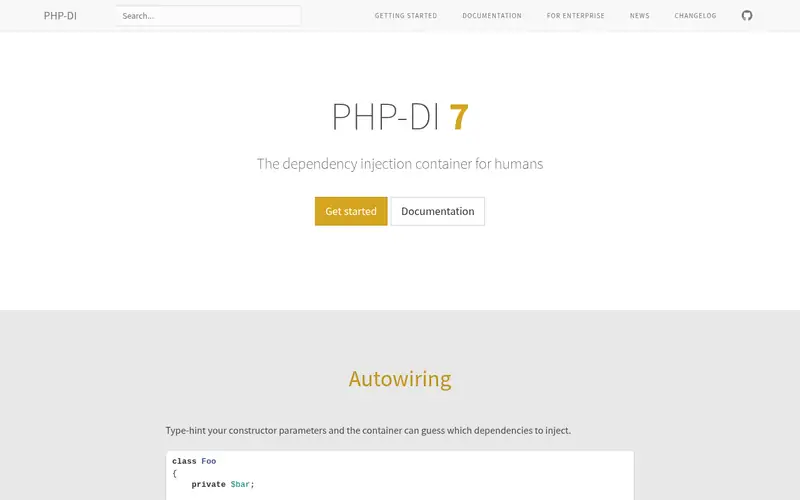
PHP-DI is a dependency injection container built for PHP applications that are not tied to one framework. It implements PSR-11 and adds autowiring, so constructor type hints are resolved without explicit definitions in many cases. Configuration can live in PHP arrays, attributes or a mix of both.
It runs on modern PHP versions and installs through Composer. The project is open source under the MIT licence. For production, PHP-DI can compile the container to plain PHP for faster startup, which requires a writable cache directory. Definitions that cannot be autowired, such as scalar arguments, still need explicit configuration. Teams that want zero configuration for every service should expect some manual definitions. It is a good fit for libraries, CLI tools and applications built on Slim or similar micro-frameworks.
Standout: Autowiring with attribute-based configuration
Free (open source), as listed by the vendor (PHP-DI website). Confirm the current plan price before you buy.
Free plan. Plans change, so confirm on the vendor's pricing page before you buy.
Benefits
- Autowiring with attribute-based configuration
- framework-agnostic PSR-11 container
Drawbacks
- Compilation step needs cache setup
- fewer helpers than full frameworks
Skip it if this limit matters to you: compilation step needs cache setup.
Verdict. A sensible pick for standalone projects that want autowiring and attributes.
Alternatives in this guide: Symfony DependencyInjection, Laravel Container (illuminate/container), League Container
Symfony DependencyInjection
Best for symfony users and projects needing a compiled container
What it is and where it fits
The Symfony DependencyInjection component is the container used by the Symfony framework and is also usable on its own. It supports service definitions in YAML, XML, PHP and attributes, plus autowiring and autoconfiguration. A compiler pass system lets you modify definitions at build time.
The component compiles the container into optimized PHP, which reduces runtime overhead. That compilation model is powerful but adds concepts such as passes, tags and service visibility that smaller projects may not need. It is open source under the MIT licence and installs with Composer. If you already use Symfony, this container is the natural default. If you want a minimal container for a small script, the configuration surface is larger than necessary.
Standout: Mature component with container compilation
Free (open source), as listed by the vendor (Symfony DependencyInjection website). Confirm the current plan price before you buy.
Free plan. Plans change, so confirm on the vendor's pricing page before you buy.
Benefits
- Mature component with container compilation
- strong YAML, XML and PHP config support
Drawbacks
- Configuration can feel heavy for small projects
- best value inside Symfony
Skip it if this limit matters to you: configuration can feel heavy for small projects.
Verdict. A sensible pick for symfony users and projects needing a compiled container.
Alternatives in this guide: PHP-DI, Laravel Container (illuminate/container), League Container
Laravel Container (illuminate/container)
Best for laravel projects and apps built on Illuminate components
What it is and where it fits
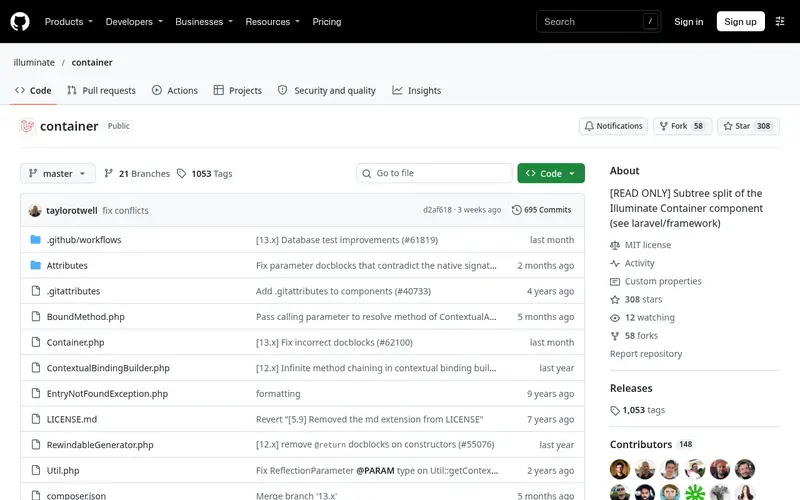
The illuminate/container package is the dependency injection container behind Laravel. It can be installed on its own through Composer, which makes it usable in non-Laravel projects that want the same binding style. It supports binding, singletons, interfaces to implementations, contextual binding and method injection.
Resolution is based on type hints, and the container can auto-resolve classes that have no explicit binding. The package is open source under the MIT licence. Its documentation is spread across the Laravel documentation rather than a standalone site, which can slow down developers who are not already familiar with Laravel. Some behavior, such as facades, belongs to the framework rather than the container package. Teams that like Laravel's API but do not use the framework often pick this package.
Standout: Simple binding API with contextual binding
Free (open source), as listed by the vendor (Laravel Container (illuminate/container) website). Confirm the current plan price before you buy.
Free plan. Plans change, so confirm on the vendor's pricing page before you buy.
Benefits
- Simple binding API with contextual binding
- usable outside full Laravel
Drawbacks
- Documentation lives mostly in Laravel docs
- some features assume Laravel conventions
Skip it if this limit matters to you: documentation lives mostly in Laravel docs.
Verdict. A sensible pick for laravel projects and apps built on Illuminate components.
Alternatives in this guide: PHP-DI, Symfony DependencyInjection, League Container
League Container
Best for teams that want a small PSR-11 container with delegates
What it is and where it fits
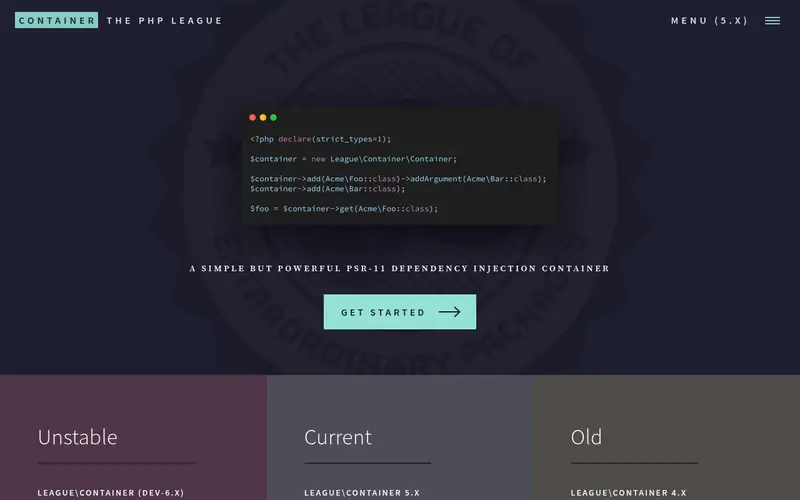
League Container is a small, PSR-11 compliant dependency injection container from The League of Extraordinary Packages. It supports constructor injection, auto-wiring, service providers, inflectors and delegate lookup, which lets one container fall back to another.
It installs through Composer and is open source under the MIT licence. The container is designed to stay out of the way, so it does not impose a directory layout or configuration format. Auto-wiring covers type-hinted constructor arguments, while scalar values need explicit definitions. The project has a smaller ecosystem than Symfony or Laravel, so fewer framework integrations are documented. It suits teams that want PSR-11 compliance without adopting a full framework and are comfortable reading the project documentation.
Standout: PSR-11 compliant with delegate lookup
Free (open source), as listed by the vendor (League Container website). Confirm the current plan price before you buy.
Free plan. Plans change, so confirm on the vendor's pricing page before you buy.
Benefits
- PSR-11 compliant with delegate lookup
- auto-wiring and service providers
Drawbacks
- Smaller ecosystem than framework containers
- fewer integrations documented
Skip it if this limit matters to you: smaller ecosystem than framework containers.
Verdict. A sensible pick for teams that want a small PSR-11 container with delegates.
Alternatives in this guide: PHP-DI, Symfony DependencyInjection, Laravel Container (illuminate/container)
Laminas ServiceManager
Best for laminas and Mezzio applications with factory-based services
What it is and where it fits
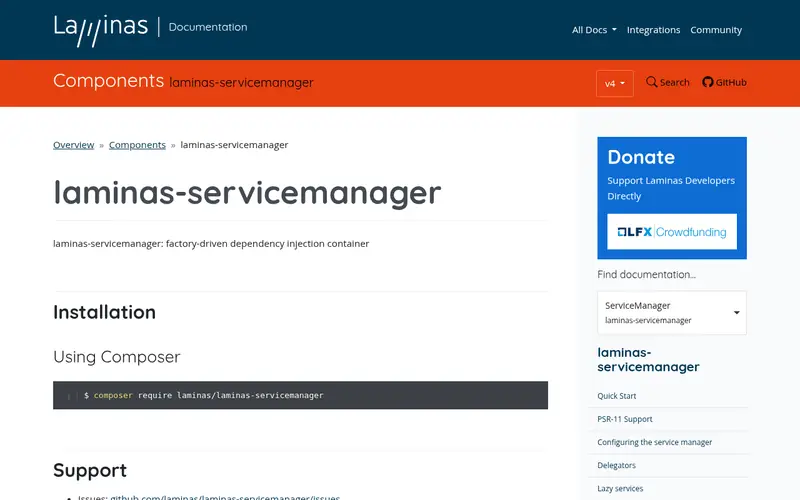
Laminas ServiceManager is the service container used across the Laminas project, including Laminas MVC and the Mezzio framework. Services are described with factories, invokables, abstract factories, aliases and delegators. Configuration is typically an array, often merged from module config files.
The component installs with Composer and is open source under a BSD-style licence. It is not a general-purpose autowiring container in the way PHP-DI is; you describe how each service is created. That explicitness is useful in large applications where service creation needs to be predictable, but it means more configuration for small projects. Teams outside the Laminas ecosystem usually pick a different container unless they need ServiceManager's plugin and delegator model.
Standout: Factory, invokable and abstract factory patterns
Free (open source), as listed by the vendor (Laminas ServiceManager website). Confirm the current plan price before you buy.
Free plan. Plans change, so confirm on the vendor's pricing page before you buy.
Benefits
- Factory, invokable and abstract factory patterns
- integrates with Laminas MVC and Mezzio
Drawbacks
- Tied to Laminas conventions
- more setup than autowiring containers
Skip it if this limit matters to you: tied to Laminas conventions.
Verdict. A sensible pick for laminas and Mezzio applications with factory-based services.
Alternatives in this guide: PHP-DI, Symfony DependencyInjection, Laravel Container (illuminate/container)
Pimple
Best for small scripts and legacy projects that need minimal DI
What it is and where it fits
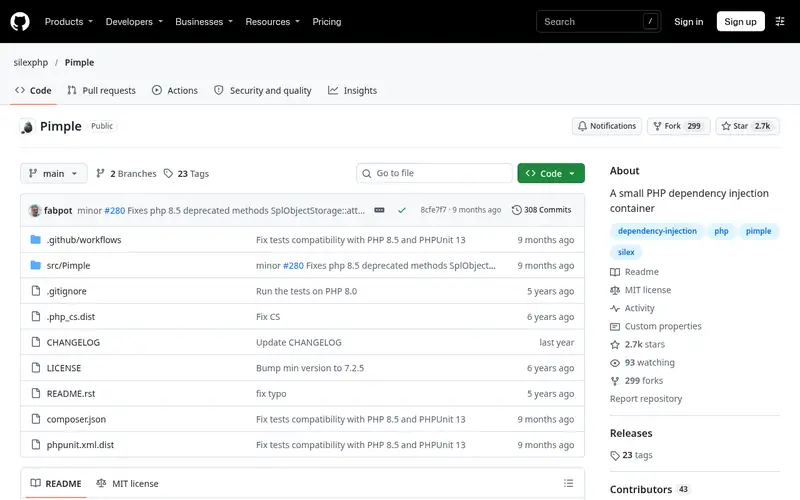
Pimple is a small dependency injection container distributed as a single PHP file. Services are defined as closures on the container and accessed like array keys. Closures are only run when a service is first requested, which gives lazy loading without extra configuration.
Pimple is open source under the MIT licence and installs with Composer or by including the file. It does not do autowiring, and the core package does not implement PSR-11, so code that expects the standard interface needs an adapter. The project is stable and minimal rather than actively adding features. It fits small applications, prototypes and legacy codebases where a full container would be overkill. Teams building larger applications should look at PHP-DI or League Container instead.
Standout: Very small single-file container
Free (open source), as listed by the vendor (Pimple website). Confirm the current plan price before you buy.
Free plan. Plans change, so confirm on the vendor's pricing page before you buy.
Benefits
- Very small single-file container
- simple API with lazy service access
Drawbacks
- No autowiring
- no PSR-11 support in the core package
Skip it if this limit matters to you: no autowiring.
Verdict. A sensible pick for small scripts and legacy projects that need minimal DI.
Alternatives in this guide: PHP-DI, Symfony DependencyInjection, Laravel Container (illuminate/container)
Who should use what
If you are building a framework-agnostic application or a library, start with PHP-DI for autowiring and attribute configuration. If your project already uses Symfony components, use Symfony DependencyInjection so you get the compiled container and compiler passes. If you work in Laravel or build on Illuminate packages, illuminate/container keeps your bindings consistent with the framework. For a small PSR-11 container with delegate lookup, choose League Container. Laminas and Mezzio projects should stay with Laminas ServiceManager, and tiny scripts or legacy code can use Pimple.
Questions to settle before you buy
What to check before you buy
- Confirm the container implements PSR-11 if you want code that is not tied to one library.
- Check that autowiring covers your constructor type hints and plan explicit definitions for scalars.
- Verify the supported PHP versions match your runtime and your deployment targets.
- Review the licence and confirm it fits your project's distribution model.
- Test container compilation and cache behavior in your deployment pipeline if the container offers it.
FAQ
Do I need a dependency injection container in PHP?
No. You can wire objects by hand in small applications. A container helps when the object graph grows, when you want lazy loading, or when you need one place to swap implementations. For a few classes, manual construction is often clearer.
What is PSR-11?
PSR-11 is the PHP-FIG standard for container interoperability. It defines a ContainerInterface with get and has methods. Code that depends on that interface can work with any compliant container. PHP-DI, Symfony DependencyInjection, illuminate/container and League Container support it.
Can I use these containers outside their frameworks?
PHP-DI, League Container and Pimple are framework-agnostic. Symfony DependencyInjection and illuminate/container can be installed standalone through Composer, though some documentation and conventions assume their home frameworks. Laminas ServiceManager is most useful inside Laminas or Mezzio.
Is autowiring always a good idea?
Autowiring reduces boilerplate for classes with type-hinted constructor arguments. It does not resolve scalars, and it can hide which implementation is used if you are not careful. Many teams combine autowiring with explicit definitions for interfaces and configuration values.
Are these containers free?
Yes. All six projects listed here are open source and free to install through Composer. Costs come from your own infrastructure and maintenance time, not from container licences. Check each repository for its current licence terms.
Sources we checked
Method: how we score · editorial policy.
Change log. First published 27 Nov 2026.