Stage 01 · Write · Researched comparison
Best Node.js Configuration Libraries in 2026
dotenv is the first pick for most teams. It loads a .env file into process.env with almost no setup, and it suits small services and scripts. node-config fits apps that need layered files per environment plus local overrides. convict adds schema validation and typed defaults on top of file loading. If you only read a few variables, env-var or envalid give you typed access and validation without a config file tree.

By Shihab Mia
Published 28 Nov 2026 · 7 tools compared
We run no ads and no affiliate links at launch. The order of a list follows our published method. See how we score.
Prices are the starting prices vendors list publicly. Plans change, so confirm the current price on the vendor page before you buy.
Key takeaways
- dotenv, node-config, convict, env-var, envalid and cosmiconfig are free and open source; Node.js built-in env file loading is free with the runtime.
- dotenv and the Node.js built-in loader read .env files into process.env; node-config and convict build a layered config object with validation.
- env-var and envalid focus on reading and validating individual environment variables with types and clear errors.
- cosmiconfig solves a different job: it discovers tool configuration files such as .eslintrc or cosmiconfig-based configs, not app runtime settings.
Who each pick is for
- Small services and scripts that read a .env filedotenv
- Apps needing per-environment config files and overridesnode-config
- Teams that want a validated schema with typed defaultsconvict
- Reading typed environment variables with clear errorsenv-var
- Startup validation of environment variables in servicesenvalid
- Tools that need to find a project's config filecosmiconfig
- Projects that want .env loading without a dependencyNode.js built-in env file loading
Comparison
| Tool | Best for | Standout feature | Listed starting price | Free plan or trial |
|---|---|---|---|---|
| 1dotenv | Small services and scripts that read a .env file | Minimal setup | Free (open source) | Free plan |
| 2node-config | Apps needing per-environment config files and overrides | Layered files per environment | Free (open source) | Free plan |
| 3convict | Teams that want a validated schema with typed defaults | Schema with types and defaults | Free (open source) | Free plan |
| 4env-var | Reading typed environment variables with clear errors | Typed getters for numbers, booleans and URLs | Free (open source) | Free plan |
| 5envalid | Startup validation of environment variables in services | Validates all variables in one call | Free (open source) | Free plan |
| 6cosmiconfig | Tools that need to find a project's config file | Searches many file names and formats | Free (open source) | Free plan |
| 7Node.js built-in env file loading | Projects that want .env loading without a dependency | No dependency to install | Free | Free plan |
How we picked
We compared libraries on fit for the job, supported platforms, licence and price, and the main limits of each. We also looked at how each handles secrets: all of these read local files or environment variables, so nothing is sent to a third party. Sources are vendor pages, official documentation and project repositories. Prices and free plan terms can change, so confirm details on the vendor site before you commit.
The tools, one by one
dotenv
Best for small services and scripts that read a .env file
What it is and where it fits
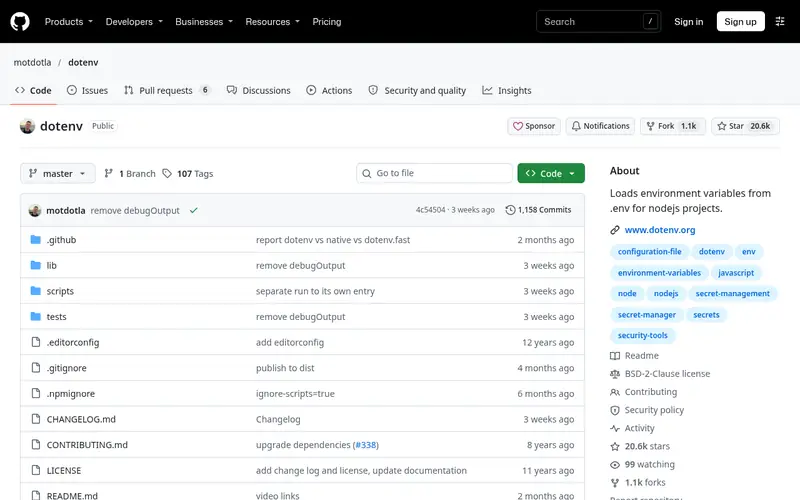
dotenv reads a .env file and assigns the entries to process.env. You call dotenv.config() early in your entry file. It runs on Node.js and works in most frameworks and serverless setups. The package ships a separate dotenvx tool for encrypted files and multiple environments, which is a different product from the core loader.
The main limit is that dotenv does no type checking. Every value is a string, and a missing key is simply undefined. Teams that need required keys, defaults or number parsing usually pair dotenv with a validation library. dotenv does not parse nested structures or merge files per environment. Skip it if you need layered config or schema checks out of the box.
Standout: Minimal setup
Free (open source), as listed by the vendor (dotenv website). Confirm the current plan price before you buy.
Free plan. Plans change, so confirm on the vendor's pricing page before you buy.
Benefits
- Minimal setup
- widely used and well documented
Drawbacks
- No schema validation
- values arrive as strings
Skip it if this limit matters to you: no schema validation.
Verdict. A sensible pick for small services and scripts that read a .env file.
Alternatives in this guide: node-config, convict, env-var
node-config
Best for apps needing per-environment config files and overrides
What it is and where it fits
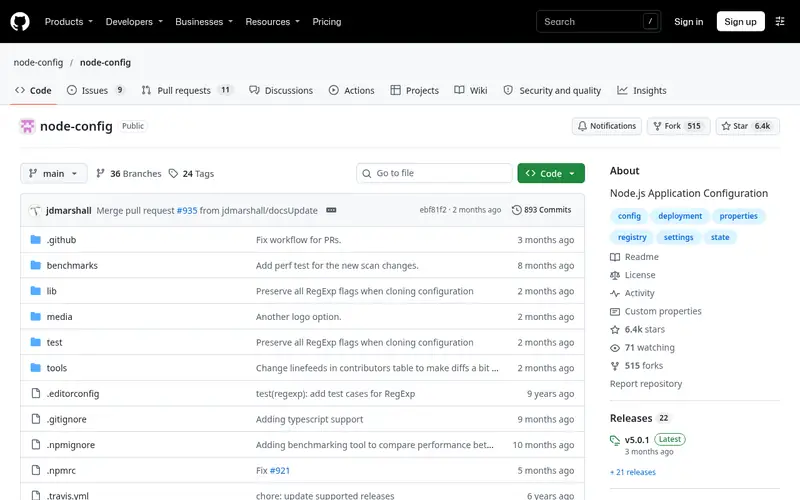
node-config loads configuration from a config directory. Files such as default.json, production.json and local.json merge in a defined order, so you can keep shared defaults and override them per environment. It supports JSON, YAML, JavaScript and other formats, plus environment variable overrides through a naming convention.
It suits larger services where settings live in files rather than a flat .env. The trade-off is structure: you must follow the directory and naming rules, and a wrong file name silently changes what loads. Validation is limited to what you add yourself. If you want a single .env file and nothing else, node-config is more machinery than you need.
Standout: Layered files per environment
Free (open source), as listed by the vendor (node-config website). Confirm the current plan price before you buy.
Free plan. Plans change, so confirm on the vendor's pricing page before you buy.
Benefits
- Layered files per environment
- local override files
Drawbacks
- File layout takes time to learn
- no built-in schema types
Skip it if this limit matters to you: file layout takes time to learn.
Verdict. A sensible pick for apps needing per-environment config files and overrides.
convict
Best for teams that want a validated schema with typed defaults
What it is and where it fits
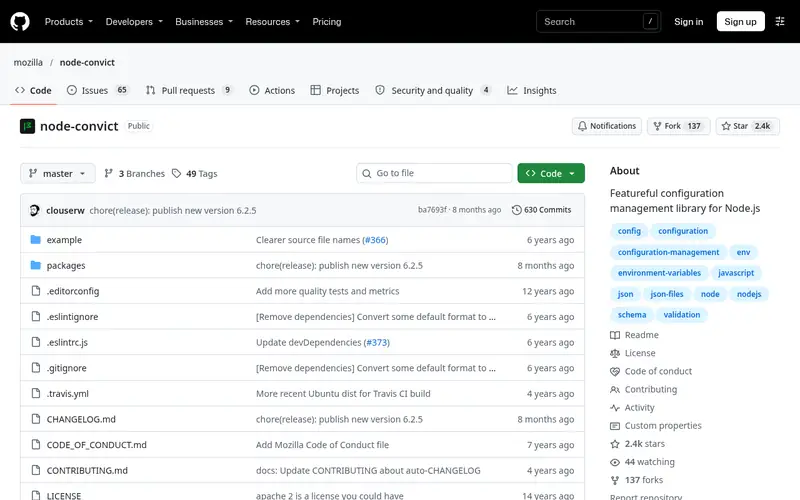
convict defines a schema for your configuration. Each key gets a type, a default and optional validation rules. It loads values from config files and environment variables, then checks the result and fails fast when something is wrong. That makes it a good fit for services where a bad setting should stop the process at boot rather than surface later.
It runs on Node.js and works with TypeScript through its type definitions. The cost is upkeep: every new setting needs a schema entry, and the schema is code you maintain. It does not replace a full secrets manager. Skip it for throwaway scripts where a plain .env read is enough.
Standout: Schema with types and defaults
Free (open source), as listed by the vendor (convict website). Confirm the current plan price before you buy.
Free plan. Plans change, so confirm on the vendor's pricing page before you buy.
Benefits
- Schema with types and defaults
- clear validation errors at startup
Drawbacks
- Schema must be maintained
- format support is narrower than node-config
Skip it if this limit matters to you: schema must be maintained.
Verdict. A sensible pick for teams that want a validated schema with typed defaults.
Alternatives in this guide: dotenv, node-config, env-var
env-var
Best for reading typed environment variables with clear errors
What it is and where it fits
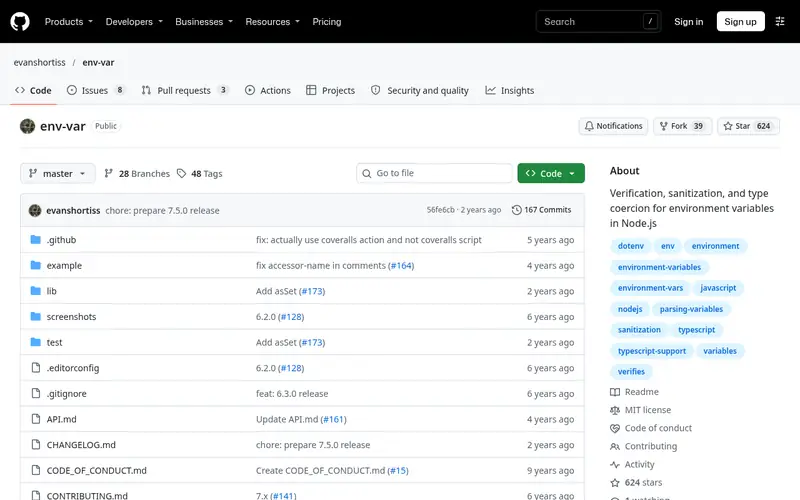
env-var wraps process.env access in a small API. You ask for a variable as a number, boolean, integer, URL or JSON value, and it throws or returns a default when the value is missing or malformed. It works alongside dotenv: dotenv loads the file, env-var reads and checks the values.
It is a good choice when your config is a handful of environment variables and you want type safety without a schema file. The limit is scope. It does not load files, merge environments or handle nested config trees. If your settings are mostly structured files, use node-config or convict instead and keep env-var for the few variables that must come from the environment.
Standout: Typed getters for numbers, booleans and URLs
Free (open source), as listed by the vendor (env-var website). Confirm the current plan price before you buy.
Free plan. Plans change, so confirm on the vendor's pricing page before you buy.
Benefits
- Typed getters for numbers, booleans and URLs
- readable error messages
Drawbacks
- Only covers environment variables
- no config file loading
Skip it if this limit matters to you: only covers environment variables.
Verdict. A sensible pick for reading typed environment variables with clear errors.
Alternatives in this guide: dotenv, node-config, convict
envalid
Best for startup validation of environment variables in services
What it is and where it fits
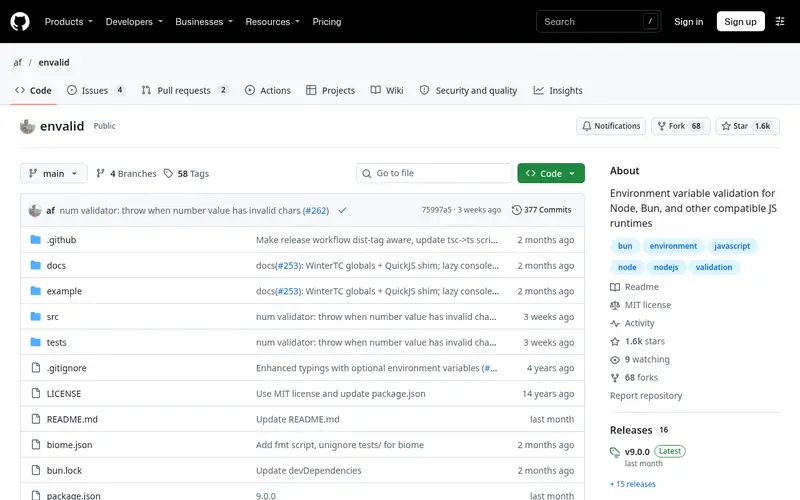
envalid validates process.env against a specification object. You declare each variable with a validator such as str, num, bool or url, and envalid returns a clean, typed object or throws a report of every problem at once. That single startup check is useful in containers and CI, where a missing variable should fail the deploy early.
It pairs well with dotenv for file loading. It runs on Node.js and has TypeScript types. The limit is the same as env-var: it does not read config files or merge environments. Teams with large nested config trees should look at convict or node-config. Teams with a dozen environment variables will find envalid enough.
Standout: Validates all variables in one call
Free (open source), as listed by the vendor (envalid website). Confirm the current plan price before you buy.
Free plan. Plans change, so confirm on the vendor's pricing page before you buy.
Benefits
- Validates all variables in one call
- supports custom validators
Drawbacks
- Environment variables only
- no file merging
Skip it if this limit matters to you: environment variables only.
Verdict. A sensible pick for startup validation of environment variables in services.
Alternatives in this guide: dotenv, node-config, convict
cosmiconfig
Best for tools that need to find a project's config file
What it is and where it fits
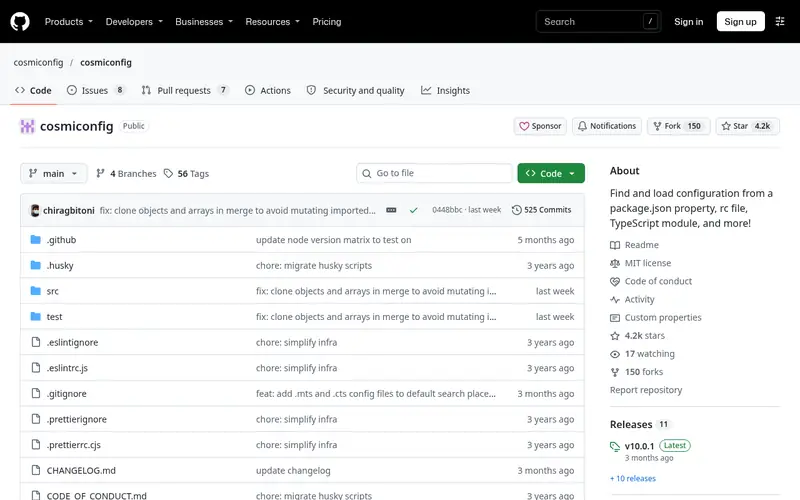
cosmiconfig finds and loads configuration for a tool. Given a module name, it searches package.json, .rc files, .config.js files and other common locations, then returns the parsed result. It is the discovery layer behind many linters, formatters and build tools rather than a way to configure your own service.
Use it when you are writing a CLI or library that needs to read user configuration from wherever the user put it. It is not a replacement for dotenv or node-config in an application runtime. The search order is powerful but must be documented, because a stray config file in a parent directory can change behavior.
Standout: Searches many file names and formats
Free (open source), as listed by the vendor (cosmiconfig website). Confirm the current plan price before you buy.
Free plan. Plans change, so confirm on the vendor's pricing page before you buy.
Benefits
- Searches many file names and formats
- used by many CLI tools
Drawbacks
- Not for app runtime settings
- search order needs care
Skip it if this limit matters to you: not for app runtime settings.
Verdict. A sensible pick for tools that need to find a project's config file.
Alternatives in this guide: dotenv, node-config, convict
Node.js built-in env file loading
Best for projects that want .env loading without a dependency
What it is and where it fits
Recent Node.js releases can load an env file directly. The --env-file flag reads a file at startup, and process.loadEnvFile() does the same from code. For projects already on a supported version, this removes the need for a dotenv dependency in simple cases.
The limits are real. There is no schema validation, no type conversion and no merging of multiple files beyond what you script yourself. Behavior and flag support depend on the Node.js version, so check the docs for your release line. It is a good default for small services and scripts; larger apps usually still want a validation layer.
Standout: No dependency to install
Free, as listed by the vendor (Node.js built-in env file loading website). Confirm the current plan price before you buy.
Free plan. Plans change, so confirm on the vendor's pricing page before you buy.
Benefits
- No dependency to install
- same runtime you already run
Drawbacks
- Tied to newer Node.js versions
- no validation or file merging
Skip it if this limit matters to you: tied to newer Node.js versions.
Verdict. A sensible pick for projects that want .env loading without a dependency.
Alternatives in this guide: dotenv, node-config, convict
Who should use what
A small service or script that needs a .env file should start with dotenv, or the Node.js built-in loader if the runtime version supports it. A larger app with per-environment files and local overrides fits node-config. A team that wants every setting declared with a type and default should use convict. If your settings are a short list of environment variables, env-var or envalid give typed reads and clear startup errors. Tool authors who need to find a user's config file should use cosmiconfig.
Questions to settle before you buy
What to check before you buy
- Confirm the library supports your Node.js version and module system (CommonJS or ESM).
- Decide whether you need file loading, validation, or both, and avoid stacking tools that overlap.
- Check how missing or malformed values fail: at startup or silently at runtime.
- Keep .env files out of version control and never commit real secrets.
- Review how the library handles multiple environments and local override files.
FAQ
Do I still need dotenv if Node.js can load env files?
Not always. Node.js can read an env file with --env-file or process.loadEnvFile() on supported versions. dotenv still helps when you need broader version support, programmatic control or integration with its related tooling. Check your runtime version first.
Which library validates configuration best?
convict and envalid both validate at startup. convict is schema-first and suits structured config with defaults. envalid is aimed at environment variables and reports all problems in one pass. Pick based on whether your settings live in files or in the environment.
Can I use these libraries together?
Yes, within reason. A common pattern is dotenv to load a file, then env-var or envalid to read and validate the values. Avoid running two full config loaders that both write to process.env, because the order of overrides becomes hard to trace.
Are these libraries safe for secrets?
They read local files and environment variables, so data stays on your machine or server. The risk is operational: committed .env files, loose file permissions or secrets baked into container images. Use a secrets manager for production credentials and keep config files out of git.
Is cosmiconfig a replacement for node-config?
No. cosmiconfig finds configuration files for a tool, such as a linter or CLI. node-config builds an application's runtime settings from layered files. They solve different problems and are rarely used for the same job.
Sources we checked
Method: how we score · editorial policy.
Change log. First published 28 Nov 2026.