Stage 01 · Write · Researched comparison
Best JavaScript Reactive Programming Libraries in 2026
RxJS is the first pick for most teams because it has the widest operator set, the largest ecosystem and strong TypeScript support. It suits developers building complex async event pipelines. Most.js is a lighter alternative focused on high-throughput streams, and Preact Signals is a good fit when you want fine-grained signal-based reactivity rather than a full observable library.

By Shihab Mia
Published 28 Nov 2026 · 5 tools compared
We run no ads and no affiliate links at launch. The order of a list follows our published method. See how we score.
Prices are the starting prices vendors list publicly. Plans change, so confirm the current price on the vendor page before you buy.
Key takeaways
- RxJS, Most.js, Bacon.js, Kefir and Preact Signals are all free and open source, so cost is not a deciding factor.
- RxJS has the broadest operator coverage and the most documentation, which helps on larger codebases.
- Most.js and Kefir are smaller and lighter, which can matter for bundle size and learning time.
- Preact Signals uses a signal model rather than observable streams, so it fits UI state better than event pipeline work.
Who each pick is for
- Teams building complex async event pipelinesRxJS
- Developers who want fast, minimal stream pipelinesMost.js
- Event streams with a readable, chainable APIBacon.js
- Lightweight reactive streams with predictable behaviorKefir
- Fine-grained signal-based reactivity in UI codePreact Signals
Comparison
| Tool | Best for | Standout feature | Listed starting price | Free plan or trial |
|---|---|---|---|---|
| 1RxJS | Teams building complex async event pipelines | Very large operator set | Free (open source) | Free plan |
| 2Most.js | Developers who want fast, minimal stream pipelines | Small core with a focused API | Free (open source) | Free plan |
| 3Bacon.js | Event streams with a readable, chainable API | Clear event stream and property model | Free (open source) | Free plan |
| 4Kefir | Lightweight reactive streams with predictable behavior | Small size with a practical operator set | Free (open source) | Free plan |
| 5Preact Signals | Fine-grained signal-based reactivity in UI code | Fine-grained updates without full re-renders | Free (open source) | Free plan |
How we picked
We compared libraries on fit for reactive and observable stream work, supported platforms, license and price, API size, documentation and main limits. Sources are official project sites, repositories and documentation. All five entries are free and open source. Prices and project activity can change, so confirm details on the official site before you commit.
The tools, one by one
RxJS
Best for teams building complex async event pipelines
What it is and where it fits
RxJS is the most widely used reactive programming library for JavaScript. It models events and async work as observables and provides operators for mapping, filtering, combining, error handling and scheduling. It runs in browsers and Node.js and ships TypeScript type definitions. The library is published under the Apache-2.0 license and is maintained by a public open-source project.
The main strength is coverage. If you need debouncing, retries, cancellation, backpressure-style control or complex stream composition, RxJS likely has an operator for it. The cost is a larger API surface and a learning curve, especially around subscription management and operator choice. Teams that only need simple event handling may find it heavier than needed.
Skip RxJS if your problem is plain UI state with few async sources, or if bundle size is tight and you only need a small subset of features. It is best suited to applications with many event sources that must be coordinated.
Standout: Very large operator set
Free (open source), as listed by the vendor (RxJS website). Confirm the current plan price before you buy.
Free plan. Plans change, so confirm on the vendor's pricing page before you buy.
Benefits
- Very large operator set
- Wide ecosystem and documentation
Drawbacks
- Steep learning curve
- Larger bundle than minimal libraries
Skip it if this limit matters to you: steep learning curve.
Verdict. A sensible pick for teams building complex async event pipelines.
Most.js
Best for developers who want fast, minimal stream pipelines
What it is and where it fits
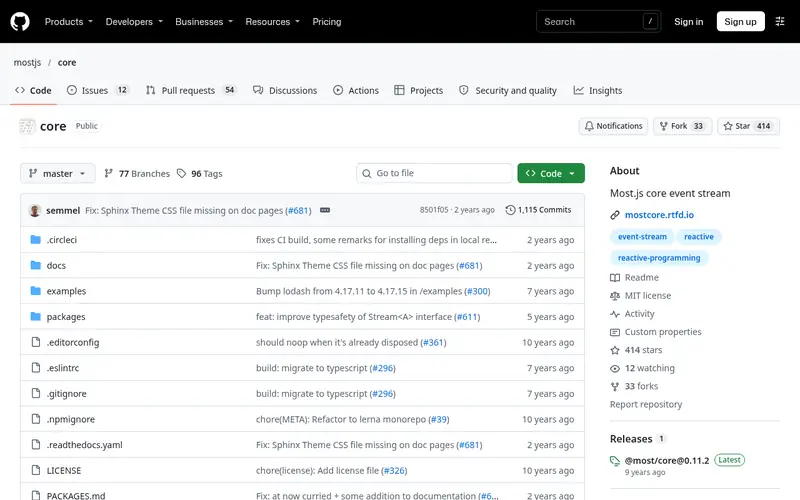
Most.js is a reactive stream library built around a compact core and a functional API. It focuses on performance and a small surface area, with operators for common transformations and combination. It runs in browsers and Node.js and is distributed as an open-source package under the MIT license.
Compared with RxJS, Most.js offers fewer operators and less third-party material, which makes it quicker to learn but less flexible for unusual cases. It suits developers who want a lean stream layer and are comfortable writing small helpers when an operator is missing. Documentation lives on the project site and repository.
Skip Most.js if you depend on a large operator catalog or need broad community examples. It is a reasonable choice for focused pipelines where the needed operators are already covered.
Standout: Small core with a focused API
Free (open source), as listed by the vendor (Most.js website). Confirm the current plan price before you buy.
Free plan. Plans change, so confirm on the vendor's pricing page before you buy.
Benefits
- Small core with a focused API
- Designed for high-throughput streams
Drawbacks
- Smaller ecosystem than RxJS
- Fewer operators and less community material
Skip it if this limit matters to you: smaller ecosystem than RxJS.
Verdict. A sensible pick for developers who want fast, minimal stream pipelines.
Bacon.js
Best for event streams with a readable, chainable API
What it is and where it fits
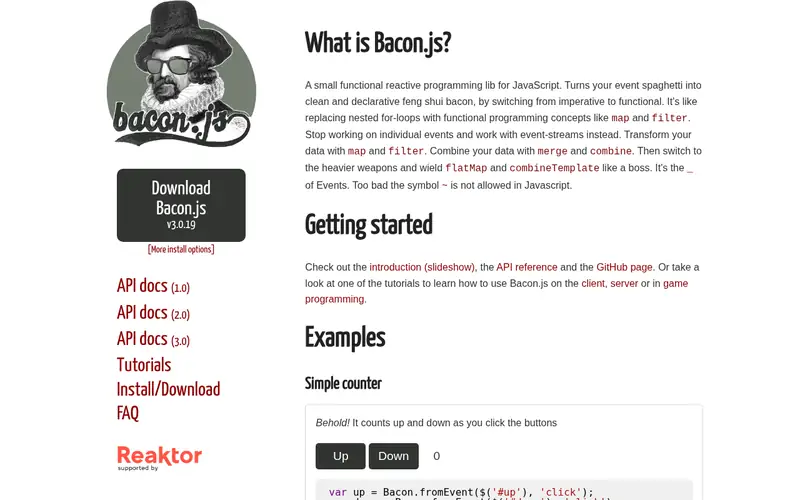
Bacon.js is a functional reactive programming library for JavaScript. It separates event streams from properties, which are streams with a current value, and provides a chainable API for combining and transforming them. It runs in browsers and Node.js and is open source under the MIT license.
The event stream versus property distinction can make stateful UI logic easier to express. The library has a smaller operator set and a smaller community than RxJS, and updates are less frequent. Documentation is available on the project site and repository.
Skip Bacon.js if you need the largest operator catalog or long-term ecosystem momentum. It is a good fit for developers who like its stream and property model and want a compact library.
Standout: Clear event stream and property model
Free (open source), as listed by the vendor (Bacon.js website). Confirm the current plan price before you buy.
Free plan. Plans change, so confirm on the vendor's pricing page before you buy.
Benefits
- Clear event stream and property model
- Chainable API that reads well
Drawbacks
- Less active than RxJS
- Smaller operator set than RxJS
Skip it if this limit matters to you: less active than RxJS.
Verdict. A sensible pick for event streams with a readable, chainable API.
Kefir
Best for lightweight reactive streams with predictable behavior
What it is and where it fits
Kefir is a reactive programming library focused on streams and properties. It offers a practical set of operators for transformation, combination and timing, and documents how streams behave. It runs in browsers and Node.js and is open source under the MIT license.
Kefir sits between minimal libraries and RxJS in scope. It has enough operators for common event work without the full RxJS surface. The community is smaller, so fewer tutorials and integrations exist. The project documentation explains stream semantics in detail, which helps when debugging.
Skip Kefir if you need a large ecosystem or advanced scheduling features. It suits projects that want a small, well-documented stream library with predictable semantics.
Standout: Small size with a practical operator set
Free (open source), as listed by the vendor (Kefir website). Confirm the current plan price before you buy.
Free plan. Plans change, so confirm on the vendor's pricing page before you buy.
Benefits
- Small size with a practical operator set
- Clear documentation of stream semantics
Drawbacks
- Smaller community than RxJS
- Fewer integrations and examples
Skip it if this limit matters to you: smaller community than RxJS.
Verdict. A sensible pick for lightweight reactive streams with predictable behavior.
Preact Signals
Best for fine-grained signal-based reactivity in UI code
What it is and where it fits
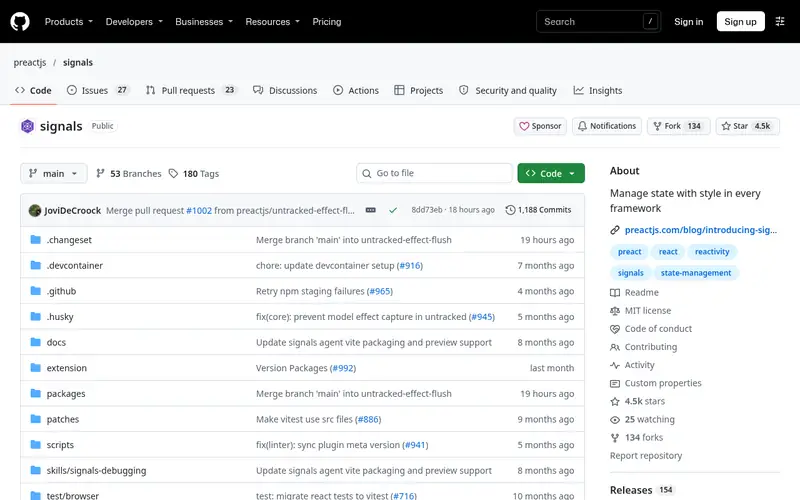
Preact Signals is a signal-based reactivity library. Signals hold values, computed signals derive from them, and effects run when dependencies change. The core package is framework-agnostic, with integrations for Preact and React. It is open source under the MIT license and runs in browsers and Node.js.
Signals differ from observable streams. They are designed for state that changes over time and for updating UI with fine granularity, not for composing long async event pipelines. If your work is mostly UI state, signals can be simpler than observables. If you need operators like retry, debounce and complex merging, an observable library is a better fit.
Skip Preact Signals if your main need is event stream composition. It is a strong choice for component state and derived values where you want targeted updates.
Standout: Fine-grained updates without full re-renders
Free (open source), as listed by the vendor (Preact Signals website). Confirm the current plan price before you buy.
Free plan. Plans change, so confirm on the vendor's pricing page before you buy.
Benefits
- Fine-grained updates without full re-renders
- Small and framework-agnostic core
Drawbacks
- Signal model differs from observable streams
- Not a full stream operator library
Skip it if this limit matters to you: signal model differs from observable streams.
Verdict. A sensible pick for fine-grained signal-based reactivity in UI code.
Who should use what
Teams with many async event sources and complex coordination should start with RxJS. Developers who want a small, fast stream layer for focused pipelines should look at Most.js. Projects that like a clear stream and property model should consider Bacon.js or Kefir. Teams whose main problem is UI state and targeted updates should evaluate Preact Signals instead of a full observable library.
Questions to settle before you buy
What to check before you buy
- Confirm the library supports every operator your pipeline needs, or plan to write helpers.
- Check bundle size impact against your build targets and performance budget.
- Verify TypeScript definitions if your codebase uses TypeScript.
- Review how subscriptions are cleaned up to avoid memory leaks.
- Check the project's recent commit activity and open issue backlog.
FAQ
Is RxJS still the default choice?
RxJS remains the most widely used option with the largest operator set and ecosystem. It is a reasonable default when you need broad coverage. Smaller libraries can be better when your needs are narrow and bundle size matters.
What is the difference between observables and signals?
Observables model streams of events over time and support operators for composition and cancellation. Signals hold a current value and track dependencies for derived values and effects. Signals fit UI state; observables fit async event pipelines.
Are these libraries free to use?
Yes. All five projects listed here are open source and free to use under their respective licenses, including MIT and Apache-2.0. Check each repository for the exact license terms before shipping.
Can I use these in Node.js as well as the browser?
RxJS, Most.js, Bacon.js, Kefir and the Preact Signals core run in Node.js and browsers. Framework integrations for Preact Signals are aimed at UI code, but the core package is framework-agnostic.
Do I need a reactive library for simple event handling?
Often no. Plain event listeners or a small helper may be enough for one or two event sources. A reactive library pays off when you have many sources, need cancellation, or must combine and transform streams.
Sources we checked
Method: how we score · editorial policy.
Change log. First published 28 Nov 2026.