Stage 01 · Write · Researched comparison
Best JavaScript Immutable Data Libraries in 2026
Immer is the first pick for most teams. It lets you write plain mutable-looking code and produces immutable results, which fits React state and Redux reducers well. Immutable.js is the alternative when you want persistent data structures with structural sharing built in. Mutative is the alternative when raw update speed matters and you want a smaller API. All three are open source and free to use.

By Shihab Mia
Published 28 Nov 2026 · 5 tools compared
We run no ads and no affiliate links at launch. The order of a list follows our published method. See how we score.
Prices are the starting prices vendors list publicly. Plans change, so confirm the current price on the vendor page before you buy.
Key takeaways
- Immer, Immutable.js, Mutative and structura.js are free and open source; native structuredClone and Object.freeze ship with the language.
- Immer and Mutative use a draft-based API, so updates read like normal mutations but return new objects.
- Immutable.js provides its own collection types, so data must be converted at the edges of your app.
- None of these libraries send your data over the network; they run in your process.
Who each pick is for
- Teams that want mutable-style updates with immutable resultsImmer
- Apps that need persistent collections with structural sharingImmutable.js
- Developers who want a draft API with a focus on update speedMutative
- Projects that need fast immutable updates on large nested objectsstructura.js
- Simple deep copies and shallow immutability without a dependencyNative structuredClone and Object.freeze
Comparison
| Tool | Best for | Standout feature | Listed starting price | Free plan or trial |
|---|---|---|---|---|
| 1Immer | Teams that want mutable-style updates with immutable results | Simple draft API that reads like normal mutation | Free (open source) | Free plan |
| 2Immutable.js | Apps that need persistent collections with structural sharing | Rich set of persistent collection types | Free (open source) | Free plan |
| 3Mutative | Developers who want a draft API with a focus on update speed | Draft-based API similar to Immer | Free (open source) | Free plan |
| 4structura.js | Projects that need fast immutable updates on large nested objects | Built around fast copy-on-write updates | Free (open source) | Free plan |
| 5Native structuredClone and Object.freeze | Simple deep copies and shallow immutability without a dependency | Built into modern browsers and Node.js | Free | Free plan |
How we picked
We picked libraries that directly handle immutable updates or persistent data structures in JavaScript, and that are currently maintained with a public repository. We looked at the API model (draft-based, persistent collections or native functions), where the code runs, licence terms and the main limits each project documents. Sources are vendor documentation, project repositories and public pricing pages. These are all free or open source, so price was not a differentiator. Prices and licences can change, so confirm details on each project site.
The tools, one by one
Immer
Best for teams that want mutable-style updates with immutable results
What it is and where it fits
Immer lets you call `produce` with a base state and a function that changes a draft. The library records the changes and returns a new immutable value, leaving the original untouched. It uses JavaScript proxies by default, with an option to fall back to copying for older environments. It runs in Node.js and browsers and has no required build step. The project is open source under the MIT license. The main limit is that drafts only track plain objects, arrays, maps and sets, and class instances need extra handling. Skip it if you need persistent data structures with structural sharing across large trees, or if proxy overhead is a measured problem in a hot path.
Standout: Simple draft API that reads like normal mutation
Free (open source), as listed by the vendor (Immer website). Confirm the current plan price before you buy.
Free plan. Plans change, so confirm on the vendor's pricing page before you buy.
Benefits
- Simple draft API that reads like normal mutation
- works well with React and Redux
Drawbacks
- Proxy-based drafts add some overhead
- frozen results can surprise code that mutates them
Skip it if this limit matters to you: proxy-based drafts add some overhead.
Verdict. A sensible pick for teams that want mutable-style updates with immutable results.
Alternatives in this guide: Immutable.js, Mutative, structura.js
Immutable.js
Best for apps that need persistent collections with structural sharing
What it is and where it fits
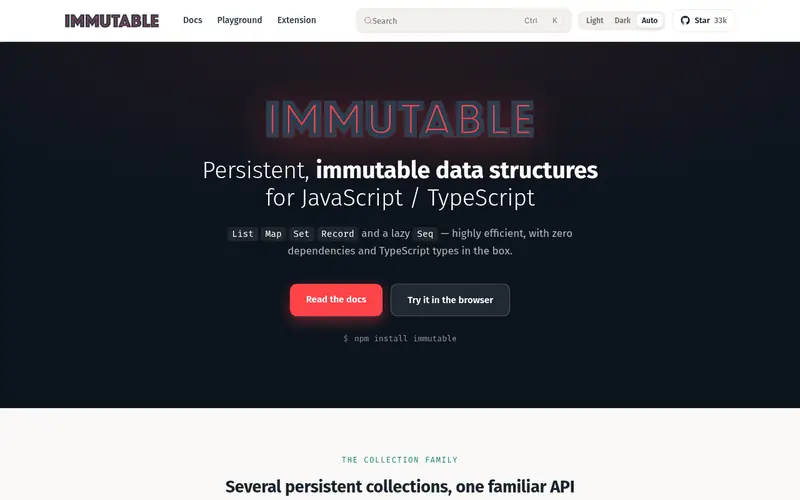
Immutable.js provides List, Map, Set, Record and other collection types that never change in place. Every update returns a new collection that shares most of its internal structure with the old one. This suits large nested state where copying whole trees would be expensive. It runs in browsers and Node.js and is open source under the MIT license. The tradeoff is that these are not native objects, so you convert with `toJS` or `fromJS` when passing data to code that expects plain values. Skip it for small state trees where plain objects and spread syntax are simpler.
Standout: Rich set of persistent collection types
Free (open source), as listed by the vendor (Immutable.js website). Confirm the current plan price before you buy.
Free plan. Plans change, so confirm on the vendor's pricing page before you buy.
Benefits
- Rich set of persistent collection types
- structural sharing keeps memory use low on large updates
Drawbacks
- Data must be converted to and from plain JavaScript at boundaries
- API differs from native arrays and objects
Skip it if this limit matters to you: data must be converted to and from plain JavaScript at boundaries.
Verdict. A sensible pick for apps that need persistent collections with structural sharing.
Alternatives in this guide: Immer, Mutative, structura.js
Mutative
Best for developers who want a draft API with a focus on update speed
What it is and where it fits
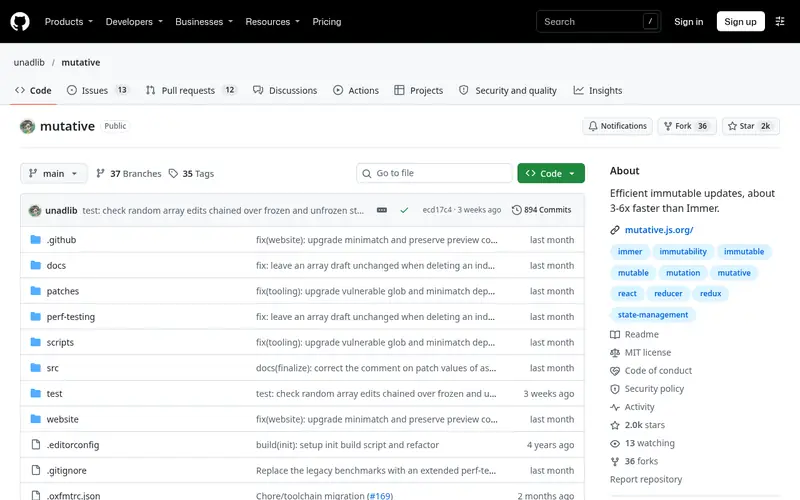
Mutative offers a `create` function that takes a base state and a mutator, then returns a new immutable result. It uses a copy-on-write approach rather than proxies, which the project presents as a performance advantage. It works in browsers and Node.js and ships as an open-source package under the MIT license. It supports plain objects, arrays, maps and sets. The main limit is ecosystem size: fewer tutorials, plugins and framework bindings exist compared with Immer. Skip it if your team already depends on Immer middleware or if you want the largest set of community examples.
Standout: Draft-based API similar to Immer
Free (open source), as listed by the vendor (Mutative website). Confirm the current plan price before you buy.
Free plan. Plans change, so confirm on the vendor's pricing page before you buy.
Benefits
- Draft-based API similar to Immer
- designed for fast immutable updates
Drawbacks
- Smaller community than Immer
- fewer integrations with existing state libraries
Skip it if this limit matters to you: smaller community than Immer.
Verdict. A sensible pick for developers who want a draft API with a focus on update speed.
Alternatives in this guide: Immer, Immutable.js, structura.js
structura.js
Best for projects that need fast immutable updates on large nested objects
What it is and where it fits
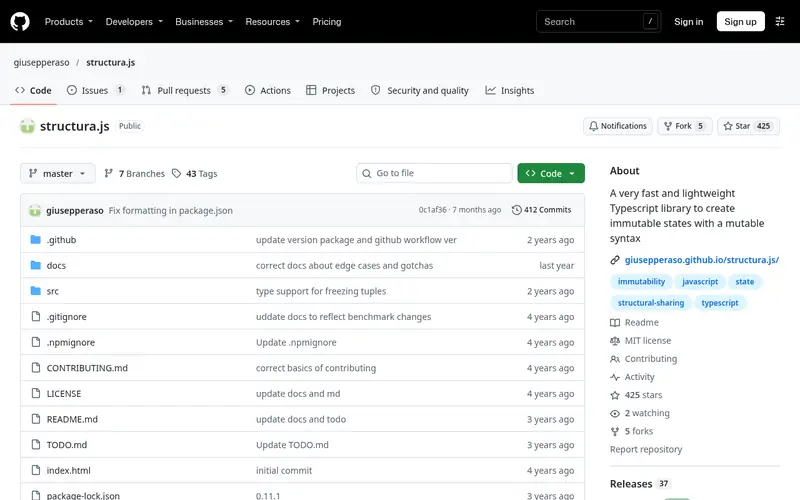
structura.js is a small library for immutable state updates built on a copy-on-write model. You create a draft from your state, change it, and finish to get a new immutable value. The project targets performance on large nested structures and keeps the API narrow. It runs in browsers and Node.js and is open source. Because the project is small, expect fewer examples and less third-party material than the larger libraries. Skip it if you need long-term ecosystem support or tight integration with a specific state manager.
Standout: Built around fast copy-on-write updates
Free (open source), as listed by the vendor (structura.js website). Confirm the current plan price before you buy.
Free plan. Plans change, so confirm on the vendor's pricing page before you buy.
Benefits
- Built around fast copy-on-write updates
- small API surface
Drawbacks
- Much smaller project and community
- less documentation than Immer
Skip it if this limit matters to you: much smaller project and community.
Verdict. A sensible pick for projects that need fast immutable updates on large nested objects.
Alternatives in this guide: Immer, Immutable.js, Mutative
Native structuredClone and Object.freeze
Best for simple deep copies and shallow immutability without a dependency
What it is and where it fits
`structuredClone` is a built-in function that deep-copies supported values, including nested objects, arrays, maps, sets and dates. It is available in modern browsers and current Node.js releases. `Object.freeze` prevents changes to an object's own properties but does not freeze nested objects, so deep immutability needs a manual walk. Both are free and require no package. The limits matter: structuredClone throws on functions and does not preserve class prototypes, and freeze does not give you structural sharing, so large copies cost memory. Use these for simple cases and reach for a library when updates are frequent or trees are large.
Standout: Built into modern browsers and Node.js
Free, as listed by the vendor (Native structuredClone and Object.freeze website). Confirm the current plan price before you buy.
Free plan. Plans change, so confirm on the vendor's pricing page before you buy.
Benefits
- Built into modern browsers and Node.js
- no dependency to install or audit
Drawbacks
- structuredClone cannot copy functions or class prototypes
- Object.freeze is shallow only
Skip it if this limit matters to you: structuredClone cannot copy functions or class prototypes.
Verdict. A sensible pick for simple deep copies and shallow immutability without a dependency.
Alternatives in this guide: Immer, Immutable.js, Mutative
Who should use what
If you write React or Redux reducers and want code that reads like normal mutation, use Immer. If your state is a large nested tree and you want persistent collections with structural sharing, use Immutable.js and convert at the edges. If update speed is the priority and you want a draft API, look at Mutative. If you only need an occasional deep copy or a shallow freeze, use native structuredClone and Object.freeze and skip the dependency.
Questions to settle before you buy
What to check before you buy
- Confirm the library supports the data types you store, including maps, sets and class instances.
- Check whether results are frozen and whether existing code mutates state in place.
- Measure update cost on your real data size before choosing a speed-focused library.
- Check bundle size and whether the library works in your target browsers and Node.js version.
- Review the licence and the project's recent commit activity before adopting it.
FAQ
Do I need a library for immutable data in JavaScript?
No. Spread syntax, Object.freeze and structuredClone cover simple cases. A library helps when updates are frequent, state is deeply nested, or you want structural sharing to avoid large copies.
What is the difference between Immer and Immutable.js?
Immer keeps plain JavaScript objects and arrays and returns new versions after a draft update. Immutable.js introduces its own collection types with structural sharing. Immer fits code that expects plain values; Immutable.js fits large trees where conversion at the edges is acceptable.
Are these libraries safe for sensitive data?
Yes, in the sense that they run locally in your process and do not send data anywhere. That differs from online formatters or converters, where you should never paste secrets, tokens or production data into a third-party web page.
Does structuredClone replace these libraries?
Only for simple deep copies. structuredClone cannot copy functions and does not preserve class prototypes. It also gives no structural sharing, so repeated updates on large trees cost more than a persistent data structure would.
Which library has the smallest API to learn?
structura.js and Mutative have narrow APIs centered on creating a draft and finishing it. Immer is similar but has more integrations and documentation. Immutable.js has the largest API because it provides many collection types and methods.
Sources we checked
Method: how we score · editorial policy.
Change log. First published 28 Nov 2026.