Stage 01 · Write · Researched comparison
Best JavaScript Form Builder Libraries in 2026
SurveyJS is the first pick for teams that want a JSON-driven form builder with a visual creator and a framework-agnostic renderer. It suits apps that need complex forms, conditional logic and surveys. Choose react-jsonschema-form if you work in React and already model data with JSON Schema. Choose FormKit if you build Vue apps and want a form framework with a schema layer rather than a full form builder platform.

By Shihab Mia
Published 28 Nov 2026 · 6 tools compared
We run no ads and no affiliate links at launch. The order of a list follows our published method. See how we score.
Prices are the starting prices vendors list publicly. Plans change, so confirm the current price on the vendor page before you buy.
Key takeaways
- SurveyJS, Form.io, react-jsonschema-form, JSON Forms, FormKit and Uniforms all ship under open-source licences, but SurveyJS and Form.io sell paid tiers for hosted form creation and data services.
- JSON Schema is the shared data model for react-jsonschema-form and JSON Forms, so form definitions can move between tools and be validated outside the UI.
- FormKit targets Vue and Uniforms targets multiple React form libraries, so framework fit decides the pick more than feature lists do.
- Form definitions often contain field names and default values; keep schemas and any test data out of third-party online form builders unless you control the deployment.
Who each pick is for
- Multi-framework apps that need a visual form creator plus a JSON rendererSurveyJS
- Teams that want an open-source form renderer with an optional hosted platformForm.io
- React apps that already define data with JSON Schemareact-jsonschema-form
- Projects that need one JSON Schema form renderer across several frameworksJSON Forms
- Vue teams that want a form framework with schema-driven inputsFormKit
- React apps that want one schema API over several form librariesUniforms
Comparison
| Tool | Best for | Standout feature | Listed starting price | Free plan or trial |
|---|---|---|---|---|
| 1SurveyJS | Multi-framework apps that need a visual form creator plus a JSON renderer | MIT-licensed form library with React, Vue, Angular, Svelte and jQuery support | Free (open source) | Free plan |
| 2Form.io | Teams that want an open-source form renderer with an optional hosted platform | Open-source renderer with a JSON form definition | See vendor pricing page | Free trial (14 days) |
| 3react-jsonschema-form | React apps that already define data with JSON Schema | Renders forms directly from JSON Schema with UI schema overrides | Free (open source) | Free plan |
| 4JSON Forms | Projects that need one JSON Schema form renderer across several frameworks | Renderers for React, Angular and Vue from one schema | Free (open source) | Free plan |
| 5FormKit | Vue teams that want a form framework with schema-driven inputs | Schema-driven inputs with validation and Vue 3 support | Free (open source) | Free plan |
| 6Uniforms | React apps that want one schema API over several form libraries | Bridges JSON Schema and GraphQL schemas to multiple React form libraries | Free (open source) | Free plan |
How we picked
We picked libraries that render or build forms from JSON schemas or schema-like configs and are maintained in public repositories or by active vendors. Criteria were fit for the job, framework support, licence and price structure, whether forms can be self-hosted to keep data private, and the main limits such as React-only or Vue-only support. Sources are vendor pages, official documentation and project repositories. Prices change, so confirm current terms on the vendor site.
The tools, one by one
SurveyJS
Best for multi-framework apps that need a visual form creator plus a JSON renderer
What it is and where it fits
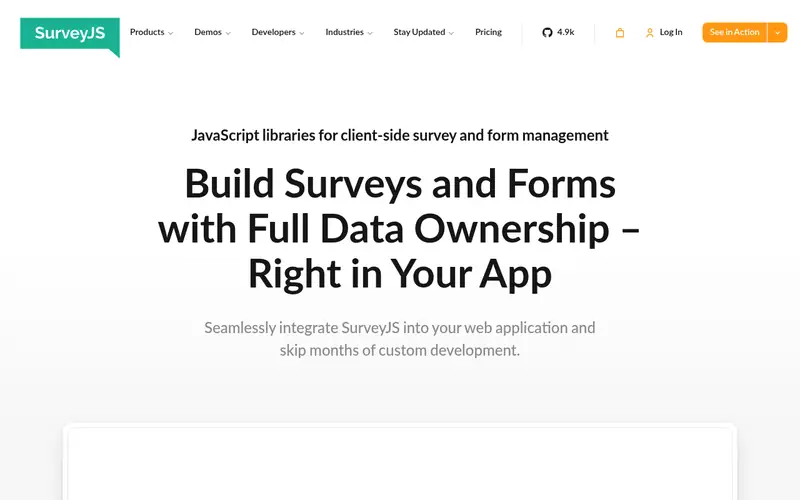
SurveyJS splits into a form library and a form creator. The library renders forms and surveys from a JSON schema and runs in React, Vue, Angular, Svelte and plain JavaScript apps. The Creator is a drag-and-drop builder that produces the same JSON, so non-developers can edit forms without touching code. Conditional logic, validation and calculated values are part of the schema.
The core form library is MIT licensed. The Creator and other modules are sold under commercial licences, and the vendor publishes its pricing on its site. Self-hosting is possible, which matters if form definitions should not leave your infrastructure. Teams that only need to render a fixed schema can use the library alone and skip the Creator.
Skip SurveyJS if you want a single small dependency for a simple React form. It fits projects where forms are a product surface and change often.
Standout: MIT-licensed form library with React, Vue, Angular, Svelte and jQuery support
Free (open source), as listed by the vendor (SurveyJS website). Confirm the current plan price before you buy.
Free plan. Plans change, so confirm on the vendor's pricing page before you buy.
Benefits
- MIT-licensed form library with React, Vue, Angular, Svelte and jQuery support
- separate Creator and PDF export products
Drawbacks
- The visual Creator and some export features sit in commercial tiers
- the full product set takes time to learn
Skip it if this limit matters to you: the visual Creator and some export features sit in commercial tiers.
Verdict. A sensible pick for multi-framework apps that need a visual form creator plus a JSON renderer.
Alternatives in this guide: Form.io, react-jsonschema-form, JSON Forms
Form.io
Best for teams that want an open-source form renderer with an optional hosted platform
What it is and where it fits
Form.io provides a form renderer that takes a JSON schema and produces forms in several front-end frameworks. The open-source renderer can be embedded in your own app. The vendor also runs a platform that stores form definitions, submissions and related data, with a form builder UI.
The renderer is the part most developers start with. The platform is the commercial product, and pricing is listed on the vendor site. Teams that need submission storage, roles and a hosted builder should compare the platform tiers. Teams that only need to render forms can use the open-source packages and manage their own backend.
Skip Form.io if you want a pure client-side library with no platform concepts. It fits organizations that want a managed form backend alongside the renderer.
Standout: Open-source renderer with a JSON form definition
See vendor pricing page, as listed by the vendor (Form.io website). Confirm the current plan price before you buy.
Free trial (14 days). Plans change, so confirm on the vendor's pricing page before you buy.
Benefits
- Open-source renderer with a JSON form definition
- hosted platform adds form management and data storage
Drawbacks
- The hosted platform is the paid path
- self-hosting the full stack takes setup work
Skip it if this limit matters to you: the hosted platform is the paid path.
Verdict. A sensible pick for teams that want an open-source form renderer with an optional hosted platform.
Alternatives in this guide: SurveyJS, react-jsonschema-form, JSON Forms
react-jsonschema-form
Best for react apps that already define data with JSON Schema
What it is and where it fits
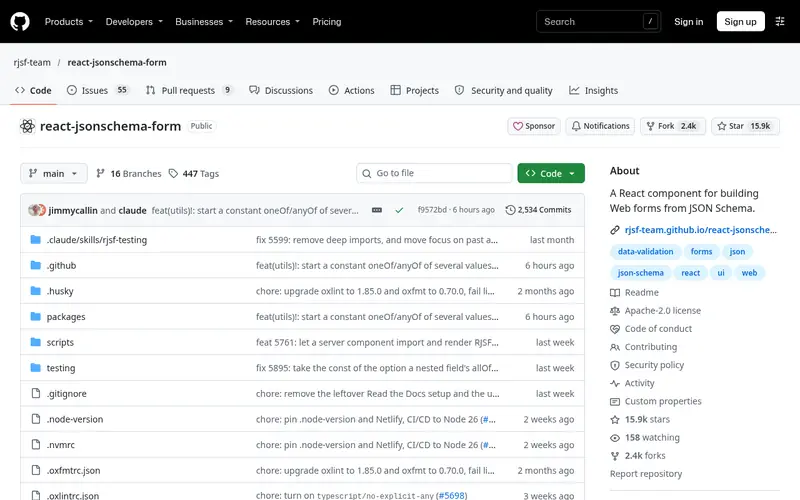
react-jsonschema-form turns a JSON Schema into a React form. You pass a schema, an optional UI schema for layout and widget choices, and a form data object. Validation follows the schema, so the same definition can validate data on a server. The project publishes packages for common design systems and accepts custom widgets and fields.
The library is open source under the Apache 2.0 licence and maintained in a public repository. It does not include a drag-and-drop builder; you write or generate the schema. That keeps the dependency small but means non-developers cannot edit forms directly.
Skip it if your app is not React or if you need a visual builder out of the box. It fits teams that treat JSON Schema as the source of truth for data shapes.
Standout: Renders forms directly from JSON Schema with UI schema overrides
Free (open source), as listed by the vendor (react-jsonschema-form website). Confirm the current plan price before you buy.
Free plan. Plans change, so confirm on the vendor's pricing page before you buy.
Benefits
- Renders forms directly from JSON Schema with UI schema overrides
- active repository with theme packages
Drawbacks
- React only
- complex layouts need UI schema tuning
Skip it if this limit matters to you: react only.
Verdict. A sensible pick for react apps that already define data with JSON Schema.
Alternatives in this guide: SurveyJS, Form.io, JSON Forms
JSON Forms
Best for projects that need one JSON Schema form renderer across several frameworks
What it is and where it fits
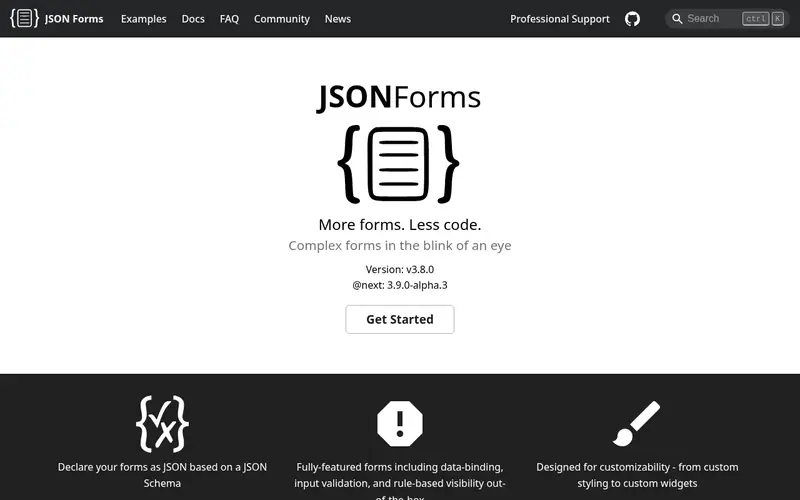
JSON Forms renders forms from JSON Schema plus a UI schema that controls layout and control types. It ships renderers for React, Angular and Vue, so a team with mixed front ends can share form definitions. The project comes from EclipseSource and is developed in the open.
The library is open source under the MIT licence. It focuses on rendering; there is no bundled drag-and-drop builder. You define the schema and UI schema yourself or generate them from another tool. Custom renderers let you map controls to your design system.
Skip JSON Forms if you need a hosted builder or only work in one framework with a simpler option. It fits teams that value a shared schema across frameworks and are willing to maintain the UI schema.
Standout: Renderers for React, Angular and Vue from one schema
Free (open source), as listed by the vendor (JSON Forms website). Confirm the current plan price before you buy.
Free plan. Plans change, so confirm on the vendor's pricing page before you buy.
Benefits
- Renderers for React, Angular and Vue from one schema
- maintained by EclipseSource with a documented UI schema format
Drawbacks
- UI schema adds a second concept to learn
- styling requires renderer-specific work
Skip it if this limit matters to you: UI schema adds a second concept to learn.
Verdict. A sensible pick for projects that need one JSON Schema form renderer across several frameworks.
Alternatives in this guide: SurveyJS, Form.io, react-jsonschema-form
FormKit
Best for vue teams that want a form framework with schema-driven inputs
What it is and where it fits
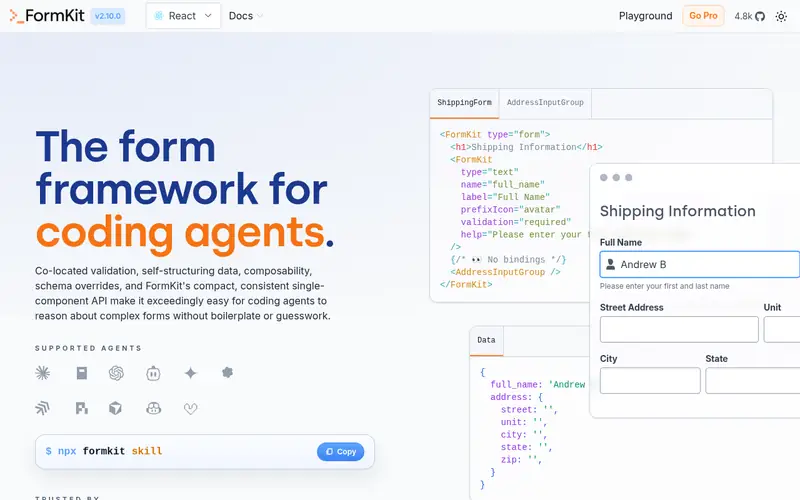
FormKit is a form framework for Vue. It provides input components, validation rules and a schema format for composing forms. The schema can be generated or written by hand, and inputs can be extended with plugins. It handles common form concerns such as validation messages and input grouping.
The core package is open source under the MIT licence. Some parts of the ecosystem, such as the Pro offering, are commercial and listed on the vendor site. FormKit does not ship a drag-and-drop builder; it gives you the primitives to build forms and your own builder if needed.
Skip FormKit if you are not on Vue or if you need a ready-made visual builder. It fits Vue teams that want a consistent input layer and are comfortable defining forms in code.
Standout: Schema-driven inputs with validation and Vue 3 support
Free (open source), as listed by the vendor (FormKit website). Confirm the current plan price before you buy.
Free plan. Plans change, so confirm on the vendor's pricing page before you buy.
Benefits
- Schema-driven inputs with validation and Vue 3 support
- clear documentation and a plugin model
Drawbacks
- Vue only
- it is a form framework first, not a full form builder platform
Skip it if this limit matters to you: vue only.
Verdict. A sensible pick for vue teams that want a form framework with schema-driven inputs.
Alternatives in this guide: SurveyJS, Form.io, react-jsonschema-form
Uniforms
Best for react apps that want one schema API over several form libraries
What it is and where it fits
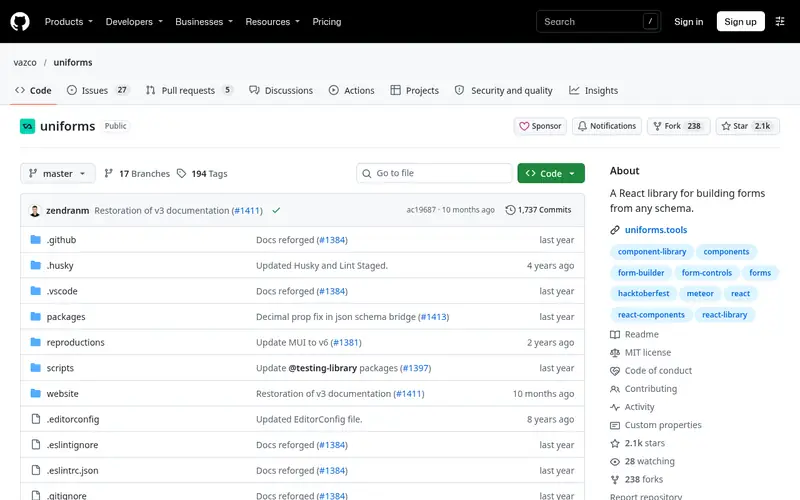
Uniforms connects a schema to a React form library. It supports JSON Schema and GraphQL schemas and can render through several underlying engines, so you can change the form library without rewriting form code. It provides automatic form generation and field components.
The project is open source under the MIT licence and maintained in a public repository. It does not include a visual builder. The trade-off is abstraction: when a field misbehaves, you debug both Uniforms and the engine beneath it.
Skip Uniforms if you want a single dependency with no indirection or if you are not on React. It fits teams that already have schemas and want to keep form rendering swappable.
Standout: Bridges JSON Schema and GraphQL schemas to multiple React form libraries
Free (open source), as listed by the vendor (Uniforms website). Confirm the current plan price before you buy.
Free plan. Plans change, so confirm on the vendor's pricing page before you buy.
Benefits
- Bridges JSON Schema and GraphQL schemas to multiple React form libraries
- lets you swap the underlying form engine
Drawbacks
- React only
- the abstraction adds a layer to debug when things go wrong
Skip it if this limit matters to you: react only.
Verdict. A sensible pick for react apps that want one schema API over several form libraries.
Alternatives in this guide: SurveyJS, Form.io, react-jsonschema-form
Who should use what
A React team with existing JSON Schema definitions should start with react-jsonschema-form and add Uniforms only if it needs to swap form engines. A Vue team that wants a consistent input and validation layer should use FormKit. An organization that needs a visual builder plus a renderer, and may self-host, should compare SurveyJS and Form.io on licence terms and platform features. A team with React, Angular and Vue front ends should look at JSON Forms to share one schema across all three.
Questions to settle before you buy
What to check before you buy
- Confirm the library supports your framework and version, and check the release activity in its repository.
- Read the licence for the renderer and for any builder or hosted tier separately; they often differ.
- Test whether your schema format is JSON Schema, a vendor format or both, and whether it can be validated server-side.
- Decide whether form definitions and submissions can leave your infrastructure, and prefer self-hosted options if not.
- Check how custom fields, validation rules and layout are extended before you commit to a schema.
FAQ
Do these libraries include a drag-and-drop form builder?
Only SurveyJS and Form.io sell a visual builder as part of their product set. react-jsonschema-form, JSON Forms, FormKit and Uniforms focus on rendering forms from schemas or configs, so you write or generate the form definition in code.
Can I use JSON Schema with all of them?
react-jsonschema-form, JSON Forms and Uniforms work directly with JSON Schema. SurveyJS uses its own JSON format. Form.io uses its own form definition. FormKit uses a schema format of its own. Check the format before assuming schemas are portable.
Are these libraries free?
All six have open-source cores under licences such as MIT or Apache 2.0. SurveyJS and Form.io sell commercial tiers for their builder and platform products. FormKit lists a commercial Pro offering. Confirm current terms on each vendor site.
Which one works outside React?
SurveyJS supports React, Vue, Angular, Svelte and jQuery. JSON Forms ships renderers for React, Angular and Vue. FormKit is for Vue. react-jsonschema-form and Uniforms are React only. Form.io's renderer covers several frameworks.
Is it safe to build forms in an online builder?
Treat any third-party online builder as a place where form definitions leave your machine. Do not paste secrets, tokens or production data into a hosted builder. Prefer self-hosted builders or local schema files when forms contain sensitive field names or defaults.
Sources we checked
Method: how we score · editorial policy.
Change log. First published 28 Nov 2026.