Stage 01 · Write · Researched comparison
Best Go Image Processing Libraries in 2026
The Go standard library's image package plus golang.org/x/image is the first pick for most projects. It covers decoding, encoding and basic drawing with no third-party dependency, and it suits teams that want a small, stable base. For speed on large images, h2non/bimg and davidbyttow/govips wrap libvips and are worth the cgo setup cost.

By Shihab Mia
Published 27 Nov 2026 · 5 tools compared
We run no ads and no affiliate links at launch. The order of a list follows our published method. See how we score.
Prices are the starting prices vendors list publicly. Plans change, so confirm the current price on the vendor page before you buy.
Key takeaways
- The standard library image package and golang.org/x/image are free, open source and need no cgo, so they are the safest default.
- h2non/bimg and davidbyttow/govips both bind libvips and need a system libvips install plus cgo, which complicates cross-compilation and container images.
- gocv binds OpenCV and covers detection, matching and video, but it is heavy and needs OpenCV built or installed on the host.
- anthonynsimon/bild is pure Go with no native dependencies, so it keeps static builds and cross-compilation simple.
Who each pick is for
- Teams that want decoding and encoding with no third-party dependencyGo standard image package + golang.org/x/image
- Fast resize and format conversion through libvipsh2non/bimg
- Services that want a typed libvips API with pipeline controldavidbyttow/govips
- Computer vision work such as detection, matching and videogocv
- Pure-Go filters, effects and transforms without cgoanthonynsimon/bild
Comparison
| Tool | Best for | Standout feature | Listed starting price | Free plan or trial |
|---|---|---|---|---|
| 1Go standard image package + golang.org/x/image | Teams that want decoding and encoding with no third-party dependency | Ships with Go and needs no cgo | Free (open source) | Free plan |
| 2h2non/bimg | Fast resize and format conversion through libvips | libvips is fast and memory-efficient on large images | Free (open source) | Free plan |
| 3davidbyttow/govips | Services that want a typed libvips API with pipeline control | Typed wrappers over libvips operations | Free (open source) | Free plan |
| 4gocv | Computer vision work such as detection, matching and video | Broad OpenCV coverage, including filters, contours and video capture | Free (open source) | Free plan |
| 5anthonynsimon/bild | Pure-Go filters, effects and transforms without cgo | Wide set of effects such as blur, sharpen and edge detection | Free (open source) | Free plan |
How we picked
We picked libraries that genuinely handle image decoding, encoding, transforms or analysis in Go, and left out archived projects and anything that is only a wrapper around another listed tool. Criteria were fit for common jobs (resize, format conversion, filters, vision), platform and build requirements including cgo and native libraries, licence and price, and the practical limits each project states. Sources are the official documentation, project repositories and vendor pages. Prices and maintenance status change, so confirm on the project site before you commit.
The tools, one by one
Go standard image package + golang.org/x/image
Best for teams that want decoding and encoding with no third-party dependency
What it is and where it fits
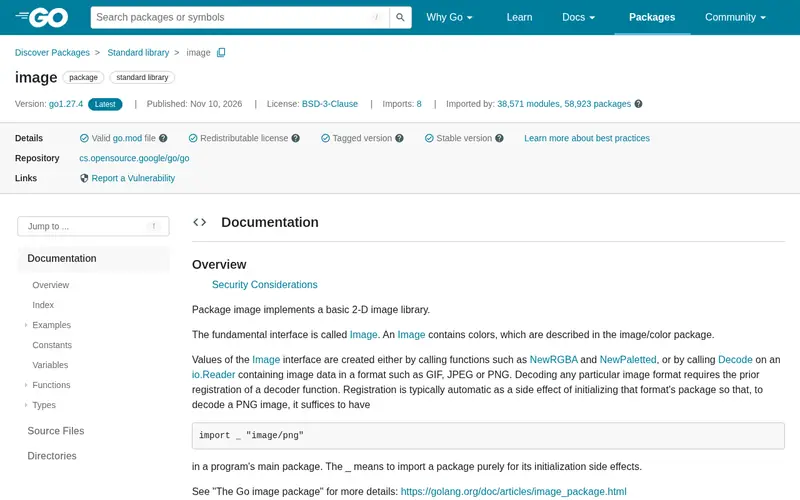
The image package in the Go standard library decodes and encodes JPEG, PNG and GIF, and provides the Image, Paletted and RGBA types plus a draw package for compositing. The golang.org/x/image module adds formats such as BMP, TIFF, WebP and VP8L, plus the draw and math/f64 packages and font rendering. Together they cover most server-side pipelines without external libraries.
Both are maintained by the Go project and carry a BSD-style licence. There is no resize function, so scaling means writing your own nearest-neighbour or bilinear sampler, or pairing this with another library. Skip it if you need one-line thumbnails or advanced filters, and start here if you want the smallest dependency surface and full control.
Standout: Ships with Go and needs no cgo
Free (open source), as listed by the vendor (Go standard image package + golang.org/x/image website). Confirm the current plan price before you buy.
Free plan. Plans change, so confirm on the vendor's pricing page before you buy.
Benefits
- Ships with Go and needs no cgo
- stable API with broad format support through x/image
Drawbacks
- No resize or filter helpers
- you write sampling and convolution code yourself
Skip it if this limit matters to you: no resize or filter helpers.
Verdict. A sensible pick for teams that want decoding and encoding with no third-party dependency.
Alternatives in this guide: h2non/bimg, davidbyttow/govips, gocv
h2non/bimg
Best for fast resize and format conversion through libvips
What it is and where it fits
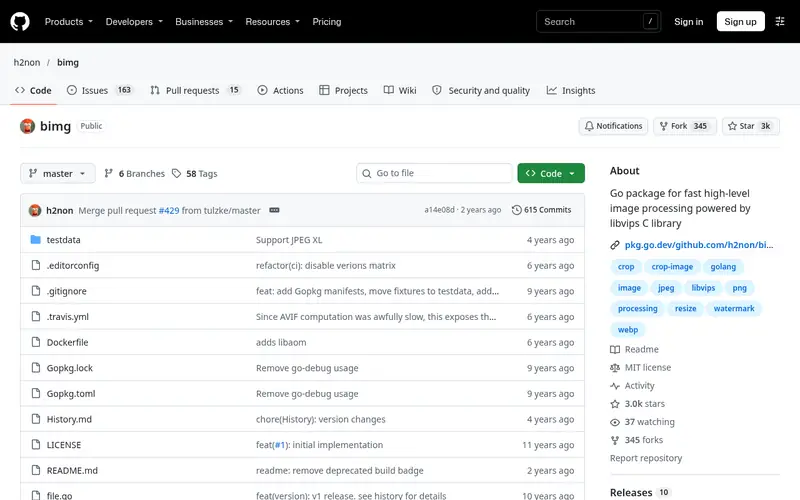
bimg is a Go binding to libvips. It exposes Resize, Crop, Rotate, Thumbnail, Watermark and format conversion, and it can read from and write to files, buffers and io.Reader. Because libvips streams and tiles work, memory use stays low on large inputs compared with loading a full bitmap.
The package is MIT licensed and free. The cost is setup: you must install libvips on the build and run host, enable cgo, and manage the native library in containers and CI. Cross-compiling to other platforms takes extra work. It suits image services that process many large files and can afford a native dependency. Skip it for pure-Go static binaries or environments where you cannot install system libraries.
Standout: libvips is fast and memory-efficient on large images
Free (open source), as listed by the vendor (h2non/bimg website). Confirm the current plan price before you buy.
Free plan. Plans change, so confirm on the vendor's pricing page before you buy.
Benefits
- libvips is fast and memory-efficient on large images
- wide format support including WebP and AVIF via libvips
Drawbacks
- Needs libvips and cgo, which complicates builds
- errors surface from the native layer
Skip it if this limit matters to you: needs libvips and cgo, which complicates builds.
Verdict. A sensible pick for fast resize and format conversion through libvips.
Alternatives in this guide: Go standard image package + golang.org/x/image, davidbyttow/govips, gocv
davidbyttow/govips
Best for services that want a typed libvips API with pipeline control
What it is and where it fits
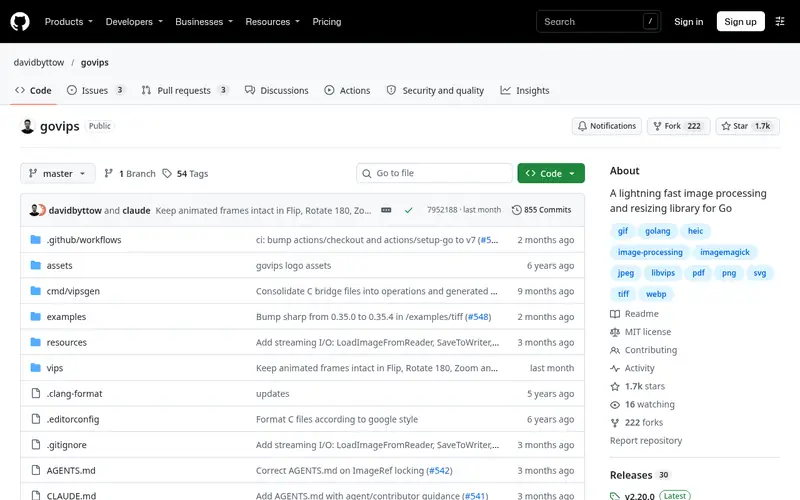
govips is another libvips binding for Go, with a different API shape from bimg. It provides an ImageRef type, a pipeline of operations, and export parameters for format, quality and compression. It also offers a cache and concurrency controls aimed at server workloads.
It is MIT licensed and free to use. Like bimg, it needs libvips installed and cgo enabled, and it inherits libvips behaviour and error messages. The two projects overlap heavily, so pick based on API style and the operations you need rather than raw capability. It fits teams already running libvips who want fine control over encoding. Skip it if a pure-Go build is a hard requirement.
Standout: Typed wrappers over libvips operations
Free (open source), as listed by the vendor (davidbyttow/govips website). Confirm the current plan price before you buy.
Free plan. Plans change, so confirm on the vendor's pricing page before you buy.
Benefits
- Typed wrappers over libvips operations
- supports export and import params for encoding control
Drawbacks
- Same libvips and cgo requirements as bimg
- native crashes can take down the process
Skip it if this limit matters to you: same libvips and cgo requirements as bimg.
Verdict. A sensible pick for services that want a typed libvips API with pipeline control.
Alternatives in this guide: Go standard image package + golang.org/x/image, h2non/bimg, gocv
gocv
Best for computer vision work such as detection, matching and video
What it is and where it fits
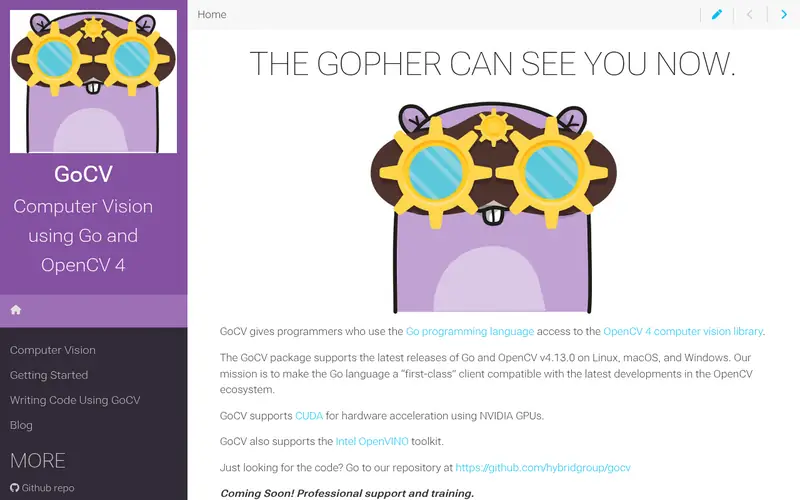
GoCV binds OpenCV for Go. Beyond resizing and colour conversion, it covers edge detection, thresholding, contour finding, template matching, feature detection and video I/O through OpenCV's modules. That makes it the choice when image processing means analysis rather than thumbnails.
It is Apache 2.0 licensed and free. Installation means building or installing OpenCV and enabling cgo, and the resulting binaries are large. Build times and platform setup are the main friction points, and some OpenCV modules may need extra build flags. It suits robotics, inspection and research tooling. Skip it for simple resize and encode jobs where the standard library is enough.
Standout: Broad OpenCV coverage, including filters, contours and video capture
Free (open source), as listed by the vendor (gocv website). Confirm the current plan price before you buy.
Free plan. Plans change, so confirm on the vendor's pricing page before you buy.
Benefits
- Broad OpenCV coverage, including filters, contours and video capture
- active project with regular releases
Drawbacks
- Requires OpenCV and cgo, which is a heavy setup
- large binary and build footprint
Skip it if this limit matters to you: requires OpenCV and cgo, which is a heavy setup.
Verdict. A sensible pick for computer vision work such as detection, matching and video.
Alternatives in this guide: Go standard image package + golang.org/x/image, h2non/bimg, davidbyttow/govips
anthonynsimon/bild
Best for pure-Go filters, effects and transforms without cgo
What it is and where it fits
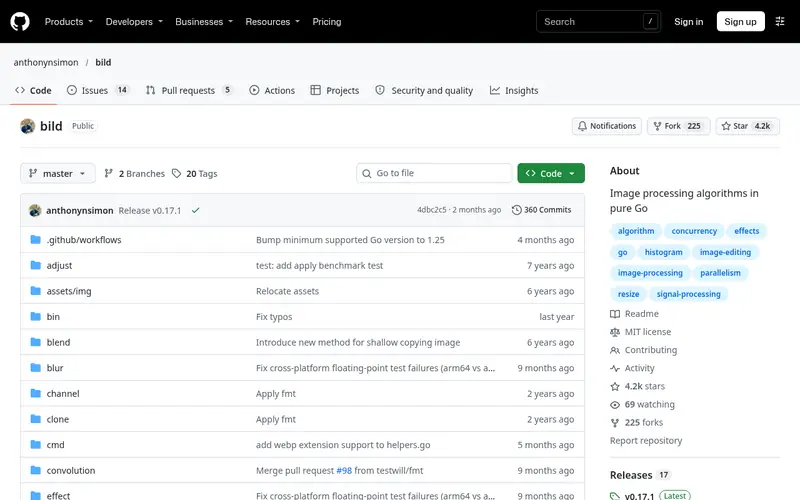
bild is a pure-Go image processing library split into packages for blur, sharpen, edge detection, adjustment, effect, transform and noise. It offers resize, rotate, crop and a set of filters, and it works on the standard image types. It is a reasonable middle ground between the bare standard library and a native binding.
The project is MIT licensed and free. It has no cgo, so cross-compilation and static builds work as usual. Activity is lower than the standard library, so check recent commits and issues before adopting it for long-lived code. Format support depends on the decoders you register, so pair it with golang.org/x/image for WebP and TIFF. It suits developers who want more filters than the standard library provides while staying in pure Go.
Standout: Wide set of effects such as blur, sharpen and edge detection
Free (open source), as listed by the vendor (anthonynsimon/bild website). Confirm the current plan price before you buy.
Free plan. Plans change, so confirm on the vendor's pricing page before you buy.
Benefits
- Wide set of effects such as blur, sharpen and edge detection
- pure Go with no native dependencies
Drawbacks
- Less active than the standard library
- fewer format decoders than x/image
Skip it if this limit matters to you: less active than the standard library.
Verdict. A sensible pick for pure-Go filters, effects and transforms without cgo.
Alternatives in this guide: Go standard image package + golang.org/x/image, h2non/bimg, davidbyttow/govips
Who should use what
If you need thumbnails and format conversion in a small service and want a pure-Go static binary, start with the standard image package plus golang.org/x/image, and add anthonynsimon/bild for filters. If you process large images at volume and can install native libraries, h2non/bimg or davidbyttow/govips on libvips will use less memory. If your work is detection, matching or video, gocv is the fit despite the OpenCV setup. If you cannot enable cgo at all, stay with the pure-Go options.
Questions to settle before you buy
What to check before you buy
- Confirm whether the library needs cgo and a native library such as libvips or OpenCV, and test your container and CI builds.
- Check the licence text and that it fits your distribution model, especially for static binaries.
- Review recent commits and open issues to judge maintenance, particularly for bild.
- List the input formats you must decode and confirm the library or x/image covers them, including WebP, TIFF and AVIF.
- Measure memory on your largest real images, since full-bitmap libraries and streaming libraries behave very differently.
FAQ
Do I need cgo for Go image processing?
No. The standard image package, golang.org/x/image and anthonynsimon/bild are pure Go. cgo is only needed for native bindings such as h2non/bimg, davidbyttow/govips and gocv, which link libvips or OpenCV.
Which library is fastest for resizing large images?
Bindings to libvips, h2non/bimg and davidbyttow/govips, are built for low memory use on large images because libvips streams and tiles work. Pure-Go libraries load full bitmaps. We did not run benchmarks, so test with your own images before deciding.
Can I process images without installing system libraries?
Yes. Use the standard image package with golang.org/x/image, or add anthonynsimon/bild. These build as static binaries with no native dependencies, which simplifies containers and cross-compilation.
Does Go support WebP and AVIF decoding?
golang.org/x/image adds WebP decoding, and libvips-based libraries support WebP and AVIF through the native library. Check the specific decoder you plan to use, since AVIF support in pure Go is limited compared with the libvips path.
How do I choose between the standard library and a third-party library?
Start with the standard image package plus golang.org/x/image if you only need decoding, encoding and compositing. Add a third-party library when you need ready-made resize, filters or effects, and weigh its maintenance activity and dependency weight against the convenience it provides.
Sources we checked
Method: how we score · editorial policy.
Change log. First published 27 Nov 2026.