Stage 01 · Write · Researched comparison
Best Flutter State Management Libraries in 2026
Provider is the first pick for most teams new to Flutter state management. It is small, well documented and wraps the built-in InheritedWidget pattern. Riverpod suits teams that want compile-safe providers without a BuildContext. Bloc fits larger apps that need explicit events, states and testable business logic. All three are free and open source. The right choice depends on team size, test needs and how much structure you want.

By Shihab Mia
Published 27 Nov 2026 · 8 tools compared
We run no ads and no affiliate links at launch. The order of a list follows our published method. See how we score.
Prices are the starting prices vendors list publicly. Plans change, so confirm the current price on the vendor page before you buy.
Key takeaways
- Provider, Riverpod, Bloc, GetX, MobX, flutter_redux and signals.dart are all free and open source on pub.dev.
- Built-in ChangeNotifier and ValueNotifier need no package and cover small apps, but scale poorly without extra structure.
- Riverpod and Bloc favor explicit, testable state; GetX trades structure for less boilerplate, which some teams dislike.
- Check each package's pub.dev page for its latest release, Dart SDK constraint and null-safety status before adding it.
Who each pick is for
- Teams new to Flutter state managementProvider
- Apps that need compile-safe, testable providersRiverpod
- Large apps with explicit events and statesBloc (flutter_bloc)
- Small teams that want minimal boilerplateGetX
- Developers who know MobX from JavaScriptMobX for Dart
- Teams that want a single immutable storeRedux (flutter_redux)
- Fine-grained reactivity with minimal rebuildssignals.dart
- Small apps that need no extra packageBuilt-in ChangeNotifier and ValueNotifier
Comparison
| Tool | Best for | Standout feature | Listed starting price | Free plan or trial |
|---|---|---|---|---|
| 1Provider | Teams new to Flutter state management | Small API built on InheritedWidget | Free (open source) | Free plan |
| 2Riverpod | Apps that need compile-safe, testable providers | Providers work without BuildContext | Free (open source) | Free plan |
| 3Bloc (flutter_bloc) | Large apps with explicit events and states | Clear event-to-state flow | Free (open source) | Free plan |
| 4GetX | Small teams that want minimal boilerplate | Combines state, routing and dependency injection | Free (open source) | Free plan |
| 5MobX for Dart | Developers who know MobX from JavaScript | Observable state with automatic tracking | Free (open source) | Free plan |
| 6Redux (flutter_redux) | Teams that want a single immutable store | Predictable single-store model | Free (open source) | Free plan |
| 7signals.dart | Fine-grained reactivity with minimal rebuilds | Tracks dependencies automatically | Free (open source) | Free plan |
| 8Built-in ChangeNotifier and ValueNotifier | Small apps that need no extra package | Ships with Flutter | Free | Free plan |
How we picked
We compared libraries on fit for common Flutter state problems, supported platforms, licence and price, testability, and the main limits each one documents. Sources are the official pub.dev package pages, project repositories and vendor documentation. We did not run benchmarks or collect user reviews. Prices and free tiers can change, so confirm the current terms on each package page before you commit.
The tools, one by one
Provider
Best for teams new to Flutter state management
What it is and where it fits
Provider exposes a value, usually a ChangeNotifier, to descendant widgets and rebuilds only the listeners that depend on it. It runs on all Flutter targets: Android, iOS, web, macOS, Windows and Linux. The package is maintained under the Flutter community and published on pub.dev. There is no paid tier and no account. Its main limit is scale: as an app grows, you manage many providers by hand and async loading states need your own patterns. Teams that want stronger compile-time safety usually move to Riverpod, which shares the same author. Skip Provider if you already need fine-grained async caching out of the box.
Standout: Small API built on InheritedWidget
Free (open source), as listed by the vendor (Provider website). Confirm the current plan price before you buy.
Free plan. Plans change, so confirm on the vendor's pricing page before you buy.
Benefits
- Small API built on InheritedWidget
- official Flutter documentation references it
Drawbacks
- Manual wiring grows in large apps
- no built-in async state model
Skip it if this limit matters to you: manual wiring grows in large apps.
Verdict. A sensible pick for teams new to Flutter state management.
Alternatives in this guide: Riverpod, Bloc (flutter_bloc), GetX
Riverpod
Best for apps that need compile-safe, testable providers
What it is and where it fits
Riverpod is a rewrite of the Provider idea by the same author. Providers are declared globally and read through a WidgetRef, so state can be tested without pumping widgets. It handles async data, caching and invalidation with AsyncValue and related types. The package runs on all Flutter platforms and on Dart server and CLI code. It is free and open source on pub.dev. Code generation through riverpod_generator is optional but common, and it adds a build_runner step. Skip it if your team wants the smallest possible API surface or avoids code generation entirely.
Standout: Providers work without BuildContext
Free (open source), as listed by the vendor (Riverpod website). Confirm the current plan price before you buy.
Free plan. Plans change, so confirm on the vendor's pricing page before you buy.
Benefits
- Providers work without BuildContext
- strong support for async and caching
Drawbacks
- Steeper learning curve
- code generation adds a build step
Skip it if this limit matters to you: steeper learning curve.
Verdict. A sensible pick for apps that need compile-safe, testable providers.
Alternatives in this guide: Provider, Bloc (flutter_bloc), GetX
Bloc (flutter_bloc)
Best for large apps with explicit events and states
What it is and where it fits
Bloc separates business logic from the UI by mapping events to states through a stream. flutter_bloc wires blocs into the widget tree with BlocProvider and BlocBuilder. The library runs on all Flutter platforms and also works in pure Dart. It is free and open source, maintained by the Felix Angelov project on GitHub and published on pub.dev. The trade-off is verbosity: each feature needs event and state classes, and small screens can feel over-engineered. Teams with several developers and a need for audit-friendly state transitions tend to accept that cost. Skip it for prototypes where a single ChangeNotifier would do.
Standout: Clear event-to-state flow
Free (open source), as listed by the vendor (Bloc (flutter_bloc) website). Confirm the current plan price before you buy.
Free plan. Plans change, so confirm on the vendor's pricing page before you buy.
Benefits
- Clear event-to-state flow
- easy to test with bloc_test
Drawbacks
- More boilerplate per feature
- event classes add files
Skip it if this limit matters to you: more boilerplate per feature.
Verdict. A sensible pick for large apps with explicit events and states.
GetX
Best for small teams that want minimal boilerplate
What it is and where it fits
GetX bundles state management, route management and dependency injection in one package. Reactive state uses observables and Obx widgets, and simple state uses GetBuilder. It runs on all Flutter platforms and is free and open source on pub.dev. The package's wide scope is its main point of debate: some developers like having routing and DI in one place, while others argue it couples layers that should stay separate and makes testing harder. GetX is a reasonable fit for small apps and solo developers. Larger teams often prefer narrower libraries with clearer boundaries.
Standout: Combines state, routing and dependency injection
Free (open source), as listed by the vendor (GetX website). Confirm the current plan price before you buy.
Free plan. Plans change, so confirm on the vendor's pricing page before you buy.
Benefits
- Combines state, routing and dependency injection
- very little boilerplate
Drawbacks
- Broad scope mixes concerns
- opinions on structure vary widely
Skip it if this limit matters to you: broad scope mixes concerns.
Verdict. A sensible pick for small teams that want minimal boilerplate.
Alternatives in this guide: Provider, Riverpod, Bloc (flutter_bloc)
MobX for Dart
Best for developers who know MobX from JavaScript
What it is and where it fits
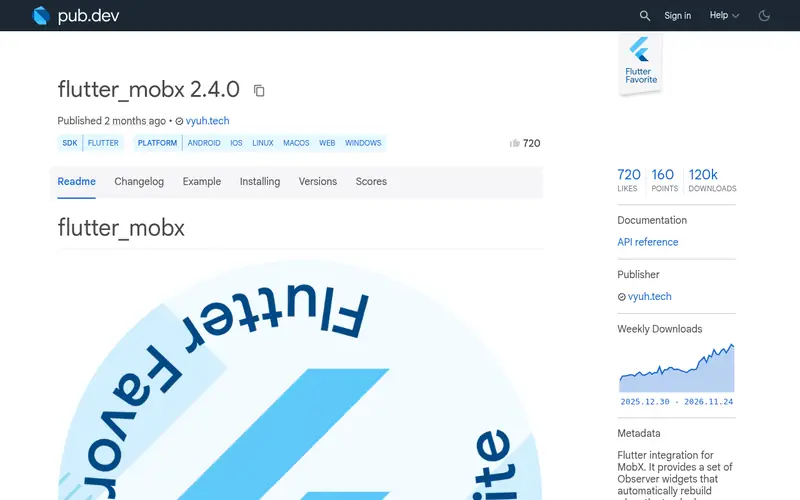
MobX for Dart brings the observable, action and computed model from the JavaScript library to Flutter. You mark state as observable, and Observer widgets rebuild when tracked values change. The flutter_mobx package integrates it with the widget tree. It runs on all Flutter platforms and is free and open source on pub.dev. Code generation through mobx_codegen and build_runner is required for stores, which adds a build step. Developers coming from MobX or React find it familiar. Teams without that background often pick Riverpod or Bloc instead.
Standout: Observable state with automatic tracking
Free (open source), as listed by the vendor (MobX for Dart website). Confirm the current plan price before you buy.
Free plan. Plans change, so confirm on the vendor's pricing page before you buy.
Benefits
- Observable state with automatic tracking
- familiar to React and MobX users
Drawbacks
- Requires code generation
- smaller Flutter community than Provider or Bloc
Skip it if this limit matters to you: requires code generation.
Verdict. A sensible pick for developers who know MobX from JavaScript.
Alternatives in this guide: Provider, Riverpod, Bloc (flutter_bloc)
Redux (flutter_redux)
Best for teams that want a single immutable store
What it is and where it fits
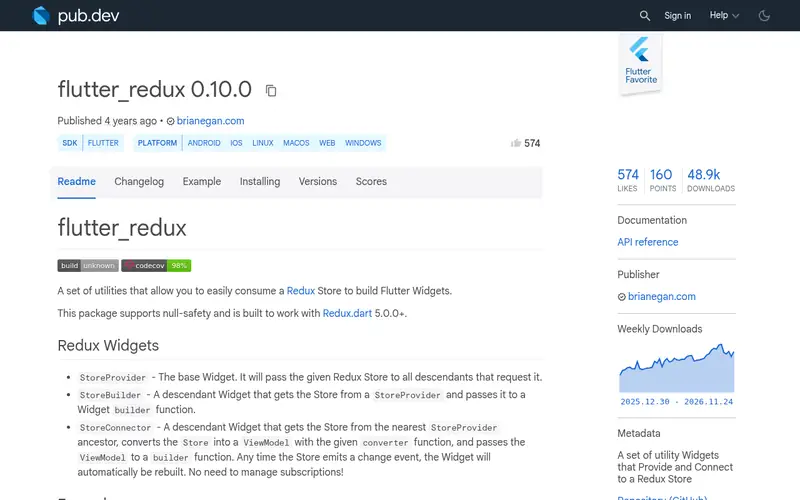
flutter_redux connects a Redux store to Flutter widgets through StoreProvider and StoreConnector. State lives in one immutable store, and reducers produce the next state from actions. The underlying redux.dart package is maintained separately. It runs on all Flutter platforms and is free and open source on pub.dev. The model is predictable but verbose: actions, reducers and middleware add code for every feature. Flutter developers who value strict unidirectional flow sometimes choose it, but most new projects pick Riverpod or Bloc. Skip it if your team has no Redux background.
Standout: Predictable single-store model
Free (open source), as listed by the vendor (Redux (flutter_redux) website). Confirm the current plan price before you buy.
Free plan. Plans change, so confirm on the vendor's pricing page before you buy.
Benefits
- Predictable single-store model
- strong tooling for time-travel debugging in Dart
Drawbacks
- Heavy boilerplate
- small Flutter-specific ecosystem
Skip it if this limit matters to you: heavy boilerplate.
Verdict. A sensible pick for teams that want a single immutable store.
Alternatives in this guide: Provider, Riverpod, Bloc (flutter_bloc)
signals.dart
Best for fine-grained reactivity with minimal rebuilds
What it is and where it fits
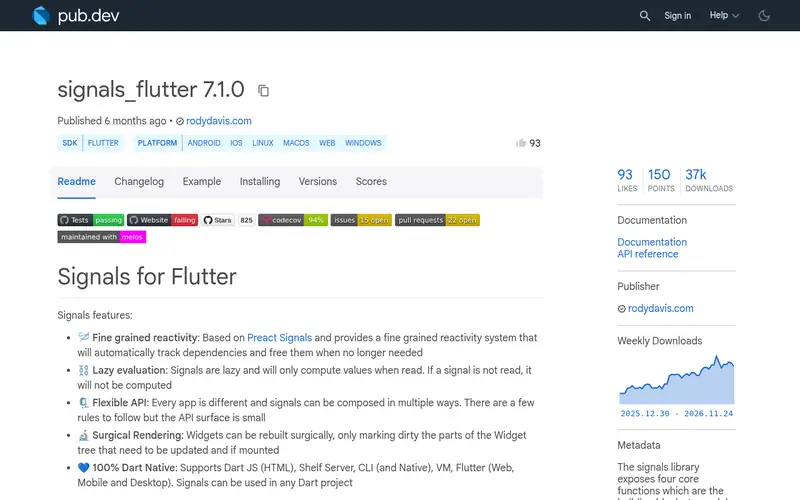
signals.dart brings a signal-based reactive model to Dart, similar to signals in modern JavaScript frameworks. Values are wrapped in signals, computed values derive from them, and widgets rebuild only where a signal is read. The signals_flutter package adds Flutter integration. It runs on all Flutter platforms and is free and open source on pub.dev. The library is newer than Provider or Bloc, so tutorials and community answers are fewer. It suits developers who want automatic dependency tracking without Riverpod's provider model. Check the pub.dev page for the current release and Dart SDK constraint before adopting it.
Standout: Tracks dependencies automatically
Free (open source), as listed by the vendor (signals.dart website). Confirm the current plan price before you buy.
Free plan. Plans change, so confirm on the vendor's pricing page before you buy.
Benefits
- Tracks dependencies automatically
- rebuilds only affected widgets
Drawbacks
- Newer and less documented
- smaller ecosystem than Provider or Bloc
Skip it if this limit matters to you: newer and less documented.
Verdict. A sensible pick for fine-grained reactivity with minimal rebuilds.
Alternatives in this guide: Provider, Riverpod, Bloc (flutter_bloc)
Built-in ChangeNotifier and ValueNotifier
Best for small apps that need no extra package
What it is and where it fits
Flutter includes ChangeNotifier and ValueNotifier in the foundation library, and ValueListenableBuilder rebuilds widgets when a notifier changes. This covers counters, toggles and small forms without adding a package. It runs anywhere Flutter runs. There is no cost and no account. The limit is structure: once several screens share state or async loading is involved, you end up rebuilding patterns that Provider, Riverpod or Bloc already provide. Use the built-in classes for small widgets and prototypes, then move to a package when state crosses widget boundaries. Provider itself is built on ChangeNotifier, so migration is straightforward.
Standout: Ships with Flutter
Free, as listed by the vendor (Built-in ChangeNotifier and ValueNotifier website). Confirm the current plan price before you buy.
Free plan. Plans change, so confirm on the vendor's pricing page before you buy.
Benefits
- Ships with Flutter
- no dependency to maintain
Drawbacks
- No async state model
- manual listener management
Skip it if this limit matters to you: no async state model.
Verdict. A sensible pick for small apps that need no extra package.
Alternatives in this guide: Provider, Riverpod, Bloc (flutter_bloc)
Who should use what
A solo developer building a first app should start with the built-in ChangeNotifier and move to Provider when state is shared across screens. A team of several developers on a long-lived product should look at Riverpod or Bloc, depending on whether they prefer providers or explicit events. A developer with a React or MobX background may prefer MobX for Dart. A small team that wants routing and state in one package can evaluate GetX, while teams that want fine-grained rebuilds can test signals.dart.
Questions to settle before you buy
What to check before you buy
- Confirm the package supports your current Flutter and Dart SDK versions on pub.dev.
- Check the last publish date and open issue count on the repository.
- Decide whether code generation (build_runner) fits your build setup.
- Write one test for a state transition before rolling the library out.
- Verify the licence and whether the package is null-safe and actively maintained.
FAQ
Is Provider still recommended in 2026?
Provider remains maintained and is still referenced in Flutter documentation. It is a sound choice for small and medium apps. Teams that need compile-safe providers and better async handling often move to Riverpod, which shares the same author and concepts.
Do I need a state management library at all?
No. ChangeNotifier, ValueNotifier and setState cover small apps. Add a library when state is shared across many widgets, when async loading needs caching, or when you want testable business logic separate from the UI.
Which library has the least boilerplate?
GetX and signals.dart need the least setup code. Provider is also small. Bloc and Redux require more files per feature but give explicit, testable flows. Less boilerplate often means less structure, so weigh that against team size.
Are these libraries free?
Yes. Provider, Riverpod, Bloc, GetX, MobX for Dart, flutter_redux and signals.dart are free and open source on pub.dev. The built-in notifiers ship with Flutter. None of them require a paid account.
Can I switch libraries later?
Yes, but the cost grows with app size. Keeping business logic out of widgets makes migration easier. Provider and Riverpod share concepts, and Provider is built on ChangeNotifier, so moving between them is usually simpler than moving to or from Bloc.
Sources we checked
Method: how we score · editorial policy.
Change log. First published 27 Nov 2026.