Stage 01 · Write · Researched comparison
Best .NET Dependency Injection Containers in 2026
Microsoft.Extensions.DependencyInjection is the default choice for most .NET projects because it ships with the platform and integrates with ASP.NET Core and the generic host. Autofac suits teams that need modules, decorators and fine-grained lifetime control. Simple Injector fits projects that want strict container validation, and DryIoc fits performance-sensitive or dynamic scenarios. All four are free and open source.

By Shihab Mia
Published 27 Nov 2026 · 7 tools compared
We run no ads and no affiliate links at launch. The order of a list follows our published method. See how we score.
Prices are the starting prices vendors list publicly. Plans change, so confirm the current price on the vendor page before you buy.
Key takeaways
- Microsoft.Extensions.DependencyInjection is free and open source, and it is already the container behind ASP.NET Core, worker services and the generic host.
- Autofac, DryIoc and Simple Injector are free and open source, and each adds features the built-in container does not provide, such as modules, decorators or strict verification.
- Scrutor is a free open-source add-on for Microsoft.Extensions.DependencyInjection, not a separate container, and it adds assembly scanning and decoration.
- Jab is a free open-source compile-time source generator, so it resolves dependencies in generated code instead of at runtime.
Who each pick is for
- Most .NET apps that need a standard, supported containerMicrosoft.Extensions.DependencyInjection
- Teams that need modules, decorators and flexible lifetimesAutofac
- Adding assembly scanning and decorators to the built-in containerScrutor
- Performance-focused apps and dynamic registration scenariosDryIoc
- Projects that want strict verification and clear diagnosticsSimple Injector
- Teams using the JasperFx stack or wanting fast scanningLamar
- Compile-time resolution with no runtime containerJab
Comparison
| Tool | Best for | Standout feature | Listed starting price | Free plan or trial |
|---|---|---|---|---|
| 1Microsoft.Extensions.DependencyInjection | Most .NET apps that need a standard, supported container | Ships with the platform and integrates with the generic host | Free (open source) | Free plan |
| 2Autofac | Teams that need modules, decorators and flexible lifetimes | Mature feature set with modules, decorators and child lifetime scopes | Free (open source) | Free plan |
| 3Scrutor | Adding assembly scanning and decorators to the built-in container | Small add-on that keeps the built-in container | Free (open source) | Free plan |
| 4DryIoc | Performance-focused apps and dynamic registration scenarios | Fast resolution and support for open generics, rules and conditional registrations | Free (open source) | Free plan |
| 5Simple Injector | Projects that want strict verification and clear diagnostics | Verifies the container at startup and reports configuration errors early | Free (open source) | Free plan |
| 6Lamar | Teams using the JasperFx stack or wanting fast scanning | Fast container with strong assembly scanning and code generation | Free (open source) | Free plan |
| 7Jab | Compile-time resolution with no runtime container | Generates resolution code at compile time | Free (open source) | Free plan |
How we picked
We compared containers on fit for common .NET jobs, supported platforms and target frameworks, licence and price, integration with Microsoft.Extensions.DependencyInjection, and the main limits each one documents. Sources are vendor sites, official documentation and project repositories. Prices and licence terms can change, so confirm details on the vendor or repository page before you commit.
The tools, one by one
Microsoft.Extensions.DependencyInjection
Best for most .NET apps that need a standard, supported container
What it is and where it fits
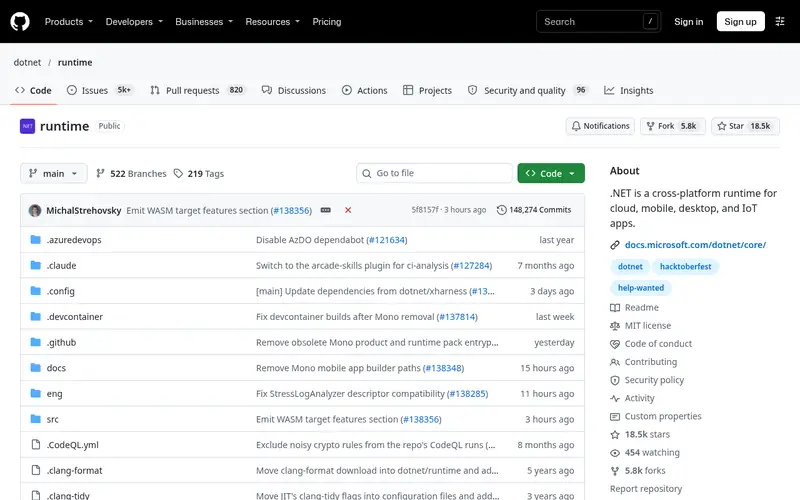
This is the container that ASP.NET Core, the generic host and many libraries use by default. You register services in `IServiceCollection` and the framework builds an `IServiceProvider`. It supports singleton, scoped and transient lifetimes and constructor injection. Because it is part of .NET, there is no extra package to maintain for the core features.
The container is intentionally small. It does not scan assemblies for registrations, apply decorators or verify the full object graph at startup. That keeps behavior predictable and startup fast, but larger codebases often add a package on top. The built-in container also does not support child containers or per-request container scopes beyond the scoped lifetime.
Use it when you want the default path and no extra dependency. If you need modules, decorators or strict validation, look at Autofac, Scrutor or Simple Injector instead. It runs anywhere .NET runs, including Linux, macOS and Windows.
Standout: Ships with the platform and integrates with the generic host
Free (open source), as listed by the vendor (Microsoft.Extensions.DependencyInjection website). Confirm the current plan price before you buy.
Free plan. Plans change, so confirm on the vendor's pricing page before you buy.
Benefits
- Ships with the platform and integrates with the generic host
- works the same across ASP.NET Core, worker services and console apps
Drawbacks
- No built-in assembly scanning or decorator support
- limited lifetime verification
Skip it if this limit matters to you: no built-in assembly scanning or decorator support.
Verdict. A sensible pick for most .NET apps that need a standard, supported container.
Autofac
Best for teams that need modules, decorators and flexible lifetimes
What it is and where it fits
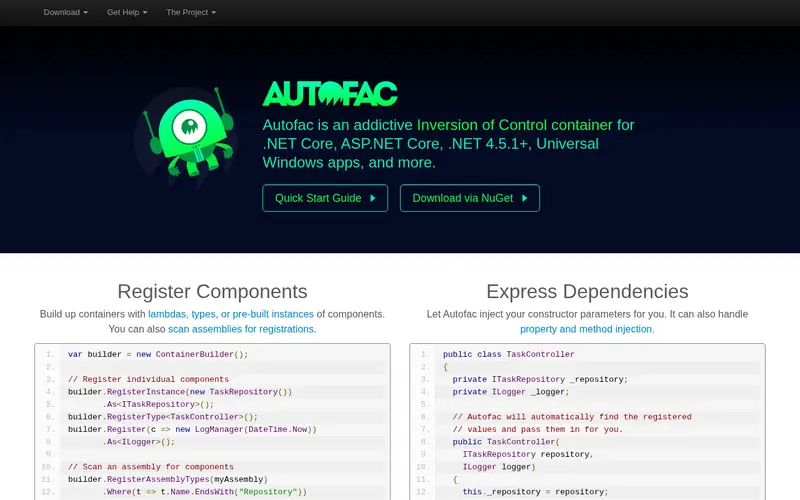
Autofac is a long-standing IoC container for .NET. It supports constructor, property and method injection, named and keyed services, modules that group registrations, decorators, and nested lifetime scopes. Registration is done in C# or through configuration. It plugs into ASP.NET Core and the generic host through an adapter package.
The container is free and open source under the MIT license. It targets modern .NET and .NET Framework. The main cost is learning its registration model: modules, scopes and `IComponentContext` are more than the built-in container exposes. Misconfigured lifetimes can also fail at resolve time rather than at startup.
Choose Autofac when your project has grown past simple constructor injection and you want explicit modules or decorator support. Small apps that only need basic registrations can stay on the built-in container.
Standout: Mature feature set with modules, decorators and child lifetime scopes
Free (open source), as listed by the vendor (Autofac website). Confirm the current plan price before you buy.
Free plan. Plans change, so confirm on the vendor's pricing page before you buy.
Benefits
- Mature feature set with modules, decorators and child lifetime scopes
- integrates with ASP.NET Core and the generic host
Drawbacks
- More concepts to learn than the built-in container
- configuration errors often surface at runtime
Skip it if this limit matters to you: more concepts to learn than the built-in container.
Verdict. A sensible pick for teams that need modules, decorators and flexible lifetimes.
Alternatives in this guide: Microsoft.Extensions.DependencyInjection, Scrutor, DryIoc
Scrutor
Best for adding assembly scanning and decorators to the built-in container
What it is and where it fits
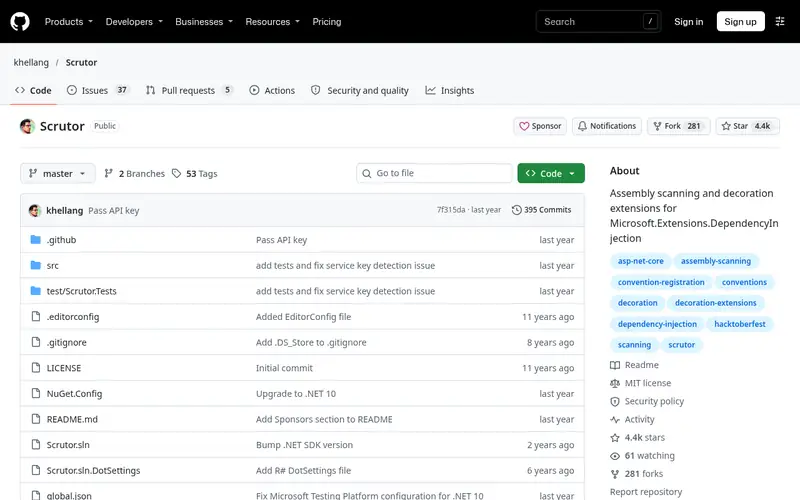
Scrutor is an extension library for `IServiceCollection`. It adds assembly scanning so you can register all types that implement an interface in one call, and it adds service decoration so you can wrap an existing registration. It does not replace the built-in container; it extends it.
The project is free and open source. It targets .NET and works anywhere `Microsoft.Extensions.DependencyInjection` runs. Because it builds on the standard abstractions, existing registrations and framework integrations keep working. The main limit is scope: it does not add child containers, modules or graph verification.
Use Scrutor when you want scanning and decorators without adopting a second container. If you need a full container with modules and lifetime scopes, Autofac or DryIoc are the better fit.
Standout: Small add-on that keeps the built-in container
Free (open source), as listed by the vendor (Scrutor website). Confirm the current plan price before you buy.
Free plan. Plans change, so confirm on the vendor's pricing page before you buy.
Benefits
- Small add-on that keeps the built-in container
- adds assembly scanning and decoration with a fluent API
Drawbacks
- Not a standalone container
- depends on Microsoft.Extensions.DependencyInjection
Skip it if this limit matters to you: not a standalone container.
Verdict. A sensible pick for adding assembly scanning and decorators to the built-in container.
Alternatives in this guide: Microsoft.Extensions.DependencyInjection, Autofac, DryIoc
DryIoc
Best for performance-focused apps and dynamic registration scenarios
What it is and where it fits
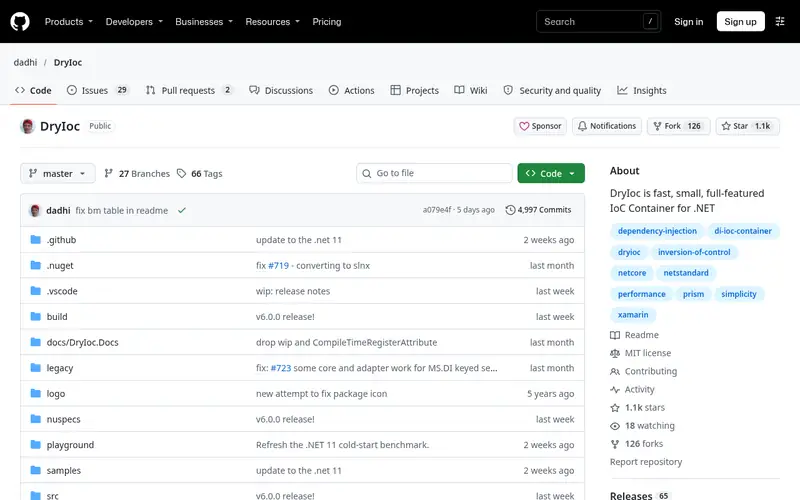
DryIoc is a container designed for speed and flexibility. It supports open generic registrations, conditional registrations, rules that change resolution behavior, and child containers. It can run as the backing container for `Microsoft.Extensions.DependencyInjection` through an adapter, so ASP.NET Core and other libraries keep working.
The project is free and open source under the MIT license. It targets modern .NET and .NET Framework. The feature set is broad, which means more options to configure and more ways to get lifetimes wrong. Documentation is thorough but assumes you know DI concepts.
Pick DryIoc when resolution performance or dynamic registration matters, such as plugin systems or large graphs. For a typical web API, the built-in container plus Scrutor is usually enough.
Standout: Fast resolution and support for open generics, rules and conditional registrations
Free (open source), as listed by the vendor (DryIoc website). Confirm the current plan price before you buy.
Free plan. Plans change, so confirm on the vendor's pricing page before you buy.
Benefits
- Fast resolution and support for open generics, rules and conditional registrations
- works with the Microsoft DI abstractions
Drawbacks
- Large configuration surface
- advanced features take time to learn
Skip it if this limit matters to you: large configuration surface.
Verdict. A sensible pick for performance-focused apps and dynamic registration scenarios.
Alternatives in this guide: Microsoft.Extensions.DependencyInjection, Autofac, Scrutor
Simple Injector
Best for projects that want strict verification and clear diagnostics
What it is and where it fits
Simple Injector is a container built around verification. It checks the object graph when the container is built and reports missing registrations, captive dependencies and lifestyle mismatches. It supports constructor injection, decorators, collections and conditional registrations.
The project is free and open source. It targets modern .NET and .NET Framework. It integrates with ASP.NET Core through an adapter, but its design favors explicit registration over convention-based scanning. Some patterns, such as resolving services directly from the container, are discouraged by design.
Choose Simple Injector when you want errors at startup rather than in production. Teams that rely heavily on assembly scanning or per-request resolution of many small services may find its rules restrictive.
Standout: Verifies the container at startup and reports configuration errors early
Free (open source), as listed by the vendor (Simple Injector website). Confirm the current plan price before you buy.
Free plan. Plans change, so confirm on the vendor's pricing page before you buy.
Benefits
- Verifies the container at startup and reports configuration errors early
- strong diagnostics and lifestyle checks
Drawbacks
- Stricter rules can reject patterns other containers allow
- less direct fit for some framework integration paths
Skip it if this limit matters to you: stricter rules can reject patterns other containers allow.
Verdict. A sensible pick for projects that want strict verification and clear diagnostics.
Alternatives in this guide: Microsoft.Extensions.DependencyInjection, Autofac, Scrutor
Lamar
Best for teams using the JasperFx stack or wanting fast scanning
What it is and where it fits
Lamar is a container from the JasperFx team, the group behind Marten and Wolverine. It focuses on fast startup and resolution through generated code, and it offers assembly scanning, decorators and lifetime validation. It can act as the container behind ASP.NET Core.
The project is free and open source. It targets modern .NET. Its scanning model is close to StructureMap's, which makes migration familiar for teams coming from that container. The main limit is ecosystem size: fewer third-party integrations and examples than Autofac.
Use Lamar if you already use JasperFx libraries or want aggressive scanning with generated resolution code. Otherwise the built-in container with Scrutor covers most needs.
Standout: Fast container with strong assembly scanning and code generation
Free (open source), as listed by the vendor (Lamar website). Confirm the current plan price before you buy.
Free plan. Plans change, so confirm on the vendor's pricing page before you buy.
Benefits
- Fast container with strong assembly scanning and code generation
- integrates with ASP.NET Core
Drawbacks
- Smaller community than Autofac
- some features assume the JasperFx ecosystem
Skip it if this limit matters to you: smaller community than Autofac.
Verdict. A sensible pick for teams using the JasperFx stack or wanting fast scanning.
Alternatives in this guide: Microsoft.Extensions.DependencyInjection, Autofac, Scrutor
Jab
Best for compile-time resolution with no runtime container
What it is and where it fits
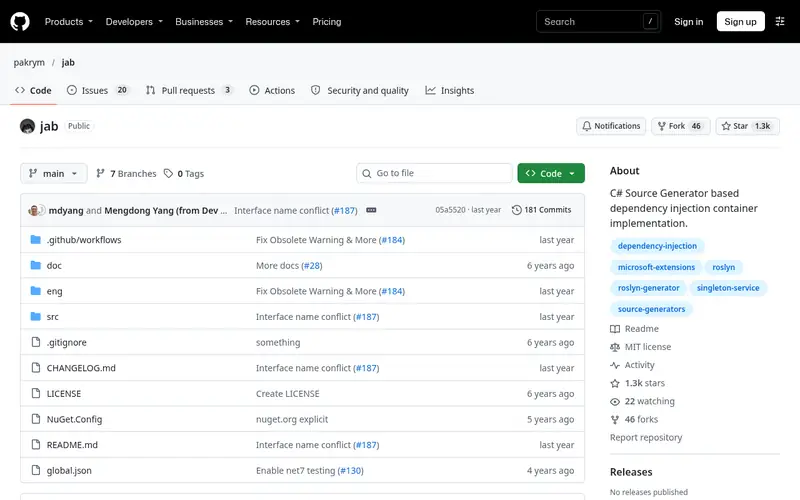
Jab is a source generator that produces dependency injection code at compile time. You annotate services, and the generator writes the resolution logic into your assembly. There is no runtime container to configure or start, which removes reflection from the resolve path.
The project is free and open source. It targets modern .NET and works with the standard DI abstractions where supported. The trade-off is flexibility: dynamic registration, runtime rules and some advanced lifetime scenarios are not available. It also has a smaller user base than the mainstream containers.
Consider Jab for small services, AOT-friendly builds or startup-sensitive apps where compile-time wiring is acceptable. For large applications with complex registration rules, a runtime container is the safer choice.
Standout: Generates resolution code at compile time
Free (open source), as listed by the vendor (Jab website). Confirm the current plan price before you buy.
Free plan. Plans change, so confirm on the vendor's pricing page before you buy.
Benefits
- Generates resolution code at compile time
- no runtime reflection or container startup cost
Drawbacks
- Smaller project with a narrower feature set
- not a drop-in replacement for runtime containers
Skip it if this limit matters to you: smaller project with a narrower feature set.
Verdict. A sensible pick for compile-time resolution with no runtime container.
Alternatives in this guide: Microsoft.Extensions.DependencyInjection, Autofac, Scrutor
Who should use what
A team building a standard ASP.NET Core API should start with Microsoft.Extensions.DependencyInjection and add Scrutor if scanning or decorators are needed. A large application with modules and cross-cutting decorators fits Autofac. A codebase that wants startup-time verification and strict lifestyle rules fits Simple Injector. A performance-sensitive or plugin-heavy system fits DryIoc, while a startup-sensitive or AOT-focused service can try Jab.
Questions to settle before you buy
What to check before you buy
- Confirm the container targets the .NET versions you deploy, including any AOT or trimming requirements.
- Check how it integrates with Microsoft.Extensions.DependencyInjection and the generic host.
- Verify lifetime support: singleton, scoped, transient and any child scope behavior you rely on.
- Review how configuration errors are reported, at startup or at resolve time.
- Read the licence and confirm it matches your organization's policy.
FAQ
Is the built-in .NET container enough?
For many applications, yes. Microsoft.Extensions.DependencyInjection covers constructor injection and the three standard lifetimes. Add a container or add-on when you need assembly scanning, decorators, modules or startup verification.
Is Autofac free?
Yes. Autofac is open source under the MIT license. There is no paid tier for the container itself.
Can I use Scrutor without replacing the built-in container?
Yes. Scrutor extends `IServiceCollection`, so it runs on top of Microsoft.Extensions.DependencyInjection. It adds scanning and decoration but does not add child containers or modules.
Which container is fastest?
We do not publish benchmarks. Resolution speed depends on registration patterns, graph depth and runtime. DryIoc and Lamar both emphasize performance, but measure with your own registrations before deciding.
Does Jab replace a runtime container?
Jab generates resolution code at compile time, so there is no runtime container to start. It suits smaller or AOT-friendly projects. Complex dynamic registration still needs a runtime container.
Sources we checked
Method: how we score · editorial policy.
Change log. First published 27 Nov 2026.