Stage 01 · Write · Researched comparison
Best C++ XML Libraries in 2026
pugixml is the first pick for most C++ projects that need DOM-style XML parsing with a small footprint and a permissive licence. tinyxml2 suits teams that want a compact, readable codebase to vendor into a project. Xerces-C++ is the better fit when you need strict standards conformance, schema validation and broad character encoding support.

By Shihab Mia
Published 28 Nov 2026 · 6 tools compared
We run no ads and no affiliate links at launch. The order of a list follows our published method. See how we score.
Prices are the starting prices vendors list publicly. Plans change, so confirm the current price on the vendor page before you buy.
Key takeaways
- pugixml, tinyxml2, RapidXML and Expat are free and open source; libxml2 and Xerces-C++ are also free open source projects.
- pugixml and tinyxml2 are small enough to vendor as source files, which keeps XML handling inside your own build.
- Xerces-C++ and libxml2 carry the widest feature sets, including validation, at the cost of larger binaries and more setup.
- RapidXML is header-only and fast but is no longer actively developed, so treat it as a legacy choice.
Who each pick is for
- C++ projects wanting a small, fast DOM parserpugixml
- Developers who want a small, readable parser to vendortinyxml2
- Projects needing a full-featured C XML toolkitlibxml2
- Applications needing strict XML standards conformanceXerces-C++
- Legacy code that needs a header-only in-situ parserRapidXML
- Streaming XML parsing in C or C++ applicationsExpat
Comparison
| Tool | Best for | Standout feature | Listed starting price | Free plan or trial |
|---|---|---|---|---|
| 1pugixml | C++ projects wanting a small, fast DOM parser | Small codebase with a simple DOM API | Free (open source) | Free plan |
| 2tinyxml2 | Developers who want a small, readable parser to vendor | Single small source file and header | Free (open source) | Free plan |
| 3libxml2 | Projects needing a full-featured C XML toolkit | Broad feature set including validation and XPath | Free (open source) | Free plan |
| 4Xerces-C++ | Applications needing strict XML standards conformance | Supports DTD and XSD validation plus SAX and DOM | Free (open source) | Free plan |
| 5RapidXML | Legacy code that needs a header-only in-situ parser | Header-only with no build step | Free (open source) | Free plan |
| 6Expat | Streaming XML parsing in C or C++ applications | Small, fast event-based parser | Free (open source) | Free plan |
How we picked
We compared libraries on fit for common C and C++ XML tasks, supported platforms, licence terms, feature coverage such as validation and XPath, and known limits like maintenance status and memory model. Sources are the official project pages, repositories and documentation. Prices and project status can change, so confirm details on the vendor or project site before you commit.
The tools, one by one
pugixml
Best for c++ projects wanting a small, fast DOM parser
What it is and where it fits
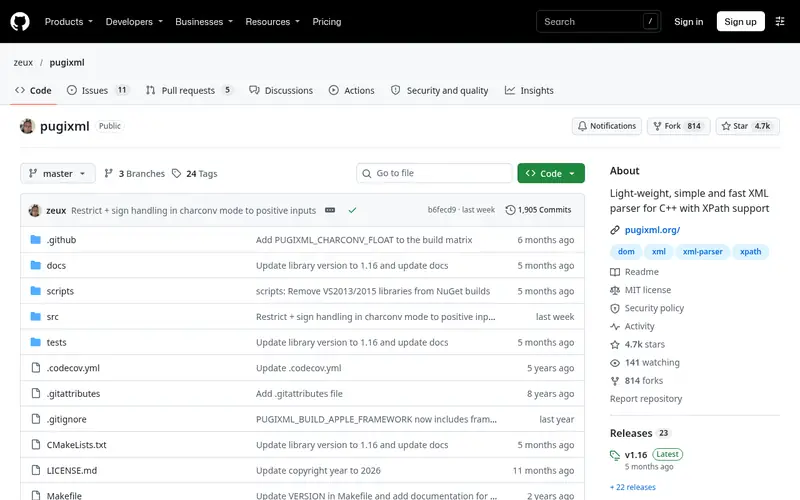
pugixml is a lightweight C++ XML parser that builds a DOM tree in memory. It supports XPath 1.0 queries, which covers most selection needs without pulling in a larger dependency. The library is distributed as a few source files plus a header, so it drops into an existing build with little configuration. It compiles on Windows, Linux and macOS with common compilers.
The licence is MIT, which allows commercial and closed-source use. The main limit is scope: pugixml does not do DTD or XSD validation, and it loads the whole document into memory, so very large files need a streaming approach instead. Teams that need validation should look at Xerces-C++ or libxml2. Teams that want a compact DOM parser and nothing more will find pugixml a good default.
Standout: Small codebase with a simple DOM API
Free (open source), as listed by the vendor (pugixml website). Confirm the current plan price before you buy.
Free plan. Plans change, so confirm on the vendor's pricing page before you buy.
Benefits
- Small codebase with a simple DOM API
- MIT licence and easy to vendor
Drawbacks
- No schema validation
- not a streaming parser
Skip it if this limit matters to you: no schema validation.
Verdict. A sensible pick for C++ projects wanting a small, fast DOM parser.
Alternatives in this guide: tinyxml2, libxml2, Xerces-C++
tinyxml2
Best for developers who want a small, readable parser to vendor
What it is and where it fits
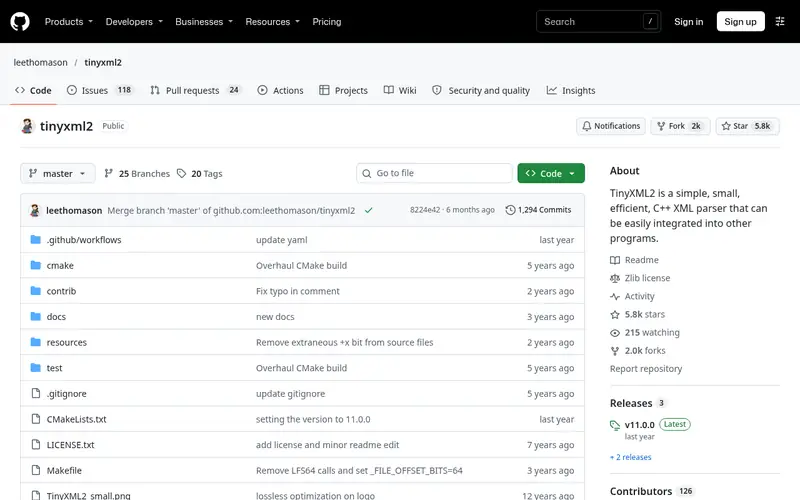
tinyxml2 is a rewrite of the original TinyXML, aimed at a smaller and cleaner codebase. It provides a DOM API for reading and writing XML, and the whole library is a single .cpp file and a header. That makes it easy to read, audit and embed directly in a project without a package manager.
It uses the zlib licence. It does not support XPath, XSD or DTD validation, and it parses whole documents into memory. For configuration files, small data exchanges and tools that need to read or write simple XML, it is a practical choice. Projects that need query languages or validation should choose pugixml, libxml2 or Xerces-C++ instead.
Standout: Single small source file and header
Free (open source), as listed by the vendor (tinyxml2 website). Confirm the current plan price before you buy.
Free plan. Plans change, so confirm on the vendor's pricing page before you buy.
Benefits
- Single small source file and header
- straightforward API
Drawbacks
- No XPath or schema validation
- limited to DOM-style parsing
Skip it if this limit matters to you: no XPath or schema validation.
Verdict. A sensible pick for developers who want a small, readable parser to vendor.
Alternatives in this guide: pugixml, libxml2, Xerces-C++
libxml2
Best for projects needing a full-featured C XML toolkit
What it is and where it fits
libxml2 is a mature C library for parsing, validating and manipulating XML. It supports DTD and XSD validation, XPath, XPointer, HTML parsing and a SAX streaming interface. It is used by many language runtimes and desktop projects, and it is available on Linux, Windows and macOS, usually through system packages or a package manager.
The licence is MIT. The trade-off is complexity: the C API takes more code to set up than pugixml or tinyxml2, and the library is a larger dependency. Maintenance arrangements for the project have been discussed publicly in 2025, so teams with long support horizons should check the current project status before adopting it. It remains a strong choice when you need validation or streaming.
Standout: Broad feature set including validation and XPath
Free (open source), as listed by the vendor (libxml2 website). Confirm the current plan price before you buy.
Free plan. Plans change, so confirm on the vendor's pricing page before you buy.
Benefits
- Broad feature set including validation and XPath
- widely used and well documented
Drawbacks
- C API with more setup
- larger dependency than header-only options
Skip it if this limit matters to you: C API with more setup.
Verdict. A sensible pick for projects needing a full-featured C XML toolkit.
Alternatives in this guide: pugixml, tinyxml2, Xerces-C++
Xerces-C++
Best for applications needing strict XML standards conformance
What it is and where it fits
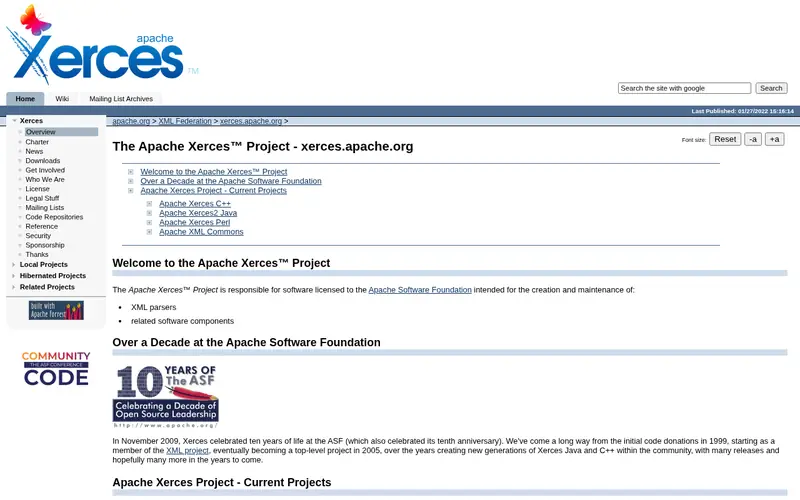
Xerces-C++ is the Apache project's validating XML parser for C++. It offers both SAX and DOM APIs, supports DTD and XML Schema validation, and handles a wide range of character encodings. It is a common choice in enterprise and server-side software where documents must conform to a schema.
It is released under the Apache License 2.0. The cost is size and complexity: the library is large, the API is more involved than pugixml or tinyxml2, and building it takes more steps. It is also slower to start for small tasks. Teams that only need to read simple configuration files will be better served by a smaller library. Teams that must validate against schemas should shortlist Xerces-C++.
Standout: Supports DTD and XSD validation plus SAX and DOM
Free (open source), as listed by the vendor (Xerces-C++ website). Confirm the current plan price before you buy.
Free plan. Plans change, so confirm on the vendor's pricing page before you buy.
Benefits
- Supports DTD and XSD validation plus SAX and DOM
- broad encoding support
Drawbacks
- Large library with a steeper learning curve
- heavier build setup
Skip it if this limit matters to you: large library with a steeper learning curve.
Verdict. A sensible pick for applications needing strict XML standards conformance.
RapidXML
Best for legacy code that needs a header-only in-situ parser
What it is and where it fits
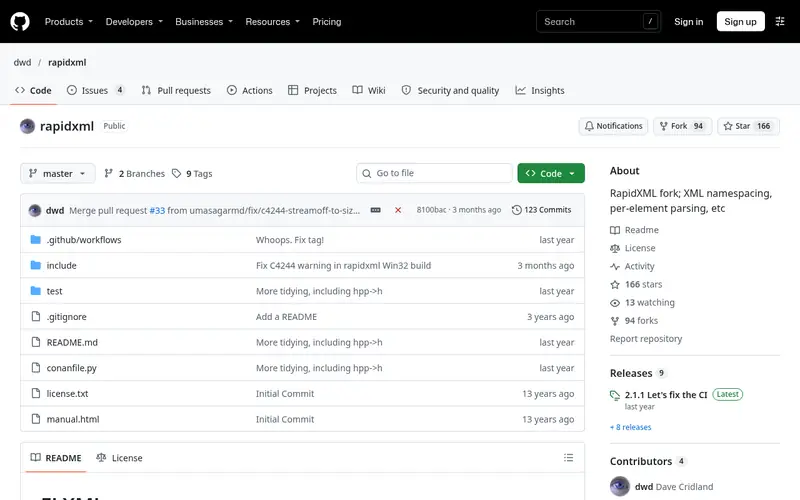
RapidXML is a header-only C++ XML parser that works in situ, modifying the input buffer to build its DOM. That design keeps allocation low and makes it fast for its size. It has no build step: include the headers and compile. The licence is MIT or Boost, depending on the version.
The main concern is maintenance. The project has not seen active development for years, and it does not support validation. It also requires care because it mutates the input buffer. For new projects, pugixml offers a similar lightweight profile with active maintenance. RapidXML is best treated as a legacy dependency rather than a new pick.
Standout: Header-only with no build step
Free (open source), as listed by the vendor (RapidXML website). Confirm the current plan price before you buy.
Free plan. Plans change, so confirm on the vendor's pricing page before you buy.
Benefits
- Header-only with no build step
- parses in place for speed
Drawbacks
- No longer actively developed
- no validation support
Skip it if this limit matters to you: no longer actively developed.
Verdict. A sensible pick for legacy code that needs a header-only in-situ parser.
Expat
Best for streaming XML parsing in C or C++ applications
What it is and where it fits
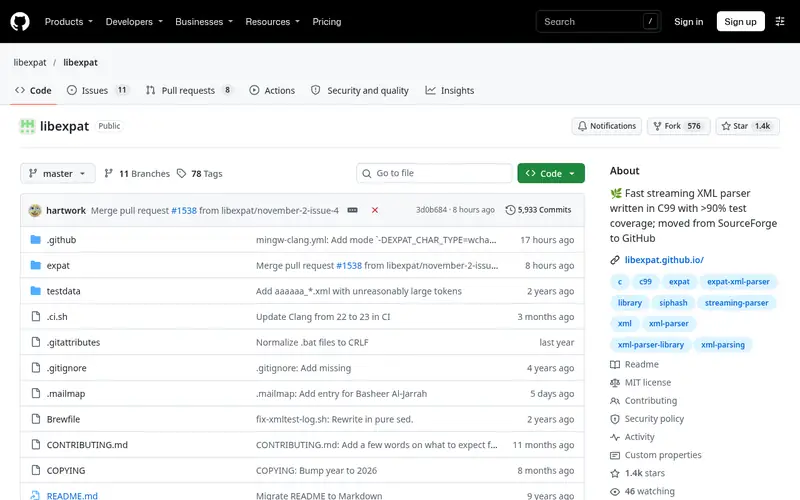
Expat is a stream-oriented C parser for XML. It reports events such as start tags, end tags and character data through callbacks, so it does not build a tree in memory. That makes it suitable for large documents and for code that only needs to scan XML as it arrives. It is used in many browsers, servers and embedded systems.
The licence is MIT. Because it is event-based, it has no DOM and no XPath, and it does not validate. Developers who want to navigate a document tree will need to build their own structures or choose a DOM parser. Expat is available on Linux, Windows and macOS, usually through system packages. It is a solid pick for streaming and for C codebases.
Standout: Small, fast event-based parser
Free (open source), as listed by the vendor (Expat website). Confirm the current plan price before you buy.
Free plan. Plans change, so confirm on the vendor's pricing page before you buy.
Benefits
- Small, fast event-based parser
- very widely deployed
Drawbacks
- SAX-style API only, no DOM
- no validation
Skip it if this limit matters to you: SAX-style API only, no DOM.
Verdict. A sensible pick for streaming XML parsing in C or C++ applications.
Who should use what
If you need a small DOM parser with XPath and an easy build, start with pugixml. If you want the smallest readable codebase to vendor, tinyxml2 is a good fit. If your documents must validate against DTD or XSD, choose Xerces-C++ or libxml2. If you are parsing very large files or streaming data, Expat avoids holding the whole document in memory. RapidXML only makes sense for existing code that already depends on it.
Questions to settle before you buy
What to check before you buy
- Confirm the licence matches your distribution model, especially for closed-source products.
- Check whether you need validation, XPath or streaming before choosing a DOM parser.
- Measure binary size and build time impact against your target platforms.
- Verify the project's current maintenance status and release cadence.
- Test with your real documents, including encoding edge cases and malformed input.
FAQ
Is pugixml or tinyxml2 better for small projects?
Both are small and free. pugixml adds XPath and tends to be faster for queries. tinyxml2 is a single source file and header, which some teams prefer for vendoring. For simple read and write tasks either works; pick pugixml if you need XPath.
Do these libraries validate XML against a schema?
Xerces-C++ and libxml2 support DTD and XSD validation. pugixml, tinyxml2, RapidXML and Expat do not validate. If schema conformance matters, choose one of the validating libraries.
Which library is best for very large XML files?
Expat is stream-oriented and does not build a tree, so it handles large files with low memory use. libxml2 and Xerces-C++ also offer SAX interfaces. DOM parsers like pugixml and tinyxml2 load the whole document into memory.
Are these libraries free for commercial use?
All six are open source and free to use. pugixml, tinyxml2, libxml2, Expat and RapidXML use permissive licences such as MIT or zlib. Xerces-C++ uses the Apache License 2.0. Check the exact licence text for your distribution.
Can I use these libraries in C code?
libxml2 and Expat have C APIs and are the usual choices for C projects. pugixml, tinyxml2, RapidXML and Xerces-C++ are C++ libraries, though some can be wrapped from C with care.
Sources we checked
Method: how we score · editorial policy.
Change log. First published 28 Nov 2026.