Stage 03 · Host · Researched comparison
Best Ruby Background Job Libraries in 2026
Sidekiq is the first pick for most teams that need high-throughput background jobs and can run Redis. GoodJob suits Rails apps that already use PostgreSQL and want Active Job without extra infrastructure. Solid Queue is the default choice for new Rails 8 projects that want a database-backed queue with no Redis. All three are open source, though Sidekiq Pro and Enterprise are paid.

By Shihab Mia
Published 27 Nov 2026 · 6 tools compared
We run no ads and no affiliate links at launch. The order of a list follows our published method. See how we score.
Prices are the starting prices vendors list publicly. Plans change, so confirm the current price on the vendor page before you buy.
Key takeaways
- Sidekiq is the most widely used Ruby job framework and requires Redis; the open-source version is free and commercial tiers add features.
- GoodJob and Solid Queue both store jobs in a relational database, so you avoid running Redis as a separate service.
- Delayed Job still works but is older and sees less active development than the newer database-backed options.
- Every library here is open source except Sidekiq's paid tiers, so check the licence and pricing page before committing.
Who each pick is for
- High-throughput jobs where Redis is already availableSidekiq
- Rails apps on PostgreSQL that want Active JobGoodJob
- New Rails 8 apps wanting a default database queueSolid Queue
- Legacy Rails apps already using itDelayed Job
- Redis-backed queues with a simple worker modelResque
- PostgreSQL users wanting a lightweight job queueQue
Comparison
| Tool | Best for | Standout feature | Listed starting price | Free plan or trial |
|---|---|---|---|---|
| 1Sidekiq | High-throughput jobs where Redis is already available | Very high throughput | Free (open source) | Free plan |
| 2GoodJob | Rails apps on PostgreSQL that want Active Job | Uses PostgreSQL, so no Redis needed | Free (open source) | Free plan |
| 3Solid Queue | New Rails 8 apps wanting a default database queue | Ships as the Rails 8 default | Free (open source) | Free plan |
| 4Delayed Job | Legacy Rails apps already using it | Simple database-backed design | Free (open source) | Free plan |
| 5Resque | Redis-backed queues with a simple worker model | Simple Redis-backed design | Free (open source) | Free plan |
| 6Que | PostgreSQL users wanting a lightweight job queue | Lightweight PostgreSQL-backed design | Free (open source) | Free plan |
How we picked
We picked libraries that are actively maintained and genuinely run background jobs in Ruby. Criteria included fit for common Rails and plain Ruby setups, which backend each needs (Redis or a relational database), licence and pricing, and the main operational limits. We did not run benchmarks or test the libraries ourselves. Details come from vendor pages, official documentation and project repositories. Prices and features change, so confirm on the vendor site before you commit.
The tools, one by one
Sidekiq
Best for high-throughput jobs where Redis is already available
What it is and where it fits
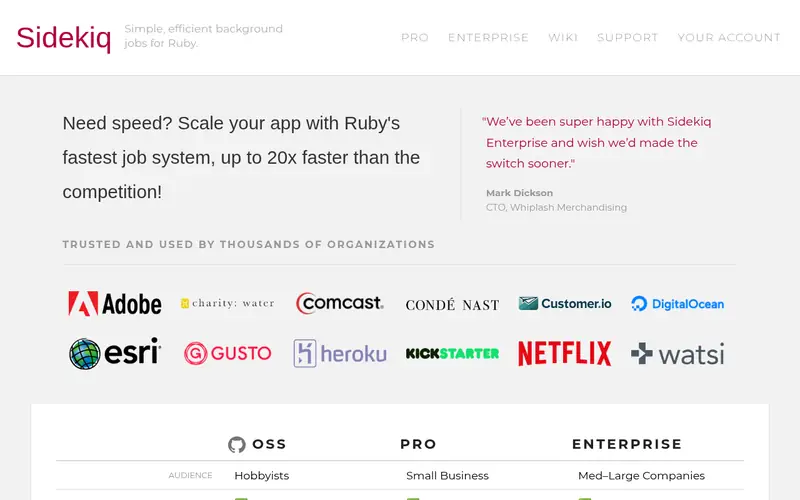
Sidekiq is a background job framework for Ruby that stores jobs in Redis and processes them with threads. It integrates with Rails Active Job but also has its own worker API. The open-source version is free under the LGPL licence. Sidekiq Pro and Sidekiq Enterprise are paid tiers that add features such as reliable fetches, batches and periodic jobs.
Because it depends on Redis, Sidekiq fits teams that already run Redis or are willing to operate it. Throughput is high compared with database-backed queues. The main trade-off is operational: you maintain a Redis instance and monitor it. Teams that want to avoid Redis should look at GoodJob or Solid Queue instead.
Standout: Very high throughput
Free (open source), as listed by the vendor (Sidekiq website). Confirm the current plan price before you buy.
Free plan. Plans change, so confirm on the vendor's pricing page before you buy.
Benefits
- Very high throughput
- mature ecosystem and wide adoption
Drawbacks
- Requires Redis
- some features sit behind paid Pro and Enterprise tiers
Skip it if this limit matters to you: requires Redis.
Verdict. A sensible pick for high-throughput jobs where Redis is already available.
Alternatives in this guide: GoodJob, Solid Queue, Delayed Job
GoodJob
Best for rails apps on PostgreSQL that want Active Job
What it is and where it fits
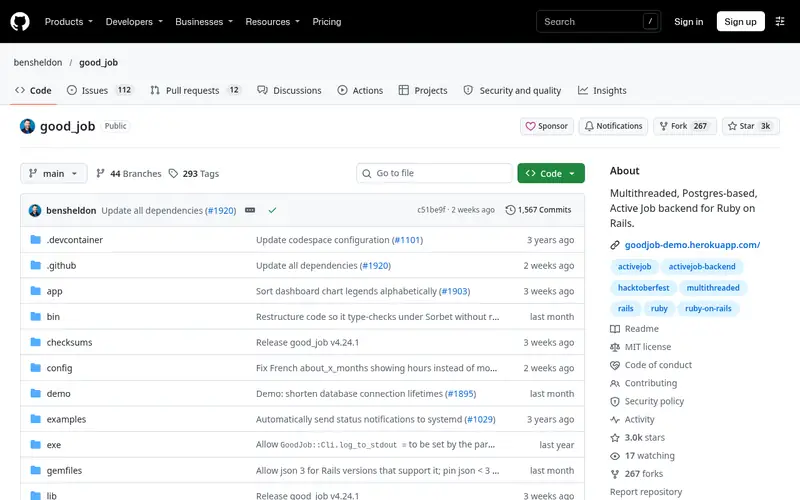
GoodJob is a multithreaded, PostgreSQL-backed job queue for Rails. It plugs into Active Job and stores jobs in the same database as your app, using advisory locks and LISTEN/NOTIFY. That means no extra service to run if you already use PostgreSQL. It supports retries, scheduled jobs, concurrency controls and a dashboard.
The library is free and open source under the MIT licence. It is a good fit for small and mid-sized Rails apps that want to keep infrastructure simple. The main limit is that it only works with PostgreSQL, and heavy job volume competes with your application database. Teams on MySQL or needing very high throughput may prefer a Redis-backed option.
Standout: Uses PostgreSQL, so no Redis needed
Free (open source), as listed by the vendor (GoodJob website). Confirm the current plan price before you buy.
Free plan. Plans change, so confirm on the vendor's pricing page before you buy.
Benefits
- Uses PostgreSQL, so no Redis needed
- integrates with Active Job
Drawbacks
- Tied to PostgreSQL
- throughput depends on your database
Skip it if this limit matters to you: tied to PostgreSQL.
Verdict. A sensible pick for rails apps on PostgreSQL that want Active Job.
Alternatives in this guide: Sidekiq, Solid Queue, Delayed Job
Solid Queue
Best for new Rails 8 apps wanting a default database queue
What it is and where it fits
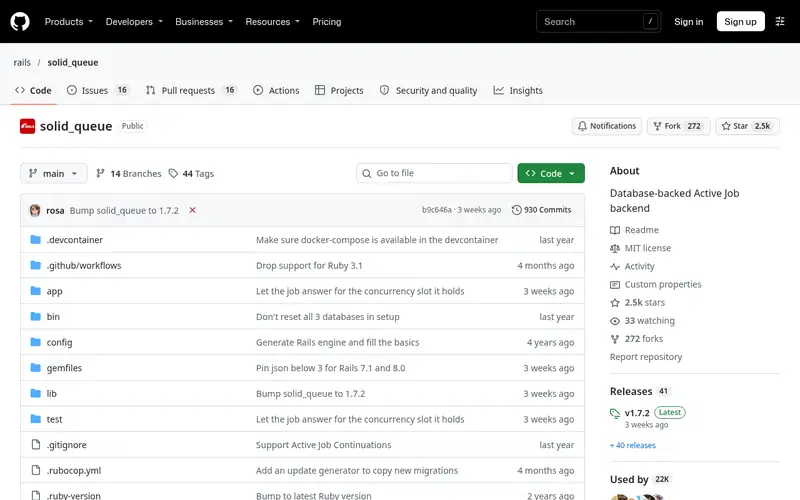
Solid Queue is a database-backed Active Job adapter maintained by the Rails project. It became the default queue for new Rails 8 applications. Jobs are stored in relational tables, and it supports concurrency controls, recurring jobs and a dashboard through Mission Control. It works with SQLite, MySQL and PostgreSQL.
It is free and open source under the MIT licence. Because it is part of the Rails ecosystem, it is the natural choice for a new Rails 8 app that wants background jobs without adding Redis. The trade-off is that it is newer than Sidekiq, and very high job volumes put load on your primary database. Teams on older Rails versions may need extra setup.
Standout: Ships as the Rails 8 default
Free (open source), as listed by the vendor (Solid Queue website). Confirm the current plan price before you buy.
Free plan. Plans change, so confirm on the vendor's pricing page before you buy.
Benefits
- Ships as the Rails 8 default
- database-backed with no Redis
Drawbacks
- Newer than older libraries
- best suited to recent Rails versions
Skip it if this limit matters to you: newer than older libraries.
Verdict. A sensible pick for new Rails 8 apps wanting a default database queue.
Alternatives in this guide: Sidekiq, GoodJob, Delayed Job
Delayed Job
Best for legacy Rails apps already using it
What it is and where it fits
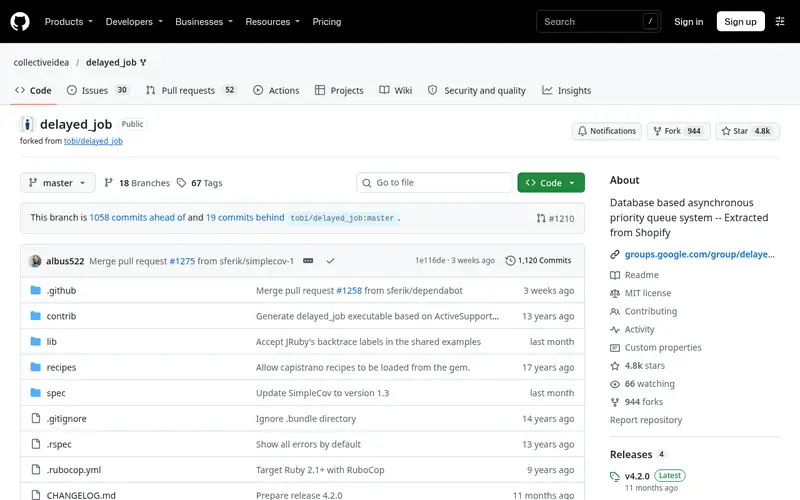
Delayed Job is one of the oldest background job libraries for Ruby. It stores jobs in a database table and works with ActiveRecord. It supports priorities, retries and scheduled jobs. It is free and open source under the MIT licence.
The project is still maintained but sees less active development than Sidekiq, GoodJob or Solid Queue. It remains a reasonable choice for legacy applications that already depend on it, or for simple setups where a database table is enough. New projects usually get more features and better performance from the newer options, so consider it mainly for existing codebases.
Standout: Simple database-backed design
Free (open source), as listed by the vendor (Delayed Job website). Confirm the current plan price before you buy.
Free plan. Plans change, so confirm on the vendor's pricing page before you buy.
Benefits
- Simple database-backed design
- long history in Rails apps
Drawbacks
- Older codebase with slower development
- fewer modern features
Skip it if this limit matters to you: older codebase with slower development.
Verdict. A sensible pick for legacy Rails apps already using it.
Alternatives in this guide: Sidekiq, GoodJob, Solid Queue
Resque
Best for redis-backed queues with a simple worker model
What it is and where it fits
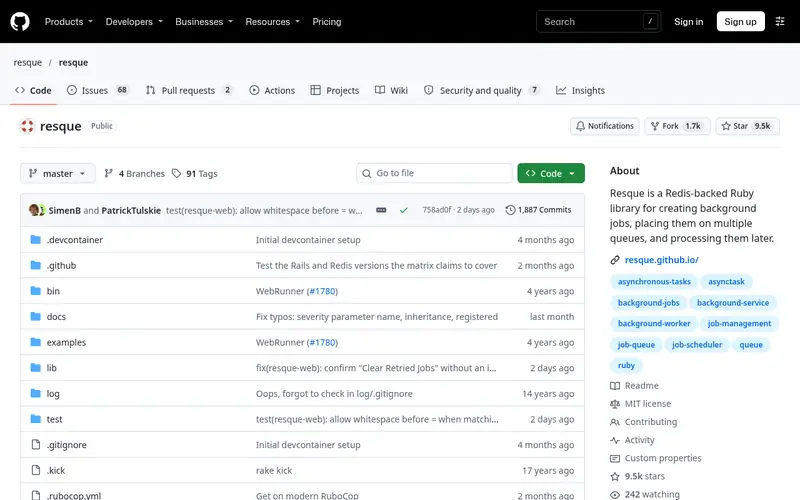
Resque is a Redis-backed Ruby library for creating background jobs and processing them on multiple queues. Each worker is a separate process, which isolates failures but uses more memory than a threaded model. It includes a web interface for monitoring queues. It is free and open source under the MIT licence.
Resque predates Sidekiq and has a smaller active community today. It still works and is used in production, but new projects more often pick Sidekiq for throughput or a database-backed queue for simplicity. Consider Resque if you inherit a codebase that uses it or you specifically want process-based workers.
Standout: Simple Redis-backed design
Free (open source), as listed by the vendor (Resque website). Confirm the current plan price before you buy.
Free plan. Plans change, so confirm on the vendor's pricing page before you buy.
Benefits
- Simple Redis-backed design
- separate worker processes
Drawbacks
- Less active development than Sidekiq
- smaller ecosystem
Skip it if this limit matters to you: less active development than Sidekiq.
Verdict. A sensible pick for redis-backed queues with a simple worker model.
Alternatives in this guide: Sidekiq, GoodJob, Solid Queue
Que
Best for postgreSQL users wanting a lightweight job queue
What it is and where it fits
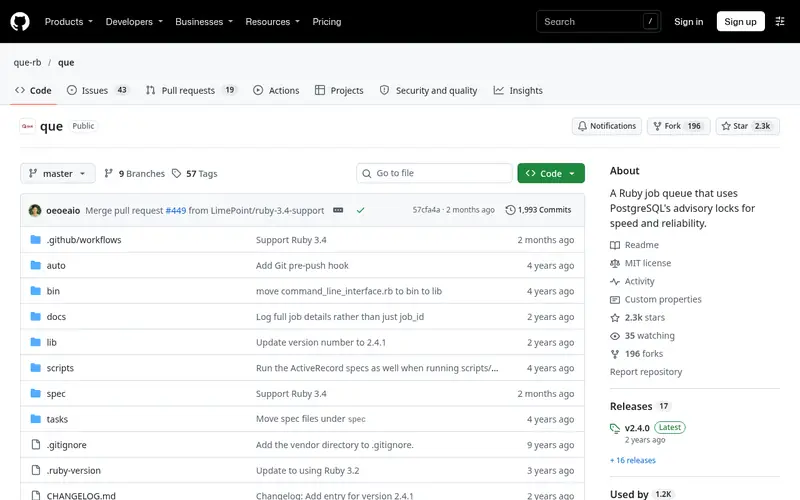
Que is a Ruby job queue that uses PostgreSQL advisory locks and stores jobs in a table. It is designed to be simple and fast for PostgreSQL users, and it integrates with Active Job. It supports priorities, retries and scheduled jobs. It is free and open source under the MIT licence.
Que is a good fit if you already use PostgreSQL and want a lightweight queue without Redis. Its community is smaller than Sidekiq's, so fewer third-party integrations exist. Teams that need very high throughput or a large plugin ecosystem may prefer Sidekiq, while those wanting Rails defaults may prefer Solid Queue.
Standout: Lightweight PostgreSQL-backed design
Free (open source), as listed by the vendor (Que website). Confirm the current plan price before you buy.
Free plan. Plans change, so confirm on the vendor's pricing page before you buy.
Benefits
- Lightweight PostgreSQL-backed design
- supports Active Job
Drawbacks
- PostgreSQL only
- smaller community than Sidekiq
Skip it if this limit matters to you: postgreSQL only.
Verdict. A sensible pick for postgreSQL users wanting a lightweight job queue.
Alternatives in this guide: Sidekiq, GoodJob, Solid Queue
Who should use what
If you already run Redis and need high throughput, pick Sidekiq. If you use PostgreSQL and want to avoid Redis, GoodJob or Que are good fits. If you are starting a new Rails 8 app, Solid Queue is the default and the simplest path. If you maintain a legacy app on Delayed Job or Resque, keep it unless you have a clear reason to migrate, and plan the move carefully.
Questions to settle before you buy
What to check before you buy
- Confirm which backend the library needs and whether you already run it.
- Check the licence and, for Sidekiq Pro or Enterprise, the current pricing page.
- Verify the library supports your Rails and Ruby versions.
- Review how retries, scheduled jobs and concurrency controls work.
- Check whether you need a monitoring dashboard and how it is provided.
FAQ
Do I need Redis to run background jobs in Ruby?
No. GoodJob, Solid Queue, Que and Delayed Job store jobs in a relational database. Sidekiq and Resque require Redis. The right choice depends on what infrastructure you already run and how much throughput you need.
Is Sidekiq free?
The open-source Sidekiq gem is free under the LGPL licence. Sidekiq Pro and Sidekiq Enterprise are paid commercial tiers that add features such as reliable fetches, batches and periodic jobs. Check the vendor pricing page for current prices.
What is the default job queue in Rails 8?
Solid Queue is the default Active Job adapter for new Rails 8 applications. It stores jobs in a relational database and does not need Redis. It is maintained by the Rails project and is free and open source.
Can I use Active Job with these libraries?
Yes. Sidekiq, GoodJob, Solid Queue, Que and Delayed Job all integrate with Rails Active Job. Sidekiq also has its own worker API. Active Job gives you a common interface if you want to switch adapters later.
Is Delayed Job still maintained?
Delayed Job is still maintained but sees less active development than newer options. It works for legacy apps that already use it. New projects usually get more features and better performance from Sidekiq, GoodJob or Solid Queue.
Sources we checked
Method: how we score · editorial policy.
Change log. First published 27 Nov 2026.