Stage 03 · Host · Researched comparison
Best Python Task Queues in 2026
Celery is the first pick for most teams that need a mature, broker-backed queue with broad framework and broker support. RQ suits small teams that want a simple Redis-only setup. Dramatiq is a good alternative when you want predictable behavior and a smaller dependency surface. All three are open source and free to use.

By Shihab Mia
Published 27 Nov 2026 · 6 tools compared
We run no ads and no affiliate links at launch. The order of a list follows our published method. See how we score.
Prices are the starting prices vendors list publicly. Plans change, so confirm the current price on the vendor page before you buy.
Key takeaways
- Celery, RQ, Dramatiq, Huey, arq and TaskIQ are open-source libraries, so the software itself costs nothing.
- Celery and RQ depend on an external broker, usually RabbitMQ or Redis, which adds operational work.
- Huey and arq offer lighter setups, with Huey supporting Redis, SQLite and in-memory storage.
- arq and TaskIQ are asyncio-first, which matters if your workers already run on an async stack.
Who each pick is for
- Teams needing a mature queue with broad broker supportCelery
- Small teams wanting a simple Redis-backed queueRQ (Redis Queue)
- Teams wanting a focused queue with predictable behaviorDramatiq
- Small apps needing a lightweight queue with storage optionsHuey
- asyncio applications that need a Redis-backed queuearq
- Async teams wanting a modular queue with pluggable brokersTaskIQ
Comparison
| Tool | Best for | Standout feature | Listed starting price | Free plan or trial |
|---|---|---|---|---|
| 1Celery | Teams needing a mature queue with broad broker support | Wide broker and result backend support | Free (open source) | Free plan |
| 2RQ (Redis Queue) | Small teams wanting a simple Redis-backed queue | Simple API and low setup effort | Free (open source) | Free plan |
| 3Dramatiq | Teams wanting a focused queue with predictable behavior | Clear documentation and a small API | Free (open source) | Free plan |
| 4Huey | Small apps needing a lightweight queue with storage options | Supports Redis, SQLite and in-memory storage | Free (open source) | Free plan |
| 5arq | asyncio applications that need a Redis-backed queue | Built for asyncio from the start | Free (open source) | Free plan |
| 6TaskIQ | Async teams wanting a modular queue with pluggable brokers | Async-first design with pluggable brokers | Free (open source) | Free plan |
How we picked
We compared libraries on fit for running Python background tasks, supported brokers and storage, async support, license and operational overhead. We also weighed documentation quality and how easy each is to debug. Sources are vendor pages, official documentation and project repositories. Prices and licenses can change, so confirm details on each project's site before you commit.
The tools, one by one
Celery
Best for teams needing a mature queue with broad broker support
What it is and where it fits
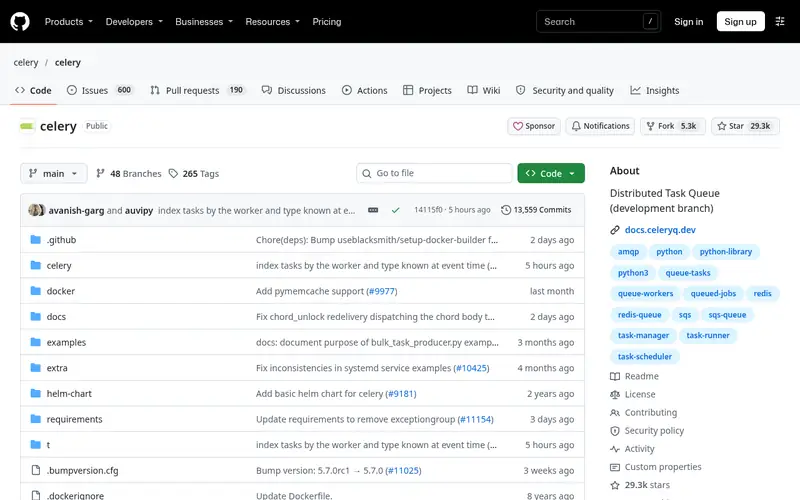
Celery is the most widely used Python task queue. It runs tasks across processes or machines and supports RabbitMQ, Redis, Amazon SQS and other brokers, plus several result backends. It integrates with Django, Flask and other frameworks through documented patterns. The project is open source under the BSD license.
Celery's strength is breadth. You can route tasks to specific queues, schedule periodic jobs with Celery Beat, and chain or group tasks. That flexibility comes with configuration overhead: broker URLs, result backends, serializers and worker concurrency all need decisions. New users often find failure modes hard to trace.
Choose Celery when you need a proven queue with many broker options and scheduled tasks. Skip it for small projects where a simpler library would do, or when you want asyncio-native task handling.
Standout: Wide broker and result backend support
Free (open source), as listed by the vendor (Celery website). Confirm the current plan price before you buy.
Free plan. Plans change, so confirm on the vendor's pricing page before you buy.
Benefits
- Wide broker and result backend support
- large ecosystem and long track record
Drawbacks
- Configuration is heavy
- behavior can be hard to debug
Skip it if this limit matters to you: configuration is heavy.
Verdict. A sensible pick for teams needing a mature queue with broad broker support.
Alternatives in this guide: RQ (Redis Queue), Dramatiq, Huey
RQ (Redis Queue)
Best for small teams wanting a simple Redis-backed queue
What it is and where it fits
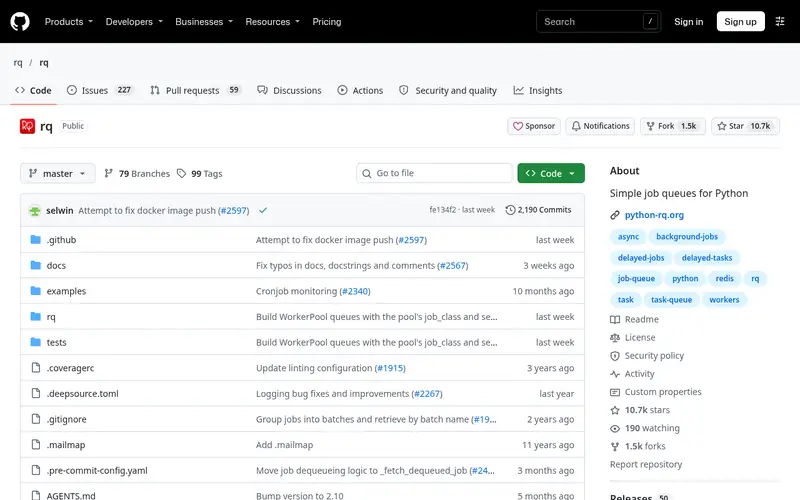
RQ queues jobs in Redis and processes them with worker processes. The API is small: you enqueue a function call and a worker picks it up. A job registry tracks status, and the separate rq-dashboard project gives a web view of queues and failed jobs. The library is open source under the BSD license.
RQ keeps the moving parts to a minimum. You need a Redis server and one or more workers, and that is close to the whole setup. It supports job dependencies, retries and scheduled jobs at a basic level. It does not aim for Celery's routing and workflow features.
Pick RQ if you already run Redis and want a queue you can understand in an afternoon. Skip it if you need multi-broker support or complex task workflows.
Standout: Simple API and low setup effort
Free (open source), as listed by the vendor (RQ (Redis Queue) website). Confirm the current plan price before you buy.
Free plan. Plans change, so confirm on the vendor's pricing page before you buy.
Benefits
- Simple API and low setup effort
- Job monitoring through rq-dashboard
Drawbacks
- Requires Redis
- Fewer built-in scheduling features than Celery
Skip it if this limit matters to you: requires Redis.
Verdict. A sensible pick for small teams wanting a simple Redis-backed queue.
Dramatiq
Best for teams wanting a focused queue with predictable behavior
What it is and where it fits
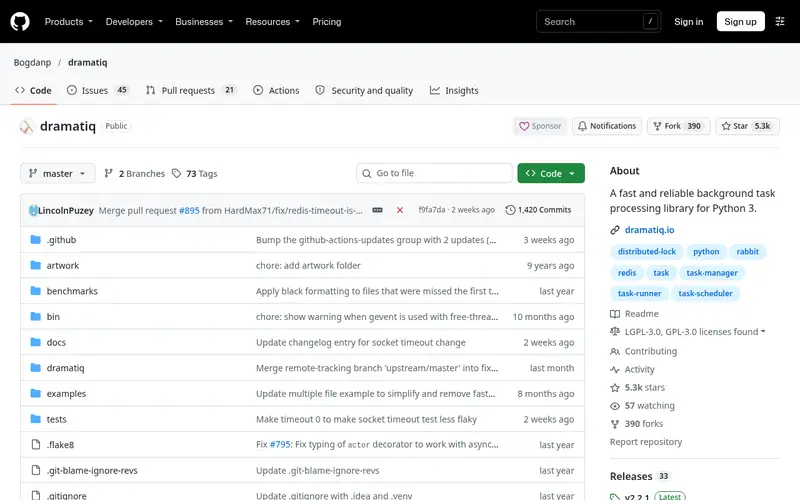
Dramatiq is a task processing library built around a small set of concepts: brokers, actors and middleware. It supports RabbitMQ and Redis brokers, with middleware for retries, rate limiting and time limits. The project is open source under the LGPL license.
Dramatiq aims for reliability and simple semantics. Tasks are called actors, and the middleware model lets you add behavior without changing task code. The documentation is direct about what the library does and does not handle. The ecosystem is smaller than Celery's, so fewer third-party integrations exist.
Use Dramatiq when you want a queue that is easy to reason about and you can live with RabbitMQ or Redis. Skip it if you depend on Celery-specific integrations or need the widest possible community support.
Standout: Clear documentation and a small API
Free (open source), as listed by the vendor (Dramatiq website). Confirm the current plan price before you buy.
Free plan. Plans change, so confirm on the vendor's pricing page before you buy.
Benefits
- Clear documentation and a small API
- Built-in retries and rate limiting
Drawbacks
- Smaller ecosystem than Celery
- Broker options are narrower
Skip it if this limit matters to you: smaller ecosystem than Celery.
Verdict. A sensible pick for teams wanting a focused queue with predictable behavior.
Alternatives in this guide: Celery, RQ (Redis Queue), Huey
Huey
Best for small apps needing a lightweight queue with storage options
What it is and where it fits
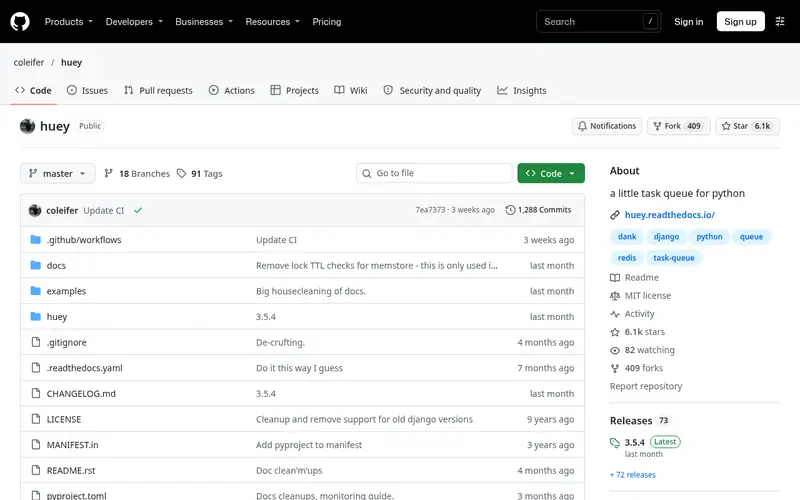
Huey is a small task queue that stores tasks in Redis, SQLite or memory. That range means you can start with SQLite for a single-server app and move to Redis later. It supports periodic tasks, task priorities and result storage. The project is open source under the MIT license.
Huey fits projects that want background jobs without standing up a separate broker service. The API is compact, and configuration is a few lines. It does not target large multi-node deployments the way Celery does, and its community is smaller.
Choose Huey for small to medium apps, especially where SQLite is already in use. Skip it if you need heavy distributed routing or a large pool of third-party extensions.
Standout: Supports Redis, SQLite and in-memory storage
Free (open source), as listed by the vendor (Huey website). Confirm the current plan price before you buy.
Free plan. Plans change, so confirm on the vendor's pricing page before you buy.
Benefits
- Supports Redis, SQLite and in-memory storage
- Small codebase and simple config
Drawbacks
- Fewer features for large distributed setups
- Smaller community
Skip it if this limit matters to you: fewer features for large distributed setups.
Verdict. A sensible pick for small apps needing a lightweight queue with storage options.
Alternatives in this guide: Celery, RQ (Redis Queue), Dramatiq
arq
Best for asyncio applications that need a Redis-backed queue
What it is and where it fits
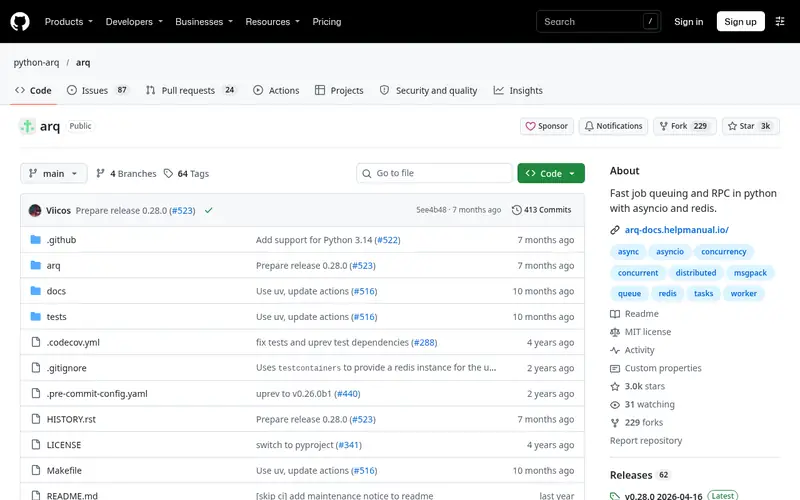
arq is an asyncio task queue backed by Redis. Jobs are async functions, and workers run on the same event loop model as the rest of an async application. It includes cron-style scheduling and job result storage. The project is open source under the MIT license.
arq suits services already built on asyncio, such as FastAPI or aiohttp apps. You avoid mixing sync worker processes with async application code. The trade-off is that Redis is the only broker, and the user base is smaller than Celery's, so fewer examples exist.
Pick arq when your stack is async and Redis is available. Skip it for sync codebases or when you need broker flexibility.
Standout: Built for asyncio from the start
Free (open source), as listed by the vendor (arq website). Confirm the current plan price before you buy.
Free plan. Plans change, so confirm on the vendor's pricing page before you buy.
Benefits
- Built for asyncio from the start
- Simple job and cron scheduling
Drawbacks
- Redis only
- Smaller user base than Celery
Skip it if this limit matters to you: redis only.
Verdict. A sensible pick for asyncio applications that need a Redis-backed queue.
Alternatives in this guide: Celery, RQ (Redis Queue), Dramatiq
TaskIQ
Best for async teams wanting a modular queue with pluggable brokers
What it is and where it fits
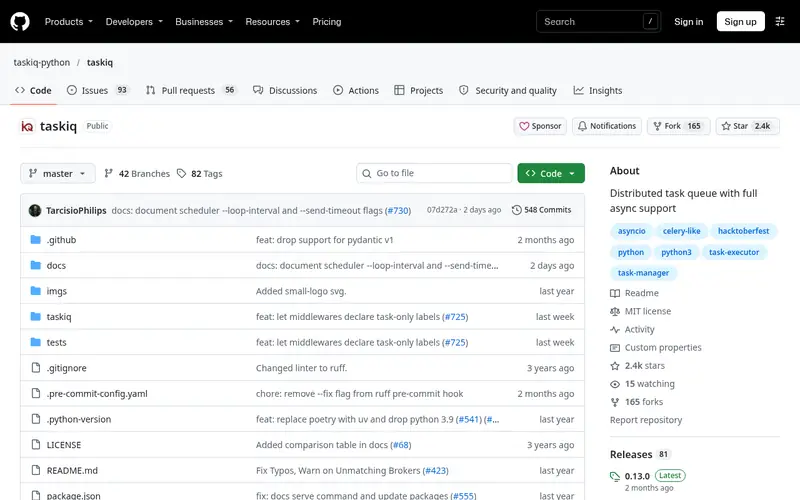
TaskIQ is an async task queue with a modular design. Brokers and result backends are separate packages, with options for Redis, RabbitMQ, NATS and in-memory operation. It offers integrations for FastAPI and other frameworks and supports middleware. The project is open source under the MIT license.
TaskIQ targets teams that want async workers and the ability to swap brokers without rewriting task code. The plugin model keeps the core small. Because the project is younger, documentation and community answers are thinner than for Celery, and some APIs may still shift.
Consider TaskIQ for new async services that value broker flexibility. Skip it if you need a long-established queue with a large body of community knowledge.
Standout: Async-first design with pluggable brokers
Free (open source), as listed by the vendor (TaskIQ website). Confirm the current plan price before you buy.
Free plan. Plans change, so confirm on the vendor's pricing page before you buy.
Benefits
- Async-first design with pluggable brokers
- Integrations for common frameworks
Drawbacks
- Younger project with a smaller community
- API may still change
Skip it if this limit matters to you: younger project with a smaller community.
Verdict. A sensible pick for async teams wanting a modular queue with pluggable brokers.
Alternatives in this guide: Celery, RQ (Redis Queue), Dramatiq
Who should use what
A team running a Django app with scheduled jobs and multiple brokers should start with Celery. A small service already using Redis can use RQ and keep setup minimal. An asyncio codebase on FastAPI should look at arq or TaskIQ. A single-server app that wants background jobs without a broker service can use Huey with SQLite. Teams that want a focused, well-documented queue with retries built in should evaluate Dramatiq.
Questions to settle before you buy
What to check before you buy
- Confirm which brokers or storage backends your infrastructure already runs.
- Check whether your application code is sync or async, and pick a queue that matches.
- Review how the library handles retries, time limits and failed jobs.
- Read the license terms if you distribute software that includes the library.
- Test worker shutdown and job acknowledgment behavior before production.
FAQ
Are Python task queues free?
Yes. Celery, RQ, Dramatiq, Huey, arq and TaskIQ are all open-source libraries with no license fee. Your costs come from the broker or storage you run, such as Redis or RabbitMQ, and from the servers that host workers.
Do I need Redis or RabbitMQ to run a task queue?
Most of these libraries need an external broker. Celery supports RabbitMQ, Redis and others. RQ and arq require Redis. Dramatiq supports RabbitMQ and Redis. Huey can use Redis, SQLite or memory, so a broker service is optional for small setups.
Which Python task queue is best for asyncio?
arq and TaskIQ are built for asyncio. arq is Redis-only and compact. TaskIQ uses pluggable brokers and result backends. Both let async workers run on the same event loop model as an async web framework.
Can I schedule periodic tasks?
Yes. Celery uses Celery Beat for periodic jobs. Huey, arq and TaskIQ include scheduling features. RQ supports scheduled jobs at a basic level. Check each project's documentation for the exact scheduling model.
Is Celery hard to learn?
Celery has more configuration than the alternatives. You set up a broker, a result backend and worker options, and failures can be hard to trace. Teams that need its features accept that cost. Smaller projects often do better with RQ or Huey.
Sources we checked
Method: how we score · editorial policy.
Change log. First published 27 Nov 2026.