Stage 03 · Host · Researched comparison
Best PHP ORMs in 2026
Doctrine ORM is the first pick for most teams that want a mature, framework-independent data mapper with strong migration and schema tooling. Eloquent suits developers already working inside Laravel who want an active record API with minimal setup. Cycle ORM is a solid alternative for projects that need a data mapper without Doctrine's learning curve, and it works well with long-running workers.

By Shihab Mia
Published 27 Nov 2026 · 7 tools compared
We run no ads and no affiliate links at launch. The order of a list follows our published method. See how we score.
Prices are the starting prices vendors list publicly. Plans change, so confirm the current price on the vendor page before you buy.
Key takeaways
- Doctrine ORM is free, open source, and framework-agnostic, with a data mapper design and its own migration tooling.
- Eloquent is free and ships with Laravel, so it is the natural choice only when Laravel is already part of the stack.
- Cycle ORM is free and open source, supports data mapper patterns, and fits long-running PHP processes.
- All picks are open-source libraries you install with Composer; none require pasting code or data into a third-party web page.
Who each pick is for
- Teams that want a framework-independent data mapperDoctrine ORM
- Laravel developers who want active record modelsEloquent ORM
- Data mapper users who need long-running worker supportCycle ORM
- Projects that prefer generated model classes from schemaPropel
- Laminas users who want SQL-level database accessLaminas DB
- Small projects that need a lightweight database layerMedoo
- Developers who want query building without an ORMAura.SqlQuery
Comparison
| Tool | Best for | Standout feature | Listed starting price | Free plan or trial |
|---|---|---|---|---|
| 1Doctrine ORM | Teams that want a framework-independent data mapper | Mature data mapper with a large ecosystem | Free (open source) | Free plan |
| 2Eloquent ORM | Laravel developers who want active record models | Simple active record API | Free (open source) | Free plan |
| 3Cycle ORM | Data mapper users who need long-running worker support | Data mapper design with a smaller API surface | Free (open source) | Free plan |
| 4Propel | Projects that prefer generated model classes from schema | Generates model classes from a schema file | Free (open source) | Free plan |
| 5Laminas DB | Laminas users who want SQL-level database access | Part of the Laminas ecosystem | Free (open source) | Free plan |
| 6Medoo | Small projects that need a lightweight database layer | Very small API and easy setup | Free (open source) | Free plan |
| 7Aura.SqlQuery | Developers who want query building without an ORM | Focused query builder for multiple databases | Free (open source) | Free plan |
How we picked
We compared tools on fit for the job, supported platforms and PHP versions, licence and price, and the main limits of each. We looked at whether each project is a full ORM or a lighter database layer, and how much mapping and migration tooling it provides. Sources are vendor pages, official documentation and project repositories. Prices and licences can change, so confirm details on the vendor site before you commit.
The tools, one by one
Doctrine ORM
Best for teams that want a framework-independent data mapper
What it is and where it fits
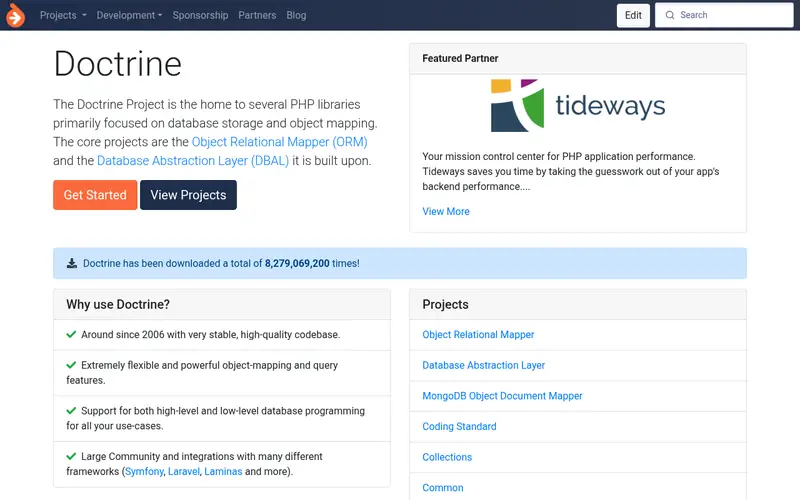
Doctrine ORM is a data mapper that keeps your domain objects separate from database logic. It runs on PHP and installs through Composer. Entities are plain PHP classes mapped with attributes, XML or YAML. The project ships migrations, a schema tool, DQL and a query builder, so most database work stays inside one ecosystem.
It is framework-agnostic and works with Symfony, plain PHP and other frameworks. The licence is MIT, so there is no paid tier. The main cost is time: mapping, the unit of work and DQL take practice, and small scripts may feel heavy. Teams that want minimal setup or an active record style should look elsewhere. Confirm current requirements and versions on the project site.
Standout: Mature data mapper with a large ecosystem
Free (open source), as listed by the vendor (Doctrine ORM website). Confirm the current plan price before you buy.
Free plan. Plans change, so confirm on the vendor's pricing page before you buy.
Benefits
- Mature data mapper with a large ecosystem
- Bundles migrations, schema tools and a query builder
Drawbacks
- Steep learning curve
- More configuration than active record tools
Skip it if this limit matters to you: steep learning curve.
Verdict. A sensible pick for teams that want a framework-independent data mapper.
Alternatives in this guide: Eloquent ORM, Cycle ORM, Propel
Eloquent ORM
Best for laravel developers who want active record models
What it is and where it fits
Eloquent is the ORM that ships with Laravel. Each model maps to a table, and relationships are defined as methods. It includes migrations, seeders, model factories and a query builder, so schema and data work sit alongside application code. It runs wherever Laravel runs and installs with Composer as part of the framework.
Eloquent is MIT licensed and free. The trade-off is coupling: using it well usually means adopting Laravel's conventions, and pulling it into a non-Laravel project takes extra wiring. It is a good fit for teams already on Laravel. Teams that want a framework-neutral data mapper should compare Doctrine or Cycle instead. Check the Laravel documentation for the current version and supported PHP releases.
Standout: Simple active record API
Free (open source), as listed by the vendor (Eloquent ORM website). Confirm the current plan price before you buy.
Free plan. Plans change, so confirm on the vendor's pricing page before you buy.
Benefits
- Simple active record API
- Tight integration with Laravel migrations and tooling
Drawbacks
- Tied closely to Laravel
- Less natural outside the framework
Skip it if this limit matters to you: tied closely to Laravel.
Verdict. A sensible pick for laravel developers who want active record models.
Alternatives in this guide: Doctrine ORM, Cycle ORM, Propel
Cycle ORM
Best for data mapper users who need long-running worker support
What it is and where it fits
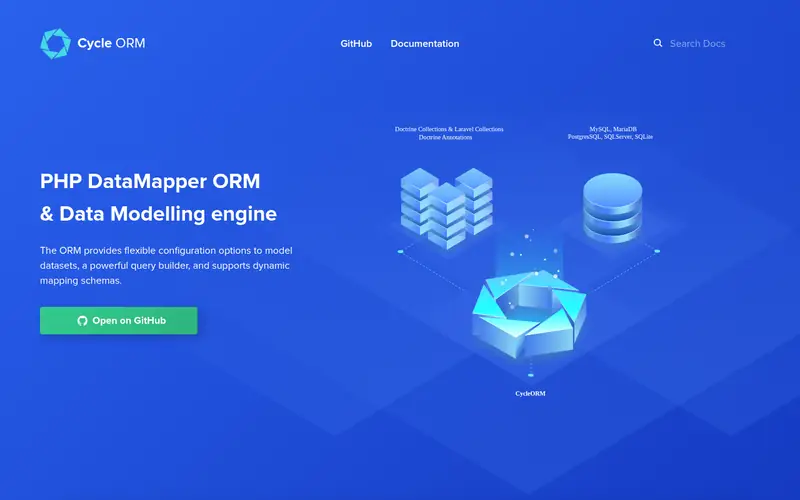
Cycle ORM is a data mapper for PHP built by the Spiral team. It supports schema mapping, relations, transactions and a query builder, and it is designed to work in long-running processes such as workers and application servers. It installs with Composer and runs on standard PHP.
The project is MIT licensed and free. It integrates with Spiral and can be used with other frameworks, though documentation and examples lean toward Spiral. Its community and ecosystem are smaller than Doctrine's, so fewer ready-made bundles exist. It suits teams that want data mapper behavior without Doctrine's full weight, and developers who run persistent PHP processes. Check the project site for supported PHP versions.
Standout: Data mapper design with a smaller API surface
Free (open source), as listed by the vendor (Cycle ORM website). Confirm the current plan price before you buy.
Free plan. Plans change, so confirm on the vendor's pricing page before you buy.
Benefits
- Data mapper design with a smaller API surface
- Built for long-running processes
Drawbacks
- Smaller community than Doctrine
- Fewer third-party integrations
Skip it if this limit matters to you: smaller community than Doctrine.
Verdict. A sensible pick for data mapper users who need long-running worker support.
Alternatives in this guide: Doctrine ORM, Eloquent ORM, Propel
Propel
Best for projects that prefer generated model classes from schema
What it is and where it fits
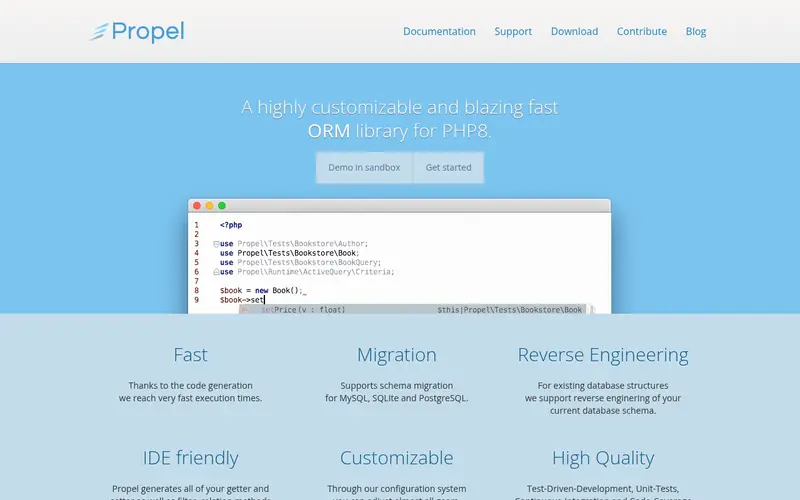
Propel is an ORM that generates PHP classes from an XML or PHP schema definition. You describe tables and relations, then generate model, query and peer classes. It includes a query API, schema migration support and a runtime for working with generated objects. It installs with Composer.
Propel is MIT licensed and free. The generated-class approach appeals to teams that want explicit code from a schema, but it means a build step whenever the schema changes. The project has a smaller community than Doctrine or Eloquent, so examples and third-party packages are fewer. It fits legacy or schema-first projects that already use it. New projects should weigh it against more actively discussed options and check the project site for current release status.
Standout: Generates model classes from a schema file
Free (open source), as listed by the vendor (Propel website). Confirm the current plan price before you buy.
Free plan. Plans change, so confirm on the vendor's pricing page before you buy.
Benefits
- Generates model classes from a schema file
- Includes a query API and migration support
Drawbacks
- Smaller active community
- Less momentum than Doctrine or Eloquent
Skip it if this limit matters to you: smaller active community.
Verdict. A sensible pick for projects that prefer generated model classes from schema.
Alternatives in this guide: Doctrine ORM, Eloquent ORM, Cycle ORM
Laminas DB
Best for laminas users who want SQL-level database access
What it is and where it fits
Laminas DB is the database component of the Laminas framework. It provides adapters, SQL abstraction, result sets and a table gateway pattern. It is not a full ORM in the Doctrine sense: you work closer to SQL and map rows yourself, which can be an advantage when you want control over queries.
It is BSD-3-Clause licensed and free, and installs with Composer. It fits Laminas applications and teams that prefer explicit SQL over entity mapping. If you need relations, lazy loading and a unit of work, a full ORM is a better fit. Check the Laminas documentation for supported PHP versions and adapter support.
Standout: Part of the Laminas ecosystem
Free (open source), as listed by the vendor (Laminas DB website). Confirm the current plan price before you buy.
Free plan. Plans change, so confirm on the vendor's pricing page before you buy.
Benefits
- Part of the Laminas ecosystem
- Table gateway and SQL abstraction without full ORM
Drawbacks
- Not a full ORM
- Less mapping tooling than Doctrine
Skip it if this limit matters to you: not a full ORM.
Verdict. A sensible pick for laminas users who want SQL-level database access.
Alternatives in this guide: Doctrine ORM, Eloquent ORM, Cycle ORM
Medoo
Best for small projects that need a lightweight database layer
What it is and where it fits
Medoo is a lightweight database abstraction layer rather than a full ORM. It provides a small API for queries, joins and inserts, and supports MySQL, MariaDB, PostgreSQL, SQLite, SQL Server and other drivers. It installs with Composer or as a single file.
Medoo is MIT licensed and free. It suits small applications, scripts and prototypes where a full ORM is overkill. It does not provide entity mapping, lazy loading or a unit of work, so larger domain models will need more manual code. Teams that need relations and mapping should pick a full ORM. Check the project site for driver support and current version.
Standout: Very small API and easy setup
Free (open source), as listed by the vendor (Medoo website). Confirm the current plan price before you buy.
Free plan. Plans change, so confirm on the vendor's pricing page before you buy.
Benefits
- Very small API and easy setup
- Supports many database drivers
Drawbacks
- Not a full ORM
- Limited relation and mapping features
Skip it if this limit matters to you: not a full ORM.
Verdict. A sensible pick for small projects that need a lightweight database layer.
Alternatives in this guide: Doctrine ORM, Eloquent ORM, Cycle ORM
Aura.SqlQuery
Best for developers who want query building without an ORM
What it is and where it fits
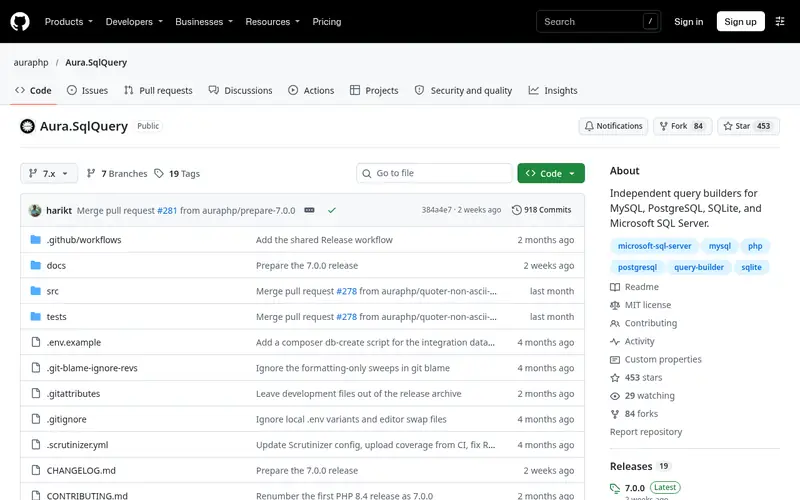
Aura.SqlQuery is a standalone query builder from the Aura project. It builds SELECT, INSERT, UPDATE and DELETE statements for MySQL, PostgreSQL, SQLite and SQL Server. It is not an ORM; it handles query construction and leaves mapping to your code.
It is MIT licensed and free, and installs with Composer. It fits projects that want structured query building without adopting a full ORM, and it works alongside other database layers. The trade-off is that you write mapping and relation logic yourself. Teams that need entity management should choose a full ORM. Check the repository for current release and database support.
Standout: Focused query builder for multiple databases
Free (open source), as listed by the vendor (Aura.SqlQuery website). Confirm the current plan price before you buy.
Free plan. Plans change, so confirm on the vendor's pricing page before you buy.
Benefits
- Focused query builder for multiple databases
- Small, independent package
Drawbacks
- No entity mapping
- Manual work for relations
Skip it if this limit matters to you: no entity mapping.
Verdict. A sensible pick for developers who want query building without an ORM.
Alternatives in this guide: Doctrine ORM, Eloquent ORM, Cycle ORM
Who should use what
Teams building framework-neutral applications with complex domain models should start with Doctrine ORM. Developers already on Laravel get the least friction from Eloquent. Projects that run long-lived workers and want a data mapper should look at Cycle ORM. Small scripts and prototypes that only need simple queries can use Medoo or Aura.SqlQuery instead of a full ORM.
Questions to settle before you buy
What to check before you buy
- Confirm the ORM supports your PHP version and database driver.
- Check the licence and whether any paid tier or support plan is required.
- Decide between data mapper and active record before writing models.
- Review migration and schema tooling, since it affects day-to-day work.
- Check community activity and documentation depth for long-term maintenance.
FAQ
Is Doctrine ORM free?
Yes. Doctrine ORM is open source under the MIT licence and installs with Composer. There is no paid tier for the library itself. Optional commercial support may be available from third parties, so check the project site for current details.
Can I use Eloquent outside Laravel?
Eloquent can be used outside Laravel with extra setup, but it is designed around Laravel's conventions and components. Most teams get better results using it inside Laravel or choosing a framework-neutral ORM such as Doctrine or Cycle for standalone projects.
What is the difference between a data mapper and active record?
A data mapper keeps domain objects separate from database logic, as Doctrine and Cycle do. Active record puts database methods on the model itself, as Eloquent does. Data mappers often suit complex domains, while active record is quicker to start with.
Do I need an ORM for a small PHP project?
Not always. For small scripts and simple queries, a lightweight layer such as Medoo or a query builder such as Aura.SqlQuery may be enough. A full ORM adds mapping and migration tooling that pays off mainly in larger applications.
Are these ORMs safe for production data?
These are open-source libraries that run inside your own application, so data stays on your infrastructure. That differs from pasting code or data into a third-party web page. Review each project's documentation and security notes before using it with production data.
Sources we checked
Method: how we score · editorial policy.
Change log. First published 27 Nov 2026.