Stage 03 · Host · Researched comparison
Best Node.js Job Queues in 2026
BullMQ is the first pick for most teams. It runs on Redis, supports delayed and repeatable jobs, retries and multiple workers, and suits apps that already depend on Redis. If you want to avoid Redis, pg-boss and Graphile Worker store jobs in PostgreSQL. If you need simple in-process scheduling without a broker, Bree is a lighter option. All six tools here are open source, so the main cost is the infrastructure you already run.

By Shihab Mia
Published 27 Nov 2026 · 6 tools compared
We run no ads and no affiliate links at launch. The order of a list follows our published method. See how we score.
Prices are the starting prices vendors list publicly. Plans change, so confirm the current price on the vendor page before you buy.
Key takeaways
- BullMQ is the most feature-complete option here and needs a Redis server.
- pg-boss and Graphile Worker keep jobs in PostgreSQL, which helps teams that already run Postgres.
- Agenda and Bree fit smaller apps that want scheduling without a separate message broker.
- Every tool on this list is free and open source; you pay only for the database or Redis you host.
Who each pick is for
- Teams already running Redis who need advanced job controlBullMQ
- Small Redis-backed workloads that want a simple APIBee-Queue
- Lightweight scheduling backed by MongoDBAgenda
- Teams that want a queue inside an existing PostgreSQL databasepg-boss
- PostgreSQL users who want high-throughput job processingGraphile Worker
- In-process job scheduling without a separate brokerBree
Comparison
| Tool | Best for | Standout feature | Listed starting price | Free plan or trial |
|---|---|---|---|---|
| 1BullMQ | Teams already running Redis who need advanced job control | Rich feature set with retries, delays and repeatable jobs | Free (open source) | Free plan |
| 2Bee-Queue | Small Redis-backed workloads that want a simple API | Small API surface that is quick to learn | Free (open source) | Free plan |
| 3Agenda | Lightweight scheduling backed by MongoDB | Persistent job storage in MongoDB | Free (open source) | Free plan |
| 4pg-boss | Teams that want a queue inside an existing PostgreSQL database | No extra broker beyond Postgres | Free (open source) | Free plan |
| 5Graphile Worker | PostgreSQL users who want high-throughput job processing | Uses Postgres efficiently with low polling overhead | Free (open source) | Free plan |
| 6Bree | In-process job scheduling without a separate broker | No external broker required | Free (open source) | Free plan |
How we picked
We picked libraries that are currently maintained, open source and genuinely built for background job processing in Node.js. Criteria were fit for the job, supported storage backends, licence and cost, operational weight, and documented limits. Sources are vendor pages, project repositories and official documentation. Prices and features can change, so confirm details on each project's site before you commit.
The tools, one by one
BullMQ
Best for teams already running Redis who need advanced job control
What it is and where it fits
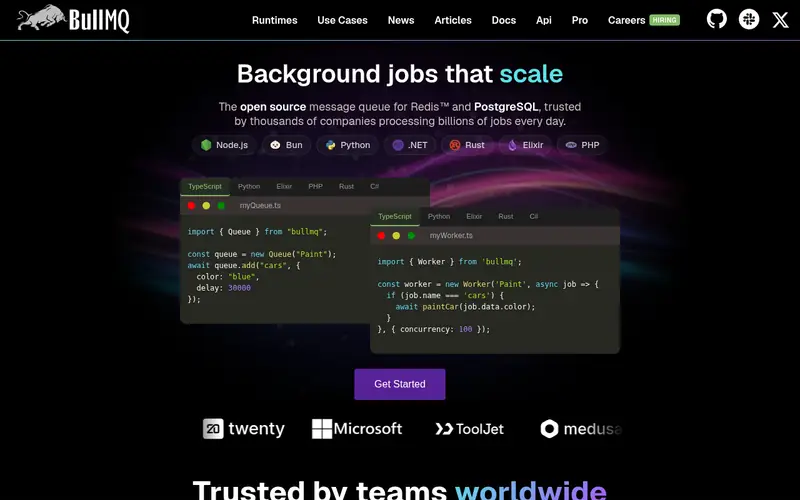
BullMQ is a Redis-backed queue for Node.js. It handles delayed jobs, repeatable jobs, priorities, retries with backoff, and parent-child flows. Workers can run in separate processes, which lets you scale processing independently of the web app. It ships with a dashboard package for inspecting queues and jobs.
It runs anywhere Node.js and Redis run, including containers and managed Redis services. The project is MIT licensed, so there is no paid tier for the library itself. The real cost is the Redis instance you host or rent. You should skip it if you cannot add Redis to your stack or if your job volume is small enough that a database-backed queue would do.
Standout: Rich feature set with retries, delays and repeatable jobs
Free (open source), as listed by the vendor (BullMQ website). Confirm the current plan price before you buy.
Free plan. Plans change, so confirm on the vendor's pricing page before you buy.
Benefits
- Rich feature set with retries, delays and repeatable jobs
- active development and documentation
Drawbacks
- Requires a Redis server
- not a fit for teams that want to avoid another data store
Skip it if this limit matters to you: requires a Redis server.
Verdict. A sensible pick for teams already running Redis who need advanced job control.
Bee-Queue
Best for small Redis-backed workloads that want a simple API
What it is and where it fits
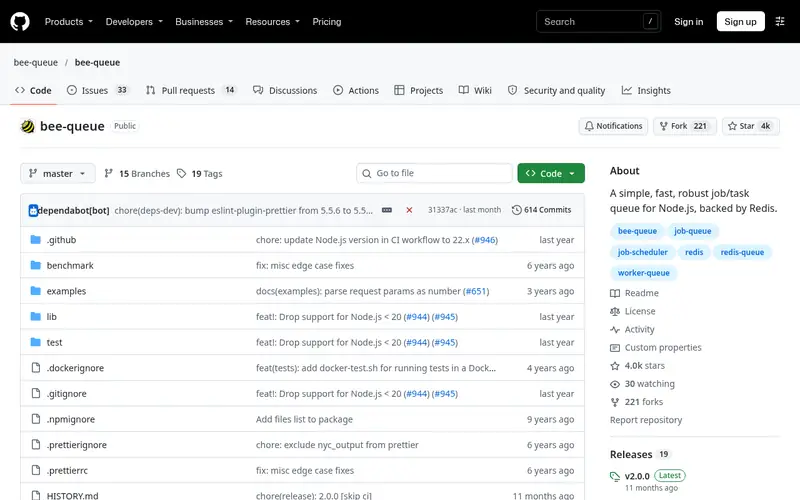
Bee-Queue is a Redis-backed job queue with a deliberately small feature set. It covers job creation, processing, retries and delayed jobs, and it focuses on performance for straightforward workloads. The API is compact, so a new developer can read the docs in one sitting.
It runs on Node.js with a Redis server. The project is MIT licensed and free to use. It does not aim to match BullMQ on features such as repeatable jobs or complex flows, and its release cadence is slower. Choose it for simple background work where you already have Redis and do not need advanced scheduling. Skip it if you need long-term project momentum or complex job graphs.
Standout: Small API surface that is quick to learn
Free (open source), as listed by the vendor (Bee-Queue website). Confirm the current plan price before you buy.
Free plan. Plans change, so confirm on the vendor's pricing page before you buy.
Benefits
- Small API surface that is quick to learn
- lower overhead than heavier queue libraries
Drawbacks
- Fewer features than BullMQ
- slower release cadence
Skip it if this limit matters to you: fewer features than BullMQ.
Verdict. A sensible pick for small Redis-backed workloads that want a simple API.
Agenda
Best for lightweight scheduling backed by MongoDB
What it is and where it fits
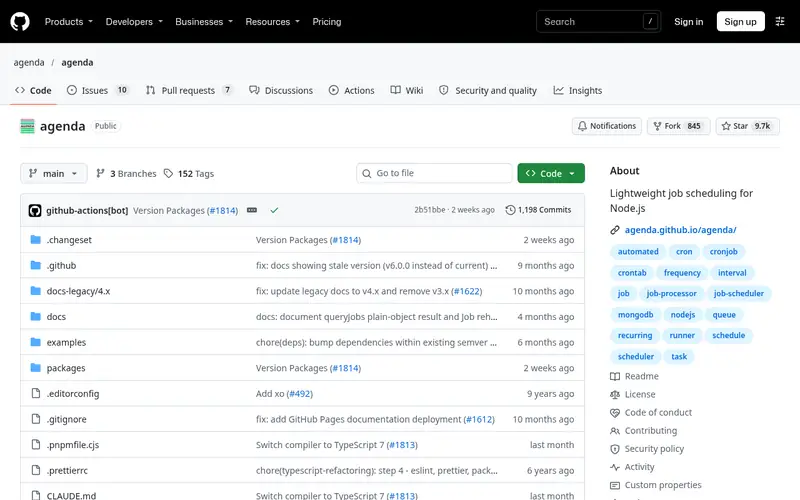
Agenda is a job scheduling library for Node.js that stores jobs in MongoDB. It is built around defining jobs and scheduling them at intervals or specific times, which makes it a natural fit for recurring tasks such as reports or cleanup routines. Jobs persist in the database, so they survive restarts.
It runs on Node.js with a MongoDB connection. The project is MIT licensed. Because it depends on MongoDB, it suits teams already using that database and less so teams standardised on Postgres or Redis. Its feature set is narrower than BullMQ's, and the project moves at a slower pace. Consider it for scheduled recurring work rather than high-throughput queues.
Standout: Persistent job storage in MongoDB
Free (open source), as listed by the vendor (Agenda website). Confirm the current plan price before you buy.
Free plan. Plans change, so confirm on the vendor's pricing page before you buy.
Benefits
- Persistent job storage in MongoDB
- simple API for scheduled jobs
Drawbacks
- MongoDB is required
- less active than Redis-backed alternatives
Skip it if this limit matters to you: mongoDB is required.
Verdict. A sensible pick for lightweight scheduling backed by MongoDB.
pg-boss
Best for teams that want a queue inside an existing PostgreSQL database
What it is and where it fits
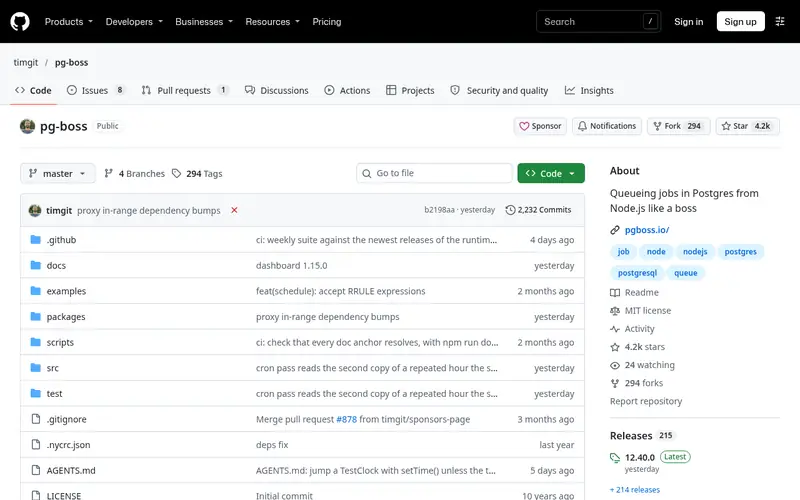
pg-boss stores jobs in PostgreSQL tables and uses the database for locking and delivery. That means one less service to run if you already operate Postgres. It supports retries, scheduling, job completion states and archiving of finished jobs.
It runs on Node.js against a supported PostgreSQL version. The library is MIT licensed and free. Because all job traffic hits your database, very high job rates can compete with application queries, so plan capacity and indexes. It is a good fit for teams that value operational simplicity over raw throughput. Skip it if your Postgres instance is already saturated.
Standout: No extra broker beyond Postgres
Free (open source), as listed by the vendor (pg-boss website). Confirm the current plan price before you buy.
Free plan. Plans change, so confirm on the vendor's pricing page before you buy.
Benefits
- No extra broker beyond Postgres
- supports retries and job archiving
Drawbacks
- Throughput is tied to your Postgres instance
- not built for very high job rates
Skip it if this limit matters to you: throughput is tied to your Postgres instance.
Verdict. A sensible pick for teams that want a queue inside an existing PostgreSQL database.
Graphile Worker
Best for postgreSQL users who want high-throughput job processing
What it is and where it fits
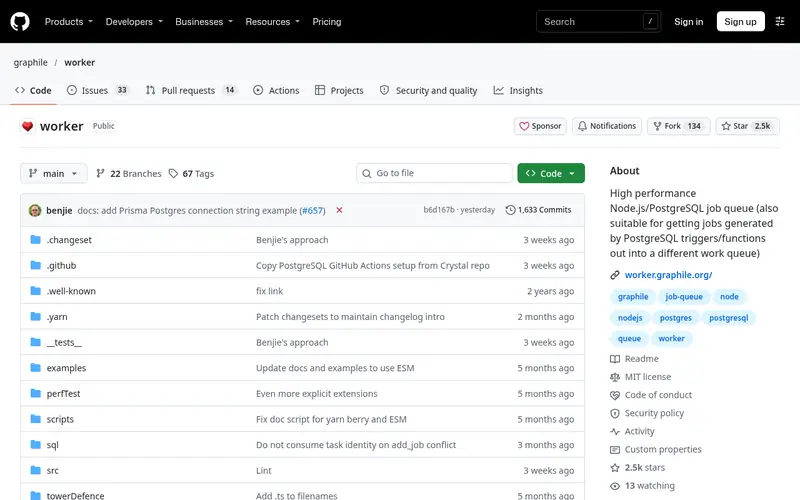
Graphile Worker is a job queue that runs on PostgreSQL. It uses efficient polling and locking so many workers can share one database without excessive load. It supports cron-style recurring jobs, retries and job keys for deduplication.
It runs on Node.js with PostgreSQL. The project is MIT licensed and free. It is part of the Graphile family, so teams using other Graphile tools may find it familiar. Setup involves more configuration than a single-file scheduler, and it requires Postgres. Choose it when you want database-backed jobs at higher volume. Skip it if you cannot run Postgres or want a broker-free in-process option.
Standout: Uses Postgres efficiently with low polling overhead
Free (open source), as listed by the vendor (Graphile Worker website). Confirm the current plan price before you buy.
Free plan. Plans change, so confirm on the vendor's pricing page before you buy.
Benefits
- Uses Postgres efficiently with low polling overhead
- supports cron-style scheduling
Drawbacks
- Postgres is required
- configuration has more moving parts
Skip it if this limit matters to you: postgres is required.
Verdict. A sensible pick for postgreSQL users who want high-throughput job processing.
Bree
Best for in-process job scheduling without a separate broker
What it is and where it fits
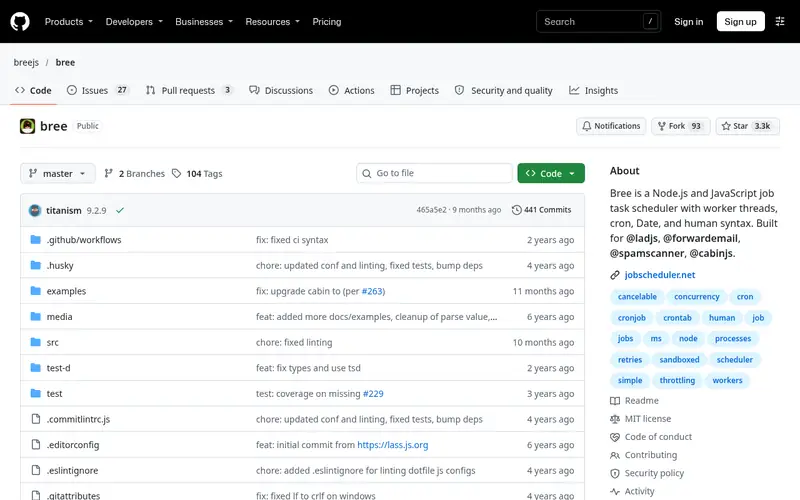
Bree is a job scheduler for Node.js that runs jobs in worker threads. It handles cron expressions, intervals and timeouts, and it keeps the main event loop free by running work in separate threads. It does not need Redis or a database to operate.
It runs on Node.js and is MIT licensed. Because jobs live in the process, they are lost on restart unless you add your own persistence. That makes it a fit for recurring in-app tasks such as cache refreshes, not for durable queues across many machines. Choose it for simple scheduling in a single service. Skip it if you need durable, distributed job processing.
Standout: No external broker required
Free (open source), as listed by the vendor (Bree website). Confirm the current plan price before you buy.
Free plan. Plans change, so confirm on the vendor's pricing page before you buy.
Benefits
- No external broker required
- simple API for cron and interval jobs
Drawbacks
- Jobs do not persist across restarts by default
- less suited to distributed workers
Skip it if this limit matters to you: jobs do not persist across restarts by default.
Verdict. A sensible pick for in-process job scheduling without a separate broker.
Who should use what
If your stack already runs Redis and you need retries, delays and repeatable jobs, start with BullMQ. If you want to avoid a new data store and already run PostgreSQL, look at pg-boss for simplicity or Graphile Worker for higher throughput. If you use MongoDB and mainly need scheduled recurring tasks, Agenda fits. If you want in-process scheduling with no broker at all, Bree covers cron and interval jobs in a single service.
Questions to settle before you buy
What to check before you buy
- Confirm which data store the library needs and whether you already run it.
- Check whether you need durable jobs that survive restarts or just in-process scheduling.
- Review retry, backoff and scheduling features against your actual workload.
- Estimate job volume and confirm your database or Redis instance can handle it.
- Check the repository's recent commit activity and open issues before adopting it.
FAQ
Do I need Redis to run a Node.js job queue?
No. BullMQ and Bee-Queue use Redis, but pg-boss and Graphile Worker use PostgreSQL, Agenda uses MongoDB, and Bree needs no external store. Pick the backend you already operate to reduce moving parts.
Is Bull still a good choice?
Bull (v3) is maintenance-only. New projects should use BullMQ, which is the actively developed successor with a broader feature set and current documentation.
Can these libraries run scheduled recurring jobs?
Yes. BullMQ, Agenda, Graphile Worker and Bree all support recurring or cron-style scheduling. pg-boss also supports scheduling. Check each project's docs for the exact syntax and limits.
Are these job queues free?
All six libraries listed here are open source and free to use. Your costs come from the infrastructure they depend on, such as a Redis server, a PostgreSQL database or a MongoDB instance.
What is the difference between a job queue and a scheduler?
A queue focuses on distributing work to workers with retries and durability. A scheduler focuses on running tasks at set times. Some tools, such as BullMQ and Graphile Worker, cover both.
Sources we checked
Method: how we score · editorial policy.
Change log. First published 27 Nov 2026.