Stage 03 · Host · Researched comparison
Best Python ASGI Servers in 2026
Uvicorn is the first pick for most teams running FastAPI, Starlette or any ASGI app, because it is the reference server those projects document and test against. Hypercorn suits projects that need HTTP/2 or multiple worker modes in one server. Daphne is the practical choice when Django Channels is already in the stack. All three are open source with no paid tiers.

By Shihab Mia
Published 27 Nov 2026 · 5 tools compared
We run no ads and no affiliate links at launch. The order of a list follows our published method. See how we score.
Prices are the starting prices vendors list publicly. Plans change, so confirm the current price on the vendor page before you buy.
Key takeaways
- Uvicorn is the most widely documented ASGI server and the default target for FastAPI and Starlette deployment guides.
- Hypercorn and Daphne cover HTTP/2 and WebSocket use cases; both are open source under permissive licences.
- Granian is a newer Rust-based server that offers an alternative runtime for ASGI and WSGI apps.
- Gunicorn is a process manager, not an ASGI server itself; it runs ASGI apps by pairing with uvicorn workers.
Who each pick is for
- FastAPI and Starlette apps that need a well-documented default serverUvicorn
- Apps that need HTTP/2, HTTP/3 or multiple worker modes in one serverHypercorn
- Django Channels projects that need ASGI with WebSocket supportDaphne
- Teams that want a Rust-based ASGI and WSGI serverGranian
- Production deployments that want a mature process manager in front of UvicornGunicorn with uvicorn workers
Comparison
| Tool | Best for | Standout feature | Listed starting price | Free plan or trial |
|---|---|---|---|---|
| 1Uvicorn | FastAPI and Starlette apps that need a well-documented default server | Reference server for FastAPI and Starlette | Free (open source) | Free plan |
| 2Hypercorn | Apps that need HTTP/2, HTTP/3 or multiple worker modes in one server | Supports HTTP/1.1, HTTP/2 and WebSockets | Free (open source) | Free plan |
| 3Daphne | Django Channels projects that need ASGI with WebSocket support | Maintained by the Django project | Free (open source) | Free plan |
| 4Granian | Teams that want a Rust-based ASGI and WSGI server | Single server for ASGI, WSGI and RSGI apps | Free (open source) | Free plan |
| 5Gunicorn with uvicorn workers | Production deployments that want a mature process manager in front of Uvicorn | Mature process manager with worker recycling and graceful restarts | Free (open source) | Free plan |
How we picked
We picked servers that run ASGI applications directly or, in the Gunicorn case, manage ASGI workers as a documented pattern. Criteria were fit for the job, supported protocols, platforms, licence and price, and how clearly the project documents its limits. Sources are vendor pages, official documentation and project repositories. Prices and plan details change, so confirm on the vendor site before you commit.
The tools, one by one
Uvicorn
Best for fastAPI and Starlette apps that need a well-documented default server
What it is and where it fits
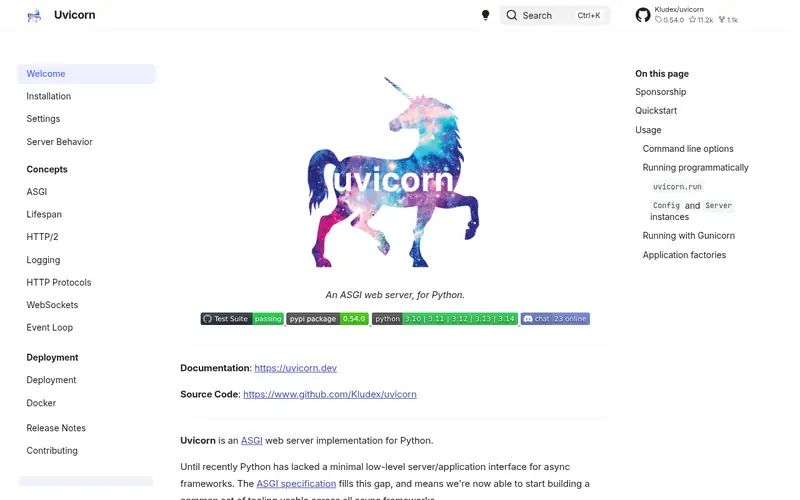
Uvicorn is a lightning-fast ASGI server built on uvloop and httptools. It runs on Linux, macOS and Windows, installs from PyPI with pip, and starts an app with a single command such as uvicorn main:app. The project is maintained under the Encode organization, the same group behind Starlette.
It handles HTTP/1.1 and WebSockets, and it can run multiple worker processes with the --workers flag. It does not serve HTTP/2. For production, the documentation suggests running it behind a process manager or a reverse proxy that handles TLS and connection buffering.
Uvicorn is BSD-licensed and has no paid tier. It suits teams that want the path most tutorials and framework docs assume. Skip it if you need HTTP/2 termination inside the app server, or if you want a single tool that also manages worker lifecycles across restarts.
Standout: Reference server for FastAPI and Starlette
Free (open source), as listed by the vendor (Uvicorn website). Confirm the current plan price before you buy.
Free plan. Plans change, so confirm on the vendor's pricing page before you buy.
Benefits
- Reference server for FastAPI and Starlette
- supports HTTP/1.1 and WebSockets with a simple CLI
Drawbacks
- No built-in HTTP/2
- production setups often pair it with a process manager
Skip it if this limit matters to you: no built-in HTTP/2.
Verdict. A sensible pick for fastAPI and Starlette apps that need a well-documented default server.
Hypercorn
Best for apps that need HTTP/2, HTTP/3 or multiple worker modes in one server
What it is and where it fits
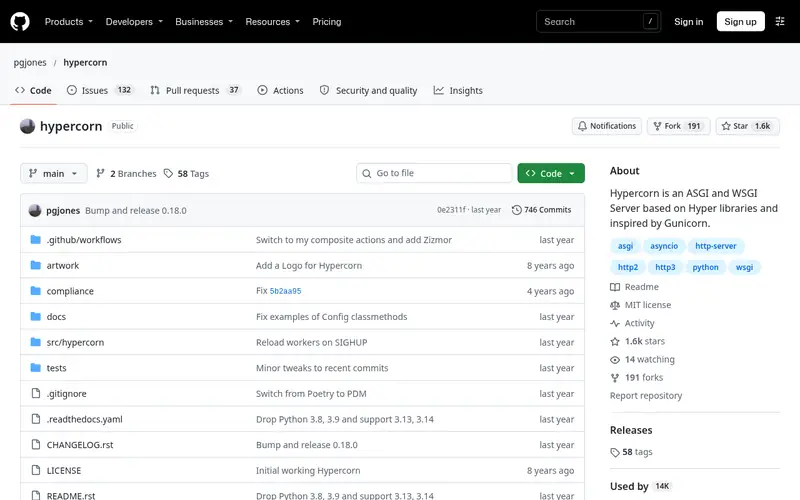
Hypercorn is an ASGI and WSGI server built on the sans-io protocol libraries from the same author. It runs on Linux, macOS and Windows and installs from PyPI. It supports HTTP/1.1, HTTP/2 and WebSockets, and it can run with asyncio or trio as the async backend.
Configuration can come from a command line, a TOML file or a Python module. It supports multiple workers and graceful restarts. The project is MIT-licensed with no paid tier.
Hypercorn fits projects that need HTTP/2 at the server layer or that already use trio. Its documentation is solid but less widely mirrored in framework guides than Uvicorn's. Skip it if your team wants the most common setup and the largest pool of Stack Overflow answers.
Standout: Supports HTTP/1.1, HTTP/2 and WebSockets
Free (open source), as listed by the vendor (Hypercorn website). Confirm the current plan price before you buy.
Free plan. Plans change, so confirm on the vendor's pricing page before you buy.
Benefits
- Supports HTTP/1.1, HTTP/2 and WebSockets
- offers asyncio and trio worker classes
Drawbacks
- Smaller community than Uvicorn
- fewer framework-specific deployment guides
Skip it if this limit matters to you: smaller community than Uvicorn.
Verdict. A sensible pick for apps that need HTTP/2, HTTP/3 or multiple worker modes in one server.
Daphne
Best for django Channels projects that need ASGI with WebSocket support
What it is and where it fits
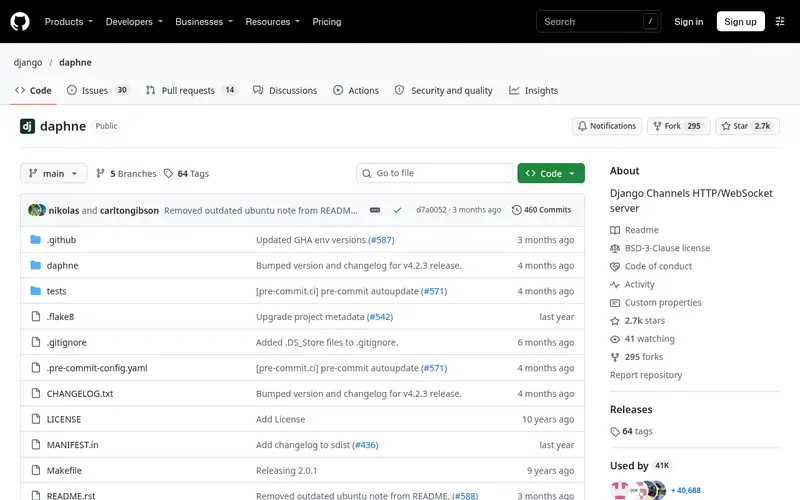
Daphne is the ASGI server maintained as part of the Django Channels project. It runs on Linux, macOS and Windows and installs from PyPI. It serves HTTP and WebSocket connections and is the server the Channels documentation uses for deployment examples.
It is BSD-licensed and has no paid tier. Daphne is a good fit when your app is built on Django Channels and you want the server the project tests against. For non-Django ASGI apps, it works but offers no advantage over Uvicorn or Hypercorn.
Skip Daphne if you are not using Channels, or if you need HTTP/2, which it does not provide.
Standout: Maintained by the Django project
Free (open source), as listed by the vendor (Daphne website). Confirm the current plan price before you buy.
Free plan. Plans change, so confirm on the vendor's pricing page before you buy.
Benefits
- Maintained by the Django project
- handles HTTP and WebSocket protocols for Channels
Drawbacks
- Tied closely to the Django Channels ecosystem
- less common outside Django
Skip it if this limit matters to you: tied closely to the Django Channels ecosystem.
Verdict. A sensible pick for django Channels projects that need ASGI with WebSocket support.
Granian
Best for teams that want a Rust-based ASGI and WSGI server
What it is and where it fits
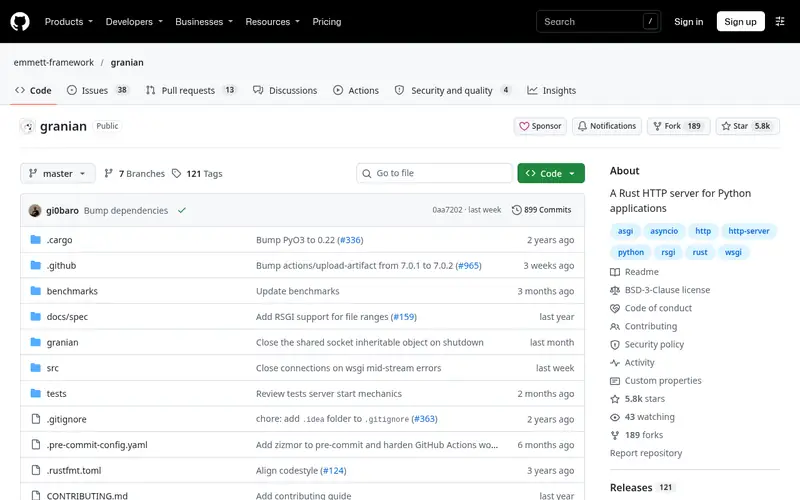
Granian is an HTTP server written in Rust that exposes a Python interface for ASGI, WSGI and RSGI applications. It installs from PyPI as a compiled wheel and runs on Linux, macOS and Windows. It supports HTTP/1.1 and HTTP/2, and it handles WebSockets for ASGI apps.
It is BSD-licensed with no paid tier. The project is maintained by the Emmett framework author and is used as that framework's server. It offers a single binary-style server for mixed ASGI and WSGI deployments.
Granian is newer than the alternatives, so expect fewer tutorials and less community troubleshooting. Skip it if your team needs a long track record or if your platform lacks a prebuilt wheel and you cannot compile Rust.
Standout: Single server for ASGI, WSGI and RSGI apps
Free (open source), as listed by the vendor (Granian website). Confirm the current plan price before you buy.
Free plan. Plans change, so confirm on the vendor's pricing page before you buy.
Benefits
- Single server for ASGI, WSGI and RSGI apps
- written in Rust with a Python interface
Drawbacks
- Newer project with a smaller user base
- fewer third-party guides
Skip it if this limit matters to you: newer project with a smaller user base.
Verdict. A sensible pick for teams that want a Rust-based ASGI and WSGI server.
Gunicorn with uvicorn workers
Best for production deployments that want a mature process manager in front of Uvicorn
What it is and where it fits
Gunicorn is a WSGI process manager, but it can run ASGI apps through its uvicorn worker class. You install both packages and start Gunicorn with the uvicorn.workers.UvicornWorker class. Gunicorn then manages worker processes, restarts and signals while Uvicorn handles the ASGI protocol.
It runs on Linux and other Unix-like systems; it does not run natively on Windows. It is MIT-licensed with no paid tier. The combination is common in container deployments where teams want Gunicorn's worker lifecycle controls.
This is two packages, not one. Skip it if you want a single dependency, or if you run on Windows. Also check the worker class name against the current Uvicorn release, since the project has changed its recommended worker path over time.
Standout: Mature process manager with worker recycling and graceful restarts
Free (open source), as listed by the vendor (Gunicorn with uvicorn workers website). Confirm the current plan price before you buy.
Free plan. Plans change, so confirm on the vendor's pricing page before you buy.
Benefits
- Mature process manager with worker recycling and graceful restarts
- widely used in production
Drawbacks
- Gunicorn itself is not an ASGI server
- you must install and configure uvicorn workers
Skip it if this limit matters to you: gunicorn itself is not an ASGI server.
Verdict. A sensible pick for production deployments that want a mature process manager in front of Uvicorn.
Who should use what
If you run FastAPI or Starlette and want the setup most guides assume, start with Uvicorn. If you need HTTP/2 at the server layer or use trio, look at Hypercorn. If your app is built on Django Channels, use Daphne. If you want a mature process manager for containers, pair Gunicorn with uvicorn workers. If you want a Rust-based server for mixed ASGI and WSGI apps, evaluate Granian.
Questions to settle before you buy
What to check before you buy
- Confirm the server supports the protocols you need: HTTP/1.1, HTTP/2, WebSockets.
- Check that prebuilt wheels exist for your OS and Python version.
- Decide whether you need a separate process manager for worker restarts.
- Read the project's deployment notes on running behind a reverse proxy for TLS.
- Check the licence and the last release date on the repository.
FAQ
Is Uvicorn an ASGI server or a framework?
Uvicorn is an ASGI server. It runs applications built with frameworks such as FastAPI, Starlette or Django, but it does not provide routing or request handling itself.
Do I need Gunicorn if I use Uvicorn?
No. Uvicorn can run multiple workers with its --workers flag. Gunicorn adds process management features some teams prefer in production, but it is optional.
Which ASGI server supports HTTP/2?
Hypercorn supports HTTP/2, and Granian supports it as well. Uvicorn and Daphne serve HTTP/1.1 and WebSockets, so HTTP/2 is usually terminated at a reverse proxy in front of them.
Are these servers free?
Yes. All the servers listed here are open source with permissive licences and no paid tiers.
Can I run an ASGI server on Windows?
Uvicorn, Hypercorn, Daphne and Granian run on Windows. Gunicorn does not run natively on Windows, so use one of the others there.
Sources we checked
Method: how we score · editorial policy.
Change log. First published 27 Nov 2026.