Stage 03 · Host · Researched comparison
Best Python Database Migration Tools in 2026
Alembic is the first pick for most teams using SQLAlchemy, because it generates and runs schema migrations from Python models. Django Migrations suits projects already on the Django ORM and needs no extra install. Flyway and Liquibase are strong alternatives when you want one migration tool across several languages, including Python services that do not use a full ORM.

By Shihab Mia
Published 27 Nov 2026 · 7 tools compared
We run no ads and no affiliate links at launch. The order of a list follows our published method. See how we score.
Prices are the starting prices vendors list publicly. Plans change, so confirm the current price on the vendor page before you buy.
Key takeaways
- Alembic is free and open source and works with SQLAlchemy Core and ORM across PostgreSQL, MySQL, SQLite and other supported backends.
- Django Migrations ships with Django, so it adds no cost or dependency, but it only fits projects built on the Django ORM.
- Flyway and Liquibase are JVM-based tools that run versioned SQL migrations and can sit alongside Python services; both have free community editions and paid tiers.
- Migration files often contain schema details and sometimes seed data, so keep them out of public repos and review them before applying to production.
Who each pick is for
- Teams using SQLAlchemy who want generated migrationsAlembic
- Django projects that want built-in schema versioningDjango Migrations
- Teams that want one migration runner across languagesFlyway
- Teams that need database-agnostic changelogsLiquibase
- Python projects that prefer plain SQL or Python migrationsyoyo-migrations
- Peewee ORM users who need simple migrationsPeewee Migrate
- Teams that want database-native, dependency-aware migrationsSqitch
Comparison
| Tool | Best for | Standout feature | Listed starting price | Free plan or trial |
|---|---|---|---|---|
| 1Alembic | Teams using SQLAlchemy who want generated migrations | Generates migration scripts from model changes | Free (open source) | Free plan |
| 2Django Migrations | Django projects that want built-in schema versioning | Included with Django, no extra dependency | Free (open source) | Free plan |
| 3Flyway | Teams that want one migration runner across languages | Versioned SQL and Java migrations with a clear naming convention | See vendor pricing page | Free plan |
| 4Liquibase | Teams that need database-agnostic changelogs | Changelogs in SQL, XML, YAML or JSON | See vendor pricing page | Free plan |
| 5yoyo-migrations | Python projects that prefer plain SQL or Python migrations | Small dependency that runs SQL or Python migration files | Free (open source) | Free plan |
| 6Peewee Migrate | Peewee ORM users who need simple migrations | Ships with the Peewee playhouse extensions | Free (open source) | Free plan |
| 7Sqitch | Teams that want database-native, dependency-aware migrations | Manages migrations as scripts with explicit dependencies | Free (open source) | Free plan |
How we picked
We picked tools that handle schema versioning and migration for Python projects, then checked fit for the job, supported platforms and databases, licence and price, and the main limits of each. Sources are vendor documentation, project repositories and public pricing pages. Prices and plan details change, so confirm them on the vendor site before you commit.
The tools, one by one
Alembic
Best for teams using SQLAlchemy who want generated migrations
What it is and where it fits
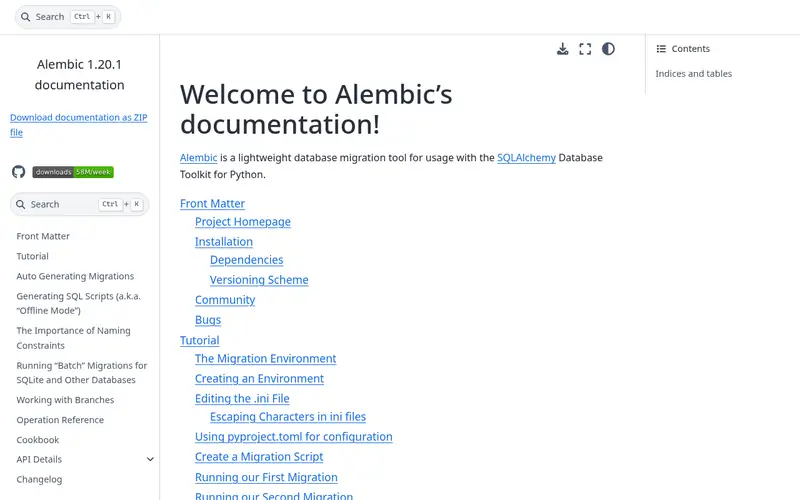
Alembic is the migration tool maintained by the SQLAlchemy project. It stores schema versions in a database table, generates revision scripts from your models with the autogenerate command, and applies or rolls back changes with upgrade and downgrade commands. It runs anywhere Python runs and supports the database backends SQLAlchemy supports, including PostgreSQL, MySQL and SQLite.
The licence is MIT, so there is no cost and no paid tier. The main limit is that autogenerate is a starting point, not a guarantee: renames, type changes and some constraints need manual edits. Teams that do not use SQLAlchemy should look at a language-neutral tool instead.
Standout: Generates migration scripts from model changes
Free (open source), as listed by the vendor (Alembic website). Confirm the current plan price before you buy.
Free plan. Plans change, so confirm on the vendor's pricing page before you buy.
Benefits
- Generates migration scripts from model changes
- integrates tightly with SQLAlchemy Core and ORM
Drawbacks
- Requires SQLAlchemy knowledge
- autogenerate can miss some schema changes and needs review
Skip it if this limit matters to you: requires SQLAlchemy knowledge.
Verdict. A sensible pick for teams using SQLAlchemy who want generated migrations.
Alternatives in this guide: Django Migrations, Flyway, Liquibase
Django Migrations
Best for django projects that want built-in schema versioning
What it is and where it fits
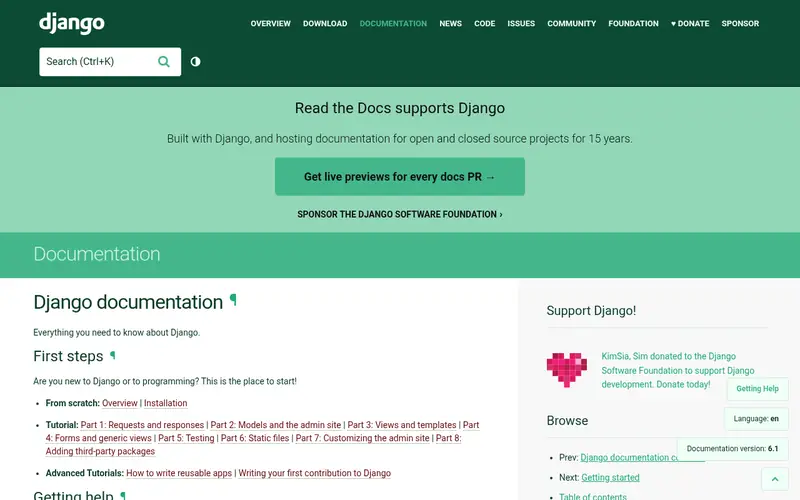
Django Migrations is part of the Django framework. The makemigrations command writes migration files from model changes, and migrate applies them in order. It tracks applied migrations in a database table and supports squashing and reversing where the migration allows it.
It is free under the BSD licence and ships with every Django install, so there is nothing to buy or configure. The trade-off is scope: it is tied to Django models, and hand-written SQL migrations need the RunSQL operation. Projects that mix frameworks or use SQLAlchemy should pick Alembic or a neutral runner.
Standout: Included with Django, no extra dependency
Free (open source), as listed by the vendor (Django Migrations website). Confirm the current plan price before you buy.
Free plan. Plans change, so confirm on the vendor's pricing page before you buy.
Benefits
- Included with Django, no extra dependency
- makemigrations and migrate cover most schema changes
Drawbacks
- Only works with the Django ORM
- less flexible for raw SQL or multi-framework codebases
Skip it if this limit matters to you: only works with the Django ORM.
Verdict. A sensible pick for django projects that want built-in schema versioning.
Flyway
Best for teams that want one migration runner across languages
What it is and where it fits
Flyway applies versioned migration files in order and records what has run in a schema history table. You can write migrations as plain SQL, which suits Python services that manage schema outside the ORM. It runs on the JVM and is often invoked from CI pipelines or a command-line wrapper.
The community edition is free and open source. Paid editions add support for more databases and team features; check the vendor pricing page for current tiers. Python teams should weigh the extra Java runtime against the benefit of a single migration tool shared with other services.
Standout: Versioned SQL and Java migrations with a clear naming convention
See vendor pricing page, as listed by the vendor (Flyway website). Confirm the current plan price before you buy.
Free plan. Plans change, so confirm on the vendor's pricing page before you buy.
Benefits
- Versioned SQL and Java migrations with a clear naming convention
- community edition is free and open source
Drawbacks
- Runs on the JVM, adding a Java dependency to Python projects
- some database support sits behind paid editions
Skip it if this limit matters to you: runs on the JVM, adding a Java dependency to Python projects.
Verdict. A sensible pick for teams that want one migration runner across languages.
Alternatives in this guide: Alembic, Django Migrations, Liquibase
Liquibase
Best for teams that need database-agnostic changelogs
What it is and where it fits
Liquibase tracks schema changes in changelog files and applies them with a command-line tool or through integrations. Changelogs can be written in SQL, XML, YAML or JSON, and the tool tracks applied changesets in a database table. It is database-agnostic, which helps when the same migrations must run against several engines.
The open-source core is free. Pro and enterprise editions add features such as policy checks and support; confirm details and prices on the vendor site. For Python-only projects, the JVM requirement and changelog format may be more overhead than Alembic or Django Migrations.
Standout: Changelogs in SQL, XML, YAML or JSON
See vendor pricing page, as listed by the vendor (Liquibase website). Confirm the current plan price before you buy.
Free plan. Plans change, so confirm on the vendor's pricing page before you buy.
Benefits
- Changelogs in SQL, XML, YAML or JSON
- supports many databases with one tool
Drawbacks
- JVM-based, so it adds a runtime dependency
- changelog format adds a layer beyond plain SQL
Skip it if this limit matters to you: JVM-based, so it adds a runtime dependency.
Verdict. A sensible pick for teams that need database-agnostic changelogs.
Alternatives in this guide: Alembic, Django Migrations, Flyway
yoyo-migrations
Best for python projects that prefer plain SQL or Python migrations
What it is and where it fits
yoyo-migrations is a Python library and command-line tool that applies migrations written as SQL or Python files. It keeps a record of applied migrations in the database and supports rollback where a migration defines a step back. It does not require SQLAlchemy or Django, which makes it a fit for small services and scripts.
It is free and open source. The project is smaller than Alembic, so documentation and community answers are thinner, and framework integrations are limited. Teams that want generated migrations from models should use Alembic instead; yoyo suits hand-written migrations.
Standout: Small dependency that runs SQL or Python migration files
Free (open source), as listed by the vendor (yoyo-migrations website). Confirm the current plan price before you buy.
Free plan. Plans change, so confirm on the vendor's pricing page before you buy.
Benefits
- Small dependency that runs SQL or Python migration files
- works without an ORM
Drawbacks
- Smaller community than Alembic or Django
- fewer integrations with frameworks
Skip it if this limit matters to you: smaller community than Alembic or Django.
Verdict. A sensible pick for python projects that prefer plain SQL or Python migrations.
Alternatives in this guide: Alembic, Django Migrations, Flyway
Peewee Migrate
Best for peewee ORM users who need simple migrations
What it is and where it fits
Peewee Migrate is part of Peewee's playhouse module. It provides a migrator that tracks schema operations such as adding columns, renaming tables and creating indexes, and applies them in order. It works with the databases Peewee supports, including SQLite, PostgreSQL and MySQL.
It is free under the Peewee licence and needs no separate install beyond Peewee. The scope is narrower than Alembic: it handles common schema operations but is not a general-purpose migration runner for arbitrary SQL. Teams on Peewee benefit from staying inside the ORM; others should look elsewhere.
Standout: Ships with the Peewee playhouse extensions
Free (open source), as listed by the vendor (Peewee Migrate website). Confirm the current plan price before you buy.
Free plan. Plans change, so confirm on the vendor's pricing page before you buy.
Benefits
- Ships with the Peewee playhouse extensions
- simple API for adding and dropping columns and indexes
Drawbacks
- Limited to Peewee projects
- fewer features than full migration frameworks
Skip it if this limit matters to you: limited to Peewee projects.
Verdict. A sensible pick for peewee ORM users who need simple migrations.
Alternatives in this guide: Alembic, Django Migrations, Flyway
Sqitch
Best for teams that want database-native, dependency-aware migrations
What it is and where it fits
Sqitch is a standalone migration tool that manages change scripts with dependency tracking and a plan file. It is not tied to a language, so Python services can use it alongside other applications. It supports PostgreSQL, MySQL, SQLite, Oracle and others through engine-specific drivers.
The tool is free and open source. It works best when migrations are written as SQL and reviewed like code. The trade-off is that it does not read Python models, so schema changes must be written by hand. Teams that want autogeneration from models should use Alembic or Django Migrations.
Standout: Manages migrations as scripts with explicit dependencies
Free (open source), as listed by the vendor (Sqitch website). Confirm the current plan price before you buy.
Free plan. Plans change, so confirm on the vendor's pricing page before you buy.
Benefits
- Manages migrations as scripts with explicit dependencies
- supports many database engines
Drawbacks
- Not Python-specific, so it sits outside ORM workflows
- steeper learning curve than ORM tools
Skip it if this limit matters to you: not Python-specific, so it sits outside ORM workflows.
Verdict. A sensible pick for teams that want database-native, dependency-aware migrations.
Alternatives in this guide: Alembic, Django Migrations, Flyway
Who should use what
Teams on SQLAlchemy should start with Alembic, because it generates migrations from models and runs on any Python platform. Django projects should use Django Migrations, which ships with the framework and needs no extra install. Teams that run Python services next to other languages should consider Flyway or Liquibase so one tool covers every service. Small projects that prefer hand-written SQL can use yoyo-migrations or Sqitch, and Peewee users can stay inside the ORM with Peewee Migrate.
Questions to settle before you buy
What to check before you buy
- Confirm the tool supports every database engine you run, including test and production targets.
- Check whether migrations are generated from models or written by hand, and pick the workflow your team can review.
- Read the licence and any paid tier limits before you depend on vendor-only features.
- Test upgrade and rollback paths on a copy of production schema before applying changes.
- Keep migration files and any seed data out of public repositories and review them for sensitive values.
FAQ
Do I need a separate migration tool if I use an ORM?
Not always. Django ships its own migrations, and Peewee has a migrator in its playhouse module. SQLAlchemy users usually add Alembic. A separate tool helps when you want one runner across several languages or when migrations are written as plain SQL.
Can I use Flyway or Liquibase with a Python project?
Yes. Both run versioned migrations against the database and are not tied to a language. They run on the JVM, so you add a Java runtime to your pipeline. Teams often use them when Python services share a database with services written in other languages.
Are these tools free?
Alembic, Django Migrations, yoyo-migrations, Peewee Migrate and Sqitch are free and open source. Flyway and Liquibase have free community editions and paid tiers with extra database support and team features. Check the vendor pricing page for current details.
How do I keep migration files safe?
Treat migration files like code: review them before merging, keep them out of public repositories if they contain schema details or seed data, and avoid committing credentials. Apply migrations to staging first, and keep backups before running them against production.
What is the difference between Alembic and Django Migrations?
Alembic works with SQLAlchemy and generates migrations from models or hand-written scripts. Django Migrations is built into Django and only works with the Django ORM. Both track applied versions in a database table. Pick the one that matches your ORM.
Sources we checked
Method: how we score · editorial policy.
Change log. First published 27 Nov 2026.