Stage 03 · Host · Researched comparison
Best Kotlin ORMs in 2026
JetBrains Exposed is the first pick for most Kotlin teams that want a lightweight, type-safe SQL layer with a DSL and DAO style. It suits backend services on the JVM. Ktorm is a good alternative if you prefer a pure-Kotlin ORM with a functional query API. Hibernate with Panache is the choice when you need a mature JPA stack and broad database support.

By Shihab Mia
Published 27 Nov 2026 · 7 tools compared
We run no ads and no affiliate links at launch. The order of a list follows our published method. See how we score.
Prices are the starting prices vendors list publicly. Plans change, so confirm the current price on the vendor page before you buy.
Key takeaways
- JetBrains Exposed, Ktorm and SQLDelight are free and open source, so there is no licence cost.
- Hibernate ORM and jOOQ are free to start, but jOOQ has paid editions for commercial database support.
- SQLDelight targets Kotlin Multiplatform and generates typesafe Kotlin from SQL, which differs from reflection-based ORMs.
- None of these tools require pasting data into a third-party web page; they run in your build and runtime environment.
Who each pick is for
- Kotlin JVM services that want a typed SQL DSLJetBrains Exposed
- Kotlin developers who want a pure-Kotlin ORMKtorm
- Teams that need a mature JPA providerHibernate ORM
- Teams that want SQL-first code generationjOOQ
- Kotlin Multiplatform projects that want typesafe SQLSQLDelight
- Spring Boot teams that want repository abstractionsSpring Data JPA
- Teams that want explicit SQL mapping without a full ORMMyBatis
Comparison
| Tool | Best for | Standout feature | Listed starting price | Free plan or trial |
|---|---|---|---|---|
| 1JetBrains Exposed | Kotlin JVM services that want a typed SQL DSL | Type-safe Kotlin DSL and DAO APIs | Free (open source) | Free plan |
| 2Ktorm | Kotlin developers who want a pure-Kotlin ORM | Functional query API with strong typing | Free (open source) | Free plan |
| 3Hibernate ORM | Teams that need a mature JPA provider | Implements JPA and Jakarta Persistence | Free (open source) | Free plan |
| 4jOOQ | Teams that want SQL-first code generation | Generates typesafe Kotlin and Java from your schema | See vendor pricing page | Free trial (open-source databases only in the free edition) |
| 5SQLDelight | Kotlin Multiplatform projects that want typesafe SQL | Generates Kotlin from SQL for multiple platforms | Free (open source) | Free plan |
| 6Spring Data JPA | Spring Boot teams that want repository abstractions | Repository interfaces reduce boilerplate | Free (open source) | Free plan |
| 7MyBatis | Teams that want explicit SQL mapping without a full ORM | SQL stays in mapper files | Free (open source) | Free plan |
How we picked
We picked tools that are actively maintained and genuinely used for database access in Kotlin projects. Criteria were fit for the job, supported platforms, licence and pricing model, and main limits such as JPA compatibility or multiplatform support. Sources are vendor pages, official documentation and project repositories. Prices change, so confirm current terms on the vendor site before you commit. We did not run benchmarks or collect user reviews.
The tools, one by one
JetBrains Exposed
Best for kotlin JVM services that want a typed SQL DSL
What it is and where it fits
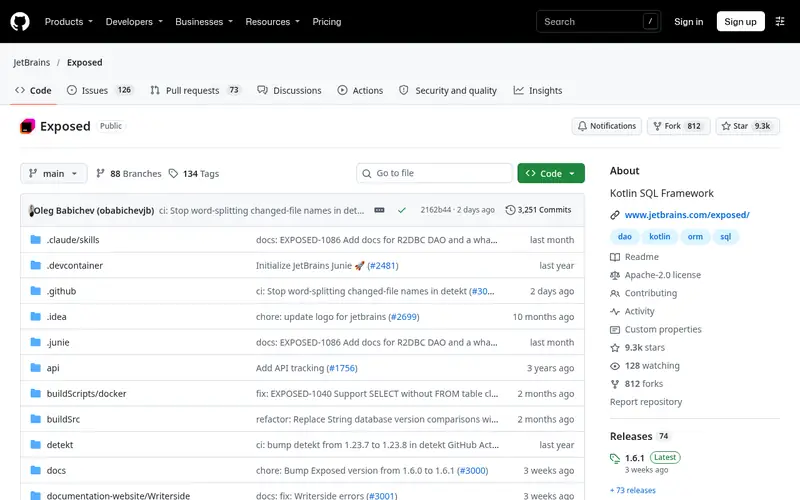
Exposed is a lightweight SQL library and ORM from JetBrains. It offers two styles: a DSL for building queries in Kotlin and a DAO layer for entity mapping. It runs on the JVM and supports PostgreSQL, MySQL, MariaDB, Oracle, SQL Server, SQLite and H2 through JDBC drivers. The project is Apache 2.0 licensed, so there is no cost.
Exposed does not implement the JPA specification. That means no annotation-driven entity mapping and no drop-in JPA provider behavior. Teams that need JPA compatibility or a large set of existing integrations should look at Hibernate instead. Exposed fits projects that want explicit SQL control with Kotlin type safety and are comfortable writing more query code.
Standout: Type-safe Kotlin DSL and DAO APIs
Free (open source), as listed by the vendor (JetBrains Exposed website). Confirm the current plan price before you buy.
Free plan. Plans change, so confirm on the vendor's pricing page before you buy.
Benefits
- Type-safe Kotlin DSL and DAO APIs
- maintained by JetBrains
Drawbacks
- Not a full JPA implementation
- smaller ecosystem than Hibernate
Skip it if this limit matters to you: not a full JPA implementation.
Verdict. A sensible pick for kotlin JVM services that want a typed SQL DSL.
Alternatives in this guide: Ktorm, Hibernate ORM, jOOQ
Ktorm
Best for kotlin developers who want a pure-Kotlin ORM
What it is and where it fits
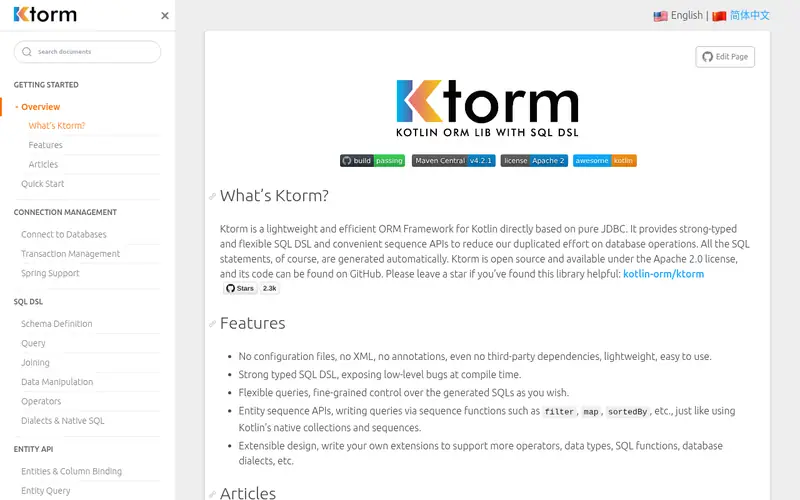
Ktorm is a lightweight ORM framework written in pure Kotlin. It provides a typed SQL DSL, entity mapping and a schema definition API. It runs on the JVM and works with JDBC-compatible databases including MySQL, PostgreSQL, SQLite, Oracle and SQL Server. The project is Apache 2.0 licensed.
Ktorm avoids annotation processing and reflection-heavy setup, which keeps compile times predictable. Its query API is functional and reads close to SQL. The trade-off is a smaller ecosystem and fewer third-party modules than the JPA world. It suits teams that want an ORM that feels native to Kotlin and are willing to write their own integration glue.
Standout: Functional query API with strong typing
Free (open source), as listed by the vendor (Ktorm website). Confirm the current plan price before you buy.
Free plan. Plans change, so confirm on the vendor's pricing page before you buy.
Benefits
- Functional query API with strong typing
- no annotation processing
Drawbacks
- Smaller community than Hibernate
- fewer integrations
Skip it if this limit matters to you: smaller community than Hibernate.
Verdict. A sensible pick for kotlin developers who want a pure-Kotlin ORM.
Alternatives in this guide: JetBrains Exposed, Hibernate ORM, jOOQ
Hibernate ORM
Best for teams that need a mature JPA provider
What it is and where it fits
Hibernate ORM is the most widely used JPA provider. It implements the Jakarta Persistence specification and works with Kotlin through annotations and entity classes. It supports a long list of relational databases and integrates with Spring Boot, Quarkus and Micronaut. The core project is LGPL 2.1 licensed and free to use.
Hibernate is a full ORM with caching, lazy loading, dirty checking and a query language. That power comes with more configuration and a steeper learning curve. Kotlin teams often pair it with the Kotlin JPA plugin or Panache in Quarkus to reduce boilerplate. Choose it when JPA compatibility, tooling and a large integration ecosystem matter more than a minimal footprint.
Standout: Implements JPA and Jakarta Persistence
Free (open source), as listed by the vendor (Hibernate ORM website). Confirm the current plan price before you buy.
Free plan. Plans change, so confirm on the vendor's pricing page before you buy.
Benefits
- Implements JPA and Jakarta Persistence
- wide database and tooling support
Drawbacks
- More configuration and mapping complexity
- heavier startup than lightweight libraries
Skip it if this limit matters to you: more configuration and mapping complexity.
Verdict. A sensible pick for teams that need a mature JPA provider.
Alternatives in this guide: JetBrains Exposed, Ktorm, jOOQ
jOOQ
Best for teams that want SQL-first code generation
What it is and where it fits
jOOQ generates Java and Kotlin code from your database schema and lets you write typesafe SQL. It runs on the JVM and supports many databases, though the free open-source edition covers open-source databases only. Commercial database support requires a paid edition; check the vendor pricing page for current terms.
jOOQ is not an ORM in the entity-mapping sense. It is a SQL builder and execution layer, which suits teams that want explicit SQL with compile-time checks. The build-time code generation step and licensing model are the main things to plan for. It fits projects with complex queries where hand-written SQL strings become hard to maintain.
Standout: Generates typesafe Kotlin and Java from your schema
See vendor pricing page, as listed by the vendor (jOOQ website). Confirm the current plan price before you buy.
Free trial (open-source databases only in the free edition). Plans change, so confirm on the vendor's pricing page before you buy.
Benefits
- Generates typesafe Kotlin and Java from your schema
- close to SQL semantics
Drawbacks
- Paid editions for commercial databases
- code generation adds a build step
Skip it if this limit matters to you: paid editions for commercial databases.
Verdict. A sensible pick for teams that want SQL-first code generation.
Alternatives in this guide: JetBrains Exposed, Ktorm, Hibernate ORM
SQLDelight
Best for kotlin Multiplatform projects that want typesafe SQL
What it is and where it fits
SQLDelight generates typesafe Kotlin APIs from SQL statements. It supports Android, JVM, Native and JavaScript targets, which makes it a fit for Kotlin Multiplatform projects. It is Apache 2.0 licensed and free. You write SQL, and the Gradle plugin generates Kotlin classes and verifies queries at compile time.
SQLDelight is closer to a SQL access layer than a full ORM. There is no lazy loading or entity graph management. Migrations are handled through schema files and version tracking, so plan them early. It suits mobile and multiplatform teams that want shared database code and are comfortable writing SQL directly.
Standout: Generates Kotlin from SQL for multiple platforms
Free (open source), as listed by the vendor (SQLDelight website). Confirm the current plan price before you buy.
Free plan. Plans change, so confirm on the vendor's pricing page before you buy.
Benefits
- Generates Kotlin from SQL for multiple platforms
- compile-time query checks
Drawbacks
- Not a full ORM
- schema migrations need care
Skip it if this limit matters to you: not a full ORM.
Verdict. A sensible pick for kotlin Multiplatform projects that want typesafe SQL.
Alternatives in this guide: JetBrains Exposed, Ktorm, Hibernate ORM
Spring Data JPA
Best for spring Boot teams that want repository abstractions
What it is and where it fits
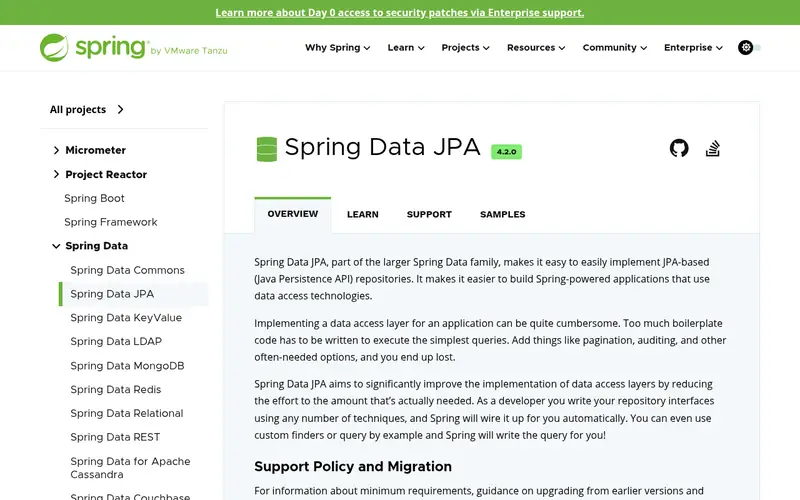
Spring Data JPA builds on JPA and Hibernate and adds repository abstractions. You define interfaces, and Spring generates query implementations. It runs on the JVM and is Apache 2.0 licensed. It is the default data layer for many Spring Boot Kotlin applications.
The abstraction reduces boilerplate but can make generated queries harder to predict. Kotlin support is good, with extensions for coroutines in related Spring modules. It suits teams already on Spring Boot. Teams outside Spring should use Hibernate directly or a lighter library such as Exposed.
Standout: Repository interfaces reduce boilerplate
Free (open source), as listed by the vendor (Spring Data JPA website). Confirm the current plan price before you buy.
Free plan. Plans change, so confirm on the vendor's pricing page before you buy.
Benefits
- Repository interfaces reduce boilerplate
- integrates with Hibernate
Drawbacks
- Tied to the Spring ecosystem
- can hide query behavior
Skip it if this limit matters to you: tied to the Spring ecosystem.
Verdict. A sensible pick for spring Boot teams that want repository abstractions.
Alternatives in this guide: JetBrains Exposed, Ktorm, Hibernate ORM
MyBatis
Best for teams that want explicit SQL mapping without a full ORM
What it is and where it fits
MyBatis is a SQL mapper framework. You write SQL in XML or annotations and map results to Kotlin or Java objects. It runs on the JVM and supports common relational databases. It is Apache 2.0 licensed and free.
MyBatis does not manage entity state or lazy loading the way a JPA provider does. That makes behavior predictable but means more manual mapping. It suits teams with complex SQL that want full control and are willing to maintain mapper files. Kotlin usage is supported through standard Java interop.
Standout: SQL stays in mapper files
Free (open source), as listed by the vendor (MyBatis website). Confirm the current plan price before you buy.
Free plan. Plans change, so confirm on the vendor's pricing page before you buy.
Benefits
- SQL stays in mapper files
- predictable query behavior
Drawbacks
- More manual mapping code
- less entity management than JPA
Skip it if this limit matters to you: more manual mapping code.
Verdict. A sensible pick for teams that want explicit SQL mapping without a full ORM.
Alternatives in this guide: JetBrains Exposed, Ktorm, Hibernate ORM
Who should use what
A Kotlin backend team that wants a lightweight typed SQL layer should start with JetBrains Exposed. A team that needs JPA compatibility and broad tooling should use Hibernate ORM, often through Spring Data JPA or Quarkus Panache. A Kotlin Multiplatform mobile project should look at SQLDelight. A team with complex reporting queries and a budget for commercial database support should evaluate jOOQ.
Questions to settle before you buy
What to check before you buy
- Confirm the library supports your database and driver version.
- Check whether you need JPA compatibility or can use a lighter SQL layer.
- Review the licence and any paid edition terms for commercial databases.
- Plan schema migrations and how the tool handles them.
- Check Kotlin version support and whether the project is actively maintained.
FAQ
Is Exposed a full ORM?
Exposed provides a DSL and a DAO layer, but it does not implement JPA. It is a lightweight SQL library with ORM features. Teams that need full JPA behavior should use Hibernate.
Which Kotlin ORM works with Kotlin Multiplatform?
SQLDelight is built for multiplatform targets including Android, JVM, Native and JavaScript. Most JPA-based ORMs target the JVM only.
Is jOOQ free?
jOOQ has a free edition for open-source databases. Commercial database support requires a paid edition. Check the vendor pricing page for current terms.
Can I use Hibernate with Kotlin?
Yes. Hibernate works with Kotlin entity classes, and plugins such as the Kotlin JPA plugin reduce boilerplate. Many teams use it through Spring Data JPA or Quarkus Panache.
Do these tools send my data to a third party?
No. These are libraries that run in your build and runtime environment. They do not require pasting data into a web page. Keep credentials in environment variables or a secrets manager.
Sources we checked
Method: how we score · editorial policy.
Change log. First published 27 Nov 2026.