Stage 03 · Host · Researched comparison
Best JavaScript Browser Storage Libraries in 2026
Dexie.js is the first pick for most teams that need a full IndexedDB layer with queries, indexes and schema versioning. Pick localForage if you want a simple key-value API that falls back from IndexedDB to WebSQL and localStorage. Pick idb if you want a small promise wrapper over the raw IndexedDB API without a query layer.

By Shihab Mia
Published 28 Nov 2026 · 7 tools compared
We run no ads and no affiliate links at launch. The order of a list follows our published method. See how we score.
Prices are the starting prices vendors list publicly. Plans change, so confirm the current price on the vendor page before you buy.
Key takeaways
- Dexie.js, localForage, idb, idb-keyval, RxDB, PouchDB and store2 are all free and open source.
- Dexie.js and RxDB add query and schema features; idb and idb-keyval stay close to the native API.
- localForage and store2 offer simple key-value storage with fallbacks to older storage engines.
- PouchDB and RxDB target offline sync and reactive data, which is more than plain storage.
Who each pick is for
- Apps that need indexed queries over IndexedDBDexie.js
- Simple key-value storage with automatic fallbackslocalForage
- A thin promise wrapper over native IndexedDBidb
- Tiny key-value storage on top of IndexedDBidb-keyval
- Reactive offline-first apps that need syncRxDB
- Offline apps that sync with CouchDB-compatible serversPouchDB
- A friendlier wrapper around localStorage and sessionStoragestore2
Comparison
| Tool | Best for | Standout feature | Listed starting price | Free plan or trial |
|---|---|---|---|---|
| 1Dexie.js | Apps that need indexed queries over IndexedDB | Rich query API with indexes and schema versioning | Free (open source) | Free plan |
| 2localForage | Simple key-value storage with automatic fallbacks | Familiar localStorage-style API that returns promises | Free (open source) | Free plan |
| 3idb | A thin promise wrapper over native IndexedDB | Small footprint with a promise-based API close to IndexedDB | Free (open source) | Free plan |
| 4idb-keyval | Tiny key-value storage on top of IndexedDB | Very small API for get, set, delete and clear | Free (open source) | Free plan |
| 5RxDB | Reactive offline-first apps that need sync | Reactive queries and observable data changes | Free (open source) | Free plan |
| 6PouchDB | Offline apps that sync with CouchDB-compatible servers | Built-in sync and replication with CouchDB-compatible backends | Free (open source) | Free plan |
| 7store2 | A friendlier wrapper around localStorage and sessionStorage | Namespacing, JSON handling and a simpler API than raw localStorage | Free (open source) | Free plan |
How we picked
We picked libraries that wrap IndexedDB or localStorage and are currently maintained. Criteria were fit for client-side storage work, supported platforms, license and price, and the main limits each library imposes. Sources are vendor pages, official documentation and project repositories. Prices and plan terms change, so confirm details on the vendor site before you commit.
The tools, one by one
Dexie.js
Best for apps that need indexed queries over IndexedDB
What it is and where it fits
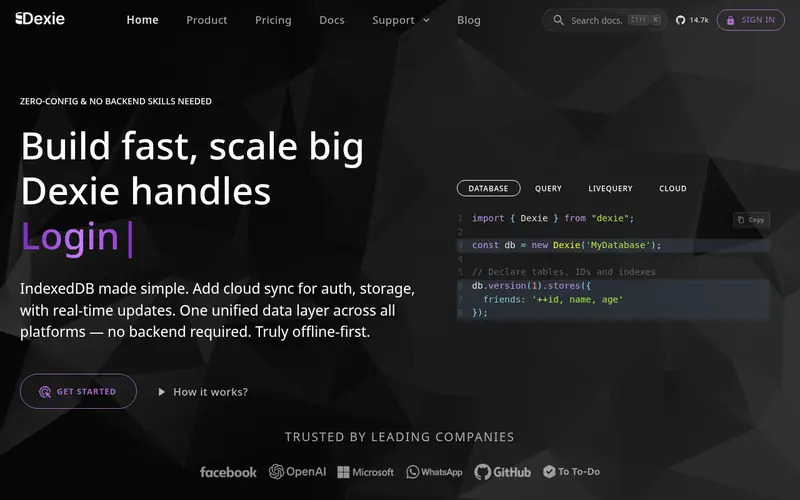
Dexie.js is a wrapper around IndexedDB that adds a query API, compound indexes, schema versioning and transactions. You define tables and indexes in code, then query with a chainable syntax instead of writing raw IndexedDB request handlers. It runs in browsers and has adapters for Node.js and React Native.
The project is open source under the Apache 2.0 license and is free to use. It also offers Dexie Cloud as a separate paid sync service, but the local library does not require it. The main limit is size and complexity: for a few keys, a smaller wrapper is enough.
Skip Dexie.js if you only store a handful of key-value pairs or need built-in sync with a remote database out of the box.
Standout: Rich query API with indexes and schema versioning
Free (open source), as listed by the vendor (Dexie.js website). Confirm the current plan price before you buy.
Free plan. Plans change, so confirm on the vendor's pricing page before you buy.
Benefits
- Rich query API with indexes and schema versioning
- works in browsers and with wrappers for Node and React
Drawbacks
- Larger learning curve than a plain key-value wrapper
- adds bundle size over the native API
Skip it if this limit matters to you: larger learning curve than a plain key-value wrapper.
Verdict. A sensible pick for apps that need indexed queries over IndexedDB.
Alternatives in this guide: localForage, idb, idb-keyval
localForage
Best for simple key-value storage with automatic fallbacks
What it is and where it fits
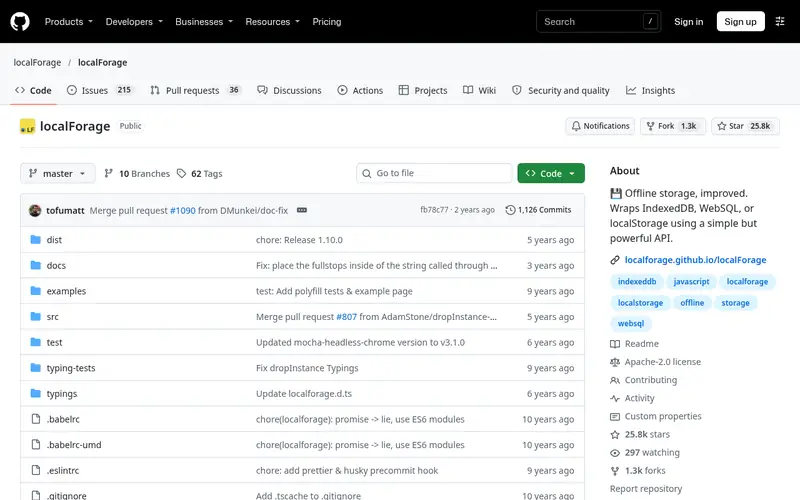
localForage gives you a key-value store with a callback and promise API that looks like localStorage. It uses IndexedDB by default and falls back to WebSQL and then localStorage depending on what the browser supports. It also stores more than strings, including blobs, typed arrays and objects.
It is open source under the Apache 2.0 license and free to use. Because it has no indexes or queries, it suits settings, caches and small offline data sets rather than large relational data. Check the repository activity before adopting it for a long-lived project.
Standout: Familiar localStorage-style API that returns promises
Free (open source), as listed by the vendor (localForage website). Confirm the current plan price before you buy.
Free plan. Plans change, so confirm on the vendor's pricing page before you buy.
Benefits
- Familiar localStorage-style API that returns promises
- falls back to WebSQL and localStorage when IndexedDB is unavailable
Drawbacks
- No query or index features
- project maintenance has slowed in recent years
Skip it if this limit matters to you: no query or index features.
Verdict. A sensible pick for simple key-value storage with automatic fallbacks.
Alternatives in this guide: Dexie.js, idb, idb-keyval
idb
Best for a thin promise wrapper over native IndexedDB
What it is and where it fits
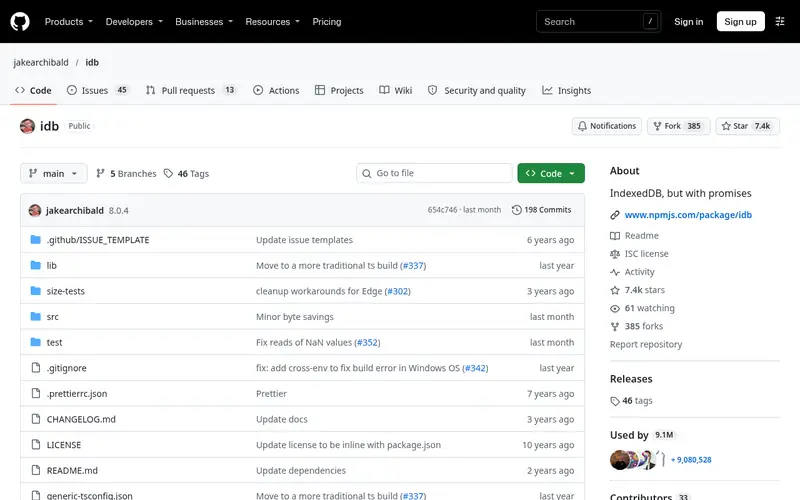
idb wraps the IndexedDB API in promises and async/await, which removes much of the event-based boilerplate. It stays close to the native model, so you still create object stores, indexes and transactions yourself. The library is small and adds little to your bundle.
It is open source under the ISC license and free to use. It runs wherever IndexedDB runs. Choose it if you know IndexedDB and want cleaner code without a query framework. Skip it if you want declarative schemas or complex queries handled for you.
Standout: Small footprint with a promise-based API close to IndexedDB
Free (open source), as listed by the vendor (idb website). Confirm the current plan price before you buy.
Free plan. Plans change, so confirm on the vendor's pricing page before you buy.
Benefits
- Small footprint with a promise-based API close to IndexedDB
- well documented by its maintainer
Drawbacks
- No query layer or schema helpers
- you still write IndexedDB logic yourself
Skip it if this limit matters to you: no query layer or schema helpers.
Verdict. A sensible pick for A thin promise wrapper over native IndexedDB.
Alternatives in this guide: Dexie.js, localForage, idb-keyval
idb-keyval
Best for tiny key-value storage on top of IndexedDB
What it is and where it fits
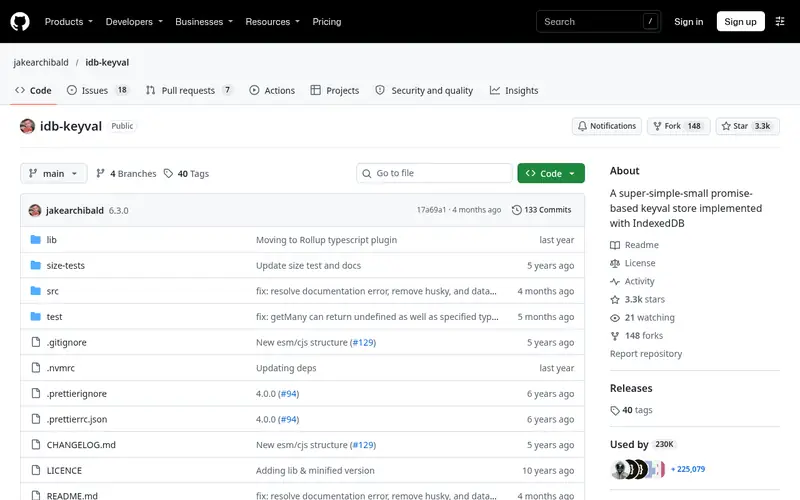
idb-keyval is a small library from the same maintainer as idb. It exposes a few functions to store values by key in a single IndexedDB store. It supports custom stores if you need more than one, but it does not offer queries or indexes.
It is open source under the Apache 2.0 license and free to use. It fits small use cases such as caching API responses or saving form drafts. For anything that needs filtering, sorting or relations, use Dexie.js or the native API through idb.
Standout: Very small API for get, set, delete and clear
Free (open source), as listed by the vendor (idb-keyval website). Confirm the current plan price before you buy.
Free plan. Plans change, so confirm on the vendor's pricing page before you buy.
Benefits
- Very small API for get, set, delete and clear
- promise-based and easy to learn
Drawbacks
- No indexes, queries or multiple stores
- not suited to structured data
Skip it if this limit matters to you: no indexes, queries or multiple stores.
Verdict. A sensible pick for tiny key-value storage on top of IndexedDB.
Alternatives in this guide: Dexie.js, localForage, idb
RxDB
Best for reactive offline-first apps that need sync
What it is and where it fits
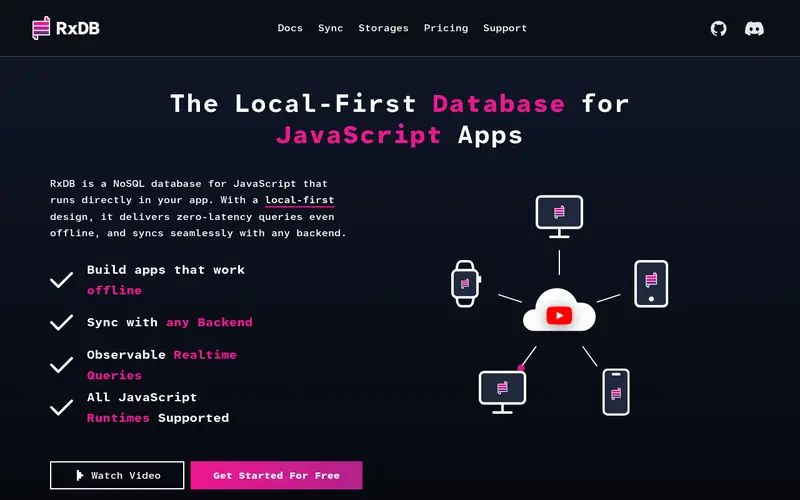
RxDB is a reactive, offline-first database for JavaScript that runs in browsers, Node.js, Electron and React Native. It stores data in IndexedDB or other adapters and exposes observable queries, so the UI updates when data changes. Replication plugins handle syncing with a server.
The core is open source and free. Some plugins, including certain storage and replication options, require a premium license. Check the pricing page for current terms. The main limit is complexity: it is a database layer, not a small key-value helper. Skip it for simple caching.
Standout: Reactive queries and observable data changes
Free (open source), as listed by the vendor (RxDB website). Confirm the current plan price before you buy.
Free plan. Plans change, so confirm on the vendor's pricing page before you buy.
Benefits
- Reactive queries and observable data changes
- replication plugins for syncing with a backend
Drawbacks
- Larger and more complex than a storage wrapper
- some plugins require a paid license
Skip it if this limit matters to you: larger and more complex than a storage wrapper.
Verdict. A sensible pick for reactive offline-first apps that need sync.
Alternatives in this guide: Dexie.js, localForage, idb
PouchDB
Best for offline apps that sync with CouchDB-compatible servers
What it is and where it fits
PouchDB is a JavaScript database modeled on CouchDB. In the browser it stores data in IndexedDB and syncs with CouchDB-compatible servers or other PouchDB instances. It handles conflicts and replication as part of the design.
It is open source under the Apache 2.0 license and free to use. It suits apps that need offline-first documents and two-way sync. The trade-off is size and a document model that differs from relational storage. Skip it if you only need local key-value storage.
Standout: Built-in sync and replication with CouchDB-compatible backends
Free (open source), as listed by the vendor (PouchDB website). Confirm the current plan price before you buy.
Free plan. Plans change, so confirm on the vendor's pricing page before you buy.
Benefits
- Built-in sync and replication with CouchDB-compatible backends
- runs in browsers and Node.js
Drawbacks
- Document model and sync design add overhead
- larger bundle than simple wrappers
Skip it if this limit matters to you: document model and sync design add overhead.
Verdict. A sensible pick for offline apps that sync with CouchDB-compatible servers.
Alternatives in this guide: Dexie.js, localForage, idb
store2
Best for a friendlier wrapper around localStorage and sessionStorage
What it is and where it fits
store2 wraps localStorage and sessionStorage with a cleaner API. It adds namespacing, automatic JSON serialization and fallbacks when storage is unavailable. It is small and has no dependencies.
It is open source and free to use. The limits are those of localStorage: roughly 5 MB per origin in most browsers, synchronous calls and string-only storage underneath. Use it for settings and small cached values. For larger data or async access, use an IndexedDB library instead.
Standout: Namespacing, JSON handling and a simpler API than raw localStorage
Free (open source), as listed by the vendor (store2 website). Confirm the current plan price before you buy.
Free plan. Plans change, so confirm on the vendor's pricing page before you buy.
Benefits
- Namespacing, JSON handling and a simpler API than raw localStorage
- small and dependency-free
Drawbacks
- Limited by localStorage size and synchronous access
- no IndexedDB support
Skip it if this limit matters to you: limited by localStorage size and synchronous access.
Verdict. A sensible pick for A friendlier wrapper around localStorage and sessionStorage.
Alternatives in this guide: Dexie.js, localForage, idb
Who should use what
If you need indexed queries over large local data, start with Dexie.js. If you want a familiar key-value API with fallbacks to older storage engines, use localForage. If you know IndexedDB and want a thin promise wrapper, use idb or idb-keyval. If your app must sync offline data with a server, look at RxDB or PouchDB. For small settings stored in localStorage, store2 is enough. Match the library to the size and shape of your data, not to feature count.
Questions to settle before you buy
What to check before you buy
- Confirm the library supports the browsers you target and the storage engine you need.
- Check the license and whether any plugins or sync features require payment.
- Review the repository for recent commits and open issues.
- Estimate your data size and whether localStorage limits are enough.
- Test behavior when storage is full, blocked or in private browsing mode.
FAQ
Do these libraries work offline?
Yes. IndexedDB and localStorage are local to the browser, so data is available without a network. Sync features in RxDB and PouchDB need a server when you want to replicate data.
Is IndexedDB better than localStorage?
IndexedDB handles larger data, binary values and async access. localStorage is simpler but limited to strings and roughly 5 MB per origin. Use IndexedDB libraries for anything beyond small settings.
Can I store secrets in browser storage?
No. Data in localStorage and IndexedDB can be read by scripts on the page. Do not store tokens or sensitive production data there, and avoid pasting secrets into third-party web tools.
Are these libraries free?
All seven listed here are free and open source. RxDB sells premium plugins, and Dexie offers a separate paid cloud sync service, but the core libraries do not require payment.
Which library is smallest?
idb-keyval and store2 are the smallest in scope. idb-keyval covers key-value storage on IndexedDB, and store2 wraps localStorage. Check current bundle sizes in each repository before choosing.
Sources we checked
Method: how we score · editorial policy.
Change log. First published 28 Nov 2026.