Stage 03 · Host · Researched comparison
Best C++ Database Libraries in 2026
SQLiteCpp is the first pick for most teams that need an embedded database in C++, because it wraps SQLite in a small C++ API and ships as source you build with your project. For PostgreSQL work, libpqxx is the direct client. For code that must talk to several database engines through one interface, SOCI is the practical alternative. All three are open source and free.

By Shihab Mia
Published 28 Nov 2026 · 7 tools compared
We run no ads and no affiliate links at launch. The order of a list follows our published method. See how we score.
Prices are the starting prices vendors list publicly. Plans change, so confirm the current price on the vendor page before you buy.
Key takeaways
- SQLiteCpp, libpqxx, SOCI, sqlpp11 and nanodbc are free and open source; ODB and MySQL Connector/C++ have separate licence terms.
- libpqxx targets PostgreSQL only, while SOCI and nanodbc abstract over several engines.
- sqlpp11 and ODB generate type-safe C++ from schema definitions, which adds a build step.
- These are libraries linked into your program, not web pages, so your data stays local.
Who each pick is for
- C++ projects that need an embedded SQLite databaseSQLiteCpp
- C++ applications that talk to PostgreSQL directlylibpqxx
- C++ code that must target several database enginesSOCI
- Teams that want compile-time checked SQL in C++sqlpp11
- C++ projects that want an ORM with generated persistence codeODB
- C++ applications built around MySQL or MariaDBMySQL Connector/C++
- C++ code that reaches databases through ODBC driversnanodbc
Comparison
| Tool | Best for | Standout feature | Listed starting price | Free plan or trial |
|---|---|---|---|---|
| 1SQLiteCpp | C++ projects that need an embedded SQLite database | Thin C++ wrapper over the SQLite C API | Free (open source) | Free plan |
| 2libpqxx | C++ applications that talk to PostgreSQL directly | Full PostgreSQL feature coverage through a C++ API | Free (open source) | Free plan |
| 3SOCI | C++ code that must target several database engines | One API across PostgreSQL, MySQL, SQLite, Oracle and ODBC | Free (open source) | Free plan |
| 4sqlpp11 | Teams that want compile-time checked SQL in C++ | Type-safe query construction checked by the compiler | Free (open source) | Free plan |
| 5ODB | C++ projects that want an ORM with generated persistence code | Generates persistence code from C++ classes | See vendor pricing page | No free plan |
| 6MySQL Connector/C++ | C++ applications built around MySQL or MariaDB | Official MySQL client for C++ | See vendor pricing page | No free plan |
| 7nanodbc | C++ code that reaches databases through ODBC drivers | Small modern C++ wrapper over ODBC | Free (open source) | Free plan |
How we picked
We picked libraries that are currently maintained and that genuinely handle database access from C++. Criteria were fit for the job, supported engines and platforms, licence and price, build integration, and the main limits each library documents. Sources are vendor pages, official documentation and project repositories. We did not run benchmarks or collect user reviews. Prices and licence terms change, so confirm them on the vendor site before you commit.
The tools, one by one
SQLiteCpp
Best for c++ projects that need an embedded SQLite database
What it is and where it fits
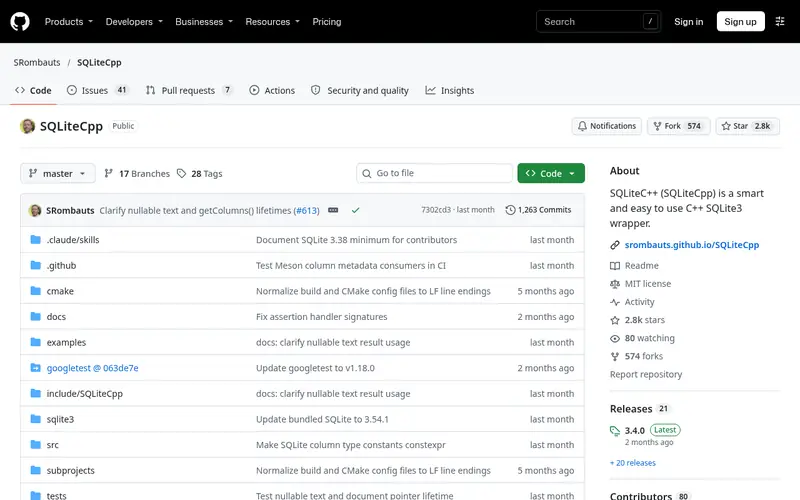
SQLiteCpp wraps the SQLite C library in C++ classes for connections, statements and transactions. It supports prepared statements, row access by column index or name, and RAII-style cleanup. Because SQLite is embedded, there is no server to run and no network connection, which suits desktop apps, mobile back ends and test environments.
The library is distributed as source under the MIT licence and builds with CMake. It depends on SQLite itself, so you either link a system copy or bundle the amalgamation. The API is small, and the project documentation covers the common patterns. There is no ORM layer and no query builder, so you write SQL directly.
Skip SQLiteCpp if you need a client-server database or a multi-engine abstraction. It is also not the right choice if you want compile-time checked queries; sqlpp11 covers that case.
Standout: Thin C++ wrapper over the SQLite C API
Free (open source), as listed by the vendor (SQLiteCpp website). Confirm the current plan price before you buy.
Free plan. Plans change, so confirm on the vendor's pricing page before you buy.
Benefits
- Thin C++ wrapper over the SQLite C API
- builds from source with CMake
Drawbacks
- SQLite only
- no built-in schema migration tooling
Skip it if this limit matters to you: SQLite only.
Verdict. A sensible pick for C++ projects that need an embedded SQLite database.
libpqxx
Best for c++ applications that talk to PostgreSQL directly
What it is and where it fits
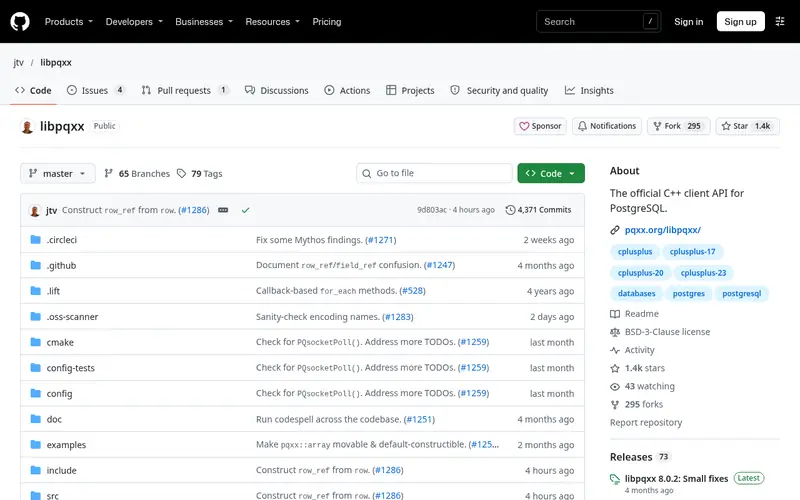
libpqxx is the official C++ client library for PostgreSQL. It wraps libpq and exposes connections, transactions, result sets and parameterized queries in C++. It supports prepared statements, binary data transfer, notifications and large objects, so features specific to PostgreSQL remain reachable.
The project is open source under a BSD-style licence and is maintained on GitHub. You need the PostgreSQL client library installed, and the build uses CMake. Version compatibility with PostgreSQL server releases is documented, so check that before upgrading either side.
Choose libpqxx when PostgreSQL is your only target and you want direct access to its features. If you need to support several engines behind one API, SOCI or nanodbc fit better. If you want compile-time query checking, look at sqlpp11 with its PostgreSQL connector.
Standout: Full PostgreSQL feature coverage through a C++ API
Free (open source), as listed by the vendor (libpqxx website). Confirm the current plan price before you buy.
Free plan. Plans change, so confirm on the vendor's pricing page before you buy.
Benefits
- Full PostgreSQL feature coverage through a C++ API
- active maintenance
Drawbacks
- PostgreSQL only
- requires libpq at build and run time
Skip it if this limit matters to you: postgreSQL only.
Verdict. A sensible pick for C++ applications that talk to PostgreSQL directly.
SOCI
Best for c++ code that must target several database engines
What it is and where it fits
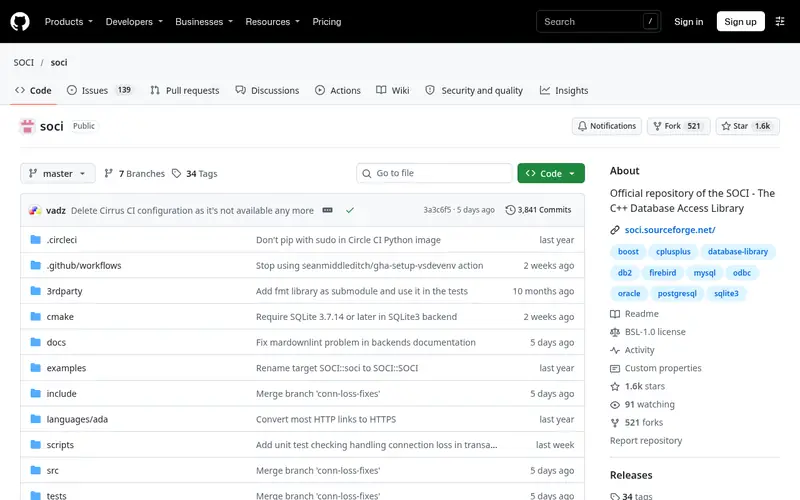
SOCI is a database access library that presents one C++ interface and loads a backend for each engine. Supported backends include PostgreSQL, MySQL, SQLite3, Oracle, ODBC and Firebird. You write queries once and change the backend at connection time, which helps when the same code must run against different databases.
The library is open source under the Boost Software License and builds with CMake. It uses a syntax where you bind C++ variables into SQL statements, which keeps type mapping explicit. Each backend has its own dependencies, so a build only includes the engines you enable.
SOCI suits teams that ship a product against multiple databases or that move between them in testing. It is heavier than a single-engine client, and backend behaviour is not identical everywhere. Check the documentation for the backend you plan to use before committing.
Standout: One API across PostgreSQL, MySQL, SQLite, Oracle and ODBC
Free (open source), as listed by the vendor (SOCI website). Confirm the current plan price before you buy.
Free plan. Plans change, so confirm on the vendor's pricing page before you buy.
Benefits
- One API across PostgreSQL, MySQL, SQLite, Oracle and ODBC
- backends loaded at runtime
Drawbacks
- Backend coverage varies in maturity
- more setup than a single-engine client
Skip it if this limit matters to you: backend coverage varies in maturity.
Verdict. A sensible pick for C++ code that must target several database engines.
sqlpp11
Best for teams that want compile-time checked SQL in C++
What it is and where it fits
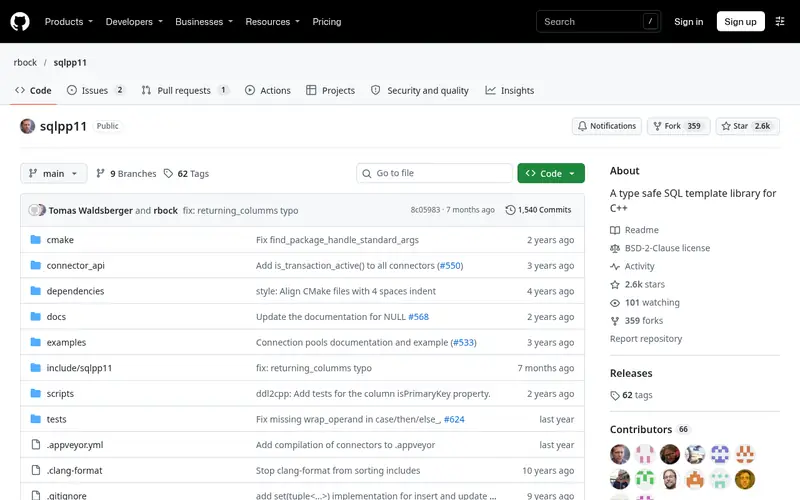
sqlpp11 is a type-safe SQL library for C++. You describe your tables in a small DSL, run a generator to produce C++ headers, and then write queries as C++ expressions. The compiler rejects queries that reference missing columns or use the wrong types, which catches many errors before runtime.
The core is header-only and open source under a BSD-style licence. Connectors exist for PostgreSQL, MySQL, SQLite3 and ODBC, each maintained as a separate component. The generator is a Python script, so your build needs Python available when table definitions change.
This library fits projects where query correctness matters and the team accepts a code generation step. It is less suitable for quick scripts or for teams that prefer writing raw SQL strings. The learning curve is real, so budget time for it.
Standout: Type-safe query construction checked by the compiler
Free (open source), as listed by the vendor (sqlpp11 website). Confirm the current plan price before you buy.
Free plan. Plans change, so confirm on the vendor's pricing page before you buy.
Benefits
- Type-safe query construction checked by the compiler
- header-only core
Drawbacks
- Requires a code generator step for table definitions
- steeper learning curve
Skip it if this limit matters to you: requires a code generator step for table definitions.
Verdict. A sensible pick for teams that want compile-time checked SQL in C++.
ODB
Best for c++ projects that want an ORM with generated persistence code
What it is and where it fits
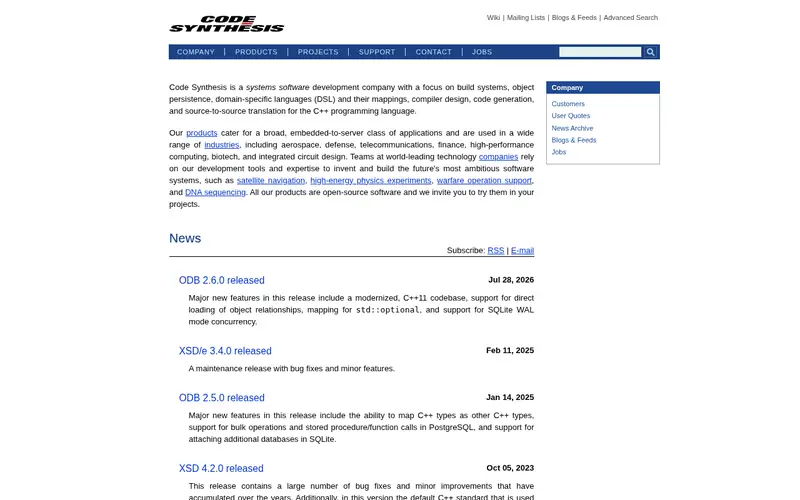
ODB is an object-relational mapping tool for C++. You annotate C++ classes with pragmas, and a compiler generates the database schema and the code that stores and loads objects. It supports PostgreSQL, MySQL, SQLite, Oracle and Microsoft SQL Server.
The project comes from Code Synthesis. The ODB compiler and the runtime library have separate licence terms, and some components are available under open-source licences while commercial use may require a paid licence. Check the vendor page for current terms rather than assuming the tool is free for your case.
ODB suits larger C++ applications that want object persistence without hand-written SQL. It is a poor fit for small projects that only need a few queries, because the compiler and build integration are significant overhead. Confirm licensing before you design around it.
Standout: Generates persistence code from C++ classes
See vendor pricing page, as listed by the vendor (ODB website). Confirm the current plan price before you buy.
No free plan. Plans change, so confirm on the vendor's pricing page before you buy.
Benefits
- Generates persistence code from C++ classes
- supports several database engines
Drawbacks
- Compiler and runtime are separately licensed
- generation step adds build complexity
Skip it if this limit matters to you: compiler and runtime are separately licensed.
Verdict. A sensible pick for C++ projects that want an ORM with generated persistence code.
MySQL Connector/C++
Best for c++ applications built around MySQL or MariaDB
What it is and where it fits
MySQL Connector/C++ is Oracle's C++ client for MySQL Server. It offers a JDBC-style API familiar to Java developers and an X DevAPI for newer document and relational access. It connects to MySQL and, in practice, to compatible servers such as MariaDB for many features.
The connector is distributed by Oracle. Community builds are available under the GPL with a FOSS exception, and commercial licensing is offered for redistribution in proprietary products. Review the licence text on the vendor page for your distribution model.
Use this connector when MySQL is your database and you want an officially supported client. If you need one API across several engines, SOCI or nanodbc reduce lock-in. If you want compile-time checked queries against MySQL, sqlpp11 has a connector.
Standout: Official MySQL client for C++
See vendor pricing page, as listed by the vendor (MySQL Connector/C++ website). Confirm the current plan price before you buy.
No free plan. Plans change, so confirm on the vendor's pricing page before you buy.
Benefits
- Official MySQL client for C++
- supports both JDBC-style and X DevAPI interfaces
Drawbacks
- Tied to the MySQL ecosystem
- licence terms depend on distribution
Skip it if this limit matters to you: tied to the MySQL ecosystem.
Verdict. A sensible pick for C++ applications built around MySQL or MariaDB.
nanodbc
Best for c++ code that reaches databases through ODBC drivers
What it is and where it fits
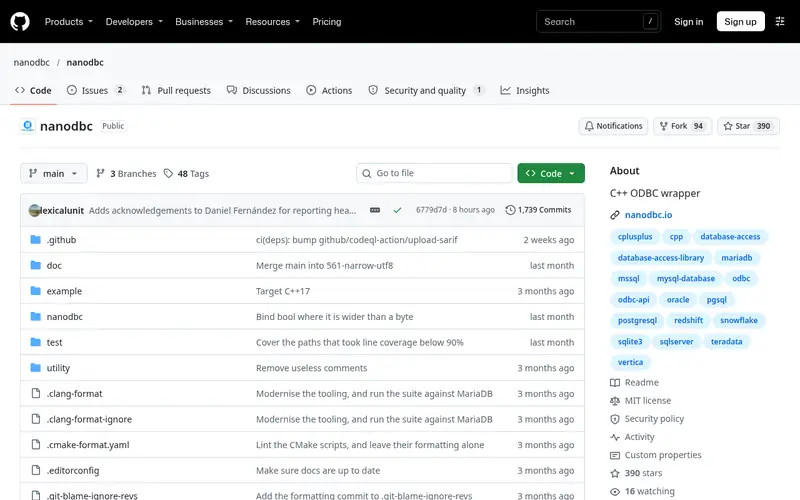
nanodbc is a small C++ wrapper around the ODBC API. Because it sits on ODBC, it can reach SQL Server, PostgreSQL, MySQL, Oracle, SQLite and others wherever a driver exists. It provides RAII handles, typed result access and parameter binding without the verbosity of raw ODBC calls.
The library is open source under the MIT licence and builds with CMake. It depends on the ODBC driver manager (unixODBC or iODBC on Linux and macOS, the built-in manager on Windows) plus the driver for your database. Driver quality and feature support vary, so test against your target.
nanodbc fits environments where ODBC is already the standard, such as enterprise Windows deployments. It is not the best pick when you want a native client for one engine, and it does not offer an ORM or query generator.
Standout: Small modern C++ wrapper over ODBC
Free (open source), as listed by the vendor (nanodbc website). Confirm the current plan price before you buy.
Free plan. Plans change, so confirm on the vendor's pricing page before you buy.
Benefits
- Small modern C++ wrapper over ODBC
- works with any ODBC driver
Drawbacks
- Behaviour depends on the installed driver
- ODBC setup can be fiddly
Skip it if this limit matters to you: behaviour depends on the installed driver.
Verdict. A sensible pick for C++ code that reaches databases through ODBC drivers.
Who should use what
If you need an embedded database with no server, start with SQLiteCpp. If your application targets PostgreSQL only, libpqxx gives the fullest access to its features. If one codebase must run against several engines, SOCI or nanodbc provide a single interface. If compile-time query checking matters more than setup speed, sqlpp11 or ODB are the type-safe options, with ODB adding full object mapping at the cost of licensing review.
Questions to settle before you buy
What to check before you buy
- Confirm the library supports every database engine you ship against, now and in the next year.
- Check the licence terms for your distribution model, especially for ODB and MySQL Connector/C++.
- Verify build integration with your toolchain and package manager before writing code.
- Review how the library handles prepared statements and parameter binding to avoid SQL injection.
- Read the project's release history and issue tracker to judge maintenance activity.
FAQ
Which C++ database library is easiest to start with?
SQLiteCpp is small and builds from source with CMake, so a first project needs little setup. libpqxx is similarly direct if you already run PostgreSQL. Libraries with code generation, such as sqlpp11 and ODB, take longer to wire up.
Do these libraries work on Windows, Linux and macOS?
Most do. SQLiteCpp, libpqxx, SOCI, sqlpp11 and nanodbc build on the three major platforms. ODB and MySQL Connector/C++ publish platform support on their vendor pages, so check the current list for your compiler.
Are these libraries free?
SQLiteCpp, libpqxx, SOCI, sqlpp11 and nanodbc are open source and free to use under their respective licences. ODB and MySQL Connector/C++ have licence terms that depend on how you distribute your software. Read the vendor pages before adopting either.
Can I use more than one of these in the same project?
Yes. A common pattern is SQLiteCpp for local storage and libpqxx or SOCI for a server database. Keep the data access code behind your own interface so the choice stays swappable.
Do I need an ORM for C++?
No. Many projects use a query library and write SQL directly. An ORM such as ODB helps when you have many related classes and want generated persistence code, but it adds a build step and licensing review.
Sources we checked
Method: how we score · editorial policy.
Change log. First published 28 Nov 2026.