Stage 03 · Host · Researched comparison
Best Java ORMs in 2026
Hibernate ORM is the first pick for most teams that want a mature JPA provider with broad database support. jOOQ suits teams that prefer type-safe SQL over object mapping. MyBatis fits projects that want hand-written SQL with mapping helpers. All three are open source. The right choice depends on how much SQL control you want and whether you need a full JPA implementation.

By Shihab Mia
Published 27 Nov 2026 · 8 tools compared
We run no ads and no affiliate links at launch. The order of a list follows our published method. See how we score.
Prices are the starting prices vendors list publicly. Plans change, so confirm the current price on the vendor page before you buy.
Key takeaways
- Hibernate ORM is the reference JPA provider and the default for most Spring Boot projects.
- jOOQ generates Java code from your schema and keeps SQL explicit and type-safe.
- MyBatis maps SQL you write yourself, which helps with legacy schemas and complex queries.
- Every tool here is open source or has a free tier, so cost is rarely the deciding factor.
Who each pick is for
- Teams that want a standard JPA providerHibernate ORM
- Spring teams that want repository abstractionsSpring Data JPA
- Teams that want type-safe SQL, not object mappingjOOQ
- Projects with hand-written SQL and legacy schemasMyBatis
- Teams that want an alternative JPA providerEclipseLink
- Teams that want a simpler JPA-style ORMEbean ORM
- Teams that want type-safe JPQL and SQL queriesQueryDSL
- Teams that need a cache-heavy, generated ORMReladomo
Comparison
| Tool | Best for | Standout feature | Listed starting price | Free plan or trial |
|---|---|---|---|---|
| 1Hibernate ORM | Teams that want a standard JPA provider | Reference JPA implementation | Free (open source) | Free plan |
| 2Spring Data JPA | Spring teams that want repository abstractions | Repository interfaces reduce boilerplate | Free (open source) | Free plan |
| 3jOOQ | Teams that want type-safe SQL, not object mapping | Generated code matches your schema | Free (open source) | Free plan |
| 4MyBatis | Projects with hand-written SQL and legacy schemas | SQL lives in XML or annotations | Free (open source) | Free plan |
| 5EclipseLink | Teams that want an alternative JPA provider | Full JPA implementation | Free (open source) | Free plan |
| 6Ebean ORM | Teams that want a simpler JPA-style ORM | Simpler API than full JPA | Free (open source) | Free plan |
| 7QueryDSL | Teams that want type-safe JPQL and SQL queries | Type-safe query building | Free (open source) | Free plan |
| 8Reladomo | Teams that need a cache-heavy, generated ORM | Strong caching and temporal support | Free (open source) | Free plan |
How we picked
We picked projects that are actively maintained, have official documentation or a public repository, and genuinely perform object-relational mapping or closely related query mapping for Java. We compared licence and pricing from vendor pages, platform and database support from documentation, and known limits such as code generation steps or caching complexity. We did not run benchmarks. Prices and licence terms can change, so confirm details on the vendor site before you commit.
The tools, one by one
Hibernate ORM
Best for teams that want a standard JPA provider
What it is and where it fits
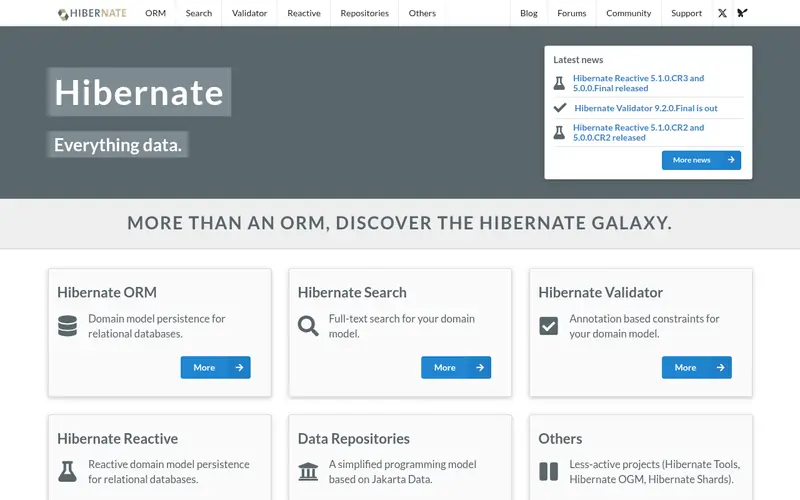
Hibernate ORM implements the Jakarta Persistence (JPA) specification and is the most common choice for Java applications that want object-relational mapping. It runs on the JVM and works with Spring Boot, Quarkus, Micronaut and plain Java SE. It supports a long list of databases through JDBC drivers.
The project is open source under LGPL 2.1 and is developed by Red Hat. Documentation covers mapping, fetching strategies, caching and schema generation. The main risk is treating it as a black box: N+1 queries, lazy loading outside a session and second-level cache settings cause most production problems. Teams that want full control over SQL should look at jOOQ or MyBatis instead.
Standout: Reference JPA implementation
Free (open source), as listed by the vendor (Hibernate ORM website). Confirm the current plan price before you buy.
Free plan. Plans change, so confirm on the vendor's pricing page before you buy.
Benefits
- Reference JPA implementation
- wide database and integration support
Drawbacks
- Lazy loading and caching need careful tuning
- large API surface
Skip it if this limit matters to you: lazy loading and caching need careful tuning.
Verdict. A sensible pick for teams that want a standard JPA provider.
Alternatives in this guide: Spring Data JPA, jOOQ, MyBatis
Spring Data JPA
Best for spring teams that want repository abstractions
What it is and where it fits
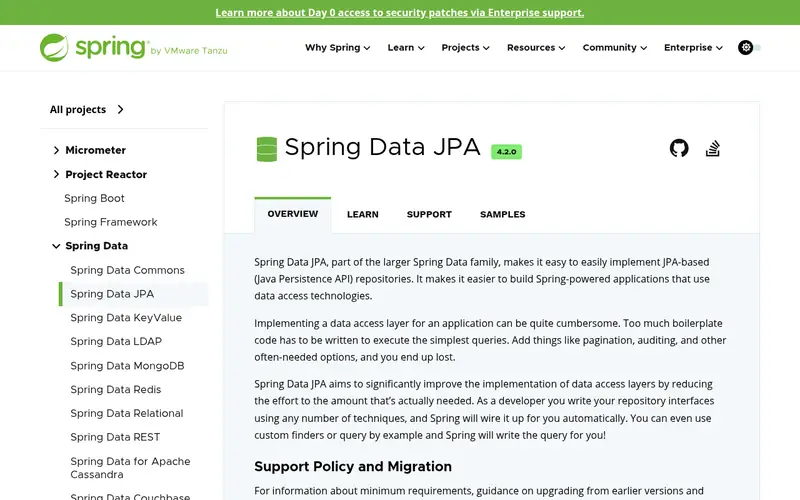
Spring Data JPA sits on top of a JPA provider, usually Hibernate, and generates repository implementations from interfaces. It runs wherever Spring runs. You declare methods like findByEmail and the framework builds the query. It is open source under Apache 2.0.
It is a good fit for CRUD-heavy services that already use Spring Boot. It is not a separate ORM: the mapping and SQL generation still come from the underlying provider, so the same tuning concerns apply. Teams that do not use Spring gain little from it. For reporting-heavy work, pair it with jOOQ or native queries.
Standout: Repository interfaces reduce boilerplate
Free (open source), as listed by the vendor (Spring Data JPA website). Confirm the current plan price before you buy.
Free plan. Plans change, so confirm on the vendor's pricing page before you buy.
Benefits
- Repository interfaces reduce boilerplate
- integrates with Spring Boot
Drawbacks
- Hides Hibernate behaviour
- complex queries still need JPQL or Criteria
Skip it if this limit matters to you: hides Hibernate behaviour.
Verdict. A sensible pick for spring teams that want repository abstractions.
Alternatives in this guide: Hibernate ORM, jOOQ, MyBatis
jOOQ
Best for teams that want type-safe SQL, not object mapping
What it is and where it fits
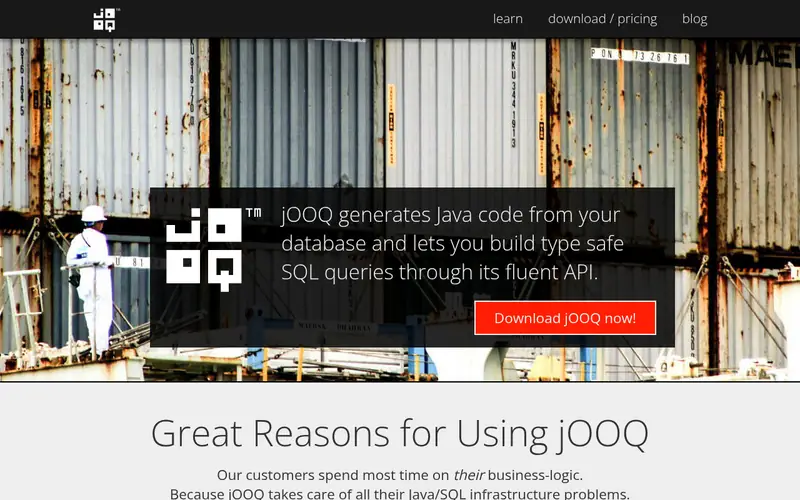
jOOQ generates Java classes from your database schema and lets you write SQL as a fluent, type-safe API. It runs on the JVM and supports many databases. The open-source edition is free under Apache 2.0 for open-source databases. Commercial editions add support for closed-source databases and extra features; check the vendor pricing page for current terms.
It suits teams comfortable with SQL who want compile-time checks instead of string queries. The trade-off is a code generation step in the build and a learning curve for the DSL. Teams that want automatic persistence of object graphs should use a JPA provider instead.
Standout: Generated code matches your schema
Free (open source), as listed by the vendor (jOOQ website). Confirm the current plan price before you buy.
Free plan. Plans change, so confirm on the vendor's pricing page before you buy.
Benefits
- Generated code matches your schema
- SQL stays visible and testable
Drawbacks
- Code generation step adds build complexity
- some databases need the commercial edition
Skip it if this limit matters to you: code generation step adds build complexity.
Verdict. A sensible pick for teams that want type-safe SQL, not object mapping.
Alternatives in this guide: Hibernate ORM, Spring Data JPA, MyBatis
MyBatis
Best for projects with hand-written SQL and legacy schemas
What it is and where it fits
MyBatis maps your own SQL statements to Java objects. It runs on the JVM and works with any JDBC data source. It is open source under Apache 2.0. You write the SQL, and MyBatis handles parameter binding, result mapping and statement caching.
It is a strong fit for teams that already know their SQL and want to keep it explicit, especially with complex joins or legacy schemas. It does not manage entity relationships or schema generation the way a JPA provider does, so expect more manual mapping code. Spring Boot integration is available through a starter project.
Standout: SQL lives in XML or annotations
Free (open source), as listed by the vendor (MyBatis website). Confirm the current plan price before you buy.
Free plan. Plans change, so confirm on the vendor's pricing page before you buy.
Benefits
- SQL lives in XML or annotations
- easy to read and tune
Drawbacks
- No automatic relationship mapping
- more manual work than JPA
Skip it if this limit matters to you: no automatic relationship mapping.
Verdict. A sensible pick for projects with hand-written SQL and legacy schemas.
Alternatives in this guide: Hibernate ORM, Spring Data JPA, jOOQ
EclipseLink
Best for teams that want an alternative JPA provider
What it is and where it fits
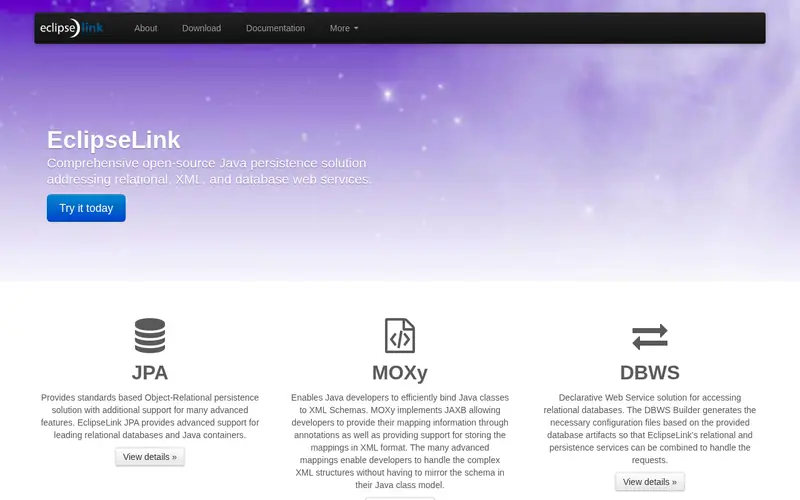
EclipseLink is the reference implementation of Jakarta Persistence and an Eclipse Foundation project. It runs on the JVM and supports JPA plus additional features such as MOXy for object-to-XML and JSON binding. It is open source under EPL 2.0 and GPL 2.0.
It is a reasonable choice when you want a JPA provider other than Hibernate, or when you need its extra binding features. Documentation is solid but community answers are thinner than for Hibernate, so expect to read the official docs more often. Most teams pick it deliberately rather than by default.
Standout: Full JPA implementation
Free (open source), as listed by the vendor (EclipseLink website). Confirm the current plan price before you buy.
Free plan. Plans change, so confirm on the vendor's pricing page before you buy.
Benefits
- Full JPA implementation
- also offers MOXy for JSON and XML binding
Drawbacks
- Smaller community than Hibernate
- fewer third-party guides
Skip it if this limit matters to you: smaller community than Hibernate.
Verdict. A sensible pick for teams that want an alternative JPA provider.
Alternatives in this guide: Hibernate ORM, Spring Data JPA, jOOQ
Ebean ORM
Best for teams that want a simpler JPA-style ORM
What it is and where it fits
Ebean is a Java ORM with its own API that also supports JPA annotations. It runs on the JVM and works with Spring Boot and plain Java. It is open source under Apache 2.0. It focuses on a smaller API surface and built-in query beans for type-safe queries.
It suits teams that find full JPA heavy and want less configuration. The trade-off is a smaller community and fewer third-party resources than Hibernate. Check that your framework version is supported before adopting it in an existing stack.
Standout: Simpler API than full JPA
Free (open source), as listed by the vendor (Ebean ORM website). Confirm the current plan price before you buy.
Free plan. Plans change, so confirm on the vendor's pricing page before you buy.
Benefits
- Simpler API than full JPA
- good query bean support
Drawbacks
- Smaller ecosystem
- fewer integrations than Hibernate
Skip it if this limit matters to you: smaller ecosystem.
Verdict. A sensible pick for teams that want a simpler JPA-style ORM.
Alternatives in this guide: Hibernate ORM, Spring Data JPA, jOOQ
QueryDSL
Best for teams that want type-safe JPQL and SQL queries
What it is and where it fits
QueryDSL generates query types from your entities or schema and lets you build JPQL or SQL queries in Java. It runs on the JVM and integrates with JPA and plain SQL. It is open source under Apache 2.0.
It is often paired with Spring Data JPA for dynamic queries that repository method names cannot express. It requires an annotation processing step in the build. It is not a full ORM on its own: persistence still comes from a JPA provider or JDBC.
Standout: Type-safe query building
Free (open source), as listed by the vendor (QueryDSL website). Confirm the current plan price before you buy.
Free plan. Plans change, so confirm on the vendor's pricing page before you buy.
Benefits
- Type-safe query building
- works with JPA and SQL backends
Drawbacks
- Annotation processing step
- project maintenance pace is slower
Skip it if this limit matters to you: annotation processing step.
Verdict. A sensible pick for teams that want type-safe JPQL and SQL queries.
Alternatives in this guide: Hibernate ORM, Spring Data JPA, jOOQ
Reladomo
Best for teams that need a cache-heavy, generated ORM
What it is and where it fits
Reladomo is an object-relational mapping framework from Goldman Sachs, released as open source under Apache 2.0. It runs on the JVM and generates domain classes from metadata. It is known for its caching and temporal (bitemporal) data support.
It suits teams with demanding caching or audit requirements and a willingness to learn a different model. It is not a general first choice: documentation assumes familiarity, and community support is limited compared with Hibernate. Most teams should evaluate it only against a specific requirement.
Standout: Strong caching and temporal support
Free (open source), as listed by the vendor (Reladomo website). Confirm the current plan price before you buy.
Free plan. Plans change, so confirm on the vendor's pricing page before you buy.
Benefits
- Strong caching and temporal support
- generated domain classes
Drawbacks
- Steep learning curve
- niche community
Skip it if this limit matters to you: steep learning curve.
Verdict. A sensible pick for teams that need a cache-heavy, generated ORM.
Alternatives in this guide: Hibernate ORM, Spring Data JPA, jOOQ
Who should use what
A Spring Boot team building CRUD services should start with Spring Data JPA on Hibernate. A team that wants explicit, type-safe SQL for reporting should look at jOOQ. A project with legacy schemas and hand-tuned SQL fits MyBatis. A team that wants a JPA provider other than Hibernate, or needs XML and JSON binding, can evaluate EclipseLink. Smaller teams that find full JPA heavy may prefer Ebean, while teams with strict caching or audit needs can review Reladomo.
Questions to settle before you buy
What to check before you buy
- Confirm the project supports your database version and JDBC driver.
- Check the licence and any commercial edition terms for your use case.
- Review how the tool handles lazy loading, fetching and caching in your framework.
- Test the code generation or annotation processing step in your build.
- Read the official migration and upgrade notes before adopting a new major version.
FAQ
Is Hibernate the same as JPA?
No. JPA is a specification. Hibernate ORM is an implementation of that specification. You can write JPA code and run it on Hibernate or another provider such as EclipseLink.
Do I need a paid licence for jOOQ?
The open-source edition is free under Apache 2.0 for supported open-source databases. Commercial editions add support for other databases and features. Check the vendor pricing page for current terms.
Can I use MyBatis with Spring Boot?
Yes. A MyBatis Spring Boot starter is available from the project. It wires the SqlSessionFactory and mappers into the Spring context.
Which ORM is best for complex reporting queries?
jOOQ keeps SQL explicit and type-safe, which helps with complex reporting. MyBatis also works well when you write the SQL yourself. A JPA provider can handle reporting but often needs JPQL, Criteria or native queries.
Are these tools safe for production data?
They are libraries that run in your application, so data stays in your systems. That differs from online formatters or converters, where you should never paste secrets, tokens or production data into a third-party web page.
Sources we checked
Method: how we score · editorial policy.
Change log. First published 27 Nov 2026.