Stage 03 · Host · Researched comparison
Best Java Job Schedulers in 2026
Quartz Scheduler is the first pick for teams that need a mature, widely used in-process scheduler with cron triggers and persistent job stores. JobRunr suits teams that want a simpler API with built-in dashboard and background job handling. db-scheduler is a good fit when you want a small library that stores jobs in your existing SQL database without extra infrastructure.

By Shihab Mia
Published 27 Nov 2026 · 6 tools compared
We run no ads and no affiliate links at launch. The order of a list follows our published method. See how we score.
Prices are the starting prices vendors list publicly. Plans change, so confirm the current price on the vendor page before you buy.
Key takeaways
- Quartz Scheduler is free and open source under the Apache 2.0 license and runs in any standard JVM application.
- JobRunr has a free open source core and a separate paid Pro edition; check the vendor page for current Pro pricing.
- db-scheduler is free and open source and keeps job state in a SQL table you already own.
- Spring's @Scheduled and ShedLock are free and work well together for simple scheduled tasks and clustered locks.
Who each pick is for
- Teams needing a mature scheduler with cron and persistent job storesQuartz Scheduler
- Developers who want simple background jobs with a built-in dashboardJobRunr
- Teams wanting a small scheduler backed by their existing SQL databasedb-scheduler
- Spring applications with simple fixed-rate or cron tasksSpring Framework @Scheduled
- Preventing duplicate scheduled task runs across multiple instancesShedLock
- Jakarta EE applications using container-managed timersEJB Timer Service
Comparison
| Tool | Best for | Standout feature | Listed starting price | Free plan or trial |
|---|---|---|---|---|
| 1Quartz Scheduler | Teams needing a mature scheduler with cron and persistent job stores | Long history and wide adoption | Free (open source) | Free plan |
| 2JobRunr | Developers who want simple background jobs with a built-in dashboard | Clean API with lambdas | See vendor pricing page | Free plan |
| 3db-scheduler | Teams wanting a small scheduler backed by their existing SQL database | Small footprint | Free (open source) | Free plan |
| 4Spring Framework @Scheduled | Spring applications with simple fixed-rate or cron tasks | No extra dependency beyond Spring | Free (open source) | Free plan |
| 5ShedLock | Preventing duplicate scheduled task runs across multiple instances | Works with Spring scheduling | Free (open source) | Free plan |
| 6EJB Timer Service | Jakarta EE applications using container-managed timers | Part of the Jakarta EE platform | Free (open source) | Free plan |
How we picked
We compared libraries on fit for in-process Java scheduling, supported platforms, license and price, persistence and clustering options, and main limits. Sources are vendor pages, official documentation and project repositories. Prices and license terms change, so confirm details on the vendor site before you commit.
The tools, one by one
Quartz Scheduler
Best for teams needing a mature scheduler with cron and persistent job stores
What it is and where it fits
Quartz Scheduler is an open-source library that runs inside a JVM. It supports simple intervals, cron expressions and calendar-based triggers. Jobs can be stored in memory or in a JDBC job store, which lets several application instances share schedule state and coordinate execution through a database lock.
It integrates with Spring through the spring-context-support module and works in plain Java SE, servlet containers and Spring Boot. The project is distributed under the Apache 2.0 license. The main cost is setup effort: you configure a SchedulerFactory, triggers and job details, and clustering requires a shared database and correct clock settings. Teams that want a minimal API may prefer a lighter library.
Standout: Long history and wide adoption
Free (open source), as listed by the vendor (Quartz Scheduler website). Confirm the current plan price before you buy.
Free plan. Plans change, so confirm on the vendor's pricing page before you buy.
Benefits
- Long history and wide adoption
- supports cron triggers, JDBC job stores and clustering
Drawbacks
- Configuration is verbose
- clustering needs a shared database
Skip it if this limit matters to you: configuration is verbose.
Verdict. A sensible pick for teams needing a mature scheduler with cron and persistent job stores.
Alternatives in this guide: JobRunr, db-scheduler, Spring Framework @Scheduled
JobRunr
Best for developers who want simple background jobs with a built-in dashboard
What it is and where it fits
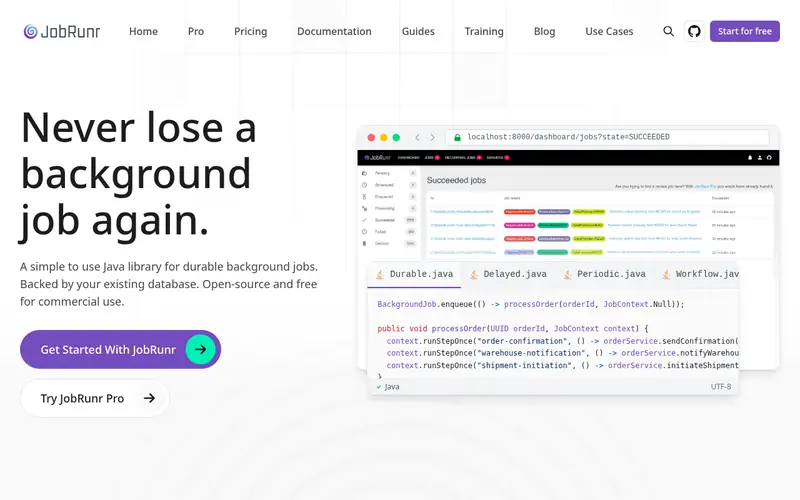
JobRunr is an open-source Java library for background job processing and scheduling. You enqueue jobs with a lambda or a job scheduler, and JobRunr stores them in a SQL or NoSQL database. It supports recurring jobs with cron expressions, delayed jobs and retries. A dashboard shows job state and lets you requeue failed jobs.
The core is free and open source. A separate Pro edition adds features such as a dashboard for multiple servers and additional storage options. Check the vendor pricing page for current Pro terms. JobRunr runs on standard JVM platforms and integrates with Spring Boot and other frameworks. It suits teams that want less configuration than Quartz and are comfortable adding a storage table to their database.
Standout: Clean API with lambdas
See vendor pricing page, as listed by the vendor (JobRunr website). Confirm the current plan price before you buy.
Free plan. Plans change, so confirm on the vendor's pricing page before you buy.
Benefits
- Clean API with lambdas
- built-in dashboard and storage options
Drawbacks
- Pro features are paid
- some advanced features sit behind the Pro edition
Skip it if this limit matters to you: pro features are paid.
Verdict. A sensible pick for developers who want simple background jobs with a built-in dashboard.
Alternatives in this guide: Quartz Scheduler, db-scheduler, Spring Framework @Scheduled
db-scheduler
Best for teams wanting a small scheduler backed by their existing SQL database
What it is and where it fits
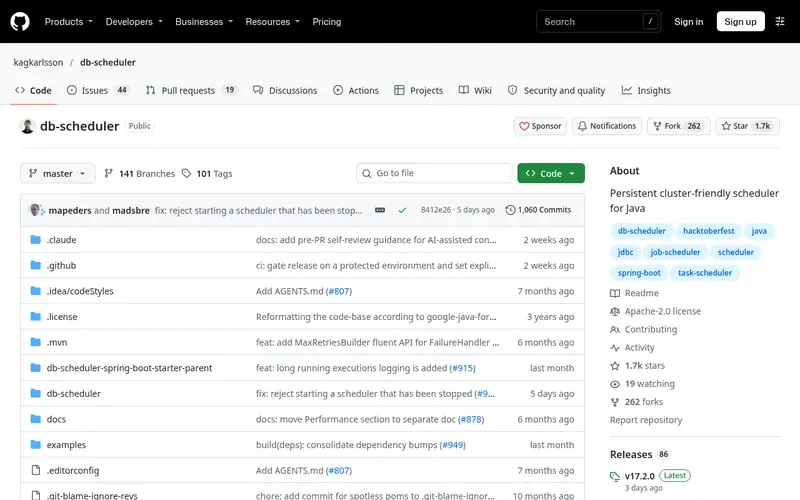
db-scheduler is a lightweight, open-source task scheduler for Java. It stores scheduled tasks in a database table and uses polling to pick up due tasks. Because it relies on the database for coordination, several application instances can run against the same table without a separate scheduler service.
It supports recurring tasks, one-time tasks and configurable polling intervals. The library is small and has few dependencies, which makes it easy to embed in an existing Spring Boot or plain Java service. It does not ship a full management UI, and advanced features like job chaining are limited compared with larger frameworks. It fits teams that already run a relational database and want scheduling without extra infrastructure.
Standout: Small footprint
Free (open source), as listed by the vendor (db-scheduler website). Confirm the current plan price before you buy.
Free plan. Plans change, so confirm on the vendor's pricing page before you buy.
Benefits
- Small footprint
- uses a single table in your existing database
Drawbacks
- Fewer features than larger schedulers
- limited built-in UI
Skip it if this limit matters to you: fewer features than larger schedulers.
Verdict. A sensible pick for teams wanting a small scheduler backed by their existing SQL database.
Alternatives in this guide: Quartz Scheduler, JobRunr, Spring Framework @Scheduled
Spring Framework @Scheduled
Best for spring applications with simple fixed-rate or cron tasks
What it is and where it fits
Spring's scheduling support lets you annotate methods with @Scheduled and enable it with @EnableScheduling. It supports fixed-rate, fixed-delay and cron expressions. It is part of the Spring Framework and is free under the Apache 2.0 license. It runs anywhere Spring runs, including Spring Boot.
The main limit is that schedules live in application memory. There is no persistent job store and no built-in coordination between instances, so in a cluster each instance may run the same task. You handle that with a lock such as ShedLock or by running a single scheduler instance. It suits small services and internal tasks where persistence and clustering are not required.
Standout: No extra dependency beyond Spring
Free (open source), as listed by the vendor (Spring Framework @Scheduled website). Confirm the current plan price before you buy.
Free plan. Plans change, so confirm on the vendor's pricing page before you buy.
Benefits
- No extra dependency beyond Spring
- simple annotations
Drawbacks
- No built-in persistence or clustering
- overlapping runs need care
Skip it if this limit matters to you: no built-in persistence or clustering.
Verdict. A sensible pick for spring applications with simple fixed-rate or cron tasks.
Alternatives in this guide: Quartz Scheduler, JobRunr, db-scheduler
ShedLock
Best for preventing duplicate scheduled task runs across multiple instances
What it is and where it fits
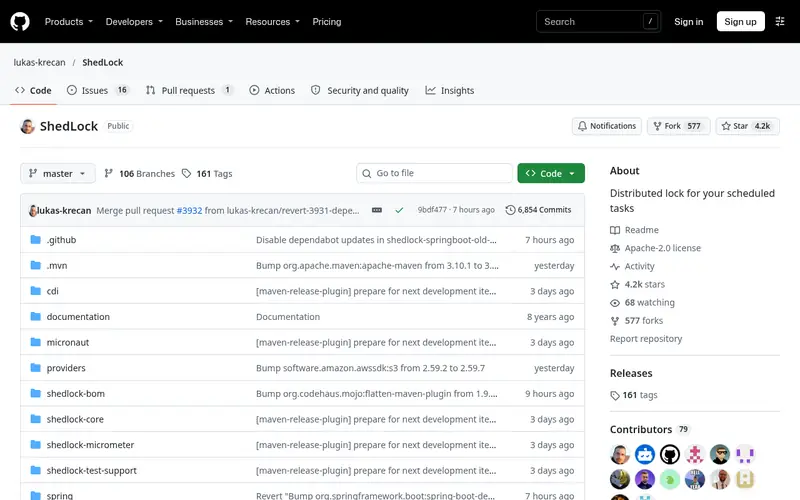
ShedLock is an open-source library that ensures a scheduled task runs at most once at a time across multiple application instances. It is not a scheduler itself. You keep using Spring's @Scheduled or another scheduler and add ShedLock annotations to guard the method. A lock record is written to a shared store such as a database table, Redis or MongoDB.
It supports Spring and other JVM frameworks and is free under the Apache 2.0 license. The main caveat is lock duration: if a task runs longer than the configured lock time, another instance may start it. You need to set lockAtMostFor and lockAtLeastFor with care. It suits teams already using Spring scheduling that need cluster safety without a full scheduler.
Standout: Works with Spring scheduling
Free (open source), as listed by the vendor (ShedLock website). Confirm the current plan price before you buy.
Free plan. Plans change, so confirm on the vendor's pricing page before you buy.
Benefits
- Works with Spring scheduling
- supports several lock stores
Drawbacks
- Only a lock helper, not a full scheduler
- lock timing needs tuning
Skip it if this limit matters to you: only a lock helper, not a full scheduler.
Verdict. A sensible pick for preventing duplicate scheduled task runs across multiple instances.
Alternatives in this guide: Quartz Scheduler, JobRunr, db-scheduler
EJB Timer Service
Best for jakarta EE applications using container-managed timers
What it is and where it fits
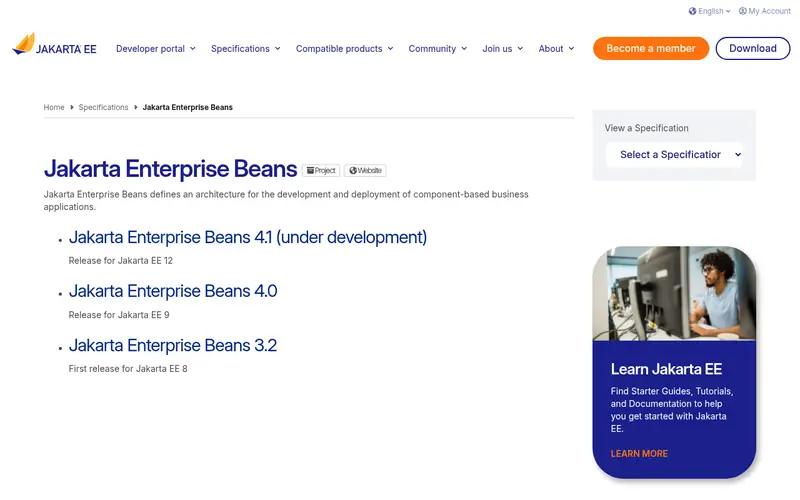
The EJB Timer Service is part of the Jakarta Enterprise Beans specification. It lets enterprise beans schedule timed callbacks using calendar-based or interval expressions. The container manages timer persistence and, in a clustered environment, can coordinate timer execution depending on the application server.
It is free as part of a Jakarta EE implementation such as WildFly, Payara or Open Liberty. The trade-off is portability and flexibility: the API is tied to the EJB model, and behavior such as missed timer handling varies by server. Teams on plain Spring Boot or a lightweight JVM stack usually pick a standalone library instead.
Standout: Part of the Jakarta EE platform
Free (open source), as listed by the vendor (EJB Timer Service website). Confirm the current plan price before you buy.
Free plan. Plans change, so confirm on the vendor's pricing page before you buy.
Benefits
- Part of the Jakarta EE platform
- container manages persistence
Drawbacks
- Tied to a Jakarta EE runtime
- less flexible than standalone libraries
Skip it if this limit matters to you: tied to a Jakarta EE runtime.
Verdict. A sensible pick for jakarta EE applications using container-managed timers.
Alternatives in this guide: Quartz Scheduler, JobRunr, db-scheduler
Who should use what
If you need a proven scheduler with cron and a JDBC job store, start with Quartz Scheduler. If you want a simpler API and a dashboard for background jobs, look at JobRunr. If you already run a SQL database and want minimal infrastructure, db-scheduler is a good fit. If your tasks are simple and live in a Spring application, use @Scheduled and add ShedLock when you run more than one instance.
Questions to settle before you buy
What to check before you buy
- Confirm the library supports your Java version and framework, such as Spring Boot or Jakarta EE.
- Check whether you need persistent job state and a shared database for clustering.
- Review the license terms of each library before adopting it.
- Test how missed or overlapping runs are handled in your deployment.
- Verify lock timing if you use ShedLock or database-backed coordination.
FAQ
Is Quartz Scheduler free?
Yes. Quartz Scheduler is open source under the Apache 2.0 license. You can use it in commercial applications without a paid license. Costs come from the infrastructure you run, such as a database for the JDBC job store.
What is the difference between a scheduler and ShedLock?
A scheduler decides when a task runs. ShedLock only prevents the same task from running at the same time on multiple instances. You still need a scheduler such as Spring @Scheduled or Quartz, and ShedLock adds a shared lock around the method.
Can these libraries run in a cluster?
Quartz supports clustering with a JDBC job store. db-scheduler coordinates through a shared database table. JobRunr uses its storage for coordination. Spring @Scheduled alone does not coordinate across instances, so pair it with ShedLock or run a single instance.
Do I need a database for Java job scheduling?
Not always. In-memory schedules work for simple tasks. Persistent job stores are useful when you need jobs to survive restarts or coordinate across instances. Quartz, JobRunr and db-scheduler can use a database for this.
Which scheduler works best with Spring Boot?
Spring's @Scheduled is the simplest choice for basic tasks, and ShedLock adds cluster safety. For persistent jobs and a dashboard, JobRunr integrates with Spring Boot. Quartz also works with Spring Boot when you need cron triggers and a JDBC job store.
Sources we checked
Method: how we score · editorial policy.
Change log. First published 27 Nov 2026.