Stage 03 · Host · Researched comparison
Best Go ORMs in 2026
GORM is the most widely used general-purpose ORM for Go and suits teams that want migrations, associations and hooks with minimal setup. Ent fits schema-as-code projects that need generated, type-safe graph queries. sqlc is the better pick when you want to write SQL by hand and get generated Go code without a runtime ORM. All three are open source and free to use.

By Shihab Mia
Published 27 Nov 2026 · 7 tools compared
We run no ads and no affiliate links at launch. The order of a list follows our published method. See how we score.
Prices are the starting prices vendors list publicly. Plans change, so confirm the current price on the vendor page before you buy.
Key takeaways
- GORM, Ent, sqlc, Bun, XORM, SQLBoiler and pgx are all open source and free to use under permissive licences.
- sqlc and SQLBoiler generate Go code from SQL or schema files, so query behavior stays close to the database.
- GORM and Ent add runtime layers with hooks, associations and migration helpers, which cost some control and speed.
- pgx is a PostgreSQL driver and toolkit, not a full ORM, and works well as the base under sqlc or hand-written queries.
Who each pick is for
- Teams that want a full-featured ORM with conventionsGORM
- Schema-as-code projects needing type-safe graph queriesEnt
- Developers who write SQL and want generated Go codesqlc
- SQL-first teams that want a query builder plus ORMBun
- Projects wanting a mature ORM with a simple APIXORM
- Database-first teams that want generated modelsSQLBoiler
- PostgreSQL teams that want a fast driver and toolkitpgx
Comparison
| Tool | Best for | Standout feature | Listed starting price | Free plan or trial |
|---|---|---|---|---|
| 1GORM | Teams that want a full-featured ORM with conventions | Large feature set with associations, hooks and auto-migrations | Free (open source) | Free plan |
| 2Ent | Schema-as-code projects needing type-safe graph queries | Generates type-safe code from Go schema definitions | Free (open source) | Free plan |
| 3sqlc | Developers who write SQL and want generated Go code | Generates type-safe Go from plain SQL queries | Free (open source) | Free plan |
| 4Bun | SQL-first teams that want a query builder plus ORM | Combines a SQL-first query builder with ORM features | Free (open source) | Free plan |
| 5XORM | Projects wanting a mature ORM with a simple API | Long-standing project with a straightforward API | Free (open source) | Free plan |
| 6SQLBoiler | Database-first teams that want generated models | Generates models and query code from an existing schema | Free (open source) | Free plan |
| 7pgx | PostgreSQL teams that want a fast driver and toolkit | High-performance PostgreSQL driver with native protocol support | Free (open source) | Free plan |
How we picked
We picked tools that are actively maintained and genuinely used for database access in Go. Criteria included fit for common ORM jobs, supported databases, licence and price, and how much control each tool gives over generated SQL. We also weighed whether a tool is a full ORM, a code generator or a driver, so readers can match it to their workflow. Sources are official project sites, documentation and repositories. Prices and features change, so confirm details on the vendor or project page before committing.
The tools, one by one
GORM
Best for teams that want a full-featured ORM with conventions
What it is and where it fits
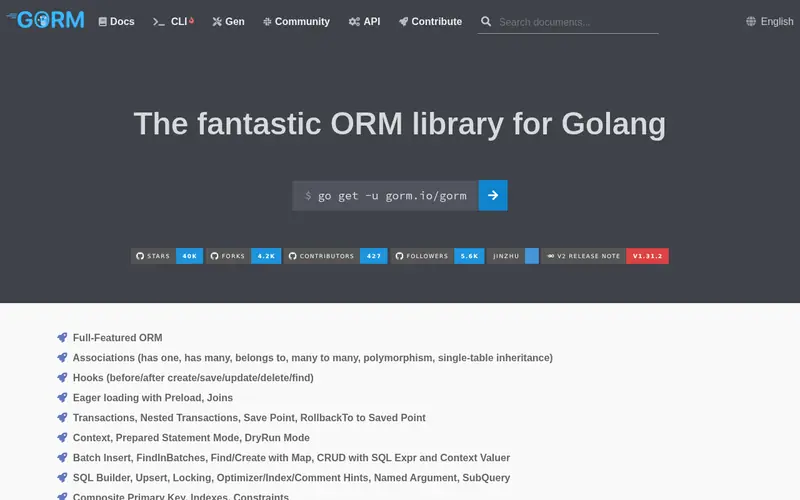
GORM is the most established ORM in the Go ecosystem. It maps structs to tables, handles associations, callbacks and soft deletes, and includes an AutoMigrate helper for schema changes. It supports PostgreSQL, MySQL, SQLite, SQL Server and others through official and community drivers.
The library uses reflection at runtime, which makes it convenient but slower than generated code for heavy query loads. Its chainable API covers most CRUD work, though advanced queries sometimes need raw SQL. GORM is a good fit for application teams that value speed of development over fine control. Teams with strict performance budgets or complex reporting queries often prefer a SQL-first tool. Documentation is at gorm.io, and the project is maintained on GitHub.
Standout: Large feature set with associations, hooks and auto-migrations
Free (open source), as listed by the vendor (GORM website). Confirm the current plan price before you buy.
Free plan. Plans change, so confirm on the vendor's pricing page before you buy.
Benefits
- Large feature set with associations, hooks and auto-migrations
- Wide database support and a big community
Drawbacks
- Reflection-based runtime adds overhead
- Complex queries can be harder to control than raw SQL
Skip it if this limit matters to you: reflection-based runtime adds overhead.
Verdict. A sensible pick for teams that want a full-featured ORM with conventions.
Ent
Best for schema-as-code projects needing type-safe graph queries
What it is and where it fits
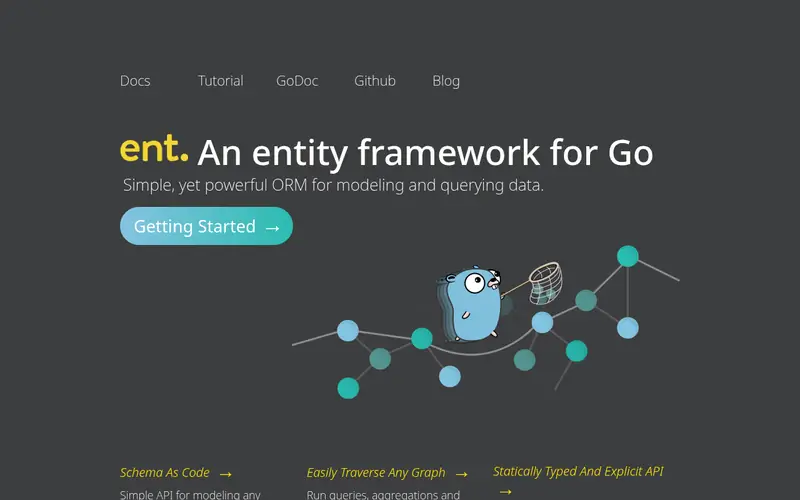
Ent, developed at Meta and now a standalone open-source project, takes a schema-as-code approach. You define entities in Go, run code generation, and get a typed client with a fluent query API. It handles edges between entities well, which suits graph-shaped data models.
Ent includes migration support, privacy rules and hooks. Because queries are generated, many errors surface at compile time rather than at runtime. The trade-off is a generation step in your build and a learning curve for the schema DSL. It supports PostgreSQL, MySQL, SQLite and other databases via drivers. Teams that like strong typing and generated clients tend to prefer it over reflection-based ORMs. Teams that want zero code generation usually skip it.
Standout: Generates type-safe code from Go schema definitions
Free (open source), as listed by the vendor (Ent website). Confirm the current plan price before you buy.
Free plan. Plans change, so confirm on the vendor's pricing page before you buy.
Benefits
- Generates type-safe code from Go schema definitions
- Strong support for graph-like relations and traversals
Drawbacks
- Code generation step adds build complexity
- Steeper learning curve than GORM
Skip it if this limit matters to you: code generation step adds build complexity.
Verdict. A sensible pick for schema-as-code projects needing type-safe graph queries.
sqlc
Best for developers who write SQL and want generated Go code
What it is and where it fits
sqlc is not a traditional ORM. You write SQL queries and schema files, and sqlc generates Go functions and structs that match them. The generated code is plain Go with no runtime query builder, so what runs is close to what you wrote.
This approach appeals to developers who are comfortable with SQL and want compile-time checks on query results. It supports PostgreSQL, MySQL and SQLite. Because there is no runtime ORM layer, performance and query plans are easier to reason about. The cost is that you maintain SQL and regenerate code after schema changes. It does not handle associations or migrations for you. Projects that want an object graph API usually pair it with a migration tool instead.
Standout: Generates type-safe Go from plain SQL queries
Free (open source), as listed by the vendor (sqlc website). Confirm the current plan price before you buy.
Free plan. Plans change, so confirm on the vendor's pricing page before you buy.
Benefits
- Generates type-safe Go from plain SQL queries
- No runtime reflection, so behavior stays predictable
Drawbacks
- Requires writing SQL by hand
- Schema changes need regeneration
Skip it if this limit matters to you: requires writing SQL by hand.
Verdict. A sensible pick for developers who write SQL and want generated Go code.
Bun
Best for sQL-first teams that want a query builder plus ORM
What it is and where it fits
Bun is a SQL-first ORM built on top of database/sql. It offers a query builder, struct mapping, relations, migrations and bulk inserts. The API stays close to SQL, so generated queries are easy to inspect and tune.
It supports PostgreSQL, MySQL, SQLite and SQL Server. Bun is maintained by Uptrace and documented at bun.uptrace.dev. It sits between a raw query builder and a full ORM: you get mapping and relations without heavy reflection-driven magic. The community is smaller than GORM's, so fewer tutorials exist. Teams migrating from other Go ORMs often find the query builder familiar. Teams that need the largest ecosystem of examples may prefer GORM.
Standout: Combines a SQL-first query builder with ORM features
Free (open source), as listed by the vendor (Bun website). Confirm the current plan price before you buy.
Free plan. Plans change, so confirm on the vendor's pricing page before you buy.
Benefits
- Combines a SQL-first query builder with ORM features
- Supports bulk operations and migrations
Drawbacks
- Smaller community than GORM
- Fewer third-party tutorials and examples
Skip it if this limit matters to you: smaller community than GORM.
Verdict. A sensible pick for SQL-first teams that want a query builder plus ORM.
XORM
Best for projects wanting a mature ORM with a simple API
What it is and where it fits
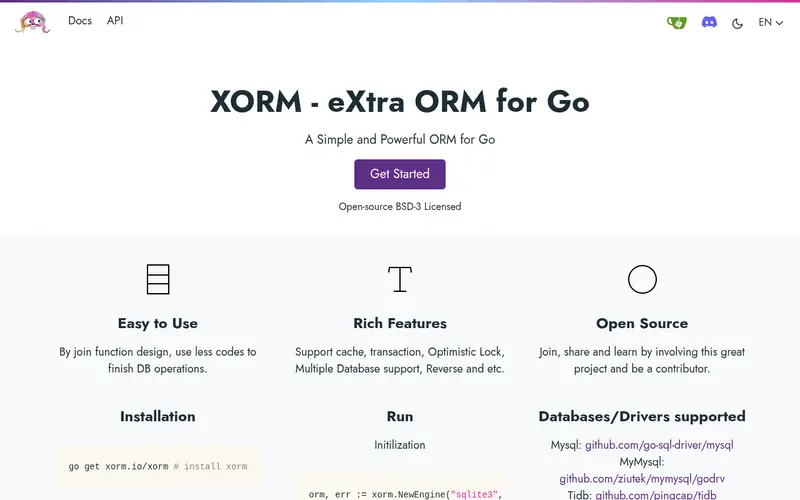
XORM is one of the older Go ORMs. It maps structs to tables, supports associations, and includes a Sync2 helper for schema synchronization. It also offers optional caches for query results.
It works with PostgreSQL, MySQL, SQLite, SQL Server and Oracle through drivers. The API is compact and readable, which helps smaller teams get started. The project's development pace is slower than GORM or Ent, and some documentation trails newer Go versions. It remains a reasonable choice for existing codebases already using it. New projects with heavy performance needs often look at generated-code tools first.
Standout: Long-standing project with a straightforward API
Free (open source), as listed by the vendor (XORM website). Confirm the current plan price before you buy.
Free plan. Plans change, so confirm on the vendor's pricing page before you buy.
Benefits
- Long-standing project with a straightforward API
- Built-in support for schema sync and caches
Drawbacks
- Development pace is slower than newer ORMs
- Documentation is less current in places
Skip it if this limit matters to you: development pace is slower than newer ORMs.
Verdict. A sensible pick for projects wanting a mature ORM with a simple API.
SQLBoiler
Best for database-first teams that want generated models
What it is and where it fits
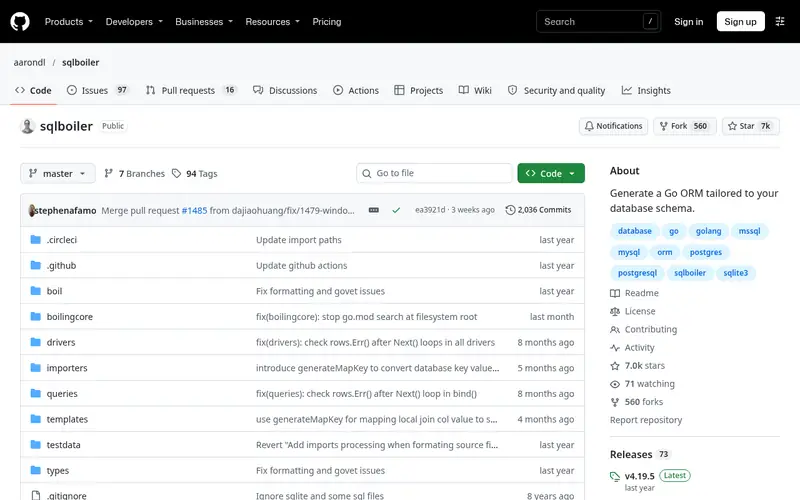
SQLBoiler takes a database-first approach. It reads your existing schema and generates Go models, relationships and query helpers. Because the code is generated from the live schema, the Go types match the database closely.
It supports PostgreSQL, MySQL, SQLite and SQL Server. Setup requires a config file and a generation step, which is more involved than GORM's conventions. The payoff is type safety and query code that reflects the actual schema. It suits teams that treat the database as the source of truth. Teams that prefer defining models in Go first usually choose Ent or GORM instead. The project is maintained on GitHub under the volatiletech organization.
Standout: Generates models and query code from an existing schema
Free (open source), as listed by the vendor (SQLBoiler website). Confirm the current plan price before you buy.
Free plan. Plans change, so confirm on the vendor's pricing page before you buy.
Benefits
- Generates models and query code from an existing schema
- Strong typing across generated methods
Drawbacks
- Regeneration required after schema changes
- Configuration is more involved than GORM
Skip it if this limit matters to you: regeneration required after schema changes.
Verdict. A sensible pick for database-first teams that want generated models.
pgx
Best for postgreSQL teams that want a fast driver and toolkit
What it is and where it fits
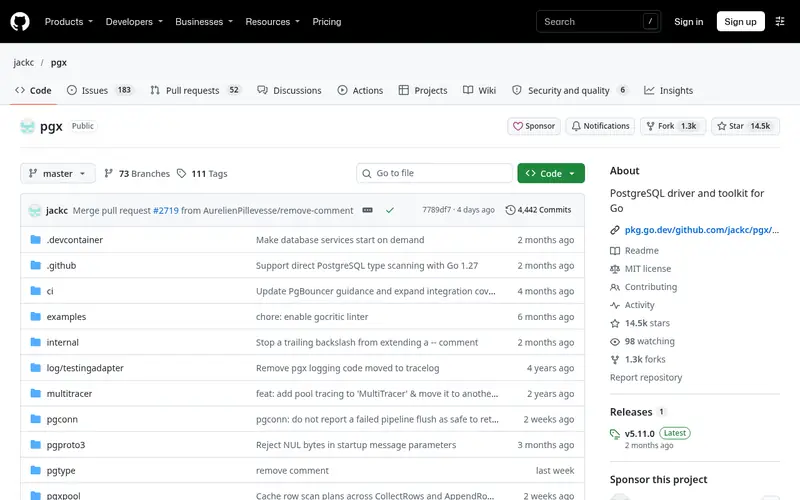
pgx is a PostgreSQL driver and toolkit rather than a full ORM. It speaks the native PostgreSQL protocol, supports prepared statements, batching and connection pooling, and can scan rows into structs. Many Go teams use it directly or underneath sqlc.
Because it targets only PostgreSQL, it is not a fit for multi-database projects. It does not generate models or run migrations. What it does offer is tight control over queries and good performance for PostgreSQL workloads. Teams that want an ORM layer on top usually pair pgx with sqlc or a query builder. The project is maintained by Jack Christensen on GitHub.
Standout: High-performance PostgreSQL driver with native protocol support
Free (open source), as listed by the vendor (pgx website). Confirm the current plan price before you buy.
Free plan. Plans change, so confirm on the vendor's pricing page before you buy.
Benefits
- High-performance PostgreSQL driver with native protocol support
- Works well as the base for sqlc or hand-written SQL
Drawbacks
- PostgreSQL only, not a general ORM
- No built-in model generation or migrations
Skip it if this limit matters to you: postgreSQL only, not a general ORM.
Verdict. A sensible pick for postgreSQL teams that want a fast driver and toolkit.
Who should use what
Teams building a typical CRUD application quickly should start with GORM. Projects with graph-shaped data and a preference for generated, type-safe code should look at Ent. Developers who are comfortable writing SQL and want compile-time checks should use sqlc, optionally with pgx for PostgreSQL. Database-first teams with an existing schema should consider SQLBoiler. Smaller teams that want a simple, older ORM may find XORM sufficient, and SQL-first teams that want a query builder with ORM features should evaluate Bun.
Questions to settle before you buy
What to check before you buy
- Confirm the tool supports every database your project uses, including production and test environments.
- Check whether the project is actively maintained, with recent commits and releases.
- Decide whether you want code generation in your build and whether your team accepts that step.
- Review the licence and confirm it fits your organization's policy.
- Test how the tool handles complex queries, transactions and migrations before adopting it widely.
FAQ
Is GORM still the most popular Go ORM?
GORM remains the most widely referenced general-purpose ORM in Go, based on its documentation, community size and adoption in tutorials. Popularity is not the same as best fit, though. Teams with heavy query loads or graph data often choose Ent, sqlc or Bun instead.
Are Go ORMs free to use?
The tools in this guide are open source and free to use. GORM, Ent, sqlc, Bun, XORM, SQLBoiler and pgx are all distributed under permissive open-source licences. You pay for hosting and database infrastructure, not for the library itself.
Should I use an ORM or write SQL directly?
It depends on the project. ORMs reduce boilerplate for CRUD work and associations. Writing SQL directly, or using a generator like sqlc, gives more control over query plans and performance. Many teams mix both approaches in the same codebase.
Does sqlc count as an ORM?
sqlc is a code generator, not a runtime ORM. You write SQL, and it generates typed Go functions. It does not manage associations, hooks or migrations the way GORM or Ent do. Some developers still group it with ORMs because it handles the mapping between Go and the database.
Can I use these ORMs with databases other than PostgreSQL?
GORM, Ent, Bun, XORM and SQLBoiler support several databases, including MySQL and SQLite. sqlc supports PostgreSQL, MySQL and SQLite. pgx is PostgreSQL only. Check the project documentation for the current list of supported drivers before you commit.
Sources we checked
Method: how we score · editorial policy.
Change log. First published 27 Nov 2026.